8 March Alliance

How Tammam Salam Became A Consensual Candidate

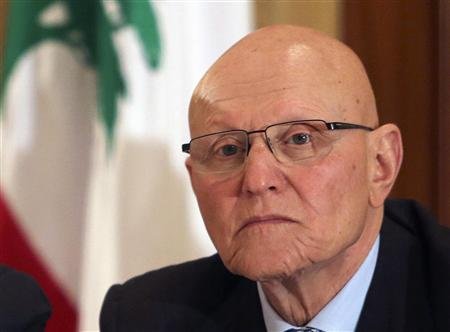
Tammam SalamTammam Salam (REUTERS/Mohamed Azakir)

Tammam Salam (REUTERS/Mohamed Azakir)

Tammam Salam. That’s the name of the man that will be tasked to form a new government once the consultations end. A consensual Prime Minister it seems.

A small background

Tammam Salam boycotted the elections of 1992 – like most of the Christians at the time – as a refusal of Syrian hegemony. Salam participated in the 1996 elections and won. In the 2000 elections he lost against Rafiq Hariri and in the 2009 elections he won in Saad Hariri’s list. That kind of makes him a centrist person. He also doesn’t speak about Syria and its crisis and doesn’t criticize Hezbollah, at least not like other Future Movement MPs. He has an Islamic influence coming from the Makassed foundation. He’s also from Beirut. The last time a PM was a Beiruti was 13 years ago. His Grandfather was Beirut’s MP in the Ottoman parliament, and was also the head of the Municipality. His father was Prime Minister under Bechara El Khoury, Camille Chamoun, Fouad Chehab, and Sleiman Frangieh. That’s four of the five Pre-war presidents of Lebanon. The Lebanese flag was also drawn in his father’s house. That last thing probably doesn’t matter, but you can see what I mean.

Tamam Salam is in the middle. Between Christians and Muslims, between Shias and Sunnis. And he’s strong within the Sunni community (A thing Mikati suffered with at the beginning). He is also a Beiruti, and not any Beiruti. He is the son of Saeb Bey Salam, and the grandson of Salim Ali (Abu Ali) Salam.

How it all started

Tammam Salam was nominated as M14’s candidate, and Jumblatt endorsed him, after refusing Rifi. Tammam Salam won’t participate in the elections if he’s nominated, which means that his success (If he succeeds) won’t be a direct threat to Mikati and Hariri. Tammam Salam visited Saudi Arabia  whose ambassador in Lebanon ironically said in the same day that the Saudis  do not interfere in Lebanese Politics – where he got the blessing he needed. Also, after the Saudi ambassador – who ironically said that the Saudis do not interfere in Lebanese Politics – visited Mikati, Mikati said he doesn’t want to be Lebanon’s next Prime Minister. Then, after leaving Saudi Arabia – whose ambassador in Lebanon ironically said that the Saudis  do not interfere in Lebanese Politics – one day before he gets nominated, Tammam Salam came back to Lebanon. Here you go, Saudi Arabia’s support.

And then?

Now’s here’s the tricky part. Hezbollah lost Mikati. Hezbollah also lost Jumblatt. And Hezbollah is losing Syria. Hezbollah can’t also repeat what he did in 2011. The elections are way too close. He made that mistake on the 7th of May 2008 and lost the 2009 elections because of it. So what will Hezbollah do? He plays it smart. M8 can endorse Karami, Tabbara, Abdul Rahim Mrad, or anyone else, but the M8 coalition will probably lose because Jumblatt won’t give his support. Instead of fighting a lost battle, they take M14’s achievement, make Jumblatt’s swing votes look useless – while they’re not at all – and push with Tammam Salam making him a consensual candidate. That’s how M14 don’t exactly look like winners, and Saudi Arabia’s increasing influence (while Syria is on fire) doesn’t look that important because Salam is suddenly everyone’s candidate. And he can be everyone’s candidate. Check the background part again.

It’s only the beginning

It’s a huge responsibility for Tammam Salam. He will have to form a unity cabinet (Because Jumblatt wants a unity government), make sure we have a new electoral law (now that the Christian parties will boycott any elections under the 1960 law) and organize elections. He’s also short on time because the parliament’s expiry date is soon unless it extends its term. Forming a government, agreeing on an electoral law and organizing elections all in 3 months is a mission impossible. Only to form a government, it took Hariri five months and Mikati  seven . And that’s another dilemma for Tammam Salam. Will he agree on the parliament’s term extension? What will his stance be on the STL, the issue that brought Hariri’s government down? What will his stance be  on the name of the ISF commander, the issue that brought Mikati’s government down? It’s going to be a tough road for Salam. It’s going to be even more difficult when different parties will start asking their share of the cake, and we might have a new interesting slice of the pie this time: The ministry of Petroleum.

 The real winners? Prime Minister Tammam Salam, Kingmaker Walid Jumblatt, and the Kingdom of Saudi Arabia.

Jumblatt is already enjoying his success: Naming the PM, choosing the type of the government, and even Vetoing.
The Reasons Behind Mikati’s Resignation

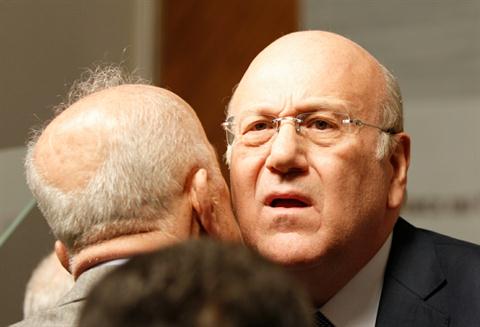
 Deputy Prime Minister Samir Moukbel and Mikati after the resignation (The Daily Star)

Deputy Prime Minister Samir Moukbel and Mikati after the resignation (The Daily Star)

The Lebanese government of June 2011 is now history. Najib Mikati resigned due to a lack of agreement on an electoral comitte to oversee the elections and Mikati’s failure to extend the the term of ISF chief Ashraf Rifi . You can see his resignation speech [here]. Such a move can be full of meanings, so why did Mikati resign? And more importantly, why now?

It’s all in the Speech

Mikati said that he thought about resigning twice before. The first time was about M8’s refusal to fund the Special Tribunal for Lebanon, and the second time was when Wissam Al-Hassan was assassinated. If Mikati had resigned when the STL wasn’t being funded, it would’ve been too early. Back then, M14 was still strong and he could’ve been easily replaced. If Mikati had resigned after Al Hassan’s funeral, it would’ve also been a fatal bullet for his political career (Resigning meant that his government was responsible for what happened). At both times, Mikati knew that if he would resign it will have negative consequences on him before everyone else. So why now? Mikati wanted an alibi to leave the government so that he can run in the elections. But he couldn’t simply leave. He wanted to leave in a context that makes him stronger, not weaker. And instead of giving him one reason to quit, they gave him two. It was the perfect moment for him. The first motive is a national one, while the second motive is about Sunni politics.

 A National Alibi

Mikati resigned because they wouldn’t let him organise elections. Read that sentence, (more…)

Waiting For The Electoral Law -The Lebanese Forces’ Hybrid Law: A Review

Lebanon's Electoral Map According To The Lebanese Forces Hybrid Law. The colored districts are the small winner-takes-all ones and the big ones within the white line are the big districts under proportional unlike in the picture.

Lebanon’s Electoral Map According To The Lebanese Forces Hybrid Law. The colored districts are the small winner-takes-all ones and the big ones within the white line are the big districts under proportional unlike in the picture.

There has been a lot of talk on a hybrid Proportional-Representation/ Winner-Takes-All electoral law in the past few weeks, and almost all the parties (PSP, Phalanges, Amal, Lebanese Forces) gave their proposals of hybrid laws in the electoral committees. The different hybrid draft laws are very similar to each other and mostly differ in the percentage of MPs elected by proportional representation (30%, 40%, 50%) but less in the constituencies’ boundaries (Small districts for the winner-takes-all seats and big ones for the PR seats). I’m going to review the draft law proposed from the Lebanese Forces. You can see the criteria of the law here.

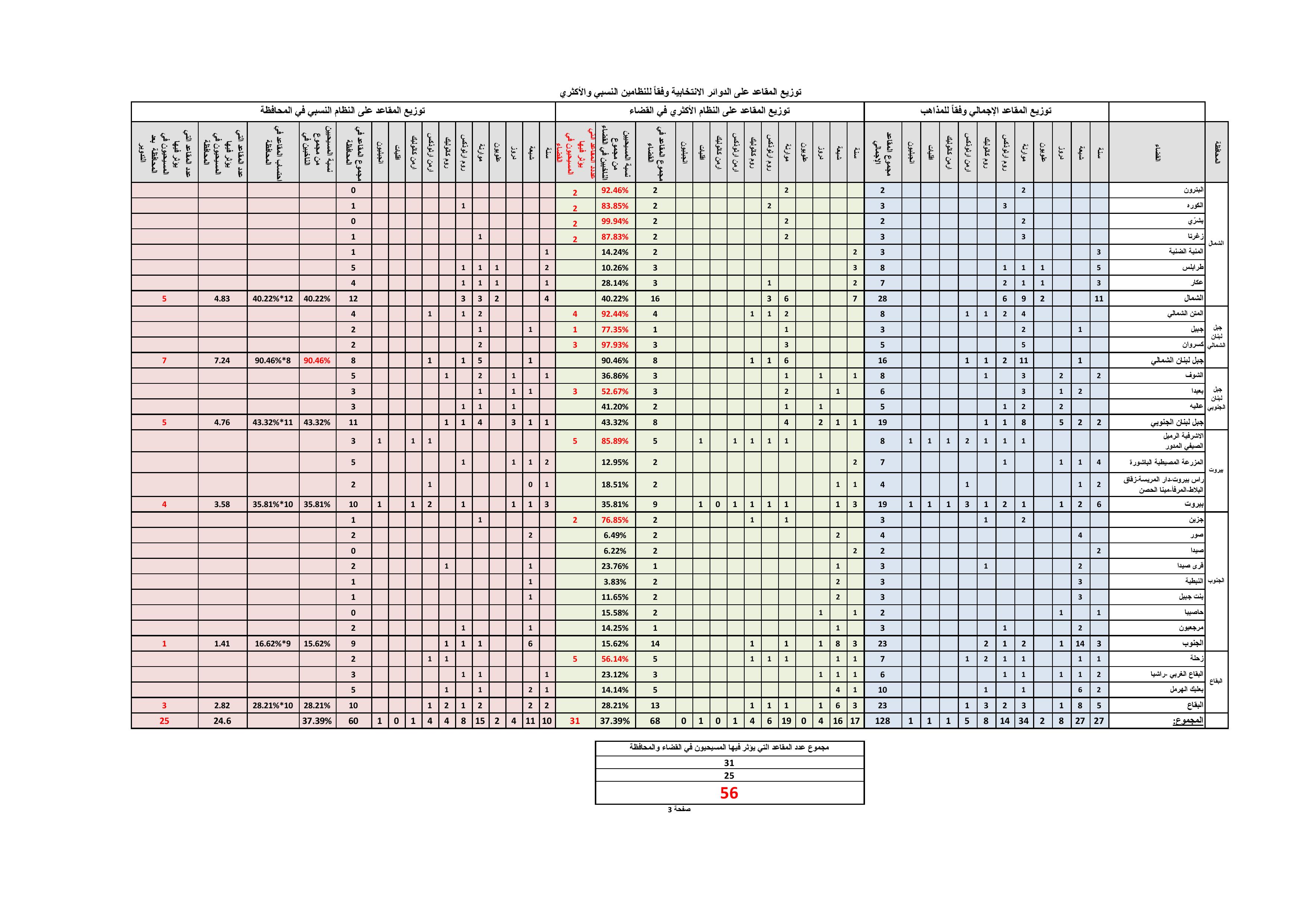
Here’s the allocation of seats according to the law and the number of voters by sects:

Number of voters (and percentage) in each district according to their religion.

Allocations Of Seats According To The Lebanese Forces Hybrid Draft Law, Christian-Elected MPs Are In Red

Allocations Of Seats According To The Lebanese Forces Hybrid Draft Law, Christian-Elected MPs Are In Red. Click to enlarge. Taken from the Lebanese Forces website

In a nutshell, the law separates Lebanon into two types of constituencies: 27 small (more…)

Waiting for the Electoral Law- Future Movement’s Proposal Or The 37 Districts Law- Part I

Ahmad Fatfat (The Daily Star/Mohammad Azakir)

Ahmad Fatfat (The Daily Star/Mohammad Azakir)

The number of electoral draft laws being discussed is too damn high. And to make things a bit more complicated than they are, Future Movement just added another draft law, and Ahmad Fatfat (among many other Future Movement MPs) are trying to make sure the draft reaches the electoral committee . The law is in the middle between the 1960 law and the 50 districts law the Lebanese Forces proposed in 2012.

The key feature of the law is that it uses small districts that can have a maximum of 5 MPs and can not be larger than a caza. The districts happen to primarily serve the interests of Future Movement, Jumblatt and in a way the Phalanges and (more…)

Privacy, Protection, And Politicians

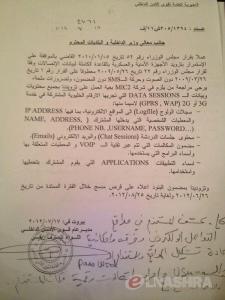
The Information Branch's request

The Information Branch’s request (Update: It shows on the document that it’s from summer, so apparently it’s an early request before the assassination). Courtesy of Elnashra

To hand over the telecom data to the ISF or not to hand over the telecom data to the ISF, that is the question.
Every once in a while, the same issue surfaces again. It’s a normal dilemma any country can have. It’s a choice one makes: The right to privacy or the right to protection. Handing the data can be useful to strengthen Lebanon’s security, but it’s a serious threat to our privacy and freedom.


Sehnaoui’s Call
(more…)

A Closer Look At Lebanon’s Dissociation Policy And Riad El Solh’s Ministerial Statement

Riad El Solh

Riad El Solh

A couple of days ago, I came across El Solh’s ministerial statement of the 7th of November 1943. His speech, considered to be more or less a written sample of the National Pact, doesn’t look as if it comes from the 1940s. You can see it [here] (I couldn’t find an english version).

It tackles contemporary issues we are facing today. (more…)

Why Wouldn’t Jumblatt Leave The Coalition?

Saad Hariri on Walid Jumblatt- Twitter

After the Ashrafieh explosion, one of the loudest accusations to the Syrian Regime came from Walid Jumblatt. Everyone expected the Jumblatti ministers to resign from the government , but until this very moment, the PSP didn’t leave the governmental coalition yet, and Hariri made an issue out of it on twitter. The moment Jumblatt leaves, Mikati will have to resign. The seven PSP MPs are enough to make a no-confidence vote successful. Walid Jumblatt is afraid of two things: a governmental vacuum, or an alternate efficient government. (more…)