14 March Alliance

A Closer Look At the Governmental Formation

Back to 2010?

Back to 2010?

Rewind to December 2013. The president threatened M8 with the independent neutral cabinet in case they wouldn’t agree in the next few days with M14 on a consensual – non independent – cabinet. For the past 9 months, M8 had refused two proposals:  The first one is an independent cabinet excluding the Hezbollah-led alliance from power (along with everyone else) , and the second one is a consensual 8-8-8 cabinet (8 ministers for M8, 8 for M14, and 8 for the centrists) where M8 wouldn’t control the blocking third (They need 9 of 24 ministers).

Three Birds With One Stone

Back to January 2014: For some reason, M8 yields. It accepts in the first week of 2014 the first condition of M14: giving up the blocking third and only keeping 8 out of the 24 ministers. And for another reason, M14 suddenly accepts to enter a government including Hezbollah and welcomes M8’s move, only 2 weeks after it had accused Hezbollah of being behind the assassination of one of its senior members, and only 1 week before the start of the special tribunal for Lebanon. In other words, this is the hypocrisy of Lebanese politicians. So how exactly did a 9 months deadlock end so fast?

Bird #1

M8 has three problems. The first one is called Michel Sleiman. Should the president form an independent government excluding M14 and M8, Michel Aoun loses the third of the ministers (he has 10 out of 30 in Mikati’s cabinet) while on the other hand, Hezbollah loses twice: The first time by the probable implementation of the Baabda declaration in the ministerial statement removing the legitimacy of Hezbollah’s intervention in Syria, and the second time with the removal of the People-Army-Resistance clause undermining Hezbollah’s armed presence in Lebanon.

Bird #2

M8’s second problem is called – I believe you guessed it – M14. The ministerial declaration will radically change – clearly not in favor of Hezbollah. Aoun’s plans of using some ministries for electoral propaganda will fade away. It’s out of question for M8 to let M14 rule by themselves, and I believe the 2005-2008 incidents sum things up regarding that matter.

Bird #3

The third problem is the Special Tribunal for Lebanon and the Syrian negotiations. One should try to see it in this perspective: Hezbollah’s legitimacy is on the line in La Hague, while in Geneva, there is one only way to stop the regional powers from using the Hezbollah arsenal as a negotiable card. By entering an all-inclusive government with M14, Hezbollah guarantees that not only the Lebanese government is backing him, but also his rivals. Unlike what it seems, Hezbollah doesn’t want to rule by himself at this particular moment. Once Hezbollah makes sure that M14 is by his side in the government he’ll probably lose weight locally, but his diplomatic wars in Geneva and his judicial war in La Hague would be over. After all, how can Lebanon’s neighbors use him as a negotiation card if there’s nothing to negotiate on because his rivals have no problems with him anymore? And most importantly, how can M14 accuse Hezbollah of political assassinations and still share with him power? Isn’t it undermining the STL?

But if M8 is winning even by giving up the blocking third in the government, why is M14 accepting his win and sharing power with M8?

Spoiler alert: M8 is not giving up the blocking third.

8-8-8?

Let’s break things up. The first set of 8 ministers is M8’s share. The second set of 8 ministers is M14’s share. And the third set is the centrists’ share: The president that has to sign the decree, the designated prime minister who won’t accept to form a cabinet in which there is no one on his side but himself, and the kingmaker Walid Jumblatt.

8-8-6-2?

Jumblatt is expected to control the two Druze seats, while he president and the PM will have the rest of centrist ministers by their side.

14-10?

For Hezbollah to agree on an 8-8-8 formula proposed by Walid Jumblatt and no one else, it definitely means that Hezbollah got reassured by Jumblatt that the PSP ministers shall side with him when the moment comes. Also, one shouldn’t forget that Tammam Salam is M14’s Beirut member of the parliament, and that the president has criticized Hezbollah since the early days of Summer. Meaning that Jumblatt is closer to M8, and that the president and his PM are actually backing M14. M8 hence gains the two Jumblati ministers and ends up with 10 ministers. Hello there, blocking third.

12-12?

This is the part when you rely on the biased and inaccurate news and rumors. Apparently, in the dark mysterious alleys of this republic, they say (Shh – I didn’t tell you anything) that there’s a Shiite minister of the president’s share that’s actually being agreed upon between president Sleiman and the speaker Berri. A consensual Centrist/M8 minister means that this Shiite minister would also be close to Nabih Berri and M8 in general. It is also said that apparently Habib Frem, a yet-to-be minister of the prime minister’s share will also stand by M8 when the moment comes. Here you go, a 12-12 government where M14 and M8 are in a way  or another equally represented.

12-12 but pro…?

The government, while seeming at the same time neutral (be it 8-8-8 or 12-12) and consensual, looks a bit more pro-M14 since the 12-12 scenario is for the moments of crisis and it will probably be 14-10 most of the time (Frem and the Shia minister of the president will have to vote with the president and the PM most of the time since they primarily represent them). However, and since the duo M8-Jumblatt controls more than 50% of the parliament seats and that the cabinet is responsible in front of the parliament, the government will have to keep the M8 majority satisfied in order to secure the vote of confidence.

So why did M14 agree to join M8? Because M14 will rule without even having a majority in the parliament.

Meet the latest miracle of Lebanese political deals: A cabinet that is pro-M14 in regular days, that is neutral in moments of crisis and that answers to a M8-led parliament.

Reminder: Agreeing on the government’s form doesn’t mean we have a government.

Lebanese Politics – 2013 In Review

Halleluja painting by Mhamad Saad

Halleluja painting  (Mhamad Saad)

2013 was a year full of political events. Today you probably don’t remember half of them. In five years, you’ll hardly remember anything. What I’ll try to do in this blog post, is to link everything that happened in 2013 in a way that will let us have a bigger picture of a year that will probably be only remembered for an extension of a parliament, a Syrian spillover, a governmental resignation and a political assassination. But 2013 was way more complicated than that.

The War For The Electoral Law – There Is Hope, Part I(January-February 2013)

2013 starts with hope. A hope that a new electoral law will change Lebanese politics as we know it and create new opportunities. Several draft laws will be discussed (see here, here, here, here, here, here, here, here, here). 128 Districts, 50 Districts, 37 Districts, 13 Districts. Majority Law, Proportional Representation, Hybrid  propositions. None of them – except the Orthodox Gathering Law, the worst among them all – will make it through the committees. For the next 3 months, the OGL will be the soul of 2013’s first political maneuver. Michel Aoun – with the Shia parties supporting the law and the Sunni ones refusing it – will use the OGL to embarrass his Christians rivals and turn them against the Future Movement. A double political victory for Aoun : Shattering for the first time the very core of a 8 year-political alliance but also confirming his Christian dominance by showing himself as the sole protector of the Christian interests.

A Lebanese Senator Having a Civil Marriage?  – There Is Hope, Part II (February 2013)

February will be a month of surprises. Saad Hariri – in order to bring March 14 back on its feet – will shock the Lebanese with two particular stances. In an attempt to counter the rising influence of Najib Mikati and the increasing power of Grand Mufti Qabbani, he will endorse Civil Marriage in Lebanon and break the foundations of the Taef agreement, by calling for a bicameral parliament, with two sectarian chambers including a senate based on the OGL law. This second political maneuver of 2013 hits two birds with one stone: Hariri makes sure that he is still the master of his sect by going against his rivals before it’s too late, and tries at the same time to mend bridges with his Christian allies by showing a very moderate side and offering a constitutional concession meant to replace the OGL while securing the Future Movement interests.

A Government Falls (March 2013)

Mikati, alarmed by Hariri’s comeback among the Sunnis, will quickly take action. After failing to keep Rifi as the head of the ISF, he will use that opportunity to show that he is the master of his own fate. His resignation would be the third political maneuver of 2013. To M8, he wants to show he’s irreplaceable. He’s also confirming his status as a powerful Sunni leader not controlled by Hezbollah, and preparing himself as a strong Sunni M8 candidate for the parliamentary elections. But his calculations will prove to be wrong.

Tammam, We Have A Consensual  Candidate (April 2013)

Tammam Salam – after a Jumblattist change of strategy –  will reach the premiership. A half victory for M14, since M8 will quickly endorse him to prevent a formation of a unilateral M14 government. Meet the fourth political maneuver of 2013: If you can’t beat them, join them. This particular maneuver will put Salam in a very hard position. He has no relevant popular backing, and can’t act without M8, M14 and the centrists. The vacuum in the executive power will hence last throughout 2013 because of M14’s refusal to enter a government with M8 and the centrists’ refusal to exclude anyone.

Time Is Money – There Was Never Hope (May 2013)

May is the result of the previous 5 months. No electoral law, governmental chaos and inter-sectarian struggles between the Christian and Sunni leaders will make way to a 14 month extension to the parliament’s term. Only Aoun, who had no interest in keeping the status-quo at that particular moment of strength, was against this extension. Since the extension bought time for Hezbollah’s fight in Syria and Kept Berri speaker for one extra year, they won’t oppose it and tensions will rise between the various March 8 sections. Meet 2013’s fifth political maneuver, or how M14 began shattering the M8 alliance by siding with Hezbollah against Aoun in the parliament.

Jihad In Saida (June 2013)

In very odd circumstances, Ahmad Al-Assir’s forces will clash with the Lebanese army. A blow to all the rising Salafis that tried to take advantage of the Sunni political vacuum after Hariri’s self-exile. Three main winners will emerge from the political annihilation of Ahmad Al-Assir: Hezbollah (M8 will be able to make a stronger case in the Takfiri propaganda), the commander of the army (Higher hopes in the presidential race) and the traditional Sunni Zuamas – Mikati, Hariri, Siniora, Karami, Salam (By the  elimination of a potential rising Salafi rival). The sixth of Lebanon’s 2013 political maneuvers hence consisted in throwing out any unwanted newcomer to Lebanese politics by encouraging him to clash militarily and lose.

It’s All About Nabih Berri (July 2013)

In July, Nabih Berri will try three times to use the vacuum in the executive power and the deadlock in the parliament to consolidate his power. First, he will try to pass several laws in the parliament with no government in power – contre l’usage . Then he will try and break the equilibrium by declaring M8 a dissolved alliance in order to see if M14 might ally with him. He will finally try to set up a deal bringing Hariri back to the premiership and giving  M8 in exchange a proper governmental representation. Nabih Berri’s Triple Maneuver is what will mark the most of July 2013.

The Rise And Rise Of Michel Sleiman (August 2013)

Reinforced by  a regional and local context (expired parliament and no government),  Michel Sleiman will find himself more legitimate than ever. He will hence make statements criticizing the Lebanese status-quo and Hezbollah’s weapons, putting him in a confrontation with March 8 and briefly ending his policy of centrism. Lebanon’s eighth maneuver in 2013 (see here and here for more details) would be in Sleiman’s confrontation with Hezbollah in order to raise the pressure on M8 and force them to concede to the governmental terms of M14.

Fakhreddine’s Legacy (September 2013)

September will be the month of upside-downs. The internal war within March 8 will reach its climax with Aoun’s slow rapprochement to Saudi-Arabia, while all Lebanese politicians will endorse the “Fakhreddine / wait and see” Political Maneuver by siding in the middle and waiting for the progress concerning a possible American strike on Syria. No one wants to preemptively side with the losing faction.

Priorities And Confusion (October 2013)

The very fact that no side lost following the September events made it easier for all the parties to keep their same stances. With no peace in the Syrian horizon, the deadlock regarding governmental formation was now combined with the start of presidential campaigns by the Christian leaders. Frangieh will be responsible of the tenth political maneuver in 2013, by asking for a constitutional amendment that is likely to force political parties to agree on a president, hence slightly implying that he might be a strong candidate and that the M8 internal war is so strong that it might split M8 into two factions: One supporting Frangieh and the other endorsing the Aounist candidate. Merging the two cases of governmental formation and presidential made it more harder for politicians to prioritize which issue is more important, hence drowning the whole situation in a more serious deadlock.

The Price Of Proxies (November 2013)

By November 2013, the spillover in Syria was now too important. Lebanon became once again the region’s bloody mailbox due to an explosion targeting the Iranian embassy. In the aftermath, the different responses by the Three allies – Hezbollah, Iran and Syria – showed that the three of them do not share the same unique enemy, and that the Iranian ties to the U.S. were getting stronger. Throughout summer and autumn, Lebanese proxies of foreign powers will launch – in parallel to the direct ongoing war in Syria – an indirect psychological warfare – let’s call that the eleventh political maneuver because it will strengthen the extremist factions in M8 and M14 – in the form of rigged cars and suicide bombings in Tripoli, the Bekaa and the Southern Suburbs of Beirut.

Manipulation And Flames (December 2013)

A twelfth political maneuver, this time by the president, was destined to loosen the demands of the M8 and M14 coalitions in the governmental formation by exploiting the power of an outgoing president  with no apparent successor. A senior M14 / Future Movement member was assassinated and the two words “Liberation war”  in  Siniora’s funeral speech will put the entire political situation in a  whole new level before 2014.

3,2,1,0! It’s 2014.

3, 2, 1 and 0. Remember these numbers very carefully. In a normal functioning democracy, Lebanon should see 3 governments in 2014. One from January till May (the presidential elections), one from May to November (the Parliamentary elections) and the last one should be formed in December after the elections. 2014 is also a big year full of political events.  We have two elections waiting: The presidential elections are theoretically in May, and the parliamentary ones theoretically in November. The parliamentary elections are supposed to come with a new electoral law, which is also interesting. Regionally, a peace conference is expected for Syria, and Iranian-U.S. ties are improving which will likely affect the Saudi/French attitude in Beirut. Will the deadlock change? Who will be the next president? Will we have a president? Who will be the P.M.? What will be the next moves? Who will win the elections? No matter what happens, 2014 will be full of surprises – partly because we already have nothing to be surprised of now.

In a functioning democracy, Lebanon should see 3 governments in 2014. But  – if the deadlock remains – be in the mood for 2, 1 or no government at all, Lebanon.

2013’s Last Political Maneuver

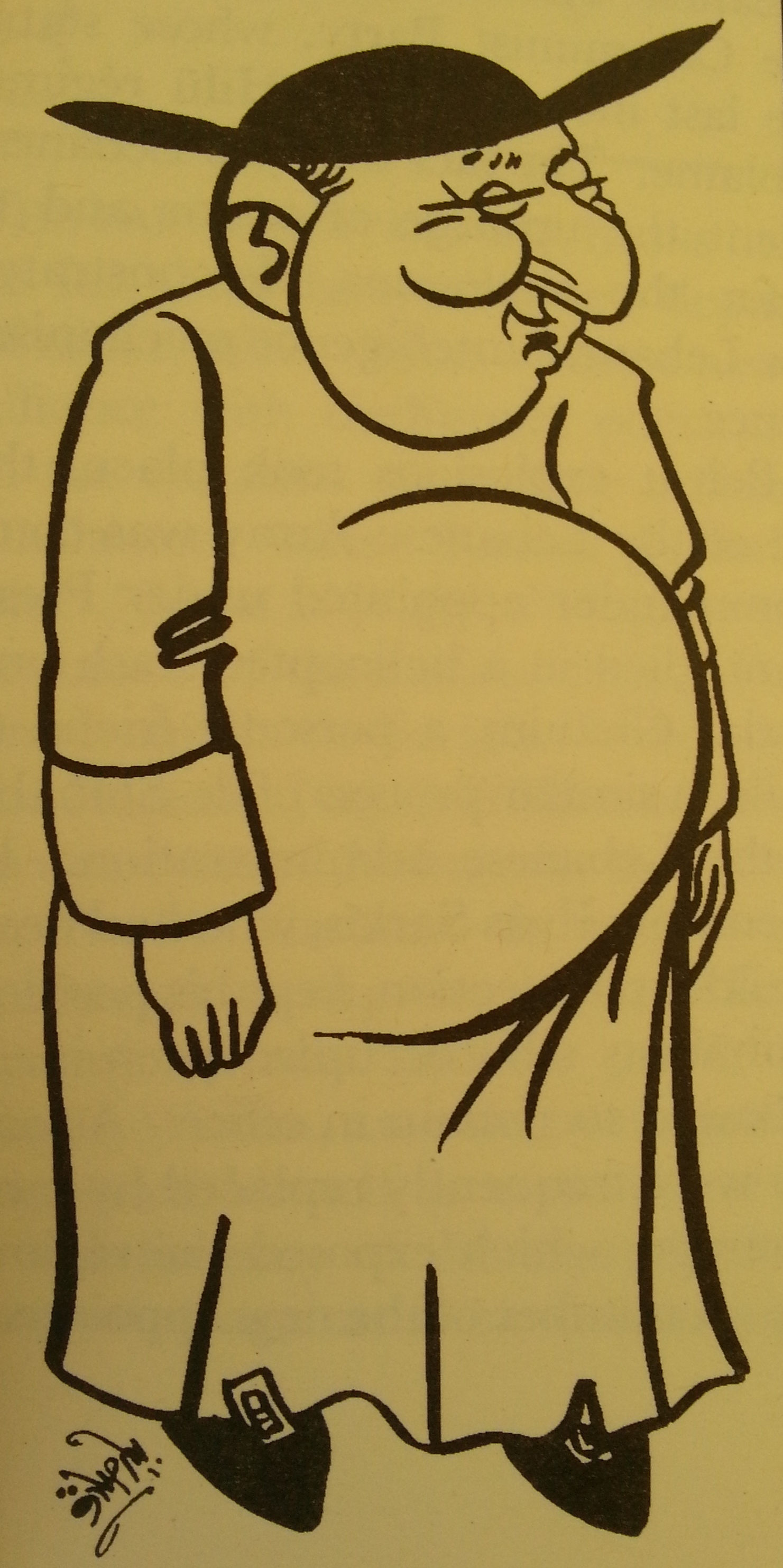
Charles Helou’s Caricature as a Jesuit priest by Pierre Sadek

Pure Chaos. That’s what the past two weeks have been all about. Hezbollah is having a more aggressive tone by the day. This week Nasrallah compared March 14’s Tripoli declaration to a declaration of war. The Syrian regime is accusing the Lebanese cabinet (that is ironically pro-Syrian regime) of interfering in Syrian affairs. Jumblatt lashed out at Aridi after the latter resigned from the caretaker cabinet. Relations are  deteriorating between Future Movement and the president who apparently gave his blessing to the 9-6-6 governmental formula. At the same time, relations between M8 and the president aren’t very good with the rumors that Sleiman might ask Salam to form a de-facto cabinet. Christian leaders are distancing themselves from each other ahead of the presidential elections while awkwardly  unifying their stances against the extension of the president’s current term. Nabih Berri stood up for the president and announced that the latter did not ask him for an extension of his term.

But is it total chaos or something is actually cooking out there? Let’s state the facts again.

The Example Of Charles Helou

It is said that Charles Helou, Lebanon’s fourth president (1964-1970) was rather a weak president. Helou felt that Fouad Chehab was still the one controlling everything, and that he was no more than his puppet in the presidential palace, so he resorted to several tricks by strengthening the anti-Chehabist opposition then by  inciting the two camps against each other, hence slightly reinforcing his position. This “Jesuit” strategy (Charles Helou went to a Jesuit school and a Jesuit University) even led the late caricaturist Pierre Sadek to draw him in his caricatures as a Jesuit priest. Why am I mentioning this? Because Michel Sleiman acted exactly the same as Helou this week.

Back To 2013

Michel Sleiman is stuck between M8 and M14. The designated prime-minister Tammam Salam broke a few weeks ago Rachid Karami’s 43 year old record in forming a government. Today marks the ninth month since Mikati resigned from premiership. We kind of got used to vacuum in power, but 9 months is really, really too much. 9 Months is how long it takes a pregnant woman to deliver a child. Meaning that some Lebanese babies actually spent their whole intra-uterine life while there was absolutely no functioning cabinet. How cool are these Babies ? (In other words, Fi ahla men Lebnen?).

Meanwhile, in 3 months, the parliament will have to convene to elect a president that will replace Sleiman 2 months after that date. Sleiman is causing panic. He’s not officially denying the rumors that he will form a de-facto government of M14 or independent figures, while at the same time telling Fouad Siniora that he has no problem with a 9-6-6 formula. So what really happened this week and why the sudden aggressive stances from everyone? It’s because each camp thinks that the other is far more closer to forming the government. And the Aridi-Jumblatt issue, along with the Syrian regime’s frequent criticism of Jumblatt and of Mikati’s caretaker cabinet indicate that even the Syrians – that supported the Mikati government (at least preferred it on Hariri’s one) in 2011 – want it gone for good.

The President’s Brilliant Maneuver

Now that the Mikati caretaker cabinet is falling apart (topped with the Aridi-Safadi raw), it is a lot more likely for a government to be formed, especially ahead of a probable presidential vacuum. With no elected president to succeed him, Sleiman will transfer his powers to the interim cabinet in power putting him in a far better negotiating position. The only remaining piece of the puzzle – and that’s what the president did this week, à la Charles Helou, is giving the impression to M8 that they are fighting a lost battle because he’s pro-M14, and to M14 that he doesn’t care about them because he’ll do what M8 wants. That should make them both (M8 and M14) more malleable concerning their governmental demands (due to fear of a cabinet solely composed from members of the other camp) and hence accelerate the formation of the government.

Between the Christian leaders’ veto on the extension of the president’s term and their inability to decide on the name of the new president, Michel Sleiman found himself in a stronger position on the negotiation table. If he won’t see his term extended, he’ll make sure to use the M8/M14 rift (along with the probable presidential vacuum) in his advantage regarding the government’s formation.

The War For Centrism

Jumblatt And Hariri

Last week was a week of surprises.  The Daily Star (close to March 14) told us that Jumblatt has sent a Letter to Bashar Al-Assad. Jumblatt denied it violently on Tuesday, and attacked The Daily Star by comparing it to Al-Akhbar (close to March 8). Al-Akhbar struck back at Jumblatt by confirming the Daily Star story and indirectly siding with the other newspaper. Regardless if Jumblatt sent a letter to Al-Assad  (asking him to re-enroll two Druze defected officers in the Syrian Army) or not, Jumblatt’s reaction to the news carries several messages. Jumblatt was criticized by newspapers close to the two coalitions and chose not to stay silent.

1-The Action

As I have noted earlier in summer, the FPM and the FM are getting closer and closer. Ahead of the May 2014 elections, Michel Aoun had started since June a (very) slow but steady change in his stances.  New rivalries, such as the one with Sleiman Frangieh are seeing light. His weekly criticisms of the Future Movement, Fouad Siniora and Saad Hariri are now exceptions. Instead, his new targets seem to be Berri, Jumblatt, and to some extent Hezbollah.

Hezbollah?!?!

Yes. Hezbollah. A couple of months ago, the FPM criticized Hezbollah for setting up/repairing a telecom network near the city of Zahle. In 2006, when Basmet Watan impersonated Nasrallah in the satirical show, Charbel Khalil, the director of the show – known for his close ties with the Free Patriotic Movement – apologized for his sketch. Last week, Charbel Khalil impersonated Hassan Nasrallah for the first time since 2006. While the timing of the criticism is to be noted, the most important thing about the sketch is that Charbel Khalil will not apologize this time.

FM And FPM

Last week, while everyone was talking about Jumblatt’s letter, something very important went unnoticed: The FPM and the FM were having their first meeting since 2005. That’s not even a major progress. That’s a huge one.  And why is it huge? Because apparently the Saudis are pressuring the M14 parties to halt their negotiations with M8 parties in the light of better American-Iranian relations. So for the Aounists and Harirists to meet in such a hostile context is a strong indicator that perhaps after all, there can be an agreement between the two political foes.

2-The Reaction

Any agreement between Future Movement and the Free Patriotic Movement is bad for all the other parties. Nabih Berri might never become speaker again. The Lebanese Forces and the Phalanges would be even more marginalized in the M14 coalition. Mikati would lose it all. M14 would control the majority of the MPs, leaving M8 with less than 30% of the seats in the parliament. M8 wouldn’t be able to constitutionally block the presidential elections by lack of quorum, while the major Christians parties, united under the banner of March 14, would choose their president without questions of his legitimacy. After all, he has the backing of practically all the Christians and half of the Muslims. Hariri might become Prime Minister again – and who knows, under the presidency of a Aounist president?

An FPM-FM alliance is probably the most logical alliance one can think of in Lebanon. Together, they hold the absolute majority in the parliament. They both started as secular parties, they both have a certain sectarian identity, and they are the parties that least participated in the 1975-90 civil war. Also, they do not have the same electoral clientele, with the FM gathering its strength in the main three cities and the rural Sunni regions, and Aoun mainly controlling the seats of Northern Mount-Lebanon, which means that they will not compete with each other and there will be no rivalry: Aoun is appealing to the Christian electorate and Hariri to the Muslim one.  Aoun can use the extra Sunni votes in Batroun, Beirut, Koura and Zgharta and Zahle to tip the balance in his favor, while Hariri can use the FPM power in several regions especially southern Mount-Lebanon to hold the precious 8 seats of the Chouf. Electorally speaking, if both enter an alliance, they will probably control all the districts except Bcharri, Baalbak-Hermel, Hasbaya-Marjeyoun, Nabatieh, Zahrani, Aley, Bint Jbeil, and Tyre. That’s roughly 90 Members of the parliament under FPM/FM control. 70% of the Parliament. No LF, no PSP, no Kataeb, no Amal, no Hezbollah needed. 70% via the votes of the FPM and the FM, only.

Now back to reality. 

As stated above, the FPM and the FM are together invincible. Maybe after a decade of rivalry, the FPM and the FM are starting to understand that the two parties were meant to rule together. But the scenario above is highly unlikely today and in the near future. Hezbollah, Nabih Berri and the Lebanese Forces would be panicking if they would even feel that such an alliance is even in its embryo form.

We do not see panic. Instead we see a bit of denial from Walid Jumblatt who is strengthening his ties with M8 by supporting the 9-9-6 governmental formation, attacking one of M14’s newspapers (after being its traget), and sending a letter to Bashar Al-Assad (?). Let’s face it, if The Daily Star is criticizing him (regardless if the letter is a rumor or not), things are not well between the FM and the PSP.

The truth is, Walid Jumblatt is a minor political player. He has a relatively small bloc. His glory resides in the fact that he’s in the middle while M8 and M14 have roughly equal parliamentary sizes (no one can seize power alone). If any of the above conditions change, Jumblatt has to adapt  so he can still be kingmaker.

While there is still hostility between the FPM and the FM – Abdel Mounem Youssef and Nicolas Sehnaoui attacked each other in the same week the meeting happened – things are very (again, very) slowly starting to change. Jumblatt is sending a clear message to Hariri: He is willing to sacrifice his position in the middle in favor of M8 if he will one day be abandoned by a FPM/FM memorandum of understanding destroying what’s left of his influence.

The closer the FPM and FM ties will be, the more Jumblatt will have to ally himself to the other M8 parties, so that he can still be – to some extent – the man controlling everything in the middle. With Aoun in the middle (to maximize his chances for the presidential elections), the Jumblatist centrist influence will be useless and Jumblatt can only try to counter this Aounist maneuver by nullifying Aoun’s new role and siding with one of the two blocs. When Aoun will side with M8, expect Jumblatt to support M14. When the FPM will start negotiations with the FM , expect Jumblatt to side with M8 (What happened last week). You might not notice it, but there’s a struggle from Jumblatt to keep the status quo. He is fighting some kind of political war so he can stay the only one in the middle and keep the size of both sides intact at the same time.

Jumblatt only remains Kingmaker by making sure that there is at no time a decisive majority in the parliament without his 7 votes. If he feels there’s a bloc (M8 or M14) getting bigger because someone from the other side is “defecting”, he’ll quickly create another majority by joining one of the two blocs before the party from the other side finishes the “defection”. The coalition will thus be in no need of the other party now that Jumblatt is on its side and the parliamentary majority is secured. After successfully aborting the political migration of a party to the other coalition, Jumblatt slowly distances himself from the new majority making it weaker and highly depending on him. That’s how he makes sure that his role of kingmaker is still intact and he is as powerful as the largest bloc in the parliament. Variants of this scenario happened in 2009 when Jumblatt became a centrist, in 2011 when he picked a side, in 2013 when he picked the other side, and in a less apparent way, last week. And the Jumblattist strategy is actually working: If I’m not mistaken, the PSP is the only party that participated (without resigning) in all the governments, with the same share, since 2005.

So What Really Happened?

Aoun decides to distance himself a bit from M8 and strengthen his ties with the FM so he can maximize his chances for the presidential elections in May. The FM falls into the trap (Perhaps Aoun didn’t do it on purpose, but it worked): Jumblatt has no choice but to side with M8 so that he can counter anything that might happen. But theoretically Aoun is still with M8 (the transition is slow). M8 hence gets Jumblatt’s support (and the definite support for the 9-9-6 governmental formula?).

M8 wins the round (unintentionally). For now.

Reminder: We still don’t have a government.

Frangieh’s Presidential Election Reform And What It Means

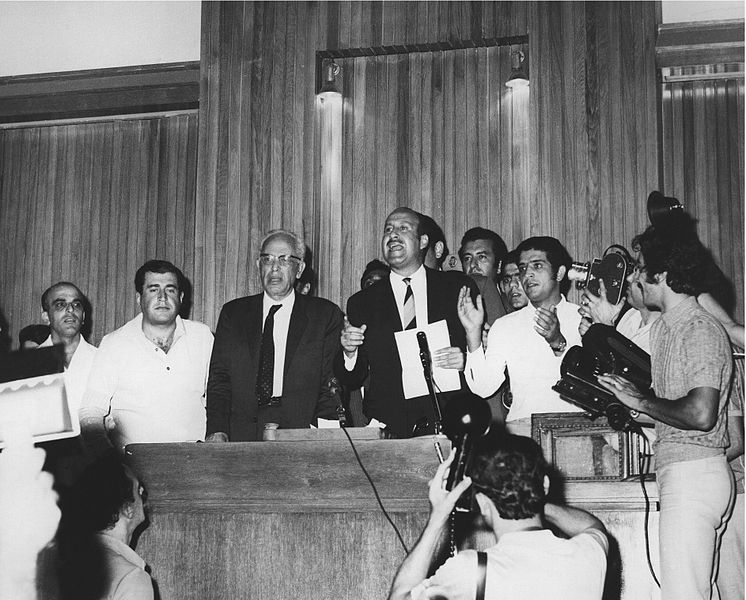
Deputy Speaker Michel Sassin declaring Suleiman Frangieh (The Grandfather) President in 1970

Deputy Speaker Michel Sassine declaring Suleiman Frangieh (The Grandfather) President in 1970

With Tammam Salam’s inability to form a government, the parliament’s failures to convene – which is unconstitutional anyway – and the electoral law impasse forgotten, I find myself obliged to talk about something new to Lebanese politics this month: The presidential elections.

Apparently on Thursday, Marada Movement leader Suleiman Franjieh warned of a presidential vacuum as the conflict over Syria continues and suggested that Lebanon adopts the 50 percent plus one vote formula to secure the office.

Wait What

Let alone the fact that Frangieh’s allies took advantage of that particular constitutional clause (Of having the two thirds quorum in the Presidential elections) in order to block the election of an M14 candidate in 2008, the very fact that Frangieh is asking for a modification of that electoral process is very weird. Why? Let’s see why. Because Frangieh belongs to a coalition in the parliament that holds between the third and half of the MPs in the parliament. That means that under the current constitutional rules, Frangieh – Let’s suppose for a while that he will be M8’s candidate – can block the electoral process by instructing his allies to boycott the session. Just to make it clear – and more complicated for you –  Frangieh said that a 50% plus one vote should be adopted. Thus Theoretically, Frangieh spoke nothing about the quorum.  He only mentioned what the number of votes for the winner should be once there is quorum. So if Frangieh doesn’t want to change the quorum rule in the constitution but only the voting rule, nothing makes sense. Is Frangieh suggesting that we change the quorum or the winning vote number? Let’s see.

M8 has 40% of the votes, M14 45%, and the others (Mikati, Jumblatt …)15%  (The numbers aren’t exact, but you get the point)

Case 1: Our lovely non functioning system (Quorum 66%, First round 66%, Second round 50%+1). Frangieh wants to run, but M14 and the others won’t vote for him. Frangieh instructs his allies to boycott. 40%>33% which means that there will be no quorum, thus no elections. In case the others will vote for him, that means he will have 55% of the votes. M14 boycotts, 45%>33%, meaning that there will also be no quorum.

Case 2: Quorum remains untouched with Frangieh’s amendment (Quorum 66%, First round 50%+1). Frangieh wants to run, but M14 and the others won’t vote for him. Frangieh instructs his allies to boycott. 40%>33% which means that there will be no quorum, thus no elections. However, Frangieh is saying that he is making the amendment to make life simpler and easier for the parliament to elect the president. Which means that the amendment doesn’t make any sense (See, I told you!) because the quorum boycott is still here and if he wishes not to boycott and elect the president with 50%+1 he can simply wait for the second round and keep the constitution like it was (see Cas 1)

Case 3:  Frangieh was actually talking about the quorum!  (Quorum  50%+1%, First round 50%+1).  40%<50% which means that Frangieh can’t freeze the process if he boycotts and has a very high chance of losing because 40%<50%. Unless…

Unless What?

Unless Frangieh is sure he can secure 65 MPs to vote for him. In politics you don’t actually propose something you might lose in, so there’s something fishy about this. If Frangieh meant cas 1 (or cas 2), he was probably just saying things to fill in the blanks of his speech. But if what Frangieh meant was cas 3, then something very dangerous is going on here.

Dangerous How?

If Frangieh can bring 65 votes, but not 86 (the 66% quorum that he wishes to remove in his reform) that can mean only few things. That means he isn’t a consensual candidate because he doesn’t have 66% of the votes (shocking, right?), that he will be running with M14 (See what I mean by dangerous?) against Aoun, or that Jumblatt and Mikati, along with Amal and Hezbollah and someone else will choose him as their sole candidate to the elections and throw Aoun outside which will probably make the latter closer to M14 than M8.

While the theory of having Frangieh and M14 as allies is unimaginable, the very fact that Jumblatt and Hariri have engaged in a media war lately, that Jumblatt is starting to prefer M8’s 9-6-6 formation over M14’s 8-8-8 one and that Aoun is actually getting closer to the Future Movement makes the second theory absurd yet executable.

However the most plausible explanation to this whole reform question is that Frangieh doesn’t want to extend to Suleiman for 6 years. Knowing that a boycott would create another revolutionary vacuum (Expired parliament, no president, no government, Yay!) he is probably paving the way for a small consensual amendment: only 1 (or 2?) extra year for Suleiman while implementing the reform of 50%+1 (M14 and the others should be enough to elect Suleiman), in exchange of something else for M8 (their formula for the government gets adopted? A consensual electoral law?). M8 will be theoretically still boycotting the elections – except this time it’s harmless to the electoral process.

Oh, and speaking of 50%+1, Frangieh’s Grandfather was actually elected by exactly 50%+1 of the votes. Actually, it was 50%+0.5, (he got 50 out of 99 votes. 99/2=49.5 which means he got 50%+0.5) and that is why in the picture, it’s not the speaker Sabre Hamade – his political rival who considered 50%+0.5 instead of the absolute majority (50%+1) to be unconstitutional – proclaiming him president, but Hamade’s deputy.

And look at us, complaining about the 66% quorum.

Tammam Salam’s Options

Tammam Salam (AP/Hassan Ammar)

(Image Credits: AP/Hassan Ammar)

Let’s rewind six months. Tammam Salam was supposed to quickly form a government, end the electoral law dispute via a proposed consensual law from the cabinet and finally supervise the elections. But then came the parliament’s mandate extension. Then came Al-Qussair and the subsequent Lebanese dilemma. Then came Al-Ghouta and the subsequent Lebanese dilemma. Then came the probable American strike and the subsequent Lebanese dilemma. And with them came the refugees, and the subsequent Lebanese dilemma.  But now that Lebanese politics are making a slow comeback to Lebanon, the lack of solutions to the current deadlock leaves the Prime Minister Designate with several options to end the crisis.

If You Can’t Beat Them, Join Them

When Tammam Salam was first designated in April, I made sure to underline how the nomination of Salam by M8 to the premiership was a political maneuver. It was meant to pressure him by making him consensual (while he wasn’t) thus forcing him (more or less) to take their opinion on the governmental formation. It was by far the most  brilliant move by M8 in 2013 that brought us to the current stalemate. If M8 hadn’t nominated him we wouldn’t be standing where we are today and an M14 government would have probably started preparations for the elections.

You Who?

What really makes things hard for the PM-Designate is that the atmosphere of political confusion during the first 9 months of 2013 and the close presidential elections left the coalitions in shatters making it  impossible for him to speak with them as united blocs. After the Orthodox Gathering law almost destroyed the M14 alliance, M8 had serious internal problems in summer. And while Aoun was very recently trying to start talks with M14, Berri was busy adding more confusion to the scene by proposing his initiative to solve the crisis (another boycotted dialogue). The apparent  bipolarisation of Lebanese politics between M8 and M14 is misleading. Salam will have to please a lot more than 2 blocs.

Veto, Veto Everywhere

There is a boring public opinion battle in Lebanon regarding the formation of a new government. Some are attacking Hezbollah and accusing it of obstructing the formation of a new cabinet. Our opponents said that they objected to the participation of Hezbollah in the government. Two weeks ago, they said that they would agree to Hezbollah’s participation, after they had disrupted the country for months. We cannot be blamed for being the ones who are disrupting the country. Our only condition regarding the new government is that it reflects the parliamentary representation of the political parties in Lebanon. The concept of the 8-8-8 government is not realistic. In reality this will be a government formed with ten March 14 ministers, that include PM-designate Tammam Salam, who is a pro-March 14 politician.”

That quote from Nasrallah’s speech (September 23) really says it all. There are vetoes coming from all the sides that named Salam. The first third of M14 wants a neutral government, the second third of M14 doesn’t want Hezbollah participation while the last third wants the 8-8-8 ministers formula. The M8 alliance wants full participation (and thus the blocking third+1, so probably 9, 10 or 11 ministers out of 24) in the government, while Walid Jumblatt – The Kingmaker – doesn’t know what he wants (and probably doesn’t want to know so he can stay in the middle and avoid another 7 May-like incident).

The Blurry Aftermath

What exactly is the Salam government’s function? The presidential elections are in May, meaning that the cabinet – if things go well (don’t get too optimistic) and it gets the confidence vote by November – would last for seven months as a non-caretaker government. So what are the objectives of Salam? Electoral law? Parliamentary elections? Presidential Elections? Postponing them (and that means a constitutional amendment)?  Or just another normal cabinet in times of elections and regional war? The very fact that no one knows what the new government will be for makes things even more complicated for the PM who can’t form a government that he doesn’t know its goals.

The Options

Remember when I told you about Tammam Salam’s options at the beginning? Unless the PM-Designate desires to commit political suicide by going against the M8 will or resigning, he has no options but to wait for a miracle – like these miracles (a, b, c)- to happen. For a newcomer – relatively weak – rising politician to resign after failing to form a consensual cabinet, it is a fatal bullet to his political career. To go against M8 would put him in confrontation with Hezbollah. If the confrontation is solely  political, it would  eliminate him as a consensual PM while featuring him as an intolerable alternative to Hariri, which is in the advantage of the two former prime ministers Hariri (who will look like a moderate M14 member) and Mikati (who will look like the strong neutral candidate). If things get nasty on the ground, that’s even worse for him.

That’s why – after 6 months – we’re still at the beginning, where the type (Independent/Political) of the government must be decided. The number of seats, the portfolio allocations, the name of the ministers, and the ministerial statement are yet to be discussed. And the sad part? These are the steps that actually take 99% of the time.

When a matter that should take six hours takes six months, you start to understand how much Lebanon is a failed state.

Greater Lebanon In Jeopardy

Greater Lebanon Event

If you’re a bit familiar with this blog, you must have noticed that I rarely talk about Syria, and when I do, it’s usually in the context of Lebanese politics.

But Lebanese politics disappeared. For the past two weeks, it has been all about Syria. About the likely American strike on Syria. About the Chemical Weapons in Syria. About the revolution in Syria. About the civil war in Syria. About the Syrian army. About the Free Syrian army. About arming the opposition. About helping out the regime.

Priorities

In a country that has no budget since 2005, no government since March, no elections since 2009, no agreed-upon electoral law, extended mandates for everything ranging from a parliament to a commander of the army, and an outgoing president as a cherry on the top, you would think that the normal priority, or norm, would be taking care of any of the previously mentioned problems. But the very fact that no one is doing anything but wait for things in Syria to get clearer really sums it up. (You might want to check this post)

Pro-Syrias

When the Syrian army left the country in 2005, it was thought that the controversial hegemony over Lebanese politics was forever gone. Who knew that 8 years later, a civil war in Syria will bring it back, yet this time with no controversy? There was always a Pro-Syrian coalition in Lebanon, at least to the extent that it was more pro-Syrian than the others. But as Syria turns into Syrias, pro-Syria in Lebanon becomes pro-Syrias, and Lebanon – at whole, probably for the first time since the 19th century  – becomes no more than pro-Syria, or in other words, an affiliated country. With no side winning the civil war, the allegiances will get more and more dangerous until a civil war might find its way to Lebanon. By then it would be too late to separate Syrian and Lebanese affairs.

The Helleu Equivalency

Charles de Gaulle once said that by arresting all Lebanese Zuamas in Lebanon, Jean Helleu indirectly achieved in 48 hours what the French were meaning to do for 25 years: unify the Muslims and Christians (via their hate towards colonialism). The Syrian civil war is achieving what the Syrian leaders could not do for 70 years: Absorb Lebanese politics into Syrian politics. The longer the Syrian civil war lasts, the more Lebanese parties will get involved in it, and the more the decaying Lebanese system will self-destruct itself and find it harder to host the political turmoil.

A New National Holiday

When a Lebanese President makes a speech for the first time in the occasion of Lebanon’s forgotten 93rd anniversary of the creation of the state of Greater Lebanon, you know things are going very (very) bad. Lebanon already has another national holiday, the independence day from France. But the symbolism of the 22nd of November is different from the First of September. The 22nd of November is the day Christians and Muslims of the country united for the first time against a foreign power and set the basis of what would be the political rules for the next 30 and arguably 70 years.  The Greater Lebanon context however is different. Until the 1940s, the Muslim population did not agree to the concept of an independent Lebanon from Syria (and a greater Arab state). The boundaries of such a state were considered to be controversial and artificial in 1920, and created problems among the Lebanese Christians and Muslims till 1937, when the Muslim boycott started to fade away with the nomination of Khaireddin Al-Ahdab as the first Sunni Prime Minister. To remember such a day would be to remember what would be the beginning of 20 years of occupation, colonialism, boycott and political confusion among the Lebanese. So why exactly did the president make a speech two weeks earlier on the occasion of that event?

Greater Lebanon

Lebanon’s boundaries are Greater Lebanon’s boundaries. Whether the day symbolizes Lebanese unity or not, it is the day Lebanon became the separate, bigger entity that exists today. An entity distinct from Syria, where its politics would be distinct from the Syrian politics. The National Holiday that is independence day is not important in these times as Lebanon is not facing a Muslim-Christian strife. Lebanon is facing something far more dangerous than that, and it is the slow but steady absorption into Syrian affairs due to the M14 alliance with the Syrian opposition and the M8 alliance with the Syrian regime. Remembering this day would be a reminder from the president to all the politicians that Lebanon is not in Syria.

When the formation of a new government depends on an American-Russian deal about Chemical Weapons in Syria, you know something is just not right.