On the Asharq Al-Awsat Attack: If We Are Truly Different from the Middle East, We Should Act Like It

A caricature published in the Saudi-owned Asharq al-Awsat newspaper writes "April fools... the Lebanese state" over the Lebanese flag in its Friday, April 1, 2016 edition. (Image source: The Daily Star/Asharq Al-Awsat newspaper)

Staff at Saudi-owned Asharq al-Awsat newspaper in Beirut observe the damage done to their office by protesters (Image source: The Daily Star/Hasan Shaaban)

Today, on the 1st of April 2016, about a dozen activists stormed into and trashed the Beirut office of the Saudi-owned daily Asharq al-Awsat after it published a cartoon in its Friday edition depicting the Lebanese state as an April Fools’ joke.

For the past four years, I have mainly posted political analysis on this blog. I have criticized all the Lebanese parties and politicians, every week, every month, every year. I looked up WikiLeaks cables about political maneuvers. I posted WikiLeaks cables about the Civil War. I wrote with sarcasm – and I enjoyed every sentence. I even criticized Fouad Chehab for censoring Mohamad Machnouk’s father fifty years ago. All of this has been possible because Lebanon made it possible, because we – at least theoretically – were not like any other Middle Eastern country: We had a little margin of maneuver when it came to freedom of speech. After all, the blog is called Moulahazat (ملاحظات), so it needs a little bit of free speech in order to work. True, a lot of bloggers and journalists (even comic writers) in this country are sued, and even more practice self-censorship. At least I know that I do it in every blog post – It’s one of the cons of being a political blogger in Beirut. You have to keep everything within the limit, you have to be harsh – but not too harsh, and you have to treat them all equally to avoid trouble. Not only do you fear the state, you also have to fear the parties. So it was a little margin to maneuver with, and I’ve never liked it anyway, but that little margin felt like heaven in the middle-eastern context.

But today, it was confirmed that not only we had to fear the state and the parties, but we also had to fear the people. And by people, I definitely do not mean everyone: Dozens were enough to make us feel we lost free speech. Dozens were enough to make us fear. That is bad. That is very, very, very bad. I would even say garbage crisis-bad.  We do not have to fear the people. In fact we should not fear the people: Freedom of speech should be defended by the people and not the other way around. And it doesn’t matter what the caricature said, whether we agree or not, because at the end of the day, we were the ones who lost our free speech – hopefully temporarily.

Freedom of speech (or at least, the illusion of it), is the last thing we have in this country, which makes it not only sacred, but more important than anything anyone would ever say. Nothing is worth sabotaging that right. Not a caricature, not a Facebook post, not a tweet, not a hate article, nothing. You respond to an article with an article, to a tweet with a tweet, to a post with a post, to a caricature with a caricature. Never with violence or censorship. Never. Unless you’re ISIS, or a dictatorship, or something between those two. The moment we destroy free speech, we become the very thing we fear, and lose the last thing we barely even had.

Freedom of speech is not a jesuisCharlie hashtag you use – in beautiful hypocrisy – when journalists die thousands of Kilometers away. It’s when you respect what the other has to say, no matter what the other has to say, and it’s when you respond to what the other has to say, like any normal sane human being in the 21st century should respond: via speech – it’s free.

Today’s events – the thuggish behavior against a media outlet, any media outlet – will encourage the self-censorship, the official censorship, and will make everyone think twice before writing anything – Not that they already do that. We should not care what other countries or regimes would have done or are doing. We are not other countries.

Lebanon’s print media is dying. Newspapers are closing. Other media outlets are leaving the country. Bloggers are being sued. Yes, the media might not be perfect in this country – in fact it is far from being perfect – but we don’t have to make it worse by denying freedom of speech because “we care about the dignity of the country and we want to protect it”.

The only dignity left in this country is the freedom of speech, perhaps we should try to protect that. It is the first step required to save Lebanon’s dying media, and it is a necessary one. The Lebanese should ask for a constitutional amendment giving them absolute freedom of speech before it’s too late.

Jean Obeid in WikiLeaks: Syria AND Saudi Arabia’s choice?

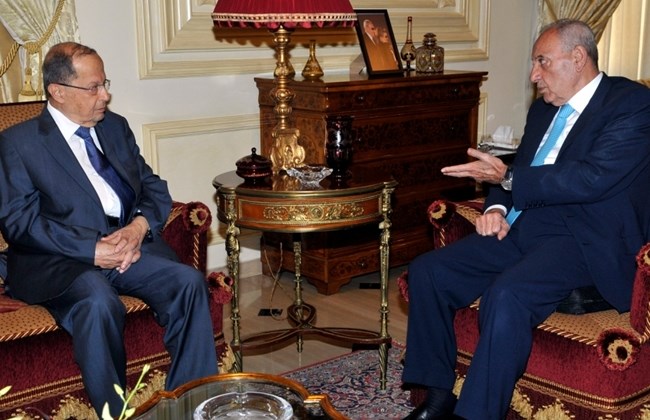
Obeid (L), meeting with speaker Nabih Berri (R). Image found on the internet

Obeid (L), meeting with speaker Nabih Berri (R). Image found on the internet

This is the 13th post in a series of monthly posts covering (forgotten/ignored) WikiLeaks cables about Lebanon.

If the past two months in Lebanese politics have taught us anything, it’s that a 7 months-old trash crisis can have absolutely no impact on the country’s government while a diplomatic crisis between Saudi-Arabia and Iran can cause panic and chaos among the politicians and almost make them sleep in the Grand Serail in order to reach a solution.

Which is why this month’s WikiLeaks post isn’t about who the Lebanese want, or even who the Lebanese parties want (Aoun/Frangieh). This month’s WikiLeaks post is about who the regional countries prefer to be in Baabda palace. One of the names that keeps surfacing in Lebanese media is the name of Jean Obeid (if you have no idea who he is, it’s OK. Wikipedia shall enlighten you). So I went on WikiLeaks, and found out that not only he is a favorite of speaker Berri, but also Syria and Saudi Arabia. How that last sentence is even possible is beyond me, but if he can still gather regional support (the cables are a bit old and mostly from 2008) we should all keep in mind that his candidacy is as serious as Michel Aoun and Sleiman Frangieh’s one. On another note, Obeid seems to have had a French veto on his name (just like Frangieh), could have enjoyed the former Patriarch’s blessing, and could have also been a compromise candidate for Hariri in 2008 according to former minister Murr. Siniora even preferred him on Edde. So when it comes to favorites, I would say that Obeid has regional politics and  a deal on his side this time, and he might end up being a sudden / last minute serious threat to both the Frangieh and Aoun candidacies.

Enjoy the cables. I picked the most relevant ones and I’ve only kept the parts focused on Obeid and organized them by chronological order. The last two cables are meetings with Obeid, so I’ve copied them all: After all, it’s nice to know how Obeid maneuvers. He might be president one day, no matter how that seems unlikely (when you’ll read the cables you’ll understand that it’s not that unlikely after all), and according to his meetings with Jeffrey Feltman, he’s not a big fan of Michel Aoun. Perhaps it’s why Berri likes him so much after all?

Michel Aoun, he added, does not comprehend the mind of Christians. Samir Ja’ja’ does not comprehend the heart of Christians. President Lahoud is feeding the flames and creating walls, not bridges, between groups.” – spoken like a true candidate for the Lebanese presidency. Poetry.

LEBANON: MARONITE PATRIARCH, PREOCCUPIED WITH RISING TENSIONS, SEEKS “NEUTRAL” PRESIDENT
2006 November 7, 12:33 (Tuesday)
06BEIRUT3568_a

The Patriarch then raised the name of Jean Obeid. He noted that Obeid would come to see him in two days. While Obeid had been “Damascus’ man” before last year, he had BEIRUT 00003568 003 OF 003 allegedly fallen out with Bashar al-Assad. When asked by the Ambassador whether he is sufficiently influential among Lebanese, Sfayr replied that Obeid remains close to Syrian “collaborators” in Lebanon. (Note: It was unclear whether Sfayr meant to suggest that he might support Obeid, a former Foreign Minister and Maronite MP from Tripoli, as a potential candidate, or just sharing gossip. We suspect the latter. We noted also that MP and clear presidential hopeful Boutros Harb may be trying to position himself as a neutral candidate, for example by skipping the most recent March 14 coordination meeting. Finally, Justice Minister Charles Rizk is a neutral candidate by default, having been appointed by and recently falling out with President Lahoud, and has been spreading word that he enjoys the Patriarch’s support. End note.)

OUTGOING FRENCH AMBASSADOR ON LEBANON DEVELOPMENTS
2007 August 6, 05:21 (Monday)
07BEIRUT1175_a

13. (S) Describing a spectrum ranging from white (good) to black (bad), Emie said that, in his view, former MP Nassib Lahoud and current Minister of Justice Charles Rizk were “by far the best.” He lamented that Rizk and Kouchner had sparred over a lunch hosted by Siniora, when Rizk “was openly contemptuous” of some views of Kouchner that Emie described as “rather naive.” The fact that Rizk speaks “impeccable French” may help to rehabilitate him in French eyes. Nassib Lahoud and Rizk were both “presidential,” with “strategic vision.” At the black end of the scale, to the point of requiring French vetoes should they become serious candidates, Emie placed former Foreign Minister Jean Obeid (“corrupt and a ‘Syrian'”), former Foreign Minister Farez Bouez (“even dirtier than Obeid”), and former Health and Interior Minister Suleiman Franjieh (who, as a personal friend of the Asad family, probably has no chance).

LEBANON: BERRI: FUTURE OF LEBANON DEPENDS ON CONSENSUS PRESIDENT
2007 August 30, 15:58 (Thursday)
07BEIRUT1334_a

12. (C) The Speaker then wrote out the people he saw as candidates: Michel Aoun was the sole opposition candidate on his list. From March 14, he listed Boutros Harb, Nassib Lahoud, Nayla Mouawad, and Robert Ghanem. Of “neutral” candidates, he listed Fares Bouez, Jean Obeid, Charles Rizk, Michel Edde, Mikael Daher, and Joseph Torbely. Only later in the conversation did it occur to the Speaker (or to the others in the room) that no one had remembered to add Amine Gemayel to the list. Then, of the list of 12 candidates mentioned, Berri started crossing out names, one by one, explaining why this or that person would not be elected. This left him ultimately with four names that he considered to be realistic candidates: Nassib Lahoud, Boutros Harb, Robert Ghanem, and Jean Obeid. He promised that if the US could lead March 14 to accept the two-thirds quorum, he would secure the opposition’s consensus on the presidency, settling on one of those four names (which Obeid known to be Berri’s preference). The Ambassador kept pushing Berri about what was so dangerous about any of those four candidates. Berri did not answer the Ambassador’s question about why parliament could not simply meet and vote on those four names until a winner emerged.

LEBANON: SAUDI AMBASSADOR OPPOSED TO “HALF PLUS ONE” BUT SEEKS MARCH 14 PRESIDENT
2007 November 5, 04:52 (Monday)
07BEIRUT1724_a

5. (S) At the same time, Saudi Arabia is adamantly opposed to March 14’s proposal to prevent an extension of the status quo by holding an absolute majority (“half plus one”) presidential election. Such an approach will also be destructive to Lebanon and will permit Syrian-backed thugs and gangs to wreck havoc. King Abdullah has instructed Saad Hariri not to move in the direction of absolute majority BEIRUT 00001724 002.2 OF 005 votin. A formula has to be found by which Lebanon avoid both catastrophes, a presidential void or a hal-plus-one presidency. While he believes that hi personal friend Jean Obeid would have been a god consensus choice, Khoja said that he now recogizes that neither March 14 leaders nor the Maronies accept Obeid. “I don’t know why,” oja said sadly; “Jean is good.” The Ambassador did not coment.

13. (C) In a separate meeting, the Ambassador briefed MP Walid Jumblatt about Khoja’s thinking. Jumblatt (who earlier in the week had hosted Khoja to dinner, when Khoja was still touting Jean Obeid as president) said that he liked the idea, as “we have to give them (the March 8 opposition) something.” From Jumblatt’s perspective, this accomplished three goals: First, March 14 secured the presidency for six years. Second, Hariri delayed taking the premiership pending a more favorable political and security climate. Third, the compromise March 14 would have to make regarding the PM was far less painful than making a compromise on the president, since the cabinet could always be changed and “improved” later. But Saad Hariri will have to be convinced, Jumblatt said, noting that he would not risk splitting March 14 if Hariri did not approve.

LEBANON: NEW YEAR’S EVE “YEAR IN REVIEW” WITH PM SINIORA
2007 December 31, 16:19 (Monday)
07BEIRUT2009_a

14. (C) The Ambassador mentioned that, on December 30, Deputy Prime Minister and Defense Minister Elias Murr raised — with suitable alarm — the question of a Jean Obeid presidency should the Sleiman presidency be derailed by the methods outlined above. Murr said that he believes Obeid (who was always Nabih Berri’s preference) is now the real Syrian candidate. The Prime Minister confirmed this rumor and said he had heard it from Obeid himself, who declared that the Sleiman candidacy “was over.” In a side-bar conversation discouraging to all, meeting participants debated the merits of Michel Edde vs. Jean Obeid as a back-up candidate. Siniora said that “Edde is a very good liar, but one can find a way to get through to Obeid in the end. Of the two, Obeid is the least worst option.” Asked why Sleiman, once thought to be Syria’s candidate, is now apparently being blocked by Damascus, Siniora explained that it is because Sleiman is “entering through the March 14 gate” rather than via Damascus. By contrast, Obeid would come to the presidency via Damascus.

LEBANON: MURR, CONVINCED STREET VIOLENCE IS COMING, PLOTS ARMY REACTION
2008 January 5, 12:02 (Saturday)
08BEIRUT16_a

12. (C) Answering the Ambassador’s question about whether the pro-Syrian foot-dragging on Sleiman was intended to block him or just gain more concessions, Murr said that he was convinced the Syrians truly do not want Sleiman. Citing contacts of his father Michel (who has long maintained a close relationship with Syria), Murr said that he has increasing evidence that Syria’s Lebanese allies, surely reflecting Damascus’ thinking in his view, now want former Foreign Minister Jean Obeid as president. (PM Siniora, as noted ref a, has told us the same thing.) With more than 30 years of dealing with Obeid, Syria’s proxies in Lebanon find him more reliable and predictable than Sleiman. Moreover, Obeid has reportedly given Damascus a written commitment that, as president, he will find bureaucratic ways to thwart the tribunal, by starving it of resources, preventing the handover of suspects or witnesses or evidence, etc. “Obeid told the Syrians that the tribunal will come into effect when Rustom Ghazeleh is 80 years old.” 13. (C) The Obeid candidacy will remain hidden until the opportunity presents itself to elect him, Murr claimed. The fact that Obeid does not need a constitutional amendment helps pave the way, since March 8-Aoun would not have to recognize implicitly the authority of the cabinet (which must prepare a constitutional amendment) in electing Obeid. Even though the March 14 Christians and Walid Jumblatt are adamantly opposed to Obeid, Saad Hariri, eager to become PM, might be tempted, especially as Rafiq Hariri’s widow Nazek likes Obeid. Hariri, Berri, and Hizballah could muster sufficient votes to get Obeid elected, Murr speculated. Even Michel Aoun, if he sees he will never become president, would prefer Obeid to Sleiman, since Obeid would be unlikely to draw supporters away from Aoun’s orbit.

MGLE01: FORMER FOREIGN MINISTER DISCUSSES NATIONAL DIALOGUE
2006 March 8, 16:30 (Wednesday)
06BEIRUT714_a

SUMMARY ——-

1. (C) Former Foreign Minister (and eternal presidential aspirant) Jean Obeid believes the national dialogue effort will founder unless regional assistance is provided on the two critical issues: the fate of President Lahoud, and disarming Hizballah. According to Obeid, Lahoud will not resign the presidency without acquiescence from the Syrian regime, and Hizballah has little room to maneuver on its arms without consulting Iran. Although the dialogue is a very real achievement and can be used as a platform to continue the consensus-building process, Obeid believes it cannot deliver unless Saudi Arabia and Egypt pressure Syria and the rest of the international community pressures Iran. In his view, the key to progress in Lebanon is the constitutional removal of Lahoud (and, presumably, Obeid’s own ascendency to Baabda Palace). End summary.

2. (C) Jean Obeid, who was Lebanon’s foreign minister in 2003-2004 during the last government of Prime Minister Rafiq Hariri, met the Ambassador and poloff on March 7 in his office. Obeid, a long-shot (except in his mind) candidate for president, worked closely with the Syrian regime during his time in office. But he is also generally regarded as an honest politician who has few enemies. Unlike many other Lebanese politicians, he does not attempt to hide his past affiliations with Syria, and in fact can be relied upon to give a fairly straight-forward analysis of their intentions, capabilities and weaknesses. Speaker (and national dialogue sponsor) Nabih Berri has previously mentioned Obeid as a presidential candidate, but this endorsement — which doesn’t exactly win Obeid many othe friends– is relatively isolated. Obeid does not enjoy a great deal of support in the Maronite community.

3. (C) In Obeid’s opinion, the national dialogue conference (currently on hold until Monday, March 13) is a useful step forward, but the 14 participants at the table understand that without regional assistance/acceptance on some issues, it will soon break up without solid agreements. He explained that the “international umbrella” offered by UNSCR 1559 has permitted the discussion of previously red-line issues, but what is actually needed at this point is indirect participation by either Saudi Arabia or Egypt to gain regional acceptance of dialogue solutions. Specifically, Obeid contended that the issue of Lahoud’s removal and selection of his successor could not be realized without the acquiescence of Syria — that is, the Asad regime would never allow Nasrallah to accept a candidate openly hostile to it. Likewise, he believes the issue of Hizballah’s arms is also controlled by a regional force, namely Iran. Although the open relatively open exchange of positions in the dialogue is a positive development, Obeid is convinced that by itself, the talks will likely break up in the coming week.

PUTTING PRESSURE ON SYRIA ————————-

4. (C) The former foreign minister argued these two issues (presidency and disarmament) had to be addressed in sequence. The primary objective, in his opinion, must be a change in the presidency — but to a president whose policies could be reliably predicted by both internal political forces and neighboring countries. Obeid said his long experience with the Syrian regime (he claimed to meet often with former Syrian Vice President Abdelhalim Khaddam and Bashar’s father, Hafez Asad) led him to believe that, even if Syria’s primary aim to reassert control over Lebanon is thwarted, the regime would never permit the selection of an anti-Syrian Lebanese president — they would unhesitatingly and rapidly create instability to prevent that development. But, according to Obeid, they are now under severe pressure and could be convinced to give up on Lahoud and accept a “neutral” president. He argued this is where President Mubarak and King Abdullah could play a decisive role and allow the dialogue to achieve its primary objective — the removal of Lahoud, and its liberating effect on Lebanon’s political and economic progress.

5. (C) Obeid is convinced that without the acquiescence of the Syrian regime, Lahoud will remain until the last day of his extended term. He stated, “Lahoud entered the (extended) presidency of his own accord, but he is not free to leave without Syria’s permission.” According to Obeid, even the Maronite patriarch could not convince Lahoud to resign, BEIRUT 00000714 002 OF 002 because without Syrian concurrence, Lahoud would be killed.

6. (C) Obeid maintained that Lahoud’s removal is the key to correcting Labanon’s instability. Obeid believes that Syria still wants to convince the Lebanese citizenry that their country is worse off without Syrian control, therefore, it is up to the US and France to convince Bashar Asad (through regional intermediaries) that it is better to allow Lebanon to stabilize, establish normal bi-lateral relations, and thereby earn improved relations with the international community. He concluded that, “…even though Lahoud is the worst president in Lebanon’s history, you must talk to his masters in Damascus (through Mubarak or Abdullah). The US and France should not base their policy on wishful thinking.”

NATIONAL DIALOGUE — A BEGINNING ——————————–

7. (C) The ever-hopeful presidential candidate stated that the opening of the national dialogue was in itself a considerable achievement. He described the “culture of divergence” that had been growing with each passing week as sectarian leaders attacked each other and issued ill-conceived ultimatums. That being the case, Obeid expressed mild surprise at the apparent civility of the current discussions and said that perhaps a new way of handling differences was slowly emerging. If nothing else, the dialogue had created a “new base” for handling divisive issues.

8. (C) The former minister reiterated that the dialogue still had a chance to accomplish its most important objective — a constitutional change in the presidency — if regional (i.e. Syrian) acceptance could be engineered.

DEALING WITH AOUN’S TARGET FIXATION ———————————–

9. (C) Obeid (with some obvious self-interest) argued that an Aoun presidency would not be a positive development. Aoun’s temperament, sense of entitlement, and lack of (civilian) leadership would inevitably produce tension and impede critically-needed progress. In Obeid’s opinion, Berri and Nasrallah could persuade the former general that he lacks the necessary support, but it would be a difficult task. Aoun understands that he will never have the support of Jumblatt, Ja’ja’, and probably Hariri and the Maronite patriarch. Therefore, if he can be convinced his other path (Shia support) is not available either, he would have to (“if reasonable”) accept the inevitable.

FELTMAN

LEBANON: EX-FOREIGN MINISTER POSITIONS HIMSELF AS CENTRIST FOR PRESIDENCY
2006 November 18, 17:01 (Saturday)
06BEIRUT3657_a

SUMMARY ——-

1. (C) Ex-Foreign Minister and Presidential hopeful Jean Obeid attributes Lebanon’s problems to external forces and to the inadequacy of current leaders in Beirut and Damascus. Citing a Shia-Sunni conflict spanning the entire Muslim world, Obeid espouses a neutral Lebanese presidency allied with neither sect. Not coincidentally, this is the latest position emphasized by the Maronite Patriarch, with whom Obeid has been strengthening his relations recently in an attempt to overcome his pro-Syrian past and become that “neutral” candidate. End Summary.

2. (C) The Ambassador called November 15 on Jean Obeid, a former Maronite MP from Tripoli who served as Foreign Minister under the last Rafiq Hariri government. Obeid once boasted of close ties to the Syrian regime, but it appears that he may have fallen out of favor in Damascus for reasons that are unclear. He has made the best of this reversal of fortunes by positioning himself with the Maronite Patriarch and others as a “neutral” presidential contender. Obeid is the uncle of current Finance Minister Jihad Azour and a relative of American lebanese Chamber of Commerce (AMCHAM) President Salim Zeenni.

REGIONAL DIMENSIONS OF LEBANON’S CONFLICT

—————————————–

3. (C) Obeid’s message stressed the regional dimensions of the current Lebanese political crisis. Known as an “Arab nationalist,” he repeatedly pointed to the Sunni/Shia conflict raging “from Afghanistan to Mauritania.” The Israeli-Palestinian conflict, Iran’s regional and nuclear ambitions, and Syria’s greed for Lebanon all feed into Lebanese domestic political strife. “Some Lebanese are adding to the conflict,” he added. The question is how to isolate Lebanon from this vast conflict, not involve Lebanon in it. However, there is a lot of Sunni and Shia money flowing in from outside which fuels the sectarian conflict in Lebanon.

4. (C) In his new guise as a centrist, Obeid had criticism for all parties. “The minority has no patience and the majority has no modesty,” he said. Obeid criticized what he sees as the tendency of the majority — i.e., March 14 — to make decisions unilaterally without adequate consultation with other parties. Prime Minister Siniora, he said, does not spare the time to contact and consult other government figures, as compared with Rafiq Hariri, who was in frequent contact with officials at all levels including mayors. Obeid claimed to have told Siniora, “Don’t expect the U.S., France and Saudi Arabia to do your work for you” in settling issues with other Lebanese parties. Siniora will have to do more himself. As for the U.S. role, Obeid recommended that any initiatives or positions taken by the USG be presented as Lebanese policy, rather than USG policy.

5. (C) Obeid cited the cabinet’s November 13 approval of the Hariri assassination tribunal as another example of March 14 unilateralism. After months of preparation for the acceptance of the tribunal, he asked, why could the GOL not wait another few days before pushing the tribunal decision through? Additionally, it seems as if March 14 has already made up its mind about the tribunal’s verdict. Such a position would only corner “a violent regime,” he warned. “You must not give it pretexts every day.”

6. (C) If the majority needs a spirit of modesty and inclusiveness, he continued, the minority — i.e., Hizballah, Michel Aoun’s Free Patriotic Movement, and other pro-Syrian groups — needs patience. “They don’t take into consideration that there was an election.” The minority’s backers, Iran and Syria, are becoming more strident in their demands, not more reasonable, and their relative power is increasing. Lebanon is heading toward more violence, he gloomily asserted.

7. (C) Lebanon needs to guide its Shia river into the BEIRUT 00003657 002 OF 002 Lebanese sea, he added. Hizballah is strong toward outside threats, like Israel, but weak or inept toward internal Lebanese parties.

EXCLUSION DESTABILIZES LEBANON

——————————

8. (C) Obeid turned on President Lahoud and his apparent position that Christians are part of a Christian-Shia axis confronting Sunni and Druze. While these alliances may shift, they are always bad for Lebanon. The Lebanese president, he said, should play the role of a bridge between confessional groups. If two out of Lebanon’s three largest groups line up against the other, there will be continuous war. Obeid praised the Patriarch’s position that the president must lead Lebanon’s Christians out of sectarian strife. The Patriarch does not want Christians to fight Christians nor Muslims to fight Muslims.

9. (C) Michel Aoun, he added, does not comprehend the mind of Christians. Samir Ja’ja’ does not comprehend the heart of Christians. President Lahoud is feeding the flames and creating walls, not bridges, between groups. Lebanon cannot be safe with a president who is part of a Christian-Sunni or Christian-Shia axis. Lebanon also cannot afford a President who is either an agent or an enemy of Syria.

TRIBUNAL ——–

10. (C) Obeid agreed with the Ambassador’s assertion that the Hariri assassination tribunal would be an important because it would be held in accordance with strict international standards on evidence and other elements of investigation and proof. However, he asserted that the SARG is “afraid, because they know more than you know.” The reason for the extension of Lahoud’s term, he said, and he had just comprehend this — was so that Lahoud could “cover up anything” related to the assassination and related crimes. (Comment: The extension of Lahou’s term occurred more than five months before the Hariri assassination. End Comment.)

11. (C) The tribunal will take 3-6 years, Obeid asserted. Obeid, a lawyer, cited to the Ambassador the length of the tribunal to investigate Libyan involvement in the Lockerbie airline bombing. After such a length of time, he continued, how can the international community hope to carry out the sentence? On the other hand, by so clearly working against the tribunal, Bashar al-Asad and Emile Lahoud are indicting themselves before anyone accuses them. Bashar al-Asad, for example, “opens the grave of Rafiq Hariri every time he gives a speech.”

FAILURE OF LEADERSHIP

———————

12. (C) Saad Hariri, Bashar al-Asad, and Walid Jumblatt — none of them measure up to their fathers, Obeid lamented. When he went to Damascus to pay his respects following the suicide of Ghazi Kenaan, the atmosphere was very tense. Ditto when he returned to Syria to pay a condolence call on Mustapha Tlas. One of the causes of this tension was Jumblatt’s remark to the effect that al-Asad would be hauled before the tribunal, like Milosevic. Asad, however, had also picked a useless fight with Saudi King Abdullah, and Obeid said that he told him via Butheina Shaban “you are an expert at losing friends and opportunities.”

13. (C) Despite his close Baathist connections, Obeid maintained he was never a Baathist. But one can’t live in the Arab world and not know the mentality of all Arabs. There are Christian leaders, he lamented, who don’t know how to deal with the other parties or with each other. Amin Gemayel, he related, had once demanded that they leave his office to have a private conversation for fear that his own brother Bashir had bugged it. FELTMAN


The Orange and the Blueberry

Check the color of the tie. (Image source: The Daily Star/Lebanese Parliament Website, HO)

Yes, I actually chose a picture where both ties are blue. I’m that mean. (Image source: The Daily Star/Lebanese Parliament Website, HO)

This is the 18th post in a series of monthly posts covering the presidential elections. This post is about the month of February 2016.

Perhaps the biggest lie in Lebanese politics is that power comes from the people. As the month of February 2016 demonstrates, it is the Lebanese supreme council of the tribal federation that decides on all matters. Everything else is just political bickering that has little and sometimes no meaning at all.

On the 27th of January 2016, the Lebanese supreme council of the tribal federation met with happiness and joy, and gave the orders to the Lebanese cabinet to end the deadlock. Just like that, what started as a feud over the appointment of Chamel Roukoz in the army command, and evolved into a crisis that almost brought down the government while paralyzing the cabinet throughout all autumn, was suddenly solved within hours. The Lebanese leaders shook their hands in the national dialogue session, and there was suddenly no problem at all. The cabinet was free to convene and do whatever it wanted to do, and as the media acted as if the deadlock was never here to begin with, everyone moved on with pleasure and delight and focused on solving the trash crisis by exporting garbage (:-$) – hint: even that turned out to be an epic fiasco.

So on the last days of January, we learned something very important, and this time we learned it for sure: When six months of protests and trash and humiliation don’t have any impact on the Lebanese policy makers and all it takes is eleven or twelve or thirteen godfathers sitting together on a table to get things going, know that power is not in the hands of the people. It’s not even in the hands of an unconstitutional parliament, a deadlocked cabinet, or a non-existent president. It’s in the hands of the Lebanese supreme council of the tribal federation, commonly referred to in the media as the national dialogue table.

Anyway, who cares about the people, time to go back to the politicians.

What the lack of quorum means right now

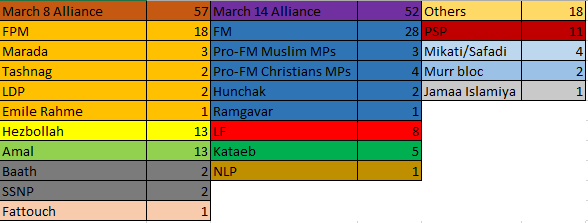
On the 8th of February 2016, the Lebanese parliament was supposed to elect its president. Unlike the previous 28294294 attempts to elect the head of state, this time it was supposed to be special (and, no, not because it was on the eve of St. Maron and that the president is supposed to be Maronite selon l’usage). For the first time since 2014, the main two candidates were now from March 8 and were both endorsed by parties from March 14. Yet just like all the previous times, March 8’s parties boycotted the session. Which why it’s time to do the math. If Michel Aoun is indeed March 8’s main candidate, and is now endorsed by all its parties (minus Frangieh’s Marada), that means that he has the support of around 55/56 MPs from March 8. Add to that the 8 MPs of the Lebanese Forces and some random votes in the center (Mikati’s bloc? Khaled Daher? Michel Murr? – especially that his swing votes in the Metn will become useless if the FPM and the LF go through with an electoral alliance, so he’ll probably eventually join in and help out the new mini-alliance of the Christian parties or risk losing his seat and Tueni’s), you end up with a candidate securing the 65 votes required for the win. [I counted the votes in a previous blog post in case you’re more interested about the numbers]

So why did the FPM boycott the session on the 8th of February 2016? There are two theories:

The first one, circulated by March 14 and their media has been alive for 12 years and can be summed up with the following three sentence: “Hezbollah doesn’t want a president. Hezbollah wants a constituent assembly. Hezbollah likes the emptiness of the status quo”.

The second theory is that the FPM does not have an absolute majority it can count on in the parliament and that participating in a session where Aoun loses by a narrow margin – with the two other candidates, Helou and Frangieh getting less votes – would be similar in impact to the 23rd of April 2014 session where Geagea got 48 votes: Yes, the candidate with the biggest number of votes might actually gain momentum, but – this is not the United States presidential primaries – on the long run we all know that Frangieh or Helou won’t suddenly withdraw from the race and endorse Aoun and that means that time would eventually kill off the Aoun candidacy the same way it did to Geagea’s. Moreover, attending a session where Helou might suddenly withdraw in favor of Frangieh can be a very risky prospect for the FPM as the Marada leader might himself end up winning an absolute majority. If the FPM (and Hezbollah)’s boycott of the session means something, it’s that the Aounists are not sure whether their other allies (or allies of ally) would stick with them. The mechanics of why the lack of quorum is happening mean that Berri will not vote for Aoun (which is why the FPM bloc is boycotting the session, since they fear he might side with Frangieh). This is where the fans (hello, March 14 guys) of the first theory come in and answer the people who believe in the second theory: If Berri is not with Aoun, it’s because Hezbollah is not forcing him to vote for Aoun, since deep down Hezbollah doesn’t want to elect a president.

If you believe that Amal is a Hezbollah proxy that ultimately answers to Nasrallah, then Hezbollah doesn’t truly want to elect Aoun but is blocking the election of everyone else, alongside the FPM, so that the alliance between Hezbollah and Aoun doesn’t fall apart. That theory has also been used by the Lebanese Forces after their deal with Aoun in order to force a clash between the FPM and Hezbollah – en vain. However, if you believe (theory number two) that Hezbollah and Amal are two separate “sovereign” parties with rival separate agendas, then Hezbollah wants Aoun to be in Baabda but just can’t convince Berri to join in on the deal.

But the reasons and the mechanics don’t really matter. Whether it’s only Amal, or secretly Hezbollah and Amal who refuse a Aoun presidency is details. What matters are the consequences: If the February presidential session that never happened taught us anything, it’s that there might be a rift among the March 8 parties that is as big as the rift in March 14.

The rift

As previously demonstrated, Amal indirectly/officially told the world on the first week of February that they are not fans of a Aoun presidency. True, that information wasn’t near as shocking as the idea of Geagea endorsing Aoun, but deep down every FPM official had hoped that Berri might in the end say yes to the General and help him reach Baabda. So when it became clear that Berri was more blue than he was orange in his presidential choices (in case you kept asking yourself what that creepy title meant), a full-blown political war on the Amal leader started. Although it’s a very nice thing to believe in the beauty of coincidences, I don’t think that the Christian parties’ criticism of all of Amal’s ministers in the cabinet and accusing them of disregarding the Christian interests in the country a week after Berri started sending signals that he does not to support the LF-FPM Christian consensual president can be counted as a coincidence: Minister of public works Ghazi Zaiter was accused of allocating less fund for the Christian areas (although some areas are much larger and more populous and have less funding than them [Check Najib from BlogBaladi’s arguments] – it’s why we need official state budgets anyway) while on the other hand, Ali Hassan Khalil, the finance minister, was criticized for replacing a Christian employee with a non-Christian one. Now again, the mechanics don’t matter. What matters here is the timing. Berri bypassed a Christian consensus on a Christian post (the presidency), and that was the LF and the FPM’s mediatized response (If you’re wondering why the Kataeb joined in too, it’s because of the competition on the Christian electorate 😉 )

Speaking of the Kataeb, they apparently found out about the trash crisis recently and decided that the best part to solve it was to pressure the government – in which they have one of the biggest shares – by protesting its policies in the streets as well as “fighting from inside the cabinet” (à la FPM). That recent hyperactivity within the party can be explained by the fact that they recently became the biggest Christian party not supporting an M8 candidate, and they clearly plan on gaining some momentum because of that. Time (and the electoral law type) will tell whether they’ll succeed or not. And even if Geagea and Hariri reiterated that the FM leaders’ remarks on the Christian wedding during the Biel commemoration were a joke, it is very clear – especially while looking at how the supporters of both parties acted – that there is a rising tension between the FM and the LF and that the FM and the Kataeb might get closer with time: Those extra-kisses from Hariri to Gemayel on the 14th of February commemoration were not so *innocent*. Hariri officially finally endorsed Frangieh on the 14th, and while it’s still practically impossible for Frangieh to make it to Baabda, the FM will need another minor Christian party to count on in the post-presidential elections era in case the Marada leader miraculously gets elected, and it seems day after day that relying on the LF (and of course, the FPM) will be awkward. It’s like asking Mikati and Hariri to be ministers in cabinet led by Walid Succarieh; on the other hand, Safadi might say yes to that prospect.

The fall and rise and fall of Ashraf Rifi

While the Lebanese government was proving once again what an epic failure it is, via the trash exportation fiasco and the no-kissing statement, something else was already cooking. It seemed that Michel Samaha was going out of jail, and while that information briefly united all the previous cadres of March 14 under one banner, another politician thought that it was more of an opportunity to gain momentum within his party. the minister of justice, Ashraf Rifi, whose presence in the ISF leadership brought the 2011 Mikati government down in March 2013, took it upon himself to resign from the government that wasn’t making it harder for Michel Samaha to leave his cell and that wasn’t standing with Saudi Arabia regionally (more on that afterwards). Yet it is unclear what Rifi was trying to do. When he previously stormed out of a cabinet session because of the same issue, Hariri disowned his stance and publicly criticized his actions . On the long run, Rifi’s move was smartly calculated, for him and his party: He showed himself as a “true” March14-er, taking his justice ministry seriously and refusing to “succumb to the fait-accompli and recognize March 8’s terms” (and yes, I’just sarcastically used March 14 terms in a Lebanese media context 😛 ). Rifi probably thought that the Prime Minister would ask him to reconsider his position in the cabinet and make him come back as a hero for his city, community, country, planet and galaxy so he may serve them with justice and order. But the former ISF commander is still new to Lebanese politics and he arguably did his first rookie mistake: He humiliated Tammam Salam in the cabinet, and bypassed Hariri’s stances when he refused to back Frangieh like most of the Future Movement officials. Rifi tried to rise through the ranks as quickly as possible by criticizing the negotiating/compromise qualities of his two bosses (and trying to look as pro-Saudi as possible by resigning in the middle of the crisis between the Gulf and Hezbollah), and signed with this move his mini-political death warrant. Bringing back Rifi to the cabinet would show weakness in the Future Movement leadership, give an impression that Hariri and Salam need Rifi more than anything – hint: no one cares about anyone in Lebanese politics – and eventually strengthen Rifi in the northern city of Tripoli, giving him the serious opportunity to overthrow – in an unlikely yet possible alliance with Karami, Mikati, and Safadi – the Future Movement in the next Tripoli parliamentary elections. So yeah, Salam – with an obvious green light for Hariri – signed the formal papers, and what started as a mini-political maneuver turned into a political farewell for Rifi – at least for now.

UPDATE: According to this report, Salam did not sign the formal papers yet (apparently it has something to do with the logistics and the fact that there is no president to co-sign). But he’s making Rifi wait, and there has been no important sign that the FM leadership asked him to reconsider his resignation.

Alice Shabtini became acting minister of justice and Michel Sleiman’s ministers in cabinet are now in charge of 4 portfolios (deputy prime-minister, defense, sports, justice) which is higher than all the previous numbers of portfolios that were awarded to the presidency between 2008 and 2014 (2008: 2/30, 2009: 3/30, 2011:3/30). In other words, that awkward moment when Sleiman has more ministerial portfolios after he left power than he ever had during his 6 years in power.

The gulf engulfing Lebanon and the Gulf

The event of the month is as regional as Lebanese politics gets, with Saudi Arabia withdrawing 4 billion $ in military aid for Lebanon and most of the Gulf countries issuing travel bans because Lebanon abstained during a meeting to back a Saudi-initiated resolution criticizing Hezbollah. I really hate the regional speculations à la Lebanese media, but those developments are clearly – undeniably – either (1) related to Hezbollah’s involvement in Syria and a Saudi response to that because of whatever’s happening in Syria or (2) Saudi Arabia going through financial difficulties with Lebanon clearly not being a priority to them (or any country in the world), or (3) Saudi Arabia’s way of refusing the new developments in Lebanese politics and sending a message that it would only resume aid if a certain president is elected or (4) that for Saudi Arabia, official Lebanon wasn’t worth the investment if it was going to either keep a neutral stance or refuse to contain Hezbollah’s intervention in Syria. Deep down, Gebran Bassil didn’t make that much of a mistake by keeping Lebanon’s neutral stance in the region, as he was following on the government’s official policy of self-dissociation (النأي بالنفس). Regardless of why Saudi Arabia stopped its 4 Billion dollar donation and why a rift suddenly happened between official Lebanon and the Gulf countries in February, the impact on the Lebanese economy was huge: many Lebanese citizens risk being deported for the Gulf countries which might destabilize the economy especially that the travel ban by the Arab countries officially killed this year’s tourism season. The impact on Lebanese politics, on the other hand, was the definition of what a Lebanese political fiasco looks like:

  • The Lebanese government took it upon itself to meet for 7 hours – they almost did an all-nighter – in order to find solutions to this “outrage”, while simultaneously ignoring any reasonable eco-friendly solution to the garbage crisis for the seventh continuous month, insulting with this move the intelligence of every Lebanese being poisoned by the piles of trash polluting the country.
  • March 14 were united in their common support to Saudi Arabia (:-$), and asked Lebanon to sign a petition saying we’re sorry (:-$) and that we’re never going to have a neutral stance (:-$) in our life again. It was always a blow to March 14, since the cabinet, in which they more or less have the biggest share (even if it’s a theoretically 8-8-8 one, its president is still pro-March 14) had failed to achieve the only true thing it promised in its policy statement: Use the Saudi donation to arm the army and preserve stability.
  • The FPM received a huge (HUGE) blow with Saudi Arabia’s move, was blamed for their new leader’s diplomatic faux-pas by Saudi Arabia and March 14, and responded in a very awkward way, saying that NO ONE COULD CHALLENGE THEM IN THEIR SUPPORT FOR SAUDI ARABIA .(?!?!?!?!?!?!?!?!?!?!?!?!?!?!?!?!?!?!?!?!?!?!?!?!?!?!?!?!?!?!?!?!?!?!?!?!?!?!?!?!?!?!?!?!?!?!?!?!?!?!?!?!?!?!?!?!?!?!?!?!?!?!?!?!?!?!?!?!?!?!?!?!?!?!?!?!?!?!?!?!?!?!?!?!?!?!?!?!?!?!?!?!?!?!?!?!?!?!?!?!?!?!?!?!?!?!?!?!?!?!?!?!?!?!?!?!?!?!?!?!?!?!?!?!?!?!?!?!?!?!?!?!?!?!?!?!?!?!?!?!?!?!?!?!?!?!?!?!?!?!?!?!?!?!?!?!?!?!?!?!?!?!?!?!?!?!?!?!?!?!?!?!?!?!?!?!?!?!?!?!?!?!?!?!?!?!?!?!?!?!?!?!?!?!?!?!?!?!?!?!?!?!?!?!?!?!?!?!?!?!?!?!?!?!?!?!?!?!?!?!?!?!?!?!?!?!?!?!?!?!?!?!?!?!?!?!?!?!?!?!?!?!?!?!?!?!?!?!?!?!?!?!?!?!?!?!?!?!?!?!?!?!?!?!?!?!?!?!?!?!?!?!?!?!?!?!?!?!?!?!?!?!?!?!?!?!?!?!?!?!?!?!?!?!?!?!?!?!?!?!?!?!?!?!?!?!?!?!?!?!?!?!?!?!?!?!?!?!?!?!?!?!?!?!?!?!?!?!?!?!?!?!?!?!?!?!?!?!?!?!?!?!?!?!?!?!?!?!?!?!?!?!?!?!?!?!?!?!?!?!?!?!?!?!?!?!?!?!?!?!?!?!?!?!?!?!?!?!?!?!?!?!?!?!?!?!?!?!?!?!?!?!?!?!?!?!?!?!?!?!?!?!?!?!?!?!?!?!?!?!?!?!?!?!?!?!?!?!?!?!)
  • Hezbollah’s officials were angry since they too – by the obvious rules of Lebanese politics – were blamed by March 14 and its regional allies for everything wrong happening in the country (M8 would have reacted the same if the opposite scenario would have happened). Nasrallah escalated, telling the Gulf Hezbollah doesn’t care what they think, which led the Gulf Cooperation Council to officially label them as a terrorist group.
  • The best thing ever? After criticizing Hezbollah and saying to Saudi Arabia that Lebanon is sorry, March 14’s highest-ranking minister in the cabinet eventually acted…exactly like Bassil during another meeting for Arab ministers –  refusing to condemn Hezbollah, which confirms one thing: The cabinet is here to stay, and Lebanon’s political class prefers to have a fall-out with a major regional country because of a sentence in a statement rather than escalate and push the cabinet to a dangerous resignation with no president in power and unconstitutional parliament in Nejmeh square.

Anyway, to sum up the month of February 2016 with one word: Zbele

On the bright side, 73 MPs actually attended the latest presidential elections session on March 2 (I think it’s a record).

Just kidding. There is no bright side. Zbele.

 649 days since the 25th of May (presidential vacancy). 485 days since the 5th of November (parliamentary extension). 231 days since the 17th of July (trash crisis). 

Lebanon’s Divisive Presidency

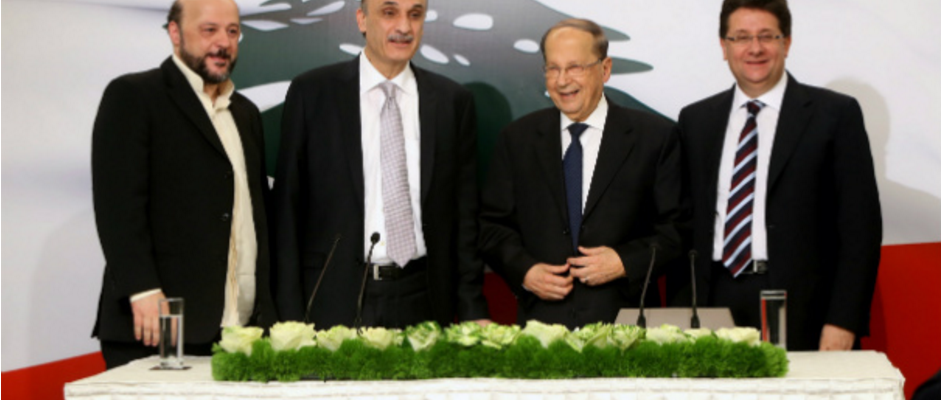
Aoun Geagea Kanaan Riachi 18 January 2016

The following analysis was first published in Sada on February 2, 2016.

After surprising developments in November, Saad Hariri of the March 14 alliance’s Future Movement endorsed Sleiman Frangieh of March 8’s Marada Movement for president, bypassing March 8’s favored candidate, Michel Aoun. Hariri’s support for Frangieh—who had previously indicated he would not stand in the way of Aoun’s candidacy before he announced his bid on December 17—was meant to drive a wedge between members of the March 8 alliance, but is now backfiring on Hariri’s own March 14 alliance.

March 14 was endorsing its own candidate, Samir Geagea of the Lebanese Forces (LF). However, Hariri endorsed Frangieh, seeking to showcase him as a consensual candidate from the very heart of March 8—and attract parties from all sides to a possible deal without granting a victory to Aoun’s Free Patriotic Movement (FPM). Initially, the strategy appeared to work: at first, March 8’s Amal Movement and the independent Progressive Socialist Party (PSP) rallied around the new bid. Meanwhile the FPM was left blindsided as Aoun suddenly appeared a less serious candidate than Frangieh, formerly a junior ally from the weakest of the four main Maronite parties. Moreover, by supporting Frangieh, the Future Movement was trying to lure Hezbollah away from Aoun. They hoped that open support for Frangieh, who has close ties with the Syrian regime, would encourage Hezbollah to switch its votes toward Frangieh and in so doing destroy the Hezbollah–FPM alliance that forms the cornerstone of the March 8 coalition.

But realizing that support for Frangieh would have shattered their ties with the FPM and discredited the party in Christian popular opinion, Hezbollah stood with Aoun. Instead, Hariri’s endorsement of a March 8 candidate drove wedges within his own March 14 alliance. The Lebanese Forces, the leading Christian party of March 14, saw Hariri’s act as a betrayal. Not only was the party humiliated when its ally endorsed a different candidate than Geagea, Frangieh’s strong backing in northern Lebanon would threaten the LF’s influence in its most important region. The LF, and Geagea himself, retaliated by endorsing Aoun—a wartime rival—keeping Geagea’s 2007 promise that if it came to it, he would “preserve his Christian credibility by breaking with Hariri” rather than support a “weak figure” for president.

While Geagea’s endorsement of Aoun is a huge moral boost for the latter’s presidential bid, it is in fact of little practical significance. The Lebanese Forces have only 8 MPs—with Frangieh abandoning support for the Aoun candidacy, Aoun loses the 3 MPs from the Marada Movement and is in the end only getting 5 more votes. As Aoun is 81 years old—and Gebran Bassil, his recently appointed political heir, has twice in a row lost parliamentary elections in his home district of Batroun to the LF’s Antoine Zahra—an alliance between the LF and FPM would make Geagea the natural presidential favorite for the next presidential elections.

Geagea’s endorsement of Aoun was also driven by concerns over the LF’s parliamentary clout. The Lebanese Forces, though the second-largest Maronite party after the FPM, commands only 8 out of 128 MPs in parliament and had limited leverage when it came to Lebanese politics. For the past ten years, they had relied on their alliance with the much larger Future Movement. So when the Future Movement abandoned the Geagea candidacy, it was clear that the alternative is to enhance their parliamentary share through a potential alliance with the FPM. While it is still too soon to know if the presidential endorsement will effectively turn into an electoral alliance, such a move could benefit both parties in the next parliamentary elections if they unite against the other Maronite lists.

The goal of Hariri’s endorsement was to bring down the March 8 alliance, but instead, the three biggest parties of the March 14 alliance are now divided. The Lebanese Forces party is supporting Aoun, the Future Movement is supporting Frangieh, and the Kataeb Party is refusing to support either of them. It is now too late for the Future Movement to endorse Geagea again, who formally dropped his candidacy when he backed Aoun’s bid, and Frangieh is refusing to withdraw from the race unless the Future Movement endorses Aoun. By contrast, the main alliance of March 8 is still holding together—at least for now. Nasrallah’s speech on January 29 reiterated Hezbollah’s support for Aoun, and the party has not lost its ties with the FPM. Though the Amal Movement’s stance is still unclear, these other two largest March 8 parties remain united.

Aoun, Geagea, and Hezbollah are now on one side of parliament, with Frangieh and Hariri on the other side. In the middle are parties like the PSP, who went back to endorsing their original candidate, Henri Helou, and the Amal Movement, which has yet to make a formal endorsement. This means that Aoun’s bid is not yet certain to gather the absolute majority in parliament. Without these 65 votes guaranteed, presidential politics go back to square one.


Frangieh, Aoun and WikiLeaks

Free Patriotic Movement leader Michel Aoun (L) meets with Marada Movement leader Sleiman Frangieh in Rabieh, Wednesday, June 11, 2014. (The Daily StarFPM office, HO)

Free Patriotic Movement leader Michel Aoun (L) meets with Marada Movement leader Sleiman Frangieh in Rabieh, Wednesday, June 11, 2014. (Image credits: The Daily Star / FPM office, HO)

This is the 13th post in a series of monthly posts covering (forgotten/ignored) WikiLeaks cables about Lebanon.

With Geagea’s official withdrawal from the presidential race and his endorsement of Aoun, Lebanon’s presidential politics is now revolving around an awkward confrontation between two (former?) allies, Michel Aoun – supported by the FPM, the LF and Hezbollah – and Sleiman Frangieh – supported by the Marada, the FM (and Amal? ?? ???).

Since none of the two candidates can gather enough votes to win an absolute majority, and since Frangieh is refusing to withdraw for Aoun unless the FM supports Aoun, Lebanese politics are probably going back to square one: No quorum, adjourned presidential sessions, and a record-breaking vacancy.

On the bright side,  the new presidential competition between Aoun and his minor (former??) ally Frangieh is an opportunity to see how the FPM and the Marada viewed each other before this rift happened, which is why this post is a mini-compilation of the most relevant parts of three WikiLeaks cables where Marada officials talk about Aoun and FPM officials talk about Frangieh (you might also like this other WikiLeaks compilation where Aoun talks about Geagea and Geagea talks about Aoun).

“Basile said that the Free Patriotic Movement (FPM) of Michel Aoun will work with Franjieh, but the FPM does not consider this new party to be its formal ally”

(This Sunday is valentine’s day so I figured it was also an opportunity for all of us to understand how Lebanese politicians friendzone each other)

So yeah, you should read the cables (Don’t forget to check their dates)

Enjoy.

MGLE01: SLEIMAN FRANJIEH ANNOUNCES “MARADA,” A NEW PARTY WITH AN OLD FACE
2006 June 12, 15:02 (Monday)
06BEIRUT1892_a

4. (C) Michel Aoun aide Gebran Basile attended the rally. He told us he was impressed by the turnout and by the positive remarks with which Franjieh opened the event. Although Franjieh was also marking the anniversary of the June 13, 1978 slaughter of his family, he avoided using the murders as a political device. Basile said that the Free Patriotic Movement (FPM) of Michel Aoun will work with Franjieh, but the FPM does not consider this new party to be its formal ally. He admitted that Franjieh, with his political background and heritage, is a strong friend of Michel Aoun. Moreover, Basile added, “he has learned a lot from us.”

7. (C) Aounists tell us that they do not consider Franjieh an ally, just a friend with common goals. When Franjieh first broached the idea of starting his own party PolChief asked him why he did not simply join Michel Aoun’s party. Franjieh balked at the idea of associating himself with another leader, even one with whom he agrees. End comment.

LEBANON: MARADA FAVORS EDDE OR SLEIMAN
2007 November 26, 04:54 (Monday)
07BEIRUT1857_a

(Sorry if I’m pasting the whole cable, but this one is very, very important)

SUMMARY

——-

1. (C) Marada leader Suleiman Franjieh supports Michel Edde as president, but stresses the need to get Free Patriotic Movement leader Michel Aoun on board and to find a candidate who can safeguard Hizballah’s interests. He suggests that, if a consensus is not reached, Lebanese Armed Forces Commander Michel Sleiman should head a transitional government until new parliamentary elections are held. Franjieh dismisses the possibility of a second government or opposition-initiated violence, claiming the opposition would not oppose the Siniora government as long as it kept a low profile. End summary.

2. (C) The Ambassador, accompanied by Pol/Econ Chief and Senior FSN Political Advisor, met with Marada leader Suleiman Franjieh at his Swiss Chalet home in Bneshay on November 21. Franjieh advisors Stephan Doueihy, Raymond J. Araygi, and Richard Haykal (AmCit) also attended the one and a half hour meeting. The Ambassador opened the meeting, his first with Franjieh in over six months, stressing full U.S. support for the French initiative to find a consensus candidate. However, it appeared that March 8 was blocking progress more than March 14. The U.S. hoped to see a president before the midnight November 23 expiration of President Lahoud’s term, he said, warning there would be consequences for any party that attempted to undermine PM Siniora’s government.

IF NOT EDDE, THEN SLEIMAN

————————-

3. (C) Franjieh, commenting that the Patriarch’s list had more pro-March 14 names than pro-March 8, said the opposition would not accept a March 14 candidate or even one close to March 14. It is looking for a candidate who will reassure Hizballah, satisfy all groups in the opposition, and not pose a serious threat to the popularity of Free Patriotic Movement leader Michel Aoun. Aoun must be on board, he stressed. Otherwise, Aoun could make a deal with Hariri and leave the rest of the opposition out.

4. (C) Franjieh claimed the opposition would support a consensus candidate. Michel Edde is the only feasible consensus candidate on the Patriarch’s list, he argued, since he satisfied both Hizballah and the international community, was a friend to March 14, and did not pose a threat to Aoun. The Christians would not be happy with a weak Edde presidency, but the more Aoun was on board, the easier it would be. The opposition supported Edde’s candidacy because it views him as being equal distance from all parties, unlike Robert Ghanem, whom most of the opposition viewed as a March 14 figure. The opposition does not want to obstruct an agreement over the presidency, Franjieh claimed; if majority leader Saad Hariri refuses Edde’s candidacy, he will bear the responsibility for the failure to elect a consensus president.

5. (C) As for Aoun’s own candidacy, Franjieh said he believed Aoun was convinced he has no chance to become president, and that he would not be surprised to see Aoun move towards a consensus candidate. Franjieh was working on Aoun to accept Edde, he said, asking that we not share this information with Aoun himself, but Aoun was an “extremely difficult personality.” You’ve studied his psychology, he said; only Aoun can influence Aoun. He works on an action/reaction dynamic, and pushing him too hard on Edde could backfire. “We are more than halfway,” he said, saying we should see more flexibility from Aoun in the coming days. (Note. The following day Aoun announced an initiative whereby he would nominate a non-March 8 president and the majority would nominate a non-March 14 prime minister. March 14 promptly rejected the initiative. As of November 25, we understand that Aoun is now cooking up a new initiative. End note.)

6. (C) Franjieh recognized that the March 14 majority would determine the next prime minister, but the opposition would attempt to get the maximum out of the new cabinet and would use this a leverage in negotiations over the presidency. The next government should be a national unity government, he BEIRUT 00001857 002.2 OF 002 said, and the president will be the referee between the two camps.

7. (C) If a consensus could not be reached, Franjieh proposed a transitional solution in the form of a national unity government whose primary goal would be to amend the electoral law and hold early parliamentary elections. Lebanese Armed Forces (LAF) Commander Michel Sleiman would be a good candidate to head this transitional government.

FRANJIEH PREDICTS NO SECOND GOVERNMENT, NO VIOLENCE, AFTER PRESIDENT LAHOUD LEAVES OFFICE

——————————————— —-

8. (C) Franjieh said President Lahoud would not appoint a second cabinet before stepping down. He hinted that the opposition might work with the Siniora government (which, under the constitution, assumed presidential powers as of the midnight November 23 expiration of Lahoud’s mandate) as long as it keeps a low profile and avoids taking major decisions such as appointing a new LAF commander or changing the LAF’s mission statement, in which case the LAF would split.

9. (C) In response to the Ambassador’s question on the possibility of armed conflict, Franjieh said Marada, like everyone else, had the right to defend itself. However, it would be in reactive mode and would not initiate anything, though he would not rule out the possibility that the opposition might support any street demonstrations that occur in protest of low wages or other related socioeconomic issues. It depends on “them,” he said, warning that if March 14 decided to proceed with a half plus one vote, however, there would be a “big problem.” The status quo was “easier” than a half plus one president, he said. Conflict was a “last resort,” and Franjieh hoped that “they” would not push the opposition into a corner, forcing them into conflict. The opposition would then take all steps to preserve its interests, he warned, but it was not looking for riots or violence.

FELTMAN

LEBANON: OPPOSITION MARADA LEADER CALLS FOR DIRECT TALKS WITH ISRAEL
2008 October 29, 12:20 (Wednesday)
08BEIRUT1538_a

10. (C) Franjieh, commenting that everything is Lebanon was already focused on the Spring 2009 elections, said that the only real contests would be in the Christian areas. Franjieh denied any differences between his Marada party and Aoun’s Free Patriotic Movement, explaining that, at the end of the day, his goal was to work for his community. Because Aoun represented the majority of Lebanon’s Christians, he needed to work with him as well, since together the opposition Christians held 22 seats in parliament. (Note: Marada holds none of those seats. End note.)

14. (C) The Ambassador asked what Zghorta Christians had in common with Aoun’s ally, Hizballah, especially after Hizballah killed fellow Lebanese during the May crisis. Franjieh, claiming he opposed any use of Hizballah’s arms within the country, nevertheless justified its actions in May, arguing that its existence was threatened by the government’s attempt to close down its telecommunications network. The government was testing the waters, he explained, to see how Hizballah would react. Moreover, he claimed outrageously, someone had convinced Saad that this would provoke a short civil war that would result in international intervention that would bring the international community back on board with March 14.

15. (C) The opposition Christians, including Aoun, had tried to ally with the Sunnis in the past, he continued, but were frustrated by Saad’s efforts to impose his own Christian candidates (e.g., Ghattas Khoury). Furthermore, the Sunnis accused Marada and others of killing former PM Hariri and of being Syrians and Iranians, which ultimately pushed them toward Hizballah. Franjieh claimed he had not even met Hizballah SYG Nasrallah until one month before the 2005 elections, but noted that both sides were united in their support to create a new electoral law along the lines of the 1960 law, which was based on smaller “qada” that would benefit Marada by removing the ability of Sunni voters to decide candidates in Christian areas.

Before the Christian Wedding: Aoun and Geagea on WikiLeaks

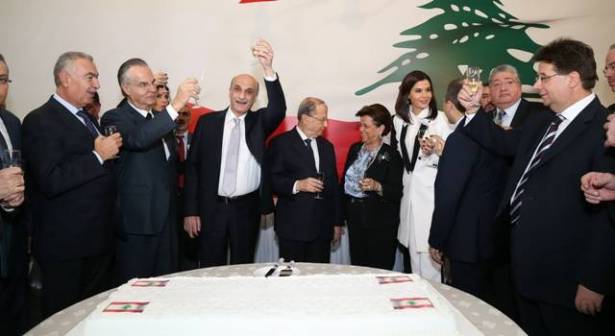
Samir Geagea (C-L) welcomes Michel Aoun (C-R) to his headquarters in Maarab, north-east of Beirut, on January 18, 2016. Aldo Ayoub, Lebanese Forces, AFP

Samir Geagea (C-L) welcomes Michel Aoun (C-R) to his headquarters in Maarab, north-east of Beirut, on January 18, 2016. Aldo Ayoub / Lebanese Forces / AFP

This is the 12th post in a series of monthly posts covering (forgotten/ignored) WikiLeaks cables about Lebanon.

Samir Geagea’s endorsement of Michel Aoun as the Lebanese Forces’ official candidate is Lebanon’s political development of the month – arguably the year. And while Lebanon’s biggest parties are yet to take the final stance on the issue, I thought it would be nice to look at the evolution of the Geagea-Aoun ties from a different point of view, via the WikiLeaks cables.

This post is a compilation of WikiLeaks cables where Aoun discusses Geagea, and Geagea discusses Aoun (there are far more cables of Geagea discussing Aoun for the simple fact that Geagea speaks to the American ambassador a lot more than Aoun). I have only kept the Aoun-Geagea parts of the cables (that I found by searching “Aoun Geagea” and then looking at the most 160 relevant results) and you can check the full cables by looking them up (using their canonical ID) on WikiLeaks.

If you think that it is useless to look at more than 30 outdated WikiLeaks cables where Geagea says that Aoun is arming the FPM and Aoun says that he was not March 8 and was forced to go there, let me correct you with one quote:

But, Geagea warned, if he has to choose between backing a weak figure like Robert Ghanem to preserve March 14 unity or preserving his Christian credibility by breaking with Hariri over a bad presidential choice, he will chose the latter. Geagea said that he would have no choice but to build an alliance with Aoun“- November 9, 2007.

Perhaps Hariri should have paid more attention to what his main Christian ally was telling the American ambassador…

FOCUS ON THE DATES – I organized the cables by chronological order. Enjoy.

LEBANON: JA’JA’ BRINGS IDEAS DOWN FROM THE MOUNTAIN
2007 January 18, 16:57 (Thursday)
07BEIRUT97_a

5. (C) One thing that would break the Christians and March 14 would be a compromise in the presidency, Geagea said adamantly. Why, he asked, should there be a compromise in the presidency, rather than a compromise speaker or prime minister? Geagea had given some thought to allowing Aoun to become president, but said that there is no way to know which way Aoun would go after reaching that overriding goal. He said that Aoun obviously prefers chaos to losing the presidency, and that he might push for violence without clearly understanding the results. Saying that he had been approached with the idea of allowing Aoun the presidency by both Jumblatt and Hariri, he had made it clear that he would not support it, and was assured that it would not be proposed by either without further discussion with Geagea. In this light he pointed out that paradoxically, Amal and Hizballah are currently “allies in non-violence.”

10. (C) Geagea reported that he is not talking to Aoun or his followers — he says that Aoun has no advisors, only followers — very much lately. This is because Aoun’s situation has become critical and Geagea does not wish to resuscitate Aoun’s declining political fortunes. Geagea believes that Aoun will find someone to run in the Metn by-election against former President Amine Gemayel, although it is difficult to see how Gemayel could lose. Aoun really believes that his candidate will win, which is further proof that his poor judgment carries a high risk for the country. As for Speaker Berri, he is “shy” and won’t meet, even declining a ceremonial visit by Geagea on the recent Muslim Eid holiday. Berri said he was not receiving visitors.

LEBANON: LEBANESE FORCES’ GEAGEA BELIEVES CIVIL WAR IS CLOSE
2007 February 12, 17:01 (Monday)
07BEIRUT229_a

9. (C) According to Geagea, Aoun can now go in either of two directions: one is to dialogue without street action; the other is to arm his people. Syria is telling Aoun that they could provide him the arms and officers to train and fight alongside his people. Aoun is inclined to stick to the first choice of dialogue, but will ask the GOL for a license for his supporters to carry arms. Aoun is said to have gathered his people after January 23 and to have told them they did not do their job adequately in rallying the masses. He then replaced a few of his top lieutenants, moving out some and putting in their places former military officers. Geagea described Aoun as uncompromising, uwilling to listen BEIRUT 00000229 003 OF 003 to his close advisors, and acting only on what he thinks will take him closer to his goal of becoming president. Aoun finds himself in the midst of his own Greek tragedy: he knows he will not become the next president, and yet is spending all his efforts in trying to reverse the current situation in a last-ditch effort to become president.

LEBANON:SAMIR GEAGEA ON THE TRIBUNAL, BOLSTERING MARCH 14, AND PRESIDENTIAL ELECTIONS
2007 April 27, 15:06 (Friday)
07BEIRUT602_a

9. (C) Geagea argued in favor of his getting together with Michel Aoun to discuss presidential candidates. Geagea noted that Aoun’s participation is perferable because, despite his waning popularity, Aoun will still have at least 20 percent support after the presidential election. Certain groups around Aoun will never support March 14 or the Lebanese Forces. He commented that the other sects could not oppose any candidate supported by both Aoun’s Free Patriotic Movement (FPM) and the LF, the two dominant Christian groups. Geagea said his own people and Aoun’s maintain contact at a low level. He believes that some of the FPM members are not happy with Aoun’s policies. Both the Ambassador and Geagea agreed that Aoun is probably not getting from his own team a true picture of his diminished support. Geagea agreed that the chance for success in getting Aoun to pick another presidential candidate other than himself, in agreement with the LF, might be slim, but it is worth trying.

GEAGEA’S PLAN FOR SELECTING THE PRESIDENT

—————————————–

10. (C) Geagea noted that while Maronite Patriarch Sfeir is likely to push for presidential elections, the Patriarch will not name his preferred choice nor help negotiate on candidates among the factions. Geagea plans to select one or two candidates * preferably people both he and Aoun can agree on * and then quietly vet the names with the Patriarch. Once Patriarch Sfeir knows (and approves) of the

BEIRUT 00000602 003 OF 003

candidate, Sfeir will become even more vocal in calling for presidential elections, unofficially signaling his support. Geagea thinks this will have the dual effect of getting the Patriarch’s “unofficial” blessing for the March 14 candidate and, if Aoun is still allied with the opposition, embarrass Aoun. After Geagea has vetted candidates with the Patriarch he will discuss them with his 14 March allies, who will be unlikely to go against a candidate supported by the Patriarch.

10. (C) Geagea does not expect to implement his plan anytime soon because he wants to give Aoun time to switch alliances or negotiate candidates with Geagea before March 14 enters into its candidate selection process. He noted that, for now at least, it is unlikely Aoun would be willing to break with Hizballah and ally with March 14. Perhaps closer to the elections ) as Aoun realizes he will lose more credibility and support if he opposes presidential elections as Geagea expects the opposition to do – he may decide to join the majority as a last chance to maintain some political influence.

LEBANON: GEAGEA FOCUSES ON ELECTIONS WITH A/S WELCH
2007 May 17, 16:52 (Thursday)
07BEIRUT698_a

3. (C) Geagea has tried to discuss presidential candidates with Christian politician General Michel Aoun on several occasions, but the General refuses to engage in any dialogue that does not have him as the only potential candidate. The General, as president, is an “impossible” outcome for Geagea. He plans to continue pushing Aoun to agree on a (non-Aoun) candidate. Geagea commented that Aoun’s public attacks against him and Druze leader Walid Junblatt have become less frequent. He believes that Aoun’s criticism drew attention to Geagea’s prominent position in the March 14 coalition and debunked Aoun’s claim that March 14 Christians are subservient to the coalition’s Muslims (a rallying cry Aoun has used to scare Christians to his side). Asked about Aoun’s seemingly large financial base, Geagea claimed he has heard rumors of Qatari funding for the General’s nascent “Orange TV” station.

LEBANON: GEAGEA OUTLINES MARCH 14 PRESIDENTIAL ELECTION STRATEGY
2007 August 6, 05:21 (Monday)
07BEIRUT1178_a

4.(C) Under this scenario, there would be three declared candidates: two from March 14 and General Michel Aoun, the candidate of the March 8 opposition. Geagea urged that the U.S. treat all candidates, including Aoun, equally. For example, any USG official who comes to Lebanon during the election period should meet all three. Stressing the importance of not cold-shouldering Aoun, Geagea said this was the way for the U.S. to acknowledge that pluralistic democracy in Lebanon was functioning as it should. While it was important for the U.S. to publicly support Aoun’s candidacy, privately it could pressure Aounist MP’s by suggesting, for example, that they might be placed on the U.S. visa ban list. The U.S. should concentrate on building momentum for elections, leaving it up to March 14 MPs to ensure that a candidate committed to March 14 policies emerges as the winner.

LEBANON: GEAGEA CHARTS MARCH 14 ELECTION COURSE, HINTS AT DANGERS AHEAD
2007 August 31, 15:30 (Friday)
07BEIRUT1342_a

5. (C) Terming Hizballah “the master of the game,” Geagea asserted that armed Hizballah members and their supporters were preparing for armed clashes should they see that March 14 is determined to proceed with the election with only a simple majority. Furthermore, according to Geagea, opposition candidate Michel Aoun’s supporters all over Lebanon were preparing themselves for confrontation, with about 1000 receiving military training in the Biqa’–a dangerous development, as it would be the first time Aounists resorted to arms.

SAMIR GEAGEA ON AOUN’S ARMS, PRESIDENCY
2007 September 18, 12:48 (Tuesday)
07BEIRUT1435_a

3. (S) Geagea said that Hizballah is being careful to avoid direct military support to Aoun, which, if discovered, would discredit Aoun with the Christians and Hizballah (with its claims that its arms are directed against Israel only) more generally. Instead, Hizballah is providing arms to Franjieh. Franjieh then opens his arsenals to Aoun, making the arms transfers, if leaked, appear to be one Christian opposition leader helping another with personal protection. One of the main recipient of the arms from Franjieh is MP Selim Aoun, an Aoun bloc MP on Ily Skaff’s Zahleh list. Selim Aoun is charged with distributing the arms to others in the Aoun camp and has established strategically located cells of 50-70 fighters each. Franjieh is providing some of the training facilities and has recently opened Marada offices far beyond its Zghorta headquarters in order to serve as rallying and training points as well as safehouses. Zahar al-Khatib plays a key training role of Aounist fighters, again in order to keep Hizballah somewhat at arms distance from Aoun.

LEBANON: GEAGEA: WHAT IS HARIRI COOKING UP?
2007 September 30, 12:07 (Sunday)
07BEIRUT1512_a

3. (C) Geagea explained Free Patriotic Movement (FPM) leader General Michel Aoun’s recent about-face (reftel) as an effort to win new allies after his first strategy, wearing his opponents down by force and threats of chaos, failed. Moral in Aoun’s circle is down, he said. Recognizing the writing on the wall, i.e., that Amal, Hizballah, and perhaps even Syria are looking for a consensus candidate for the presidency, Aoun realizes that to salvage any chance he has of becoming that candidate, he has to mend fences with March 14. He is therefore opening up “tous azimuts” — or in all directions. Aoun will only accept a candidate other than himself if he realizes he has no hope and March 8 is unwilling to go the route of chaos (i.e., a vacuum or two government scenario).

5. (C) Geagea dismissed the Ambassador’s last concern, noting that building bridges had never been Aoun’s forte; on the contrary, his constantly shifting alliances only revealed that he is willing to negotiate with the devil to achieve his personal ambitions. Geagea agreed, however, that over half of Lebanese Forces Christians would (despite decades of antipathy) like to see a reconciliation with the FPM as a way to build Christian strength and solidarity.

7. (C) Geagea, pondering for a moment with his chin resting in his hand, stated, “this is bizarre.” Why did Aoun see UN Envoy for Lebanon Geir Pederson three times this week? he asked aloud. The Ambassador responded that, according to Pederson, Aoun was “in love” with March 14. It’s the only way we can change him, Geagea countered, otherwise he will “float again.” As he had always told Saad Hariri, getting Aoun’s agreement on a consensus candidate would be a good thing for March 14.

13. (C) Moving to a one-on-one conversation with the Ambassador while pacing in his driveway, Geagea said that the real problem is that both Hariri (who genuinely wants Nassib Lahoud) and Syria (who hopes for LAF Commander Michel Sleiman as president) have zeroed in on Robert Ghanem as their fall-back choice. Both Hariri and Syria want a weak president, easily manipulated, and they will end up sharing Ghanem between them, Geagea said. Ghanem has no significant Christian support, meaning that independent Christians will once again feel cheated out of an office that is their right. This sense of alienation will drive them back into the arms of Michel Aoun, and the resurgent Aoun will humiliate and marginalize March 14 Christians, who will have gained nothing from their alliance with Hariri. Geagea admitted that his outreach to Aoun was in part designed to create a unified Christian veto against Ghanem.

LEBANON: GEAGEA SUSPECTS A EUROPEAN PUSH FOR SLEIMAN
2007 October 23, 07:06 (Tuesday)
07BEIRUT1656_a

6. (C) Geagea acknowledged that there is movement within the Aoun camp, with Michel Aoun reportedly “perplexed” (a word Geagea also used in describing others). Geagea reported that at the meeting with the EU foreign ministers at the French residence, Free Patriotic Movement leader General Michel Aoun appeared desperate for his own candidacy, speaking little and in a restrained voice. Given Geagea and Aoun’s shared disinterest in Sleiman, the possibility of Sleiman as the European choice prompted Geagea to dispatch LF vice-president George Adwan to meet Aoun the day after the meeting with the FMs. (Note: While Geagea has in the past several weeks used intermediaries to pursue contact with Aoun, sending Adwan is a marked rise in rank. End note.)

7. (C) Geagea maintained that Aoun still harbors hopes. He said that Aoun needed to be told directly that he will not be the next president, and that Aoun’s advisors will never do this. Geagea dismissed the oft-repeated rumor on the Beirut political gossip circuit that he had actually offered Aoun the possibility of naming the candidates, with March 14 electing one of Aoun’s choices (as long as it precluded Aoun himself). What he actually offered, Geagea said, was the possibility to Aoun that the two of them decide together who would be acceptable candidates. Parliament would elect a president off of a list determined by Geagea and Aoun, who represent an estimated 90 percent of Lebanon’s Christians. But Aoun refused to go along with this suggestion.

LEBANON: AOUN, CLAIMING THE ABILITY TO BOSS NASRALLAH AROUND, RELUCTANT TO DISCUSS FALL-BACK TO PRESIDENCY
2007 October 26, 14:05 (Friday)
07BEIRUT1678_a

9. (C) Aoun predicted that these Aoun-March 14 contacts would not produce results. He expressed a willingness to deal constructively with Saad Hariri, but only after Saad “shows that he’s serious.” Describing at length a series of BEIRUT 00001678 003.2 OF 005 half-hearted and aborted attempts at an Aoun-Hariri face-to-face meeting, Aoun pronounced that Hariri “doesn’t know what he wants. When he does, he knows where I am.” As for Walid Jumblatt, Aoun said that he would not see him until he toned down his anti-Hizballah rhetoric. If Aoun saw Jumblatt now, he would harm his position in the Shia community and gain nothing in return. Moreover, Aoun said, “I am still waiting” for Jumblatt to visit him after Aoun’s May 2005 return from exile. “Let him come see me,” Aoun concluded. As for Samir Geagea, Aoun gave a wordless dismissive flick of the hand. The meeting earlier in the week with former President Amine Gemayel “was not serious.”

LEBANON: GEAGEA WARNS OF DANGEROUS GAMES, AND IS PLAYING ONE OF HIS OWN
2007 November 9, 14:21 (Friday)
07BEIRUT1760_a

16. (C) Geagea said Aoun had called him the previous Saturday suggesting a meeting, to which Geagea replied he was welcome any time (i.e., at Geagea’s residence in Maarab). Aoun reportedly didn’t accept, suggesting the Patriarch’s residence in Bkirke instead. Geagea agreed, but then Aoun did an about-face and insisted on his residence in Rabieh. Suleiman Franjieh, meanwhile, told Geagea the week before that he was ready to meet at Bkirke, presumably as a knee-jerk reaction to Aoun’s meeting with March 14 MP Samir Geagea, his cousin and arch-rival. Franjieh then suddenly changed his mind, due, Geagea guessed, to Syrian opposition.

17. (C) Does Aoun recognize that he won’t be president, the Ambassador asked. Yes and no, Geagea replied; “he will fight until the end.” Then he risks losing everything, the Ambassador pointed out. That’s your calculation, Geagea responded, Aoun doesn’t calculate.

19. (C) But, Geagea warned, if he has to choose between backing a weak figure like Robert Ghanem to preserve March 14 unity or preserving his Christian credibility by breaking with Hariri over a bad presidential choice, he will chose the latter. Geagea said that he would have no choice but to build an alliance with Aoun, lest all of his followers shift to Aoun on their own. “You have to work on Saad,” Geagea said. “Convince him that he can’t ignore his Christian partners,” persuade him that, in the Sunni struggle against Hizballah, Hariri will need the Christians on his side. “Thank God for Walid,” Geagea commented, referring to Jumblatt remaining steadfast in his support of a strong, credible President. Geagea lamented that Hariri is so ready to abandon the “half plus one” electoral strategy, when that may be the only option to get a strong candidate with Christian credibility who is not Michel Aoun.

LEBANON: AOUN CLAIMS TO DROP OUT OF PRESIDENTIAL RACE
2007 November 10, 10:24 (Saturday)
07BEIRUT1764_a

6. (C) Aoun, claiming he was more March 14 than many from March 14, said he did not need to defend himself. I want to be neutral, he claimed, saying he was not March 8; they forced him there. He had tried to build national support by finding a way to rein in Hizballah, but his attempts were misunderstood and now seemed like a bad move. Maybe I didn’t convince people, he said, if so, I assume the responsibility. Let Samir Geagea and Walid Jumblatt figure out to make Lebanon free and independent, he said, predicting that, with Aoun out of the picture, Hariri would need a minimum of understanding with Hizballah to avoid a confrontation.

LEBANON: GEAGEA AGAINST LAF COMMANDER SLEIMAN FOR PRESIDENT
2007 November 26, 16:45 (Monday)
07BEIRUT1865_a

8. (C) In response to the Ambassador’s inquiry, Geagea said that head of Free Patriotic Movement Michel Aoun would not be able to discredit a president elected by a half plus one majority because such a president would be a strong president, assuming that the U.S. got the Arab and European states behind him so strongly that Syria and its allies would accept him as inevitable. In fact, Geagea added, a strong candidate would split Aoun’s bloc because its members place a high priority on getting a president in Baabda and some MPs could abandon Aoun to win favor with whomever is in power. If Aoun sees that March 14 is serious, he would be more concerned about securing his own role and that of his bloc in the cabinet, than about denouncing the president, surmised Geagea.

LEBANON: GEAGEA PUTTING THE BRAKES ON SLEIMAN PRESIDENCY?
2007 November 30, 07:58 (Friday)
07BEIRUT1897_a

4. (C) Saad is naive, Geagea complained; he thinks if someone is friendly toward his family, they’re a good choice. If that better gets along with Hizballah, even better. Saad doesn’t want problems with Hizballah, he just wants to keep things as they are. You can’t play politics with this! Geagea exclaimed. Although Geagea agreed that electing Sleiman would diminish Aoun’s support, he warned that Sleiman would be too busy focusing on Christian-Christian relations to deal with important issues like border control and Hizballah’s arms. We want a commander who doesn’t meddle with us, he insisted, not someone who will use his position to build a political movement that will compete against us by bringing Aoun supporters on board.

LEBANON: WITH A/S WELCH, GEAGEA PRESSES HALF PLUS ONE
2007 December 17, 18:21 (Monday)
07BEIRUT1971_a

14. (C) Geagea noted, however, that it was important to respect Sleiman, and therefore wait until after December 31 to pursue a half plus one majority. He said that March 14 leaders should communicate with Sleiman so that he understands that he cannot become president after that point. The next step, he continued, would be to elect a half plus one president and immediately move him into the presidential residence at Baabda. Such a move would prove invaluable in terms of securing Christian public opinion for March 14 and usurping public opinion from Free Patriotic Movement leader Michel Aoun. Geagea believed the Patriarch would welcome the new president and a majority of the population would follow suit.

LEBANON: GEAGEA PLEASED WITH 2/14 RALLY, PLEADS PLIGHT OF CHRISTIANS
2008 February 15, 18:47 (Friday)
08BEIRUT255_a

6. (C) Asked whether the Arab League initiative would succeed, Geagea responded with a short, “No.” Syria does not want a presidential election, he added. This was clear from Amr Moussa’s last meeting when Hariri asked whether, if March 14 accepted a 10/10/10 cabinet, the opposition would agree to holding the election. This surprised Aoun, whose answer was no, Geagea claimed, prompting Moussa to ask Aoun how he could say no when Berri had said yes. Berri and Aoun then spoke privately, after which Aoun said “maybe” if additional conditions on cabinet portfolios were agreed. Aoun’s position is rigid, Geagea agreed; it is not based on strategic calculations but rather on one his desire to be president.

LEBANON: GEAGEA PROPOSES REVAMPING GOVERNMENT WITH CHRISTIAN MINISTERS
2008 March 4, 16:13 (Tuesday)
08BEIRUT331_a

6. (C) Revisiting Moussa’s most recent attempt at negotiations, Geagea said electoral reform remains an obstacle, even within March 14. Geagea is calling for proportional representation, a system he argues would advantage March 14 Christians and break Hizballah strongholds. Moreover, he added, proportional representation would divide Free Patriotic Movement Michel Aoun’s opposition bloc by at least 50 percent. Another advantage could be the election of March 14 Shia MPs, he posited. However, he acknowledged, some of Saad Hariri’s MPs may lose and Jumblatt would need convincing, and requested that the U.S. urge them to support proportional representation.

LEBANON: WITH A/S WELCH, GEAGEA ADVOCATES EARLY PARLIAMENTARY ELECTIONS
2008 April 22, 13:58 (Tuesday)
08BEIRUT546_a

12. (C) Third, March 14 should convince members of the Armenian Tashnaq party to break its alliance with Free Patriotic Movement leader Michel Aoun. Geagea remarked that Aoun is in deep trouble because of internal dissent in his party and he is trying to do whatever he can to divert attention away from his problems. Geagea suggested that the Armenian Tashnaq are a way to counter Aoun, adding that since MP Michel Murr’s split with Aoun, it will be easier to move Tashnaq from Aoun. Nevertheless, Geagea predicted, it will not be simple because Tashnaq inexplicably clings to Aoun. Geagea quoted the Tashnaq as saying that “elections-wise, we are allied with Murr, and politically, we support Aoun.”

LEBANON: AOUN WILL GO TO DOHA; INSISTS ON NATIONAL UNITY GOVERNMENT
2008 May 15, 19:35 (Thursday)
08BEIRUT697_a

2. (C) Charge Sison, accompanied by A/DCM and DATT, met with Free Patriotic Movement leader General Michel Aoun at his office in Rabieh on May 15. Aoun confirmed that he would attend the National Dialogue meeting beginning May 16 in Doha, although he expressed unspecified concerns with the draft Arab League communique. Absence is never justified, he stated. Aoun further said that he did not like the formula of the Dialogue (involving the 14 top political leaders — the same formula used in the 2006 Dialogue), elaborating that he believed the number should either be increased or decreased. He complained that Christian leaders such as Phalange leader Amine Gemayel, Lebanese Forces leader Samir Geagea and Boutros Harb had little representation in parliament, and there should not be a majority of insignificant leaders present with only a few powerful opposition leaders. All the participants should have equal political weight, he argued. Nasrallah would not go to Doha, though he probably would send a representative, Aoun said. He was unsure whether Speaker Nabih Berri would attend, though Berri’s advisor later confirmed that Berri was going.

LEBANON: GEAGEA TELLS S/P GORDON MAINTAINING MARCH 14 MOMENTUM CRUCIAL AFTER DOHA
2008 June 4, 17:33 (Wednesday)
08BEIRUT840_a

5. (C) Geagea emphasized that PM Siniora really needs to appoint ministers that will solidify March 14 support, especially among Christians. Geagea said selecting “popular” Christians who will be seen as strong proponents for the Christian community is important. He pointed out that under the 16-11-3 cabinet agreed at Doha, (Ref A), the majority will get sixteen out of the thirty cabinet positions. Geagea asked, “why not make the selection of these cabinet positions count?” Geagea said now is the time to counter opposition MP Michel Aoun and his image as the “defender of the Christians,” and Siniora’s selection of strong Christians for the cabinet is the best place to start.

LEBANON: GEAGEA SAYS HIZBALLAH AND SYRIA DO NOT WANT FIGHTING IN THE NORTH
2008 July 2, 16:27 (Wednesday)
08BEIRUT962_a

10. (C) Recognizing that Free Patriotic Movement (FPM) leader Michel Aoun cannot “truly be broken” until the next parliamentary elections, Geagea was adamant that March 14 and President Michel Sleiman stop consulting with the opposition on the cabinet formation. Geagea, noting that Prime Minister Fouad Siniora fully agreed with him as of ten days ago, advocated that the majority move ahead with forming the cabinet, to include Aoun, without running every proposal by him.

LEBANON: GEAGEA WARNS DAS HALE THAT ISRAEL IS STRENGHENING HIZBALLAH, DESCRIBES MARCH 14 DIVISIONS
2008 September 2, 09:56 (Tuesday)
08BEIRUT1273_a

13. (C) At the close of the meeting, DAS Hale asked Geagea about General Michel Aoun’s popularity in Lebanon, and the nature of his relationship with Hizballah. Geagea said that Aoun is not as popular as one might think, that his popularity had actually reached a low. Nonetheless, he said Aoun will always have a base of supporters who will stay with him regardless of how he performs. Geagea said he thought Aoun was firmly allied with Hizballah. “I thought at first it was tactical, just to get the presidency, but now he is totally there.”

LEBANON: WITH DAS HALE, GEAGEA WORRIED ABOUT SYRIAN TROOPS AT BORDER
2008 October 8, 11:00 (Wednesday)
08BEIRUT1455_a

8. (C) Geagea reported that his efforts at Christian reconciliation, following his September 21 rally and public apology, were being stymied by former minister and MP and Christian rival Suleiman Franjieh. According to Geagea, Franjieh insisted that the reconciliation talks include his ally, Free Patriotic Movement leader Michel Aoun. Scoffing, Geagea reported that he refused the request, saying, “Even Aoun does not want to be there!” He suspected that Franjieh requested Aoun’s presence to ensure there would be “another heavyweight” in the room.

LEBANON: GEAGEA REJECTS TALKS WITH ISRAEL, PUSHES FOR SHEBA’A WITHDRAWAL
2008 November 24, 16:37 (Monday)
08BEIRUT1671_a

6. (C) Geagea said the university and professional association elections, while not a perfectly reliable representation of electoral trends, were still a valid indicator, and March 14 was doing well in them. He thought March 14 was making gains in public opinion, partly because Aoun was making speeches the Lebanese people could not understand, and making trips to Iran and Syria the Lebanese people do not like. Nevertheless, Geagea said his March 14 allies were causing problems. He alleged that Saad Hariri depended heavily on cash handouts to win influence which the public sees as bribery. Geagea also worried Hariri was too confident about his prospects in Tripoli, which Geagea said was “not locked up.”

LEBANON: GEAGEA DESCRIBES SLOW BUT STEADY PROGRESS
2008 December 30, 10:22 (Tuesday)
08BEIRUT1799_a

3. (C) Geagea averred that rival Christian leader and head of the Free Patriotic Movement (FPM) Michel Aoun’s November trip to Damascus had sapped his popular support. “Aoun is weak. The Christians can’t digest his embrace of Syria, especially his returning from Damascus empty-handed.” Geagea speculated that Aoun may believe the Syrians will help him win Christian seats in the south (Note: Aoun is allied with Amal in the South. End note.) by pressing Hizballah and Shi’a Speaker of Parliament and Amal party leader Nabih Berri to include FPM candidates on their slates in districts such as Zahleh and Marjayoun. “But I don’t understand this trip to Damascus, and I don’t understand why Hizballah isn’t giving him better guidance. They’re smarter than he is.”

LEBANON: GEAGEA SEES “MONKEYNESS” HURTING ELECTION CAMPAIGNING
2009 January 29, 15:59 (Thursday)
09BEIRUT125_a

4. (C) Admitting that the March 14 alliance was struggling to agree on hich candidates would run in each district (Ref A) Geagea insisted that their rival Aoun has “more problems.” In Zgharta, he illustrated, Franjieh formed his own list at the exclusion of any Aoun candidate, yet Fares Karam, an Aounie, reportedly is insisting on running. Aoun does not have any candidates in Akkar, Geagea said, and is competing with the SSNP for a slot on the list in Koura (Ref B).

5. (C) Aoun’s son-in-law, Telecommunications Minister Gebran Bassil, has still not decided whether he will run in Batroun, Geagea relayed, where independent candidates might take votes away from Bassil. Geagea said that in Batroun, the population equally divides its support among LF, Aoun, and MP Boutros Harb of March 14. Geagea described Jbeil district as supportive of President Michel Sleiman, rather than Aoun.

6. (C) Geagea said that independent candidates in Kesarwan — “those monkeys” — threatened both his and Aoun’s popularity. He criticized Mansour Ilbon for publicly attacking the LF and Kataeb, and said that Farid Haikal el Khazen was confusing because he is “pro-Syrian, anti-Aoun, and wants to be independent.”

7. (C) Geagea remarked that March 14 does not have a credible candidate to run against Agriculture Minister Elie Skaff in Zahle, who is allied with Aoun. Zahle MP Nicholas Fattoush, elected in 2005 on March 14’s list, was again a possibility for March 14, Geagea said, but he was “not liked” in his own district.

LEBANON: AOUN SETTING THE STAGE TO CHALLENGE ELECTION RESULTS?
2009 January 29, 15:27 (Thursday)
09BEIRUT124_a

7. (C) Aoun said that despite a “rather negative” relationship with independent Christian leader Michel Murr, he believed he might be able to come to some sort of limited agreement with the Murr family on parliamentary seats in the heavily Christian Metn district. He based this belief on a special bond he said he had formed with Murr’s son Elias, the current Defense Minister, when, according to Aoun, he “saved Elias from being executed by Samir Geagea.” (Note: Elias Murr was reportedly with Lebanese Forces leader Elie Hobeika in 1986, when LF rival Geagea sent fighters against Hobeika for participating in tripartite talks in Damascus with the Amal militia and Druze leader Walid Jumblatt. Aoun sent troops in to assist Hobeika and Murr. End note.) As a result, said Aoun, “we cannot be enemies.” While he stressed any accord would be very limited in scope, Aoun believed he could come to an agreement with Elias Murr.

LEBANON: MARCH 14 LOOKING STRONGER; OPTIMISTIC ABOUT ELECTIONS
2009 February 26, 17:32 (Thursday)
09BEIRUT233_a

12. (C) Geagea assessed that Syria and Iran were behind the BEIRUT 00000233 003 OF 004 recent souring of relations among Lebanese leaders. He accused Aoun of fomenting Christian fears of Sunni extremism, and generalizing the fear to the Sunni sect as a whole, in an attempt to sway Christian votes away from March 14.

LEBANON: GEAGEA STATES CONCERN ABOUT VIOLENCE TO AA/S FELTMAN AND NSC SR DIRECTOR SHAPIRO
2009 March 11, 16:03 (Wednesday)
09BEIRUT279_a

9. (C) Geagea also urged a solution to the issue of Lebanese prisoners in Syria. A A/S Feltman acknowledged that, of Geagea’s listed concerns, detainees was the only issue the U.S. envoys had not raised in Syria. Feltman asked Geagea whether movement on Lebanese detainees in Syria would be a victory for Christian opposition MP Michel Aoun, particularly before June elections. Geagea said Aoun, in fact, was “on the defensive” on the detainee issue, and positive steps by the Syrians would not benefit him. The transfer should occur between the Lebanese and Syrian governments, Geagea stressed.

LEBANON: GEAGEA ON GHAJAR, GENERALS, AND POST-ELECTION SCENARIOS
2009 May 5, 18:06 (Tuesday)
09BEIRUT501_a

8. (C) Geagea presented the Ambassador with the somewhat surprising prediction that Free Patriotic Movement leader Michel Aoun and his Change and Reform Bloc would win only 12-15 seats in the new parliament (compared to 21 currently), and therefore should not play a large role in any government formed. The Ambassador followed up, asking how March 14 would do in specific primarily-Christian districts. Geagea claimed March 14 would take three or four seats in the Metn (out of eight), as well as in Zahle (out of seven). He called Jbeil a “disaster,” implying that his alliance would lose all three seats because of independent Nazem Khoury’s refusal to run with March 14 SYG Fares Souaid. He believed FPM’s Gebran Bassil would definitely lose in Batroun, giving both the Christian seats there to March 14. He acknowledged that March 14 would lose seats compared to its 2005 numbers in Baabda, Zgharta, and Koura, but thought independents in Keserwan might take two seats. “We have made a lot of mistakes in preparing the elections, but I have never been worried,” he said. (Comment: Just in the districts BEIRUT 00000501 003 OF 004 mentioned — which exclude districts such as Jezzine, where Aoun will definitely win seats — using Geagea’s very optimistic estimates, Aoun’s bloc would win 14 seats. Most pollsters believe Aoun’s bloc will easily win more than 20 seats, and Suleiman Franjieh’s Marada Party — which sits in Hizballah’s parliamentary bloc — will take at least two formerly March 14 seats in Zgharta. End comment.)

LEBANON: WITH DAS HALE, GEAGEA FEARS HIZBALLAH WILL USE VIOLENCE TO GET VETO POWER
2009 May 11, 06:40 (Monday)
09BEIRUT517_a

7. (C) Geagea predicted that Free Patriotic Movement leader Michel Aoun’s decision to form a list in Jezzine that will compete against his March 8 ally, Parliament Speaker Nabih Berri, cost him Shia votes in Baabda and Jbeil. According to Geagea, the emergence of competing lists was a failure on Hizballah’s part to mediate between its Christian ally, Aoun, and its Shia ally, Berri. Geagea relayed that he recently joked with Hizballah MP Mohammed Raad, asking him if he was ready to “give Aoun to March 14.” Raad reportedly laughed and answered in the affirmative.

LEBANON: NASRALLAH SPEECHES COULD HELP MARCH 14 GEAGEA SAYS
2009 May 19, 16:03 (Tuesday)
09BEIRUT562_a

6. (C) Christian opposition leader Michel Aoun had also lost support as a result of Nasrallah’s speech, in Geagea’s opinion. Nasrallah’s speech had raised fears in Christian communities, some of which were overrun by Hizballah fighters in May 2008. Christian concerns, as a result of these speeches, would affect elections, Geagea said. Aoun’s statements and gestures proved he was “losing and nervous,” Geagea assessed. Although Aoun did not have the means for violence in the case of an unfavorable electoral outcome for the opposition, his allies did, Geagea opined.

LEBANON: GEAGEA ON ELECTIONS, SECURITY, AND CABINET FORMATION
2009 June 10, 12:34 (Wednesday)
09BEIRUT645_a

3. (C) Noting that Christian voters determined the results of the elections, Geagea opined on what caused the Christian voters to sway towards March 14. He explained that there are a plethora of factors that could have caused this phenomenon to occur, but believed that Free Patriotic Movement leader Michel Aoun made a strategic mistake by aligning with Hizballah. Historically, the Christians have been aligned with the state, noted Geagea, explaining that Aoun’s decision to ally with Hizballah instead of with President Sleiman or the Patriarch caused March 8 to lose the majority in the elections.

GOVERNMENT FORMATION DEADLOCKED OR DEAD END?
2009 August 21, 17:14 (Friday)
09BEIRUT946_a

4. (C) Geagea dismissed the possibility that President Michel Sleiman would possess the key to unblock the situation. “It will come from Riyadh,” he assessed. He urged that the U.S. to push the Saudis to talk to Syria, “but don’t let them in (to Lebanon’s internal affairs).” Geagea was unsure whether Hizballah was actively directing Aoun to play the role of the spoiler. “We don’t know if they are encouraging him, but for sure they are having fun with (the process),” he assessed in support of his conviction that Hizballah and Iran were satisfied with Aoun’s latest antics. “They get what they want, but without consequences,” he judged.

The Christian Wedding and the Presidential Elections

Lebanese Forces leader Samir Geagea and former General Michel Aoun celebrate with officials from both parties Geagea's official endorsement of Aoun's candidacy for the presidency. Image source - Annahar

Lebanese Forces leader Samir Geagea and former General Michel Aoun celebrate with officials from both parties Geagea’s official endorsement of Aoun’s candidacy for the presidency. Image source – Annahar. In case you were wondering, I’m calling this agreement the “Christian wedding” because of the cake.


Political maneuvers are Lebanon’s daily bread, but very few are the moments that will truly shape Lebanon’s modern history: The 8th and 14th of March 2005, the 6th of February 2006, the 7th of May 2008, the 2nd of August 2009 and the 12th of January 2011 were the main plot twists in Lebanon’s recent political history. That was until the 18th of January 2016 happened.

On the 18th of January 2016, Lebanon’s biggest Christian rivals since the civil war ended more than 25 years of confrontation, and made (political) peace: Samir Geagea, of March 14’s Lebanese Forces, endorsed Michel Aoun, of March 8’s FPM, as his presidential candidate. For the first time in decades, the biggest two representative parties among Christians had agreed on a major issue. It was an attempt to end what is soon to become a 2 years presidential crisis that has left the country’s main post vacant because of the deadlock caused by the March 8 alliance and March 14 alliance’s disagreement. While it is far too soon to know the impact of this agreement on Lebanese politics and its outcome on the presidential elections in particular, the Aoun-Geagea agreement was almost unthinkable 8 months ago, and is on the verge of shattering the March 8 and 14 alliances for good.

As Elie of the blog A Separate State of Mind points out, the move also comes to the backdrop of a 10 point agreement that the two forged over the past 6 months. It reads as follows:

Geagea Aoun Agreement

I will comment on those points afterwards.

How it happened – Step 1

Although it was definitely unexpected, Geagea’s endorsement of Aoun was the most obvious of all political maneuvers – even too obvious to be true. Presidential elections are sacred to Lebanon’s Christian parties – the past 70 years of Lebanon’s history remind us of that every day. It is the highest post any Maronite can be elected to, and thus becomes the career goal of the Christian Zuamas. So when Hariri threw his political bomb in the last days of 2015 and hinted at the possibility of electing Sleiman Frangieh – the second in command of March 8’s Christians and one of the most pro-Syrian politicians in the parliament – while abandoning the candidacy of Samir Geagea, it was a political declaration of war.

Yet it was a rather smart gamble from Hariri: The Lebanese Forces were by far the most predictable party in Lebanese politics. For 11 years, they had stood with the Future Movement, while other alliances kept changing every year. In 2013, when the parliament was called to vote on the Orthodox gathering electoral law, they were the only Christian party that refused to do so – at the request of the FM, after they had drafted another electoral law draft together. In 2014, they stood alongside the FM once again and gave the parliamentary extension the Christian legitimacy it needed – the FPM and Kataeb had boycotted the session. In 2015, and while Lebanon’s Muslim parties – among them was the FM – were struggling to gather Christian legitimacy for a parliamentary session, it was the Lebanese Forces who saved the day once again, this time even bringing the FPM with them to the session. True, the Lebanese forces refused to participate in the 2014 unity cabinet, but that decision did not bring major harm to their long-term ally.

How it happened – Step 2

So when Hariri, as well as Berri and the PSP rallied around the candidacy of Sleiman Frangieh, the FM probably thought that the Lebanese Forces would at the very most oppose that move while insisting on the candidacy of Geagea, someone from March 14 or anyone else in the middle. But they were wrong, and should have paid more attention to the recent LF maneuvering in Lebanese politics. Every time a mini-dialogue between the FM and Hezbollah was starting, the FPM and the LF were responding  – because of the fear that Hezbollah and the FM might agree on someone other than Geagea or Aoun- by getting closer. The mini Hezbollah-FM dialogues eventually led to mini FPM-LF rapprochements (in fact, if you remember correctly, the fear of an FPM-LF alliance pushed the Kataeb, Michel Sleiman, and other minor Christian politicians to unite under one front in March). All in all, that led in the end to an agreement to agree on an agreement between Aoun and Geagea in June 2015. It was called “the declaration of intent” and was the two Christian parties’ way of saying to their Muslim allies “it’s either one of us, or we ally together against you”. The message was very obvious: If you read the June 2015 declaration, you’ll find out  that it revolves around one main idea: protecting the Christian interests, and at their core, the election of a” strong president”. And in case you still don’t know what a “strong president” means after 20 months of presidential vacancy, “Strong” = Aoun and /or Geagea.

How it happened – Step 3

The FM – unlike Hezbollah, who refused to support Frangieh – chose to ignore the message that was the declaration of intent, and supported Frangieh in a very intelligent attempt to blow up the March 8 alliance:

I explained it two years ago, last year, and I’ll explain it again: For Hezbollah, Aoun is silver but Frangieh is gold. Frangieh – unlike Aoun who has 18 MPs representing solely the FPM – doesn’t have a big bloc (4 MPs, including himself and Emile Rahme who is much more pro-Hezbollah than he is pro-Frangieh). Frangieh also has a limited electorate that he can rely on. And by limited, I mean it in a geographical, demographic, and sectarian way. Most (If not all) of Frangieh’s popular base is Christian, mostly Maronite, from the Zgharta Caza (Which is one of the smallest in terms of parliamentary representation with 3 MPs) and some of the surrounding villages in Koura. Frangieh doesn’t have foothold outside the North, belongs to a feudal family – and most importantly – faces continuous competition from other renowned political families established in Zgharta (Such as the Mouawads). In other words, Frangieh is too weak and can be manipulated by Hezbollah / Future Movement while Aoun (as a comparison) is much, much harder to keep under control. If Aoun switches sides, his ~ 22/23 MPs would be enough to change the status quo and throw a party outside the cabinet – be it Hezbollah, or even the FM. Frangieh can’t do anything with his 3 MPs (Yes, 3, because once he’s elected he loses his seat 😛 – And it’s actually 2 since you can’t really count Rahme as a loyalist). Frangieh won’t have his own base in the parliament to rely on, which means that he will fully be dependent on Hezbollah or the FM in everything concerning the legislation. Even if Frangieh wants to call for demonstrations, it wouldn’t have any impact unless Hezbollah joins him. Aoun wouldn’t need Hezbollah at all on the popular level (the 2015 summer demonstrations prove it) –  in fact it would hurt him since the counter-propaganda would make it look as if his supporters aren’t Christian – making him an “illegitimate” Christian president. Frangieh is also a lot more pro-Syrian than Aoun is, and the Frangiehs have historical family ties with the Assad family that are almost 50 years old. Which means that even if every single MP in M14 endorses Frangieh, he would always be a friend of Syria – and thus closer to Hezbollah. Aoun, on the other hand, is a lot more unreliable so he might be a pain in the ass in case he decides to switch sides or go against the Syrian regime.

La morale: If you’re Hezbollah, and have to choose between Frangieh and Aoun, you’ll choose Frangieh every time. Every time.

How it happened – Step 4

But that’s not how the party of God thinks, since Hezbollah decided not to fall in the trap of supporting the Frangieh deal and eventually stood with Aoun. Agreeing to the Frangieh deal would have probably meant that Hariri was going to become PM again, that March 14 would regain foothold in the cabinet, and that the alliance Hezbollah has with the only non-Shia party collapses (it would have discredited Hezbollah for the next decade). Frangieh was not worth shattering the March 8 alliance.

Hariri’s gamble was brilliant, but it failed. And the FM were too slow to end it. The fact that the LF were very predictable and had never moved against the FM probably made the latter party think that rumors about a possible LF support to Aoun in early January were just a bluff destined to put a halt to the Frangieh deal. Maybe it was a bluff and maybe it wasn’t, but when the FM did not respond to the rumors, insisted on Frangieh, and did not support Geagea again, the Christian wedding eventually happened.

How it happened – Step 5

2009 lebanese parliament seats

The most important table in Lebanon for the next few months. Number of seats for every party in the parliament. Note that there are 127 instead of 128 because an FPM PM has past away in the summer. Compiled with the help of Wikipedia.

(a candidate needs at least the absolute majority, 65 votes, to win the elections in the second round. In the first round the candidate needs the two-thirds of the 128 votes, and that’s 86 votes)

The Lebanese Forces had all the reasons in the world to deny support for both candidates – Aoun and Frangieh. Look at the table above: As far as everyone was concerned, Frangieh had the support of the Future Movement (as well as their closest allies (blue)?), Amal, the PSP, and himself (the Marada). That means 28+13+11+3 = 55 seats. Their close allies (in blue) are about 9 MPs, and the other centrists have around 7 votes. 55+9+7= 71. And that’s if EVERYONE approves and has no problem with frangieh. But as the example of Khaled Daher (Daher, of the FM, said he preferred Aoun over Frangieh) shows, definitely not everyone from the center and M14 is going to vote for Frangieh. It is even said – in the dark alleys of the republic – that Berri is giving his MPs the freedom to choose between Aoun and Frangieh. Moreover, the quorum needed to let the session proceed is 86 MPs, which means that you need 43 MPs to stop the elections, and Hezbollah, the (Marada-less) FPM, and their smaller allies have 23+13+2+2+1= 41 MPs. Providing quorum, without Aoun and Hezbollah’s blessing, in order to elect Frangieh, will be the most difficult task on earth.

And if the LF deny quorum, it will be an impossible task. So everything the LF could have done to thwart the election of Frangieh was to deny quorum. The absence of support from the biggest two Christian parties in parliament would have also had a huge moral impact on elections that concern the top Christian post. There was no need to go as far as supporting Aoun. Not participating in the elections would have been more than enough, and would have weakened both Aoun and Frangieh.

But the LF did not only refuse to support Frangieh: They fully endorsed Aoun, another candidate from March 8, and for several important reasons. Frangieh, for the LF, is the worst candidate that the FM could ever endorse. He is at the heart of March 8, will directly threaten Geagea’s stronger base in the North, and  – while being one of the Maronite four – is not even the top Christian politician of March 8. It’s as if there was a choice between Karami and Hariri for the premiership in 2023, and the LF choose March 8’s barely-known Abdul Rahim Mrad instead of Hariri. So you can imagine the humiliation the LF went through when Hariri endorsed Frangieh.

If you can’t beat them, join them

The endorsement of Aoun by Geagea is definitely an “eye for an eye” maneuver. But the new mini-alliance between the two Christian parties is also more than that: It makes Geagea the second-in-command of a Christian alliance whose leader is 81 year old, and who cannot constitutionally run for a second-term in six years. And while Bassil might be a natural “heir” to Aoun’s presidency, he is – until now – far less popular than Geagea (having lost twice in a row the parliamentary elections in his home district against Geagea’s candidate) who will also have the seniority. If Aoun makes it this time, Geagea is likely going to be his successor. True, it is not written in their agreement, but it’s a natural result of the deal.

The Lebanese Forces, after 11 years in parliament, have realized that they cannot defeat Aoun on their own, even with the full weight of a 40 MPs FM-led bloc. They have also probably come to realize that the FM can turn their back on them, just as every Lebanese party can turn his back on another Lebanese party. The Kataeb are a rival to their monopoly within M14, and the only real way to increase their influence is by increasing their number of MPs in parliament. In a parliament of 128, they have a bloc three times smaller than the FPM’s. An alliance with the FPM would mean total dominance of the Christian constituencies by the FPM-LF duo in the next elections, and the ousting of the Kataeb and Christian independents from the Metn, Achrafieh, and the North. Their alliance would also give them negotiating ground everywhere else, as they will probably claim that they could control and influence at least 80% of the Christian electorate. That means a lot more MPs for the two Christian parties in the next elections, and even more MPs for the LF in particular.

The ten-point agreement between the LF and the FPM, while not directly criticizing Hezbollah, is very, very similar to the Baabda declaration and calls for an independent (no sign of the word “neutral” in the article) foreign policy, more efficient border control, a new electoral law, no use of weapons, as well as other cliche sentences that have become irrelevant with time and are not even worth translating. The agreement can’t be more vague which is actually good for both political sides on the short-term. For example, the LF can say that “independent” implies “neutral”, and the FPM can say that it does not imply that. It works for both parties.

Geagea never had the support of March 8 and the center, lost the Kataeb’s support early on, and is now Future Movement-less. The LF have lost the presidential battle: That is more clearer today, that it ever was or will ever be. And this why they have opted to support Aoun’s candidacy. It’s a long-term investment that could definitely be worth the wait. For Aoun, the endorsment of Geagea is a huge moral boost, but has little impact whatsoever because of the small bloc the LF have in parliament. If Frangieh withdraws in favor of Aoun (no sign of that happening anytime soon), Aoun would have definitely secured his supremacy in parliament (the endorsement of three out of the four Maronite four) and would thus only need to find a way to secure the quorum in parliament (offering the premiership to Hariri would be an interesting thing he could try).

 The impact in parliament

The impact of the Christian wedding on Lebanese politics will be huge. If you look at the table above, the 42 MPs that were expected to deny quorum + the 8 MPs of the LF mean that Aoun now has at least around 50 MPs behind him. Without Amal’s support of 13 MPS, he doesn’t have the 65 MPs required for him to win, and even if support rises from the center (Mikata/Safadi), he will have only secured an absolute majority, which means that the other blocs could easily deny quorum and ironically use Aoun’s own weapon of denying quorum against him. And while Jumblatt withdrew his Frangieh support and is endorsing Helou once again (probably because he wants to keep a neutral stance between what seems to be a choice of the Christian-supported parties and another choice of a mainly Sunni-supported party, especially since his home district of the Chouf almost has an equal number of Sunni and Christian voters), that can only mean that the key player that will decide the outcome of the presidential elections is likely to be Berri. Amal have to choose between two Christian Zuamas who are the allies of its ally, and there are several scenarios of what might happen. It is said that Berri might even let his MPs choose freely. The FM is apparently sticking with Frangieh, although anything can still happen from now till the 8th of February – the date of the next presidential elections session. Some rumors are even hinting to the fact that Aoun might break with Hezbollah if Amal don’t support him, but that really doesn’t make a lot of sense since it would push Hezbollah towards Frangieh and effectively hand Frangieh the presidency.

The curious case of the Kataeb

While it is very clear that the Muslim parties still do not know what they are going to do with the whole Aoun-Frangieh conundrum, the Kaateb are experiencing one of the most difficult periods of their recent history. While they might actually benefit from this deal (all the anti-Hezbollah Christians of March 14 now only have the Kataeb as party to support – note how the Kataeb are actually using this to their favor with Gemayel saying that he would never support an M8 candidate and criticizing Geagea for supporting March 8’s choice), their very small bloc in parliament,  as well as the fact that both the FPM and the LF have more support in the Christian areas, mean that the Kataeb risk total parliamentary annihilation in the next elections. The FM could always share with them a couple of Christian seats in Muslim-dominated districts, but the fact that they did not support the FM’s endorsement of Frangieh, that they stood against the FM when it came to the electoral law, to the parliamentary session of 2015, and to almost every major issue (except the cabinet formation) is not in their favor. Moreover, without the LF, the Kataeb cannot challenge the FPM in the Christian constituencies, reducing their margin of negotiation with the FM to an all-time low.

Finally, a lovely reminder that the Christian wedding did not end the trash crisis. We are still drowning in garbage. Thank you.

This post was the 17th post in a series of monthly posts covering the presidential elections. This post was about the month of January 2016.

 609 days since the 25th of May. 445 days since the 5th of November.