Lebanese Politics

Waiting For The Electoral Law – March 14’s Hybrid Law: A Review

Lebanon's Electoral Map According To The March 14's Hybrid Law. The colored districts are the small winner-takes-all ones and the big ones within the white line are the big districts under proportional unlike in the picture.

Lebanon’s Electoral Map According To The March 14’s Hybrid Law. The colored districts are the small winner-takes-all districts and the big ones within the white line are the big districts under proportional representation.

The Lebanese Forces, Future Movement, and the PSP agreed on a hybrid electoral law last week. The law is very similar to the electoral law the Lebanese Forces proposed in February (Here’s the analysis on that law), with some exceptions. I’m going to use the same arguments I used when I reviewed the previous law, but comment on the new changes. Unlike the previous law that had an unclear criteria here, I didn’t find any criteria at all for this law

Here’s the number of voters by sects, in case you’re interested:

Number of voters (and percentage) in each district according to their religion.

Also, here’s a table for the seat allocations:

Table of seats according to March 14's hybrid law

Table of seats according to March 14’s hybrid law (High Res)

In a nutshell, the law separates Lebanon into two types of constituencies: 26 small districts (Allocated 68 seats), that are in most cases cazas, under a winner-takes-all system and 6 big districts (Allocated 60 seats), that are in most cases the mohafazas, under a PR system. The main aim of the law is to get the biggest number of Christian-elected MPs to the parliament. The electoral constituencies are in most cases the administrative districts (Cazas, Governorates) of Lebanon. However, there are some few weird things: West Bekaa-Rashaya or Baalbek-Hermel aren’t separated. Also, on a bigger level, the Mohafaza of Mount-Lebanon is split to two districts: A northern bigger one and a southern smaller one (Aley-Chouf).

From Unclear Criteria To No Criteria At All (Or How It Keeps Getting Worse)

My criticism on the old law proposal:

The previous law proposal of the Lebanese forces allocated the seats on the basis of a certain criteria that you can see here. However, a big number of the districts don’t obey to any of the criteria. For example, in Jezzine the Greek Catholics aren’t considered to be a minor sect in the district so the seat stays in the caza and doesn’t shift to the governorate. That’s only one example, and there’s a lot more. Apparently the Christian seats are taken as one block and the minor Christian sects’ seats within a Christian district with a Maronite majority don’t go to the Mohafazas and stay in the caza. The lawmakers need to clarify a few things. Also, there are other districts where the criteria is missing something or doesn’t match the district’s seat repartition. For example, why is it that the Protestant seat gets transferred from Beirut I to the Governorate and not the Armenian Catholic one?

My new criticism: There seems to be no criteria at all in the allocation of seats. There are several small changes in a lot of districts (The Chouf gets 4 MPs instead of 3 in the old hybrid LF proposal. Baalbak gets 4 instead of 5. Tripoli gets for instead of 3, just as examples). Also, the law is clearly in favor of the March 14 parties, while giving the Christians a bigger influence than the 1960 law.

Unequal Voting (same criticism than before)

Among other things that makes this draft law odd is the disproportion of seats within the majoritarian system. For example, Akkar, where 120608 voted in 2009, has 3 seats, while Bcharre that had 17183 voters in 2009 has 2 seats. Bcharre voters are 4.55% of the North’s voters, while Akkar voters are 31.96% of the North voters. That means that on the Mohafaza scale, the Akkaris get to choose 31.96% of 11 MPs which is 3.51 MPs. A total of 3.51+3=6.51 MPs for the people of Akkar, while Bcharre gets to choose 4.55% of 11 MPs which is 0.50 MPs. A total of 2+0.50=2.50 MPs for Bcharre. the number of electors in Akkar are 7.01 times more than Bcharre, which means that Akkar should have 7 times more MPs. Ironically it only has 6.51/2.50= 2.6 times more than Bcharre.

That disproportion between the districts will be present in almost all hybrid laws, because some districts get to have more influence sometimes even though they have a smaller population. And after all, that’s how the law gives more influence to Christians. When the Akkar (66% Sunni) district should be as 7 times more influential than Bcharre (100% Christian) and is instead only 2.66 times more influential, you get to understand how the Christians, 38%, will be able to elect 52 MPs (40.62%). A big number of the small districts happen to be mainly Christian and that’s how the Lebanese Forces draft law can boost the number of the Christian-elected MPs.

The Analysis (The Small Differences That Made Future Movement and the PSP Accept The Law)

If you take a look at the previous electoral law proposed by the Lebanese Forces in February, you’ll quickly spot some interesting differences with the current consensual LF-PSP-FM law:

  1. Instead of having 3 seats, Tripoli gets one additional seat. That means that the Mikati Bloc will find it harder to run on the Mohafaza now that it has lost a Sunni MP there (The “proportional representation” North district has 4 MPs now instead of 5, making it hard for Mikati to get an extra MP using the M8 votes of the Mohafaza, while the FM will get an extra MP on the caza where they can easily win all the 4 seats of Tripoli because it’s under a majoritarian system)
  2. Instead of having 5 seats, Baalbak-Hermel ends up with 4 seats (1 gets transferred to the governorate) meaning that Hezbollah will lose an extra MP that will be put in the governorate where he will be subject to the influence of all of the governorate’s voting where the Shias are 42% thus lessening the Shia influence on that extra seat.
  3. Beirut: Instead of having a Beirut I of 5 MPs and a Beirut III of 2 MPs, the number of MPs becomes 4 for Beirut I that is up to 85% Christian and 4 to Beirut III that is 28% Christian. Meaning that the Christians lose the ability to elect en extra MP in Beirut I while also losing the ability to influence the election of 2 more MPs that were transferred from Beirut III to the Mohafaza (according to the previous LF law) where the Christians are 35%. That suits the FM by minimizing the Christian influence.
  4. Also, there’s a remake of Beirut I. It loses Mdawar (the Armenian district) to Beirut II, meaning that the Armenian population, that supports M8, would not be able to help M8 win Beirut I anymore.
  5. Instead of Having 3 MPs in the Caza and 2 in the Mohafaza for Kesserwan (like the previous LF law proposal), there are now 2 in the Caza and 3 in the Governorate. The LF has lost the 2 previous elections in Kesserwan. Minimizing the number of MPs on the Caza is a smart way from them to get a better result, so that they might win that extra MP in case they get better results in Northern Mount Lebanon.
  6. And now the Best part, the Chouf and Southern Mount-Lebanon: Baabda that has no more than  18% of Druze votes gets removed from Southern Mount Lebanon and added to Northern Mount Lebanon. Also, the Chouf gets an extra MP, making them 4. That can only mean that Jumblat will be able to directly control 6 seats on the majoritarian system (4 from Chouf, 2 from Aley), but also to influence the election on the “Proportional Representation district” of Chouf-Aley (Southern Mount-Lebanon), where the Druze will form around 40%, now that it’s deprived from the Christian-Shia heavyweight of Baabda. 40% of 7 MPs is somewhere around 3 MPs for Jumblatt (that’s if he’s running alone), giving him a total of 9 MPs. Jumblatt will thus be (more or less) able to keep the same size of his bloc.
  7. Northern Mount-Lebanon: Now that Baabda joined the others, the Shia vote will be somewhere around 15%. However, 2 of the 12 seats are Shia, meaning that 16% of the seats are Shia. There will be thus an overflow from the Christian votes toward the Shia seat, and the Christian influence (including the LF) would not be diminished in the PR district.
  8. Hasbaya-Marjeyoun aren’t separated anymore, and there is only 1 MP on the Caza scale and not 2 like before. This is clealry intended to maximize the number of seats on the Mohafaza (South) scale, where M14 hs a bigger chance of getting MPs, knowing that the Shias are a majority in Marjeyoun-Hasbaya meaning that M8 will still win anything there because of the winner takes-all system. The Shia still are a majority in the South, but with proportional representation and a big number of seats, M14 will surely do better.

How Much Christian-elected seats?

  • On The winner-takes-all districts: Beirut I (4), Baabda (3), Metn (4), Kesserwan (2), Jbeil (1), Batroun (2), Bsharri (2), Koura (2), Zgharta (2), Jezzine (2), Zahle (5). A total of 29
  • On the Proportional Reresentation districts: North (4.4 = 40% of 11), Northern Mount Lebanon (8.68 = 72% of 12), Southern Mount Lebanon (2.6 = 37% of 7), Bekaa (3.36 = 28% of 12), South (1.65 = 15.6% of 11), Beirut (2.8= 35% of 8). A total of 23.49 seats

That means that the Christians, under that draft law, would elect 52.49 seats. Under the previous hybrid law draft, the Christians were able to elect 56. The Lebanese Forces had  to please their allies somehow….

So Who Wins?

I’m going to consider that the Lebanese are reluctant to change, elect the same MPs again and again and apply the results of 2009 on the new Lebanese Forces law.

  • The Cazas

M14: Koura (2), Batroun (2), Bcharri (2), Meniyeh-Donieh (2), Tripoli (4), Akkar (3), Metn (1/4), Chouf (4), Aley (2), Saida (2),, Zahle (5), West Bekaa-Rashaya (3), Beirut (4,2,4). A total of 42/68 seats in the winner-takes-all districts for M14

M8: Zgharta (2), Metn (3/4), Jbeil (1), Kesserwan (2), Baabda (3), Jezzine (2),Tyre (2), Saida Villages(1), Nabatiyeh (2), Bint Jbeil (2), Marjeyoun (1), Baalbak-Hermel (5). A total of 26/68 seats in the Winner-takes-all districts for M8.

PS: For Beirut, I considered that the agreements of Doha splitting the Beirut 2 seats equally between M14 and M8 are now history. For the Governorate of Beirut (Proportional Representation), I use the same results as 2009.

  • The Governorates

I used the results of 2009,  and made these tables:

Results according to the hybrid law (1) Results according to the hyvrid law (2)

PS: I don’t know what the minimum threshold (The minimum percentage that a list should have so that it can get one of its candidates elected) will be, so I made the assumption that it would be somewhere around 10%. That’s why you will notice the presence of independent MPs.

That means that the final outcome is 68 (26+42) MPs  for M14, 55 MPs for M8 (29+26), and 5 Independent MPs.

As you can notice, we have an independent breach, but the results are clearly in favor of M14, even  almost the same results than 2009 (70-58).  A lot of things changed since 2009 and a number of alliances will probably change, but that’s approximatively how the results might look like.

With 9 seats for Jumblatt, and a difference of 70-58, the Bey of Mukhtara will still be Lebanon’s Kingmaker. That’s exactly why the Progressive Socialist Party gave its approval to this draft law.

Gerrymandering, Again.
Martyrdom and Abdul-Karim Khalil’s last words

Image

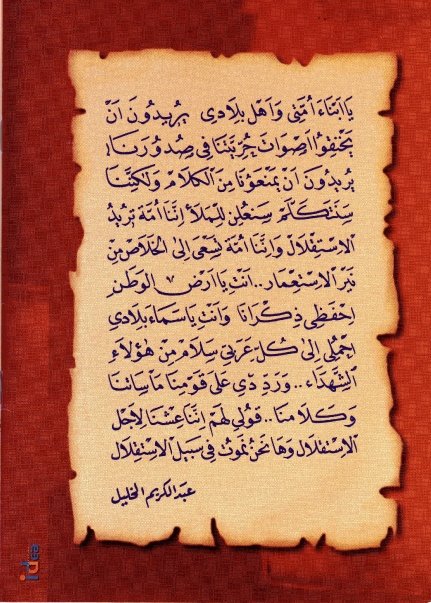
Arabic Version of Abdul-Karim Khalil’s last words (Image found on this Facebook page)

Au nom de mes frères martyrs, écoutez-mois, fils de mon pays et de ma nation. Voici nos dernières paroles. Les Ottomans veulent étouffer la voix de la liberté dans nos poitrines. Ils veulent nous empêcher de parler, mais nous déclarons que nous sommes une nation qui veut son indépendance, une nation qui cherche à se débarrasser du joug Ottoman. Terre de la nation, conserve notre mémoire! Ciel de notre pays, porte à tout Libanais, à tout Syrien, à tout Arabe, le salut de ses martyrs! Dis leur que nous avons lutté pour l’indépendance, et que nous mourons pour l’indépendance.

English version (took from the Facebook page) “My dear fellow countrymen, the Turks want to suffocate our voice in our lungs. But we will ask all the nations of the world for our independence and freedom. My beloved country, remember always these eleven martyrs! O paradise of my country, carry our feelings of brotherly love to every Lebanese, to every Syrian, to every Arab, tell them of our tragic end and tell them: ‘For your freedom, we have lived and for your independence we are dying.'”

These were Abdul-Karim Khalil’s last words before he was hanged (He then kicked the step ladder himself, denying that honor to the hangman) by the Ottomans on the 21st of August 1915 because of his struggle for freedom.

There has always been a debate in Lebanon on what makes a man a martyr. I believe Abdul-Karim Khalil sums it up very well in this part of  his speech: “O paradise of my country, carry our feelings of brotherly love to every Lebanese, to every Syrian, to every Arab, tell them of our tragic end and tell them: For your freedom we have lived and for your independence we are dying.”

Even though Abdul-Karim Khalil was not hanged on the 5th and 6th of May with most of the other martyrs, he did belong to the wave of victims that suffered under the Ottomans.

Starving one third of the population till death should not be forgotten. The oppression should not be forgotten. The martyrs of 1915 and 1916 should not be forgotten.

Martyrs’ day should not be forgotten.

Is Lebanon Turning Into A Military State?

Image from 2011 (Associated Press)

Image from 2011 (Associated Press)

There were days when the director of the General Security wasn’t an officer. There were days when even the presence of a General as a democratically elected president would be criticized. These days are over.

For Lebanon’s president Michel Suleiman is a General. His predecessor Emile Lahoud was also a General. The interior minister Marwan Charbel is a General. The head of one of the biggest parliamentary blocs, Michel Aoun, is a General. The new interior minister is likely to be a General. A month ago, a General, Ashraf Rifi, the former head of the ISF, was on the verge of being a Prime Minister-Designate

When Tammam Salam was tasked to form a government, Foreign Policy had a great article on how the same families in Lebanon get to stay in power democratically while the rule of families is being toppled everywhere else in the Arab World. The Frangiehs, the Jumblatts, the Hariris, the Gemayels are few examples. Even when you think it’s not present, you quickly realize that Gebran Bassil is Michel Aoun’s son-in-law, that Marwan Hamade is Gebran Tueni’s uncle, and that  Setrida Geagea is Samir Geagea’s wife

Though Lebanese tend to forget that quickly, political inheritance is not the only thing we have in common with the neighboring Arab countries. We also have ruling generals. True, the Arab spring was made to prevent Jamal Mubarak and Seif El Islam Gaddafi of inheriting power, but it was also  Colonel Gaddafi and General Mubarak that were the targets. In the same way the Lebanese don’t view the election of the same families to the parliament as a wrong matter, they don’t view the presence of Generals in power as a bad thing.

It is also not possible to elect judges, Grade One civil servants, or their equivalents in all public institutions to the Presidency during their term or office or within two years following the date of their resignation and their effective cessation of service, or following retirement.

Article 49 in the constitution prohibits the commander-in-chief of the army of being a president (unless he’s elected two years after he resigns) for a reason. However the constitution was amended several times in Lebanon’s history to let Grade One civil servants serve as Presidents.

The problem of amending the constitution and letting a commander-in-chief of the army be a president is that one day, like all the countries in the world, we might have a coup – as unlikely as it might sound – and the General can pressure the members of the parliament to amend the constitution and elect him, making his rule look legitimate. If the amendment hadn’t been done several times before, the move would have made him an illegitimate ruler. But now that it’s done, each time he gets criticized for being elected under a constitutional amendment, his response would be: “It was done before. Are you suggesting that Fouad Chehab and Michel Suleiman were illegitimate rulers? They were democratically elected by the parliament, under a constitutional amendment. And you’re telling me that there’s an opposition? Do I need to remind you that the Lebanese Forces did not vote for Suleiman  in 2008 and that Raymond Edde was a presidential candidate in 1958?”

But for a coup to succeed in Lebanon, with all the sectarianism and without splitting the army in two armies (or ten, or twenty), it would likely take three centuries. So the main problem of having generals in power isn’t primarily because of a possible coup, but rather because of the nature of the Lebanese system. I’ll make it clearer.

A and B are both represented in the parliament. A and B elect the president, have a say in everything else and can even veto some positions. A and B also have armed wings. On one sunny summer day, A and B clash. The army receives orders to stop the fighting between A and B. There are three possible scenarios:

1) If the officer slightly sides with A, he might get a favor from A. If he sides with B, he might get favors from B.

2) If he stands in the middle, stops the fighting, without actually hunting the armed men down, he gets praised by A and B.

3) If he stands in the middle, stops the fighting and hunts every armed man down, he gets vetoed by A and B.

When Fouad Chehab refused to follow Camille Chamoun’s orders to fight the revolution in 1958, it was scenario 2. When Michel Suleiman did not stick to the orders of the government on banning protests on the 14th of March 2005, it was scenario 2. Emile Lahoud, Michel Aoun and Ashraf Rifi are other examples of the scenario 1 (Who needs scenario 2 when – even if for a while – there’s an A that’s stronger than B?)

That’s why generals become politicians in Lebanon. They take sides, or stand in the middle, depending on the context. But do not be fooled, for there are two types of men standing in the middle: The man who stands between A and B, and the man who stands against A and B (While following the orders of course, that are to stop A and B from fighting)

The “Amn Bel Taradi – الامن بالتراضي”, or consensual security, the fact of stopping the fighting between A and B without actually disarming A and B and punishing them for the instability they are causing, is mainly due to the fact of having officers in power. As you can see, Scenario 3 is missing,  not because it’s too good to be true, but because officers in Lebanon made it to top posts due to the scenarios 1 and 2. So why would an officer risk  his career by going for scenario 3 while he can get easily rewarded and have all the glory he wants via scenarios 1 and 2? Even when he has the political approval from everyone to go for scenario 3, Scenario 2 for an officer stays the preferred scenario, because it doesn’t get him too much problems. The battles between Jabal Mohsen and Bab El Tabbaneh are a perfect example.

When A and B know that there will not be a response from the army, it’s always an escalation of fighting that follows. Scenario 2 usually goes like that:

1) stop a fight by standing in the middle.

2) But the fighting resumes, and it’s a more brutal battle, because the fighters know there is no punishment.

3) Stand in the middle again and stop the bigger fight.

4) Repeat step 2 and 3 several times. Eventually, it’ll be too big to control and it will be more than a small local battle.

It’s not the fault of the army, and  I’m not saying the work some officers are doing in power is bad. Fouad Chehab delayed the civil war 17 years, and Michel Suleiman is probably doing the same thing. But when Generals are democratically given power, it’s for the purpose of keeping things under control. However what happens next is an instability due to the scenario 2 – الامن بالتراضي – that will eventually lead to a total loss of control.

In a nutshell, by bringing neutral generals to power, you think you are doing good, but the scenario 2 – and its consequence, consensual security – will begin, and in order to solve it, you bring more neutral generals to power making things even worse.

When Ahmad Al-Assir Calls For Jihad

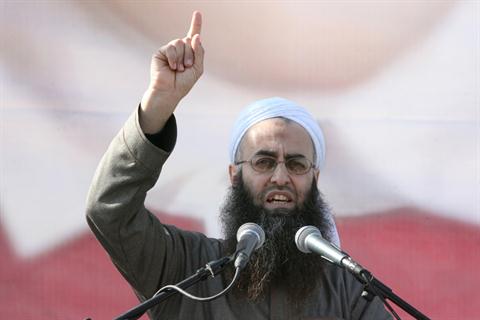
Ahmad Al-Assir (The Daily Star/Hasan Shaaban)

Ahmad Al-Assir (The Daily Star/Hasan Shaaban)

Just when you thought the Syrian spillover couldn’t get worse, and that the events happening on the borders, the refugees crisis, the shelling of the Lebanese towns, the political quarrels and the unrest in Tripoli aren’t enough, salafi sheikh Ahmad Al-Assir and sheikh  Salem Al Rifai issue a Fatwa for Jihad. It’s quite an important move, considered that Hezbollah is already deeply involved in the Syrian civil war, apparently protecting the Sayyida Zeinab shrine in Damascus and leading the battle for Al Qussair. But what is even more interesting is the timing of Assir’s move.

Assir is losing influence. There were times when Ahmad Al-Assir would appear on every television, literally every day. These days are over. The collapse of the Lebanese government that was supported by Hezbollah made Assir lose the attention he got over the past few months. A Sunni moderate coming from a traditional Beiruti family is Lebanon’s prime minister-designate, and he got nominated from all the 27 Sunni MPs. Assir can’t go out and say that Tammam Salam is Hezbollah’s candidate, and Future Movement are clearly making a comeback in Lebanese politics with the appointment of a member of their parliamentary bloc as a PM. Assir never had that important impact in Lebanese politics, but he was rising star that’s now fading away. He can’t draw the attention anymore, is seeing his demonstrations getting banned and can’t attack Hezbollah the same way he used to do, because the party isn’t leading the coalition anymore. All the Sunni parties – except him – will be probably represented in the government, further isolating Lebanese Salafis, and making his speeches look even more sectarian than they are. The ultimate solution becomes calling for Jihad, hoping that he can regain some of the popularity he lost when things calmed down in Lebanon by accusing Hezbollah of killing Sunnis in Syria and by mobilizing Lebanese.

The worst timing ever. Why? Because earlier yesterday, the Greek Orthodox and Syriac Orthodox Bishops of Aleppo were kidnapped. So it’s not a very smart move to scare the Lebanese Christians few months before the elections. Ahmad Al-Assir gave Hezbollah just what he wanted; not more, not less. By calling for Jihad in Syria the same day Bishops get abducted, Sunni Radicalism suddenly became the most important boogeyman for the Lebanese Christians, ultimately reinforcing Michel Aoun at a very critical moment: Governmental formation and electoral law negotiations.

It’s interesting though how Hezbollah and Salafis seem to be fighting each other in Syria. Looks more like a Lebanese spillover in Syria than a Syrian spillover in Lebanon…


Lebanon In The Valley Of Despair – Wikileaks And The Lebanese Civil War

WikiLeaks

“Lebanon in the valley of despair” is the name of a U.S. diplomatic cable dating from 1975.  The best way to commemorate the civil war is by remembering its brutality and the failure of the peace negotiations. I hereby leave you with some parts  of the leaked U.S. diplomatic cables of 1975-1976.

1975 March 6 – The Very Beginning

TENSIONS GENERATED THROUGHOUT LEBANON OVER PAST
WEEK BY CLASHES BETWEEN LEBANESE ARMY AND “ARMED
ELEMENTS” IN SIDON (REFTELS) HAD BEGUN TO LESSEN
PERCEPTIBLY LATE MAR 5, FOLLOWING COUNTRY-WIDE MANIFES-
ATIONS BY CITIZENS (MOSTLY CHRISTIANS BUT SOME SHI’A)
DEMONSTRATING IN SUPPORT OF ARMY AND GOL. DEMONSTRATIONS
WENT OFF MORE OR LESS PEACEFULLY, WITH ONLY ONE PERSON
REPORTED KILLED (ACCIDENTALLY BY STRAY BULLET).

(see full text here)

1975 September 26 – Dialogue

LEBANON HAS WAGERED MUCH ON A SINGLE CAST OF THE DICE WITH
THE FORMATION OF THE 20 MAN “COMMITTEE OF NATIONAL DIALOGUE”
(REFTEL). AN EXAMINATION OF PREVIOUS ROUNDS THIS YEAR WILL
SHOW THAT TEMPORARY OF A SIDE ISSUE WHICH HAD ASSUMED CENTRAL
IMPORTANCE IN THE COURSE OF THE FIGHTING. ROUND ONE WAS BROUGHT
TO VMA CLOSE BY GEMAYEL’S AGREEMENT TO TURN OVER FOR QUESTIONING
SEVERAL INDIVIDUALS ACCUSED OF COMPLICITY IN SO-CALLED AIN
RUMMANEH “MASSACRE” OF APRIL 14. ROUND TWO TAPERES OFF FOLLOWING
THE RESIGNATION OF THE MILITARY CABINET WHICH ASSUMED POWER
ONLY AFTER RPT AFTER THAT ROUND BEGAN; AND ROUND THREE ENDED
WITH NAMING OF KARAME CABINET. FOLLOWING SUCCESSION OF ABORTIVE
CEASEFIRE, LEBABESE, WITH ASSISTANCE OF SYRIANS, HAVE SETTLED
UPON DIALOGUE COMMITTEE AS DEVICE FOR HOPEFULLY BRINGING RELIEF
FROM STRIFE WHICH HAS BROUGH THIS COUNTRY AS NEAR TO NATIONAL
COLLAPSE AS ANY DEVELOPMENT IN ITS TROUBLED HISTORY.

(see full text here)

1975 November 1 – Clashes

AT TIME OF DRAFTING THIS CABLE, CLASHES IN MAIN
HOTEL DISTRICT ADJACENT TO EMBASSY CONTINUE. SMALL ARMS FIRE
IS HEARD, PUNCTUATED OCCASIONALLY BY EXPLOSIONS. ELSEWHERE
IN CITY, SECURITY SITUATION
DETERIORATED AFTERNOON OCTOBER 31 AND HEAVY FIGHTING
WAS REPORTED OVERNIGHT. IN ADDITION TO HOTEL
DISTRICT, SHIA/AIN RUMANNEH/FURN ASH SHURBAH
COMPLEX BROKE DOWN BEGINNING APPROX 1300 HOURS
YESTERDAY. CLASHES THERE OVERNIGHT WERE REPORTEDLY
AS BAD AS ANY PREVIOUSLY EXPERIENCED AND CASUALTIES
IN THAT SECTOR ALONE WERE ALLEGED TO BE BETWEEN 40
AND 100 DEAD. AS OF MID-MORNING TODAY, ONLY MACHINE
GUN EXCHANGES WERE REPORTED BETWEEN SHIAH AND AIN
RUMMANEH, BUT WE HAVE NO MORE RECENT INFORMATION.
EXCHANGES OF UNDETERMINED FEROCITY WERE EXPERIENCED
OVERNIGHT ALONG CENTRAL AXIS PARALLELING BESHARA
AL-KHOURY STREET (I.E., SODOCE, RAS AN NABEH, NASRA,
WESTERN ASHRAFIYAH, ETC.); BETWEEN QARANTIANA AND
NORTHERN ASHRAFIYAH; AND BETWEEN SUBURBS OF HADATH AND LAYLAKI.

IN SUMMARY, DESPITE PERSISTING EFFORTS
TO IMPOSE A CEASE-FIRE, WE NOW BACK TO SQUARE MINUS
ONE ON SECURITY SCENE.

(see full text here)

1975 November 6 – Another Day Of Calm

1. SUMMARY: LIKE A BOXER PUNCH-DRUNK FROM FOUR GRUELING
ROUNDS OF PUNISHMENT, BKEIRUT CONTINUES NOV 6 TO RISE FROM THE
CANVAS; THE LEGS ARE WOBBLY, THE VISION BLURRED. THERE ARE
RISING HOPES BUT AS YET LITTLE CONFIDENCE, THAT THE CITY WILL
NOT HAVE TO ANSWER THE BELL FOR ROUND 5. END SUMMARY.

2. BEIRUT AND MOST OF LEBANON ENJOYING ANOTHER DAY OF CALM
NOV6, WITH ONLY RARE BURSTS OF MACHINEGUN FIRE TO MAR THE
FAMILIAR CIVILIAN NOISE POLLUTION OF HAMRA AND OTHER REAWAKEN-
ING COMMERCIAL DISTRICTS. TWO ROCKETS WERE FIRED INTO
ASHRAFIYEH OVERNIGHT, BUT GENERAL ABSENCE OF BACKGROUND
EXPLOSIONS ALMOST EERIE. DESPITE CALM, LEBANESE VENTURING
OUT IN FALL FINERY WEAR A WARY EXPRESSION AND COMPETENT
OBSERVERS ARE NOT RPT NOT PREPARED TO DECLARE PEACE IN OUR
TIME. SOME, IN FACT, ARE PREDICITING A RETURN TO ARMS AS EARLY
AS NEXT MONDAY. TRIPOLI REPORTEDLY IS TENSE FOLLOWING DISCO-
VERY OF UNIDENTIFIED BODY, BUT WAVE OF KIDNAPPING IN BEIRUT IS
APPARENTLY FINISHED AS OF THIS REPORT.

(see full text here)

1975 December 18 – Dialogue Is Failing

SAEB SALAM AND KAMAL JUMBLATT SEPARATELY ISSUED CALLS
FOR THE RESIGNATION OF FRANGIE AND MININT CHAMOUN, THOUGH
IT MUST BE SOURCE OF EMBARRASSMENT TO TWO MEN OF SUCH
DIFFERENT TEMPERAMENT AND PHILOSOPHY THAT THEY AGREE ON
THIS QUESTION.

(see full text here)

1976 January 14 – The Battle For Beirut Continues

SUMMARY: THE BATTLE OF BEIRUT AND SUBURBS CONTINUES.
TRIPOLI AND ZAHLE AREAS ALSO REPORTED TO BE HOT.
MARONITE MEETING JAN 13 RESULTED IN HARD POSITION ON ISSUE
OF PALESTINIAN PRESENCE BUT A HINT OF FLEXIBILITY OF INTERNAL
POLITICAL REFORMS. PRES FRANGIE IS CONTINUING CONSULTA-
TIONS AMONG CHRISTIAN LEADERS PRIOR TO MEETING WITH
SYRIAN PRES ASAD. THIS MEETING IS STILL PROJECTED FOR
JAN 17. END SUMMARY

2. EXCEPT FOR BRIEF BREATHING SPELL FOR THE BATTLE OF BEIRUT
AND SUBURBS HAS CONTINUED. FIGHTING IN AND AROUND TEL
ZAATAR, THE NORTHERN BRIDGES OVER BEIRUT RIVER, AND THE
HOTEL DISTRICT FIGURES MOST PROMINENTLY. TEL ZAATAR AND
JISR EL PACHA APPEAR TO BE HOLDING OUT WITH LITTLE SIGN THAT
PHALANGISTS HAVE MADE MUCH PROGRESS IN THEIR AREAS.  ONE

REPORT STATES THAT JISR EL PACHA HAS BEEN EVACUATED.THIS
IS NOT CONFIRMED BUT PHALANGISTS MAY HAVE TIGHTENED THEIR
HOLD ON THE CAMP. NUMBEROUS ATTEMPTS BY PALESTINIANS
AND THEIR ALLIES TO FORCE THEIR WAY FROM CHIAH PAST HAZMIEH
HAVE FAILED SO FAR, BUT HAVE SERVED TO KEEP THE POT BOILING
FROM FURN EL CHEBBAK THROUGH HADATH-LEIGLCPAM PHALANGISTS
PERSIST IN THEIR EFFORTS TO BRING THE WAR HOME TO TARIK
JADIDE AND MAZRAA BY SHELLING, WHICH HAS RESULTED IN A
GROWING NUMBER OF CASUALTIES.

(see full text here)

1976 April 4 – Syria’s Asad becomes a Crusader

IF I GOT NOTHING ELSE FROM MY MEETING WITH FRANGIE,
CHAMOUN AND GEMAYEL, IT IS THEIR CLEAR, UNEQUIVOCAL
AND UNMISTAKEABLE BELIEF THAT THEIR PRINCIPAL HOPE FOR
SAVING CHRISTIAN NECKS IS SYRIA.THEY SOUNDED LIKE
ASAD IS THE LATEST INCARNATION OF THE CRUSADERS.

(see full text here)

Some events are very similar to what happened in the past few months:

“TRIPOLI REPORTEDLY IS TENSE”, “LEBANESE HAVE SETTLED UPON DIALOGUE COMMITTEE”, “BRING THE WAR TO TARIK
JADIDE”, “WAVE OF KIDNAPPING IN BEIRUT IS APPARENTLY FINISHED AS OF THIS REPORT”.

Ironically, a wave of kidnapping is also apparently finished as of this post.

 Sad.

How Tammam Salam Became A Consensual Candidate

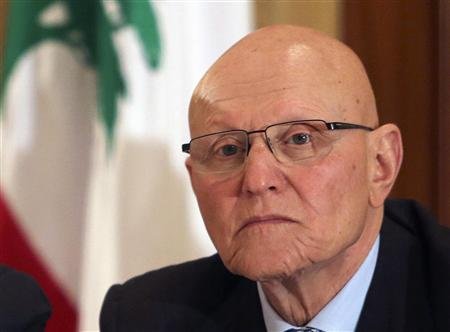
Tammam SalamTammam Salam (REUTERS/Mohamed Azakir)

Tammam Salam (REUTERS/Mohamed Azakir)

Tammam Salam. That’s the name of the man that will be tasked to form a new government once the consultations end. A consensual Prime Minister it seems.

A small background

Tammam Salam boycotted the elections of 1992 – like most of the Christians at the time – as a refusal of Syrian hegemony. Salam participated in the 1996 elections and won. In the 2000 elections he lost against Rafiq Hariri and in the 2009 elections he won in Saad Hariri’s list. That kind of makes him a centrist person. He also doesn’t speak about Syria and its crisis and doesn’t criticize Hezbollah, at least not like other Future Movement MPs. He has an Islamic influence coming from the Makassed foundation. He’s also from Beirut. The last time a PM was a Beiruti was 13 years ago. His Grandfather was Beirut’s MP in the Ottoman parliament, and was also the head of the Municipality. His father was Prime Minister under Bechara El Khoury, Camille Chamoun, Fouad Chehab, and Sleiman Frangieh. That’s four of the five Pre-war presidents of Lebanon. The Lebanese flag was also drawn in his father’s house. That last thing probably doesn’t matter, but you can see what I mean.

Tamam Salam is in the middle. Between Christians and Muslims, between Shias and Sunnis. And he’s strong within the Sunni community (A thing Mikati suffered with at the beginning). He is also a Beiruti, and not any Beiruti. He is the son of Saeb Bey Salam, and the grandson of Salim Ali (Abu Ali) Salam.

How it all started

Tammam Salam was nominated as M14’s candidate, and Jumblatt endorsed him, after refusing Rifi. Tammam Salam won’t participate in the elections if he’s nominated, which means that his success (If he succeeds) won’t be a direct threat to Mikati and Hariri. Tammam Salam visited Saudi Arabia  whose ambassador in Lebanon ironically said in the same day that the Saudis  do not interfere in Lebanese Politics – where he got the blessing he needed. Also, after the Saudi ambassador – who ironically said that the Saudis do not interfere in Lebanese Politics – visited Mikati, Mikati said he doesn’t want to be Lebanon’s next Prime Minister. Then, after leaving Saudi Arabia – whose ambassador in Lebanon ironically said that the Saudis  do not interfere in Lebanese Politics – one day before he gets nominated, Tammam Salam came back to Lebanon. Here you go, Saudi Arabia’s support.

And then?

Now’s here’s the tricky part. Hezbollah lost Mikati. Hezbollah also lost Jumblatt. And Hezbollah is losing Syria. Hezbollah can’t also repeat what he did in 2011. The elections are way too close. He made that mistake on the 7th of May 2008 and lost the 2009 elections because of it. So what will Hezbollah do? He plays it smart. M8 can endorse Karami, Tabbara, Abdul Rahim Mrad, or anyone else, but the M8 coalition will probably lose because Jumblatt won’t give his support. Instead of fighting a lost battle, they take M14’s achievement, make Jumblatt’s swing votes look useless – while they’re not at all – and push with Tammam Salam making him a consensual candidate. That’s how M14 don’t exactly look like winners, and Saudi Arabia’s increasing influence (while Syria is on fire) doesn’t look that important because Salam is suddenly everyone’s candidate. And he can be everyone’s candidate. Check the background part again.

It’s only the beginning

It’s a huge responsibility for Tammam Salam. He will have to form a unity cabinet (Because Jumblatt wants a unity government), make sure we have a new electoral law (now that the Christian parties will boycott any elections under the 1960 law) and organize elections. He’s also short on time because the parliament’s expiry date is soon unless it extends its term. Forming a government, agreeing on an electoral law and organizing elections all in 3 months is a mission impossible. Only to form a government, it took Hariri five months and Mikati  seven . And that’s another dilemma for Tammam Salam. Will he agree on the parliament’s term extension? What will his stance be on the STL, the issue that brought Hariri’s government down? What will his stance be  on the name of the ISF commander, the issue that brought Mikati’s government down? It’s going to be a tough road for Salam. It’s going to be even more difficult when different parties will start asking their share of the cake, and we might have a new interesting slice of the pie this time: The ministry of Petroleum.

 The real winners? Prime Minister Tammam Salam, Kingmaker Walid Jumblatt, and the Kingdom of Saudi Arabia.

Jumblatt is already enjoying his success: Naming the PM, choosing the type of the government, and even Vetoing.

The Reasons Behind Mikati’s Resignation

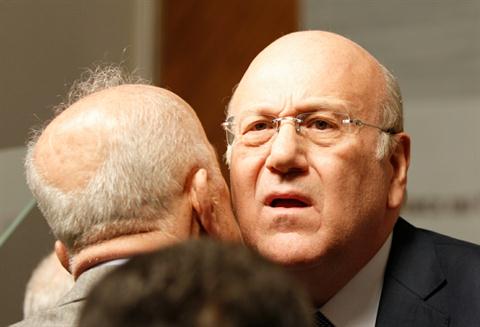
 Deputy Prime Minister Samir Moukbel and Mikati after the resignation (The Daily Star)

Deputy Prime Minister Samir Moukbel and Mikati after the resignation (The Daily Star)

The Lebanese government of June 2011 is now history. Najib Mikati resigned due to a lack of agreement on an electoral comitte to oversee the elections and Mikati’s failure to extend the the term of ISF chief Ashraf Rifi . You can see his resignation speech [here]. Such a move can be full of meanings, so why did Mikati resign? And more importantly, why now?

It’s all in the Speech

Mikati said that he thought about resigning twice before. The first time was about M8’s refusal to fund the Special Tribunal for Lebanon, and the second time was when Wissam Al-Hassan was assassinated. If Mikati had resigned when the STL wasn’t being funded, it would’ve been too early. Back then, M14 was still strong and he could’ve been easily replaced. If Mikati had resigned after Al Hassan’s funeral, it would’ve also been a fatal bullet for his political career (Resigning meant that his government was responsible for what happened). At both times, Mikati knew that if he would resign it will have negative consequences on him before everyone else. So why now? Mikati wanted an alibi to leave the government so that he can run in the elections. But he couldn’t simply leave. He wanted to leave in a context that makes him stronger, not weaker. And instead of giving him one reason to quit, they gave him two. It was the perfect moment for him. The first motive is a national one, while the second motive is about Sunni politics.

 A National Alibi

Mikati resigned because they wouldn’t let him organise elections. Read that sentence, (more…)