Lebanese Politics

The Late Rise Of Michel Sleiman – Part I

Lebanon's President Michel Sleiman during his visit to Uruguay. ANDRES STAPFF / Reuters

Lebanon’s President Michel Sleiman during his visit to Uruguay.
ANDRES STAPFF / Reuters

“The evolution of the Resistance was a need during the impotence of the state and the persistence of this Resistance was achieved by virtue of the support granted by the Lebanese people, the State, and the Lebanese Army.
The success of the Resistance in the mission of vanquishing the israeli occupier springs from the courage and greatness of its martyrs and yet, the farms of “Shebaa” which are still occupied and the enemy’s persistence in threatening to violate our sovereignty impose upon us to elaborate a defensive strategy that will safeguard the country concomitantly with a calm dialogue to benefit from the capacities of the resistance in order to better serve this strategy. Accordingly, we will manage to avoid depreciating the achievements of the resistance in internal conflicts and subsequently we will safeguard its values and national position. […]

Moreover, the recent security incidents gave the impression that the Armed Forces did not assume the complete and required role. In this regard, it is noteworthy that the issue of ensuring the minimum level of agreement and securing the required political cover contribute to ward off such incidents in the future. In addition to this, it is essential to reinforce the morale of the Armed Forces on the national level, to equip these troops and to encourage the educated and promising youth to join the Army. ” – Michel Sleiman, from his inaugural speech (25 May 2008)

5 years later:

“It has become urgent to consider and adopt the National Defense Strategy, in light of the ongoing regional transformations and the changes that have affected the main function of the Resistance’s arms as they have crossed the Lebanese borders. Such review must be undertaken on the basis of the conception that I had submitted in that regard to the people and the national dialogue committee which considered it as a basis for discussion, and which was referred to by the UN secretary-general in his last reports to the Security Council; also based on our clear, precise and constant differentiation between resistance and terrorism, and in view of shielding our capability to resist and defend Lebanon exclusively. It is about time for the State, with its Army and higher political leadership, to be the main regulator and the decision-maker for the use of such capability.
In parallel, after Lebanon succeeded in liberating most of its territories from the Israeli occupation thanks to the converging efforts of all its national forces of resistance and deterrence, we will not forget to follow-up on the implementation of the Army armament and equipment program […]
The time is long gone when the Army was forbidden from defending Lebanon and when the state was forbidden from defending the Army. The Army is and will never be a buffer force between small Lebanese armies, militias or armed groups under the pretext of defending some cause that concerns a specific group, sect, neighborhood or region… the Army is the legitimate representative of the Lebanese nationalism and the constant embodiment of Lebanon’s unity and the Lebanese people… the Army has been and shall always be a symbol for every transition from a present governed by concerns and fear to a future freed by determination and hope.” – Michel Sleiman,  from his speech, August 1, 2013
Our President has changed. He’s speaking with a different tone, about things no one in his position would’ve probably dared to even discuss. When a simple idea, very marginal in an inaugural speech becomes the center of one of the last speeches he makes before (supposedly) leaving office, you know something is cooking out there.  (I highly recommend reading the full two speeches to see the difference)
The Last Reform
When you read the president’s promises made on May 25 2008, and you compare them to our current situation, you don’t know whether you should laugh or cry. “Political stability”, “dialogue”, “rotation of power through free elections”, “electoral law which ensures the sound representation”, “independence of judicial authority”, “younger and more competent administration”,” reformative educational policy”, “engaging the Lebanese communities in diaspora”, “activating the economic cycle”, “emphasis on tourism”, “confirming the participation in the establishment of the International tribunal”, “freeing the prisoners and the detainees”, “recovering our sons who sought refuge in Israel”, “defensive strategy”, “forbidding security violations”.
To make it worse, the president back then ended the speech by adding the sentence “Let us avoid drowning in promises”, implying that the promises made on the 25th of May were the least measures that should be taken between 2008 and 2014. When the Lebanese President will stand out of Baabda on the 25th of May 2014 – if his term doesn’t get an extension –  he would be leaving Lebanon in the complete opposite scenario (If the status quo remains the same): No political stability, no dialogue, no rotation of power, no free elections, no electoral law, no sound representation, no independence of judicial authority, no younger administration, no competent administration, no reformative educational policy, no engaged Lebanese communities in diaspora, no economic cycle activated, no tourism, no participation in the international tribunal, no detainees freed, refugees in Israel barely recovered, no defensive strategy, and nothing but security violations. To sum it up, in five years of rule, the president did not only achieve nothing, he also transferred Lebanon from the bad to the worst. It is too late to start any of the reforms, and the last meaningful possible salvation the general can think of for his 6 years and that can be equivalent to all the others  combined is ending his term with a defensive strategy in place and finding a solution to Lebanon’s never ending debate.
The New Camille Chamoun
In a previous post, I compared the genius political skills of Nabih Berri to the maneuverings of Camille Chamoun. Even though Sleiman isn’t as wise as Chamoun, he is at the very end of his mandate in the same position Chamoun was at the beginning of his in 1952. At the beginning of his mandate Chamoun was known for frequently changing his prime ministers without getting lots of criticism for it from the Lebanese in general and the Sunnis in particular. The main Sunni leader Riad Al-Solh was assassinated before Chamoun took power, and the very fact that there was a void in leadership entitled Chamoun to put several persons in office in the first half of his term: Khaled Chehab, Abdallah Al-Yafi, Saeb Salam, Sami Al-Solh, and Rachid Karami. It was possible for Chamoun because none of the leaders was charismatic/popular/old enough to be removed without angering the population. The very fact that he could change the PM at any time – till 1955 – without being questioned put Chamoun in a very strong position in which the PM was very weak and had to rely on the president in case he wanted a longer stay in the Serail. Sleiman is more or less in the same position today: From Paris, Saad Hariri is no longer than an ex-prime minister that is losing popular support by the day to allies and rivals . Mikati is now history. Tammam Salam can’t form his government. Fouad Siniora seems the most practical solution, after trying all the other paralyzed governments. This leads to one equation: 4 mainly  equal Sunni men, with rising dozens are aspiring to enter the Grand Serail. With two prime ministers – a designated and caretaker one – with absolutely no power, and several other alternatives  to them, Michel Sleiman finds himself the only entity in the executive authority, that is irreplaceable (8 months of vacuum in the presidency preceded Suleiman), neither designated, nor caretaking, and that will remain like that for the next 9 months. In 2008 and 2009, Siniora was the strongest one in the executive authority. In 2010, it was Hariri. In 2011 and 2012, it was Mikati. In 2013,  It is no one. Not only there is no PM in power, but even if there would be a PM in power, he could be easily replaceable by many others as there is not one exclusive Sunni leader anymore. Sleiman’s position today is the most stable among his other colleagues, allowing him to speak more freely. There is no government to please, no one irreplaceable (à la Iza Mish Aajbak, Bye Bye) prime minister to work with – let alone the presence of that prime minister in office. Presidents usually start their mandate strong and end weak. For Michel Sleiman, it seems like it’s the opposite.
I am very sorry but I had to split that post to two because it was very lengthy. Part II comes out tomorrow. Stay tuned.

Hezbollah, Terrorism And A Political Maneuver

The Easiest Way to create problems between the Lebanese government, Hezbollah, the UNIFIL and the European Union?  (Ramzi Haidar-Getty Images)

The Easiest Way to create problems between the Lebanese government, Hezbollah, the UNIFIL and the European Union? (Ramzi Haidar-Getty Images)

Hezbollah might be achieving military advances in Syria, but diplomatically, he’s facing a major setback. On monday, Hezbollah’s military wing got listed in the European Union as a terrorist group.

Useless Move By The European Union?

The European Ban doesn’t mean a lot to Hezbollah. Hassan Nasrallah doesn’t spend his vacations aux Champs-Élysées, and Hezbollah’s weapons don’t particularly reach the Lebanese south via Frankfurt’s airport. The move will only complicate things with the Lebanese state, which was probably what Israel wanted in the first place. Hezbollah is represented in the Lebanese government and it is likely to stay that way meaning that the European Union’s projects might face difficulties or even stop, and it isn’t in the great interest of the EU to look like they’re abandoning the Lebanese state. No one wants to get the mainstream American image in Lebanon. And that’s just a small consequence.

European Soldiers On Lebanese Soil

We tend to forget that easily, but there are 3742 soldiers on Lebanese territory that are members of EU states armies. That can’t be any good for the UNIFIL that is supposed to act as a neutral force in the south. The French, Spanish and Italian forces (among others) will have to distance themselves a bit and the designation of Hezbollah as a terrorist group might create a very tense atmosphere.

No True Separation

There’s no such thing as separate military and political wings for Hezbollah. The issue can become very confusing as many (if  not all) of the “political wing members” of Hezbollah are also members of the military one. A small example: Is Hassan Nasrallah considered a member of the military or political wing?

Nabih Berri Or The New Camille Chamoun

This is not the first time something like this happens. Lebanon had a 10 years travel ban between 1987 and 1997. The salvation came in 1997 when Rafic Hariri was Prime Minister and Berri was speaker. 16 years later, the speaker, the same Berri, asks Hariri’s son in the week the Hezbollah designation happened – what a coincidence – to serve as a prime minister again. Berri’s moves are so ingenious (see here and here) that he might be considered as a new Camille Chamoun. He knows exactly whom he should speak with, what to say to him, and when he should make his move. In a time when alliances are seeming to collapse, Berri wants to be the most useful politician in the cold. By asking to bring the closest Pro-American  – formerly vetoed by Hezbollah – Sunni politician as a PM, Berri makes a compromise: In exchange of handing Hariri the premiership, he makes sure that even the biggest Lebanese opponent to the party won’t work against it diplomatically. Saad Hariri might even be able to remove Hezbollah from the list like his father removed the ban in 1997. Berri would’ve seemed as the political ally of Hariri and the diplomatic savior of Hezbollah: That’s how you make sure you can still be speaker of the parliament in 2014.

Can You Smell The Competition?

First, rumors start spreading that Aoun is getting closer and closer to the Future Movement and that meetings are happening between FPM officials and the Saudi Ambassador. The next thing you know, Berri, out of nowhere, suddenly asks Hariri to come back and serve as a Prime Minister. There can be only one explanation to that: Jumblatt chose a Future Movement  ally as a Prime Minister and told Hezbollah that the party will be present in the government or there will be no government. It’s already getting too crowded in the cabinet, and if someone is going to be left out, it won’t be the kingmaker Jumblatt, nor the PM’s M14 allies, nor Hezbollah, which leaves us with Berri and Aoun, explaining the ” I love you more competition” on Hariri between the FPM and Amal. For someone who once attacked the FM almost every week one can’t but notice how Aoun’s criticism is relatively non-existent in July.

Maybe the designation of the military wing as a terrorist organisation was supposed to pave the way for a foreign intervention in Syria, but one thing’s for sure: Hezbollah’s military victories resulted in a small diplomatic failure that is starting to weaken him politically.

The End Of The March 8 Alliance?

Berri and Aoun

“There is no such thing as the March 8 alliance anymore, Berri told The Daily Star.”

That quote from the Daily Star article (entitled March 8 finished, Aoun out in the cold) sums it up. But Is really Aoun out in the cold? Or is it some kind of an ingenious Berri tactic?

Between The Lines

The key ministerial portfolio held by an Amal movement minister in the last government was the foreign ministry (of Adnan Mansour). If one reads between the lines, Berri says at some point that  “On the domestic level, our choices differ and each will follow their own course”. In other words, Berri is a political genius that just made a bluff. While saying that he will not support the FPM in their struggle for their governmental share, he implicitly states that the FPM are obliged to support him to keep the foreign ministry under Amal control because both have the same choices on a non-domestic level. And Gebran Bassil fell in the trap by agreeing with Berri that “We support Speaker Berri’s saying that we diverge on domestic matters and converge over strategic issues.” In other words, Aoun would be backing a Berrist for the Foreign ministry post but Berri would not be backing Aounists to occupy the domestic-related ministries (All the ministries currently held by Aounists such as the telecom and energy ministries)

No More Sacrifices For Allies?

Rewind to June 2011: A small dispute (Called back then العقدة السنية, meaning “the Sunni Knot”) between Hezbollah’s Sunni allies (Mikati and Karami) over the number of posts that should be held by each of them delays the government’s formation. In a government of 30 ministers, there should usually be 6 Sunnis and 6 Shias; Mikati’s government eventually had 7 Sunnis and 5 Shias. It was  Berri back then who untied the knot by sacrificing one minister of his share for Ahmad Karami. This time, Berri made his preemptive move as the Salam cabinet formation is clearly facing difficulties. By declaring the 8 March Alliance dead, Berri is dissociating himself from his allies: He will no longer be  pleasing them from his share should they want an extra minister. He is making it clear for Tammam Salam that he is not letting go a minister so that the coalition doesn’t collapse like he did in 2011.

Zoom Out

According to Gebran Bassil, “Political lineups have been shattered”. By getting too busy analyzing the small details, the big picture became unnoticed. While Michel Aoun was busy shattering the March 14 Alliance into pieces via his Orthodox Gathering Law, the other side was preparing to strike back. March 8 knew what was March 14’s Achilles’ heel, but the opposite is also true. March 14’s counter-attack didn’t take long. After the May electoral confusion that nearly destroyed the ties between Gemayel, Geagea and Hariri, March 14 made their move. It was clear that Aoun wanted elections  he was going to win, while Berri saw the extension as an alibi to stay 17 extra months as a speaker. It was clear that Aoun wanted his son-in-law Shamel Roukouz to succeed Jean Kahwagi as a Commander of the army, while Berri had no interest in it. It was also clear that there was a tense atmosphere between Berri and Mikati that developed into a constitutional crisis. The plan was very simple: Let time play its role: Postpone the governmental formation until the M8 Alliance collapses. With no government, the extension of the parliament’s terms was an easier job while the constitutional crisis became evident with the appearance of certain deadlines that were irritant to Aoun and Mikati: One doesn’t want an extension of Kahwaji’s term, the other doesn’t want to see the parliament legislating in the presence of a caretaker government (probably to appear as the protector of the Sunni interests in Lebanon). Thus M14 played it smart : They stood by Berri when he wanted to extend the parliament’s term, then blocked all the speaker’s attempts to hold a session by standing with Aoun and making sure that there will be a lack of quorum. All it took was 1 month of conflicting interests between the M8 members to (apparently) end a 7 year alliance. All it took was letting the M8 alliance rule and fail due to the lack of chemistry between its parties.

No Electoral Ground

Political alliances are usually built on the foundations of the electoral alliances. In no electoral district the FPM and Amal find themselves forced to ally with each others to win. No Aounist is elected in a region having Amal votes, while no Amal MP is elected due to Aounist help. In fact, the two parties were an exception in 2009 when they ran against each other in Jezzine (while they were allies), making it easier for M14 to have a seat in the district (even if it didn’t eventually win any MP in the constituency). Once they don’t need each other to get into the parliament, the two parties won’t stick together till life in the parliament. Geagea needs Hariri to secure him MPs in Zahle and Akkar. Jumblatt and Hariri need each other to prevail in the Chouf. Baabda is ideal for an FPM-Hezbollah electoral alliance, and the Kataeb need the small Sunni and Druze votes to prevail in certain constituencies. Out of all the alliances, the easiest one to break was the Berri-Aoun one, because it had no electoral basis.

À La Adnan Sayyed Hussain?

Berri is apparently distancing himself from the Hezbollah-FPM duo and getting closer and closer to the “centrists”, comprising Jumblatt, the President, Mikati and  – who knows – Salam. Salam was trying for the past 4 months to get his formula of 8/8/8 ministers (8 for centrists, 8 for M8, 8 for M14)  accepted. Once M8 ceases to exist, Hezbollah and Aoun may get their share of 8 ministers independently from Berri, who would be taking a part of the centrists’ share. Once again, Rewind to 2011: A minister supposedly centrist resigns from the Hariri government (That included 10/30 of the ministers from the opposition). The resignation of the eleventh minister, Adnan Sayyed Hussein, who was theoretically a minister loyal to the president, brought the government down (after more that the third of the ministers resigned). Berri might be planning the same strategy again: By announcing the end of the March 8 alliance, he is in fact trying to ensure the blocking third in the government for the “ex-M8” members (by pushing himself to the center away from Aoun). M8 might be playing dead in a last attempt to maximize its share in the government.

So Is It The End?

If you consider that the March 14 coalition doesn’t exist anymore, than you are right to consider the March 8 coalition destroyed. Perhaps it is true: Nobody knows where Jumblatt stands – actually nobody ever knew – while Mikati and Berri are distancing themselves from everyone. On the two other sides: Hezbollah and the FPM struggle alone while the OG law spread confusion and cautiousness between Geagea, Gemayel and Hariri. One thing is sure though: If M14 and M8 are truly from the past now, than they fought themselves till collateral damage prevailed.

Only know you love her when you let her go. Time to see what alliance members truly love each others.

Constitutionality In The Eye Of The Beholder

Nabih Berri

Guess Whose Eyes Are These

The political system is established on the principle of separation of powers, their balance and cooperation.

Three weeks ago, Lebanon’s highest judicial court, the constitutional council, stood there silently, watching an illegitimate and unjustified extension of the parliament’s term. There’s nothing worse than having a paralyzed constitutional council in a country. What was supposed to be incorruptible, unreachable by politicians, the last hope to halt  tyrannical laws – a council dissolving illegitimate senates in Egypt and capable of impeaching presidents – turned out to be a political property as it even failed to convene; two judges were loyal to Berri and another was loyal to Jumblatt. To be fair, the council’s president that was against the extension, also turned out to be a relative of the Lebanese President. Meaning that any decision – with or against the extension – would’ve been a political one rather than a purely independent judicial one. In Lebanon you can call it sharing power,  expanding an influence or even rewarding a loyal supporter with a civil servant post. In other countries, it’s called corruption.

No True Separation

The quote at the beginning isn’t from the Universal Declaration of Human Rights, but from the Lebanese Constitution, its preamble, article E . So what defines a democracy? Separation of powers does play a role, at least according to Montesquieu. It prevents a single body from usurping all the powers, or even corrupting and paralyzing the two other bodies.

When half of the constitutional council members are named by the parliament and the other half is the government’s share, is it truly an independent judicial power? When the parliament – that already has immense powers of electing the President, the PM, giving the government the confidence, and indirectly ruling everywhere – fails to form a government and starts surpassing its legislative authority by voting laws with no government in power, by extending civil servant terms – a purely executive right – and by having the third of the previous cabinet as MPs, wouldn’t be considered usurpation of power rather than separation and cooperation? Would an MP give a no-confidence vote if he were the minister? Is it anything but merging the three branches of the state? If there was still one thing to be proud of in this country, it was the separation of powers between the government, the judiciary, and the parliament. Even that turned to be an illusion.

Berri’s Double Standards

Constitutionality is in the eye of the beholder. Back in 2007, when the speaker refused to call for a parliamentary session (thus paralyzing the parliament), he argued that the government was not legitimate because it did not have Shia ministers. For him, the government was not considered as a functioning executive power anymore, and the parliament – selon l’usage – cannot usually convene to vote laws with no executive authority in power, because forming a government has the priority over voting laws so that the country avoids power vacuum. I have always criticized politicians for their double standards (see here). Today is Berri’s turn: If there is one undeniable and irrefutable political  fact today, it is that the Mikati government is a caretaker one, with no authority, and even less legitimate than the Siniora government that was present in 2007, for even if Siniora’s legitimacy was questioned, he did not resign and stayed in his post till 2008.

Just one simple innocent Moulahaza: The speaker paralyzes the parliament for 18 months because 7 ministers resign, but when the government officially falls, he is so eager to call for a session in three consecutive days, with 74339240032 draft laws on the agenda – without forgetting that a postponement of the elections and an extension of the mandate was also made under no government in power –  while constitutionally, the speaker is not allowed to call for a session from the end of May till the 15th of October unless the president issues a decree (article 23) .

Berri’s Point Of View

Berri considers that he has the right to call for a session because constitutionally when a government falls the parliament automatically convenes in an extraordinary session. Even if it’s not written in the constitution, the extraordinary session isn’t for legislation but for forming a government as soon as possible. However for Berri, it was understood as a green light to call for a legislating session. If he says so, why wasn’t it also understood as a green light in 2007? Apparently constitutionality is not only in the eye of the beholder, it also changes with time.

What’s Greater Than A Democracy?

There’s a video on YouTube “في احلى من لبنان” (What’s greater than Lebanon?) made by the ministry of tourism encouraging tourists to visit Lebanon. To sum it up quickly, they forget to tell you a lot of things : That the sea is probably the most polluted one in the Middle East (0:06), that the mountains are being crushed (0:20), that the sun exists everywhere in the world (0:26), that we have a  poor food quality (0:36) and that you’ll probably have gastroenteritis in a week. They don’t tell you that Baalbak, by far the most important landmark in Lebanon wasn’t mentioned because it was being shelled by the FSA, that the biggest three coastal cities are now militia hubs, and that a couple of years ago there used to be a poster of Condoleeza Rice at the airport road with the following saying beneath it:  “لا تشتري العبد الا والعصا معه”  (Feel free to to go on Google Translate). But my primary concern with the video isn’t that the Lebanese feel that sharing a video is more useful than protecting the museum  treasures,  stopping the destruction of hippodromes and old houses, watching over our coasts or even asking for a better touristic police. The world is not fool. Sharing videos from the thirties’ era won’t bring tourists to Lebanon, but working to improve and stabilize the country will. Stopping the weekly skirmishes, bringing a government to life, not destroying Amin Maalouf’s house – among hundreds of other cultural buildings taken down every day – might bring more tourists than sharing a one minute YouTube video telling us that we have sun, water, women (0:45) and food (like all the places in the world apparently)

And what is my primary problem? And how is the video related to the subject of the post? At 0:50 comes the biggest lie you might ever hear. A lie so big that even the Lebanese chooses to believe it. “What’s Greater Than A Democracy?“.

Put aside the ruling generals. Put aside the warlords that became humble civil servants. How can a country with no freedom of press, with no separation of powers, with no elections and with no government can be considered a democracy? The biggest tyranny is the illusion of democracy. When a Lebanese politician – an MP and apparently a candidate to the presidency, which by the way is supposed to be the protective post of the constitution – goes on TV and says that “What strengthens you is your strength on the ground, here in Lebanon, not what is written down in [the Constitution]”, tell me, dear reader, do you feel you’re in a democratic republic where five sheet of paper protect you and give you your basic rights wherever you go, or in an animal farm where you’ll be the prey of both the lion and the wolf?

Guess What!

Egypt is a democracy – well not really, the army just made a coup, but you get the point – and you know why? Because one year after elections, 30 millions take the streets, overthrow a democratically elected president  belonging to a religious party because of his mistakes, put the president of the constitutional council as interim president and organize early elections, only 2 years after they had removed another dictator hailing from the army.

The difference? You live in a country where you have been ruled by generals hailing from the army and religious parties for the past five decades, where the parliament elected on the basis of a gerrymandered electoral law extends his term and then starts acting like a government, monopolizing the executive power and legislative power. A country where even a constitutional council can’t convene.

In a democracy, the rules of the game are clear. When they aren’t, and the referees can’t take a decision,  constitutionality becomes in the eye of beholder. And when the constitution – that includes the written democratic principles – becomes in the eye of the beholder, it is not the constitution anymore, but rather a constitution among others.

Several constitutions do not unite one people.

Beyond The Battle Of Saida

https://moulahazat.com/wp-content/uploads/2013/06/ahmad-al-assir-on-bicycle.jpg

Ahmad Al-Assir On A Bicycle

Ahmad Al-Assir was living the Lebanese Dream. He headed a political and religious movement, with hundreds of followers behind his back. He used to spend most of his time with the (In)famous Fadel Shaker. Even if it wasn’t in one day *gasp*, he went Skiing and didn’t mind enjoying the sun at the beach. He shared ice-cream with the Kids, rode bicycles, made a tour around Lebanon from Arsal to Tripoli, and – why not – visited Faraya.

Meet Sheikh Ahmad Al-Assir, Lebanon’s rising controversial cleric, who also had armed disciples   patrolling with freedom in the streets of Abra. He called for Jihad, fought in Syria, warned Hezbollah, attacked the army, before finally running away from the mosque he was preaching from (and that was apparently closer to a military complex than to a praying place).

It Doesn’t Make Sense

Why. Just, why. Ahmad Al-Assir gave Hezbollah a deadline till Monday, but attacked the army on Sunday. Why would a rising Salafi cleric commit political suicide is a question that doesn’t have an answer and will probably never have. Maybe with time things will get clearer, but Ahmad Al-Assir knew that attacking the army would’ve been the end of his career. It was simply the wrong decision, at the wrong place, at the wrong time.

A Bad Idea.  You don’t attack the army when you don’t have people inside it who can calm things down. You don’t attack the army when there’s a 60000 men difference. And you don’t attack an army with no available political support. Had he attacked Hezbollah members, he would’ve got through with it using the alibi of avoiding the Sunni-Shia strife. But Al-Assir insisted on maximizing his enemies, for no relevant reason. 

A Bad Timing. There can’t be any worse moment. The commander-in-chief of the army wants to prove himself few months before the presidential elections, and the politicians are busy forming a consensual government after the quasi-unanimous extension of the parliament. In other terms, it’s the political honeymoon season in Lebanon: An attack on one side turns the entire country against you. And Al-Assir chose the easiest target that the Lebanese might unanimously support: The army.

A Bad Place. Saida isn’t exactly a heaven for Al-Assir. It’s a lot smaller than Tripoli and Beirut, was traditionally left-leaning, is surrounded by one of Lebanon’s biggest Shia regions, and has several Christian villages to its east. Al-Assir would’ve probably lasted more than two days in Tripoli, but in Saida, it was impossible for him to hold his headquarters for more than a couple of hours.

It Never Made Sense

Something was weird from the beginning. Ahmad Al-Assir is the grandson of Yussef Al-Assir, one of the few (if not the only) Muslim clerics that worked with the Protestant missionaries and translated the Bible to Arabic in the Nineteenth Century. His father was a folk singer, and if it’s not awkward enough, his mother is not even a Sunni, but a Shia. Why would anyone with such a background belong to – not mention lead, or even found – a Salafi group is a mystery.

Is It Non-Sense?

Not at all. Hariri used Al-Assir to make Mikati look as an unpopular and illegitimate Prime Minister among Sunnis. Mikati saw in Al-Assir a chance to start filling the Sunni void left by Hariri and piss him off. Hezbollah made use of the Salafi boogeyman to make the Shias feel safer within the party. For Berri and Jumblatt, he was one of the people responsible of the bad security situation, and whose actions gave an alibi to the extension of the parliament’s terms. For Michel Aoun, he was the takfiri that should make the Christians forget about the Wilayet Al-Faqih propaganda of 2009 and think instead of a scary Dawlat Al-Khilafa. For the Lebanese Forces and Kataeb, he was an annoyance to Hezbollah, and that was enough for them.

A force d’être manipulé, on devient manipulateur. Assir kept on growing and growing and growing, until in a moment of complete political stupidity – when nobody needed him – he committed his mistake. Now that the current parliament is staying, that Jumblatt will still be the kingmaker and Berri will still be the speaker there is no need anymore for the annoying Assir – that is few Kilometers away from the Chouf and the South – to create instability. For Aoun, the Salafiphobia doesn’t lead anywhere with no elections. No need to fill any Sunni void anymore with Salam as a PM-Designate, and it is wiser for Mikati and Hariri to politically end any other possible rising Sunni. Hezbollah had enough with him, and the Lebanese Forces started viewing him as an ideological threat. It was only a matter of time before Al-Assir got hated by everyone: They gave him – via the media – the illusion that he was strong enough and he willingly created his own trap and fell into it.

And Now What?

The parliament’s extension was left unnoticed with Saida’s violence. The commander of the army is now a potential candidate to the presidency. The rumor about Kahwagi’s threat to the president of resigning less than 9 Months (the constitutional deadline is 6 months) before the elections raises suspicions. So does the sudden urge to extend the mandate of Kahwagi on the head of the army that makes him not eligible to run and embarrasses him in case he would want to resign and become a candidate. You would hear a unpreceded unanimous support to the army. But beware, for a silent presidential electoral battle between three Generals (Aoun, Sleiman, Kahwaji) is starting.

The battle of Saida is over. The Battle for Baabda has just begun.

Does Lebanon Need The First Amendment?

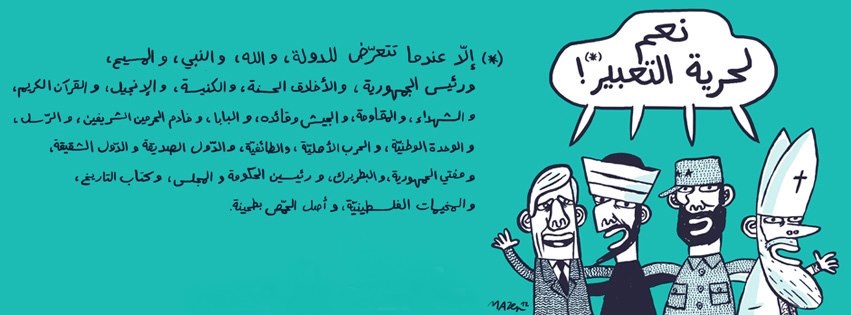
By Mazen Kerbaj

Picture By Mazen Kerbaj

Jean Assy, a free patriotic movement activist, was arrested a couple of days ago for tweeting against the president. Should hate speech be protected or not by the freedom of speech? People can debate for hours and hours, and like Elie sums it up pretty well in his post,  Jean Assy has people to watch his back, Many other Lebanese – like you – do not.

Is It Freedom?

What is exactly the difference between the United States and Lebanon? Well, you got that right: Everything. But on the top of that everything, there’s the freedom of speech. With freedom of speech, comes the freedom to criticize, and with the freedom to criticize, comes democracy. And with democracy, comes everything else, be it good or bad.

Lebanon – compared to the United States – has no freedom of speech. And it’s not about the biased media, or the conspiracies, or the wasta, or whatever we tend to convince ourselves with. We do not have freedom of speech, because we do not have a constitution that guarantees us freedom of speech. Our constitution, unlike the American one, gives the parliament the right to issue laws that can regulate the freedom of speech. In the United States, the Congress shall make no law regulating the freedom of speech (First Amendment to the Constitution):

Congress Shall make no law respecting an establishment of religion, or prohibiting the free exercise thereof; or abridging the freedom of speech; or the right of the people peaceably to assemble, and to petition the government for a redress of grievances

Meanwhile in Lebanon:

The freedom to express one’s opinion orally or in writing, the freedom of the press, the freedom of assembly, and the freedom of association shall be guaranteed within the limits established by law.

You can clearly see the difference between the first amendment and article 13 of the Lebanese constitution: The fact that there’s a law regulating freedom of speech, and that there’s a boundary, really says it all. And according to the law that’s inspired by the constitution, the religious leaders and president are immune to the freedom of speech. I do not understand how we dare to speak of the freedom of press, while something called the Publication Court (محكمة المطبوعات) still regulates the press and censors it. Even social media will be under censorship if the Lebanese Internet Regulation Act (LIRA) passes in the parliament.

The world was shocked in June when Muhammad Al-Qatta, a 15 year old child, got executed by Syrian rebels for blasphemy. KFC Tripoli was burned in September because of an anti-Islam movie that wasn’t even produced in Lebanon. Hezbollah’s Hassan Nasrallah made a (very) rare live appearance in a demonstration against that same movie. Draw a caricature mocking a Maronite Patriarch in a Saudi Newspaper, and you become bad. Speak against – Or insult, depending on your political allegiance – the other Patriarch, and you become worse. A human decides to burn the Coran 11000 Km away from Lebanon, and Lebanon’s peaceful – beware, that’s sarcasm – coexistence is suddenly under an imminent threat.

The Two types of Drivers

Two types of drivers in Lebanon exist. And no, they are not classified by gender, but by the way they react to the insults they get while driving. There’s the driver that starts insulting the other driver, stops the car in the middle of the highway, gets out of the car, beats the other driver, threatens him, possibly shoots him, before finally spending the night together at the police station. And then there’s the other type of driver: The one that hears the insult, smiles back while knowing that his mom is not a whore and he is not an animal – specifically a dog – , continues driving and reaches home where he later celebrates father’s day.

La Morale

When Jean Assi insulted the President, did the president become what Jean Assi said about him? No. It only made Jean Assi’s argument weaker. When that  American said that the Coran contains satanic verses, did it make the Coran contain satanic verses? No. It only made him look like a bigot. When the Patriach was made similar to the Devil in the caricature, did that make him the devil? I guess that’s a no too.

My Two Cents

You do not censor what you don’t like. That is not and will never be freedom. If you don’t like it, or don’t agree with it – even if it’s hate speech – you move on and/or respond to it. When you censor it, you’re acting like an ostrich hiding its head in the sand. To sum it up: You don’t fight an extremist bigot full of hate speech by putting him in jail because of his words. You fight him by letting him say what he wants, properly responding to him, and make him look like a fool.  Otherwise, the hate speech will spread faster, and there would not be any proper control over it. With the absolute Freedom of speech, you can at least know the impact of the thoughts and fight them. For Jon Stewart, a regime (Egypt) that is afraid of a Joke is not a regime. Can a regime afraid of an insult be considered one?

But Before wondering if the Lebanese need the first amendment and an absolute freedom of speech, we should start by wondering if they want an absolute freedom of speech. A right that includes with it the right to “blasphemy”, to write against the 18 sects, to draw comics about the prophet, -who knows- to side with the enemy publicly, to tweet against the president, to issue governmental and security leaks, while being simultaneously protected by the government.

Do the Lebanese really want freedom of speech?

The Week Of Confusion (Or How All The Stances Suddenly Changed)

Tripoli in June 2009 (Agence France-Presse)

Tripoli in June 2009 (Agence France-Presse)

Remember Why The Government Collapsed? The Prime Minister resigned when the parties of the coalition couldn’t agree on the formation of the body that will supervise the elections (and to what this body represents: An official green light to the 1960 law). Mikati back then resigned (Link) because Michel Aoun rejected the formation of the body. Jumblatt however, was siding with the President and the Prime Minister, asking to hold elections on time according to the 1960 law.

The Irony

Walid Jumblatt, who always called on holding elections on time, now wants an extension of the parliament’s mandate. Michel Aoun, who once said that he will not run with his party in the elections should they be under the 1960 law, is now officially a candidate. That can only explained by the fact that the political maneuvering Michel Aoun has done with the Orthodox Gathering Law for the past few months clearly made him more popular among Christians than the Christian M14 parties three weeks before elections (Link). If 2000 to 3000 votes change side in each Christian district, the FPM will have the ability to win several more districts than 2009 like Batroun, Ashrafieh and Koura. 10 extra MPs on M8’s side mean that the majority changes side in the parliament. And that makes one understand why the Future Movement are currently Ok. with an extension of the Mandate. Hezbollah doesn’t have time for elections with what is happening at Qussair, and an extension to the Mandate also means that Berri gets to stay speaker for 6 extra months and even 2 extra years (Who knows). And why the big No from Jumblatt to elections? 68 MPs on the side of M8 without the Jumblatt votes make Lebanon’s kingmaker as powerful as the Kataeb. The man who was responsible of the last two governmental changes in 2011 and 2013, will not stay as influential as he is now if the Status Quo changes and an alliance gets able to hold more than 64 MPs without him.

And one can see why the government convenes today to vote for holding the elections on time (Update: That’s what just happened) : The government, of M8 has a chance of getting a majority with the 1960 law, after all. The worst thing that might happen is everyone keeping the same shares for the next four years

Meanwhile, a Blow To All Norms

  • Selon l’usage, the parliament never convenes to vote or discuss a law with a resigned government in power. In the Lebanese history, this has rarely happened as there are  three documented events: a vote to pass a budget in 1969 in the middle of the Cairo agreement crisis, several sessions after the assassination of Rachid Karami in 1987 in the middle of the civil war, and the session that set free Samir Geagea in 2005. In 2013 however, the parliament convened with no “extraordinary reasons”, breaking the rule, only to vote an amendment on the electoral law.
  • Now here’s the awkward part. A caretaker outgoing Prime Minister,  cannot theoretically sign a law the Parliament voted. Yet Mikati signed the law,  breaking another norm.
  • The government that resigned also decides to meet again and take decisions. Not only is it weird and very unconventional that a caretaker government convenes and takes decisions, but to meet in order to vote on the specific reason that brought the government down?
  • And now the parliament wants to extend its mandate. The parliament, elected by the people for 4 years and 4 only, wants an extension because “they couldn’t agree on an electoral law” (link to an earlier post). What kind of alibi is that? How can’t you feel democracy running in our veins?

Mother of All Deadlocks.

Extending the parliament’s mandate can be considered to be unconstitutional, and just in case the law finds itself on its way to the constitutional council, there’s a big chance that the parliament’s extension would be nullified. However, it takes some time, and there’s a high chance that the result would come too late (July). By then, there would have been no elections held, the outgoing parliament would have no authority and there wouldn’t be another 128 members to replace them. We’re left with a Prime Minister Designate who can’t have a vote of confidence from a parliament that doesn’t exist, with a caretaker government, and with a President leaving in 10 months. Meet the collapse of the Lebanese system.

The Curious Case of Tammam Salam

Tammam Salam doesn’t know what to do. He was supposed to form a government that supervises the elections. But now we seem to be heading to 2 options:

  • Apparently the resigned government would supervise the elections should they happen, now that it desires to name the body members. Meaning that Salam would not be Prime Minister on election day. What’s the use of Salam’s government if it won’t be there on the 16th of June?
  • If we’re going towards an extension of the parliament’s mandate, then there is no use anymore for Salam’s “elections government”.

Not only Salam doesn’t know what is required from him, but he also probably doesn’t know which side he is representing and should be thus negotiating with: March 14 parties? Or all the parliament? (taking into consideration that he got named by 124 MPs. (link))

There’s a Lebanese expression:  كثرة الطباخين بتحرق الطبخة. Between finding an electoral law, extending the mandate, organizing the elections in three weeks, adjourning elections, forming a government, the Lebanese parties are unable to know on what and with whom to negotiate.

Remember when the 1960 law was “never to be spoken of again”?