Parliamentary Elections

Understanding Lebanon’s Electoral Demographics With 40 Maps

Electoral map of Lebanon according to the modified 1960 law of 2008

Electoral map of Lebanon according to the modified 1960 law of 2008

Lebanese like four things: Speculation, religion, percentages, and rankings. What is the fastest growing sect? In 25 years, what religious group will be the biggest? What religious groups are shrinking in size? Where? Every Lebanese citizen asked himself at least once these questions. Perhaps because of a trans-sectarian fear of becoming a minority, or perhaps because of simple curiosity. For a country with no census since 1932, the closest thing officially available and that is constantly updated is the electoral data. The Lebanese Association for Democratic Elections (LADE) created an amazing and extremely useful website, lebanonelectiondata.org where you’ll find visualizations on trends in voter registration by confession, gender, as well as white ballots cast and voter representation in parliament. The amount of information offered is too huge but it’s also extremely organized and simple.

All the following maps are taken from the website, and in case you’re interested to know the exact percentage for every district – the maps are based on the modified 1960 electoral law of 2008 – don’t hesitate to check their website (simply click on the district of your choice in the interactive map). And for those of you who prefer Excel tables instead of maps, you can find what you’re searching for here.

A- Confession Trends

a- Maronite

Maronite 2005-2009

Map 1: Maronite influence change between 2005 and 2009
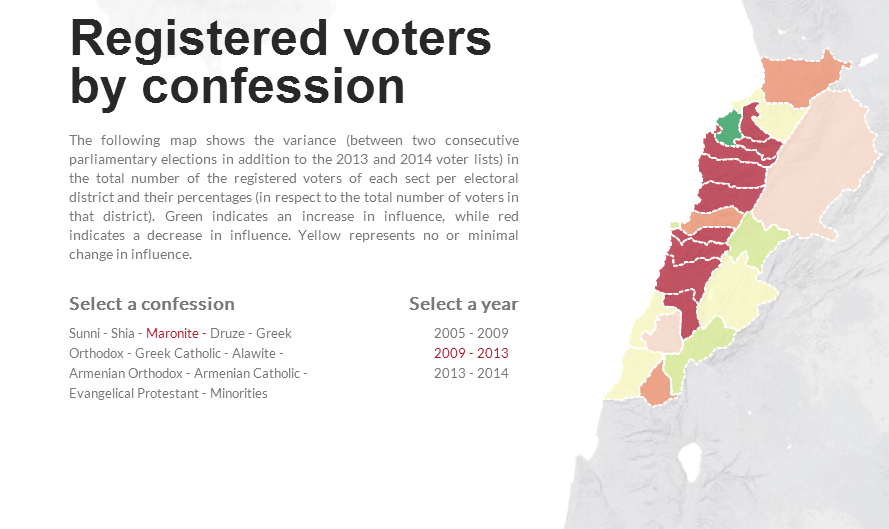
Maronite 2009-2013

Map 2: Maronite influence change between 2009 and 2013

Maronite 2013-2014

Map 3: Maronite influence change between 2013 and 2014

b- Greek Orthodox
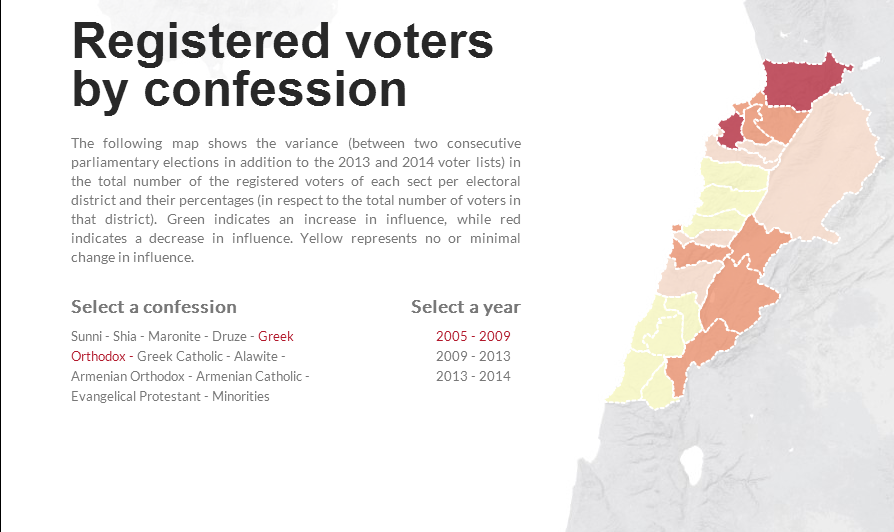
Greek Orthodox 2005-2009

Map 4: Greek Orthodox influence change between 2005 and 2009
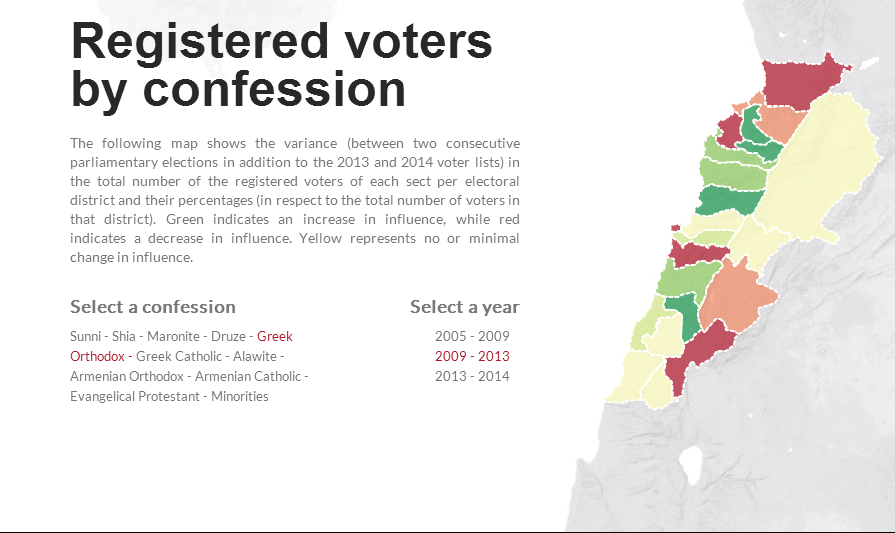
Greek Orthodox 2009-2013

Map 5: Greek Orthodox influence change between 2009 and 2013
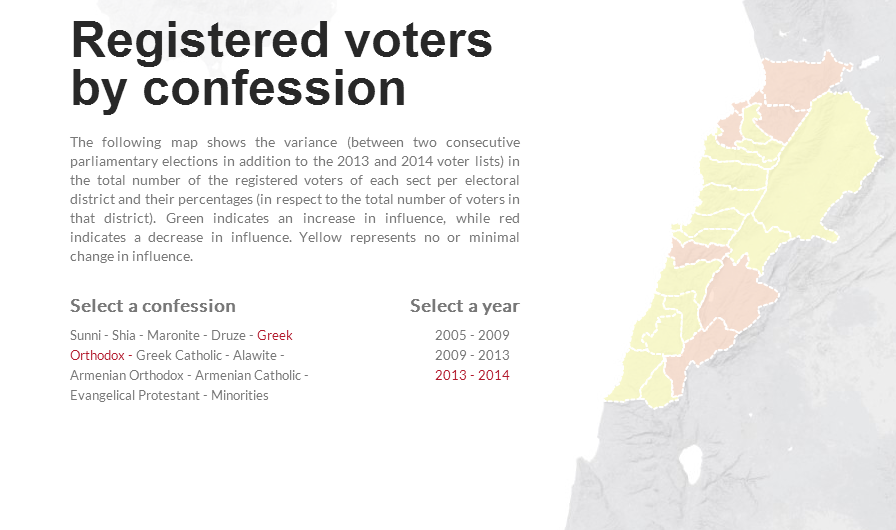
Greek Orthodox 2013-2014

Map 6: Greek Orthodox influence change between 2013 and 2014

c- Greek Catholic
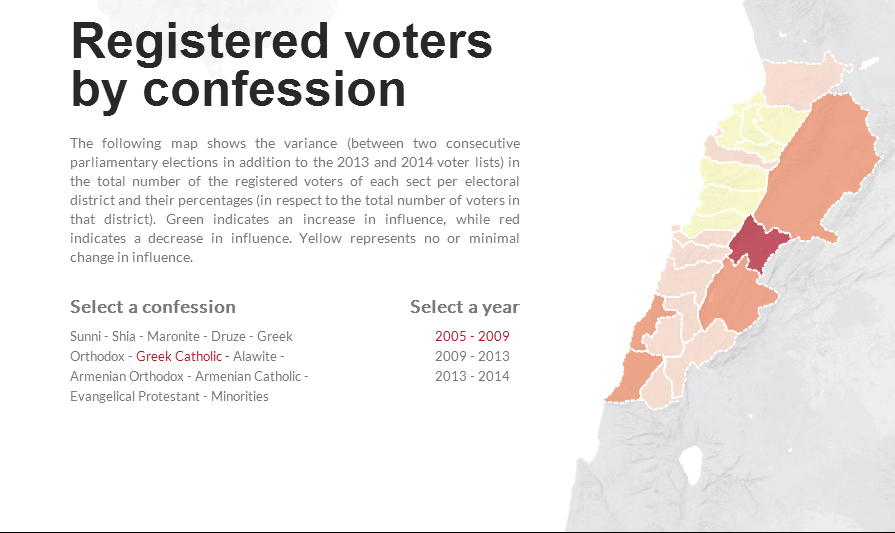
Greek Catholic 2005-2009

Map 7: Greek Catholic influence change between 2005 and 2009
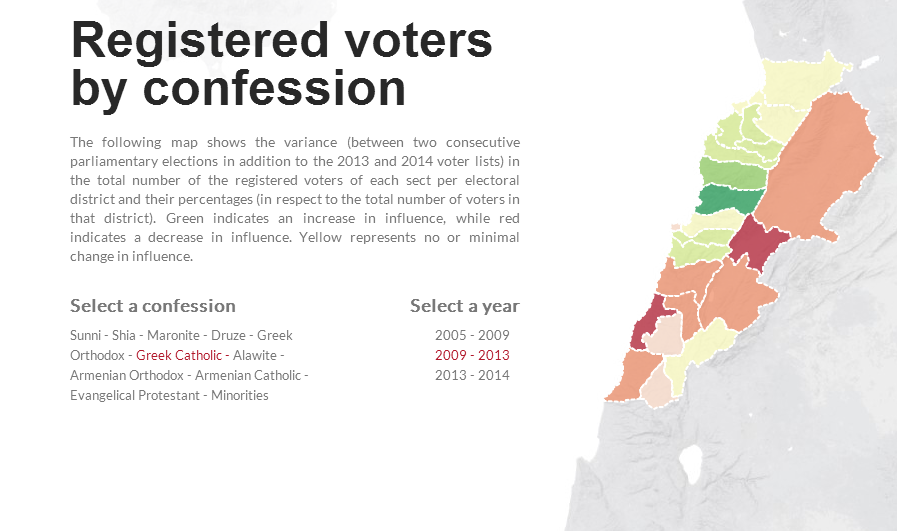
Greek Catholic 2009-2013

Map 8: Greek Catholic influence change between 2009 and 2013

Greek Catholic 2013-2014

Map 9: Greek Catholic influence change between 2013 and 2014

d- Armenian Orthodox

Armenian Orthodox 2005-2009

Map 10: Armenian Orthodox influence change between 2005 and 2009
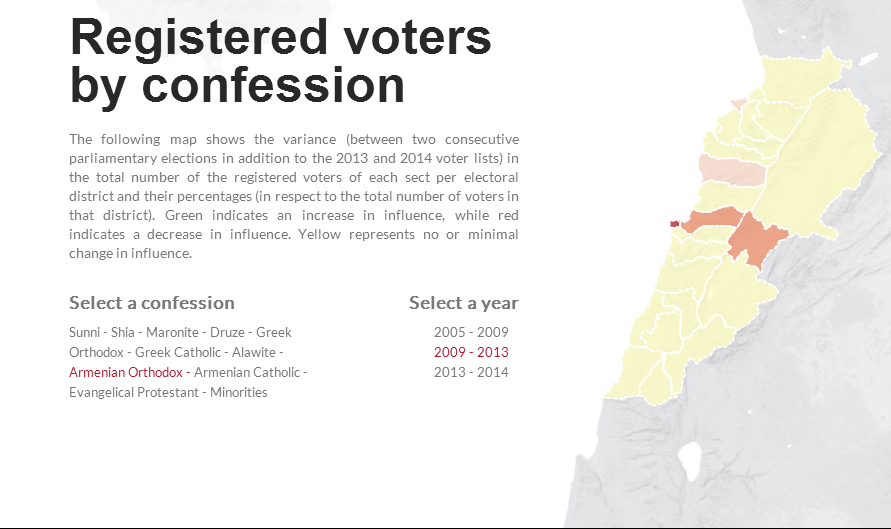
Armenian Orthodox 2009-2013

Map 11: Armenian Orthodox influence change between 2009 and 2013

Armenian Orthodox 2013-2014

Map 12: Armenian Orthodox influence change between 2013 and 2014

e- Armenian Catholic
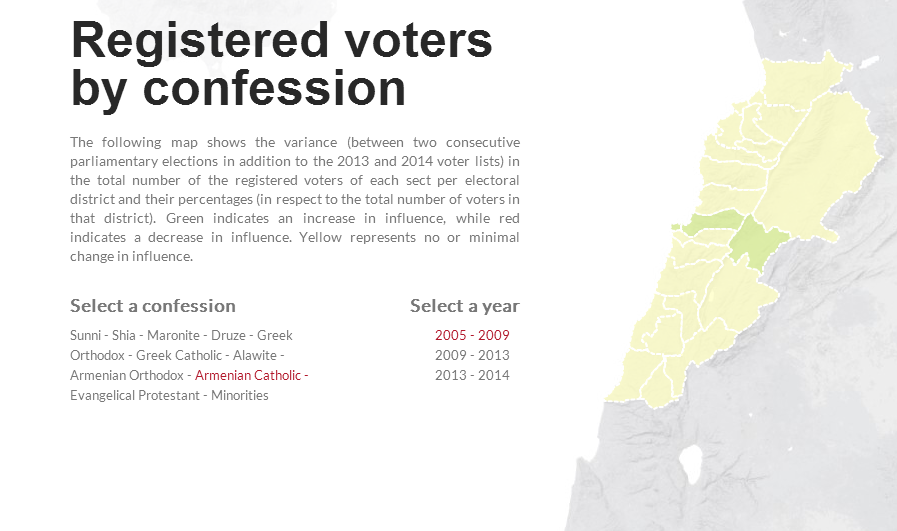
Armenian Catholic 2005-2009

Map 13: Armenian Catholic influence change between 2005 and 2009
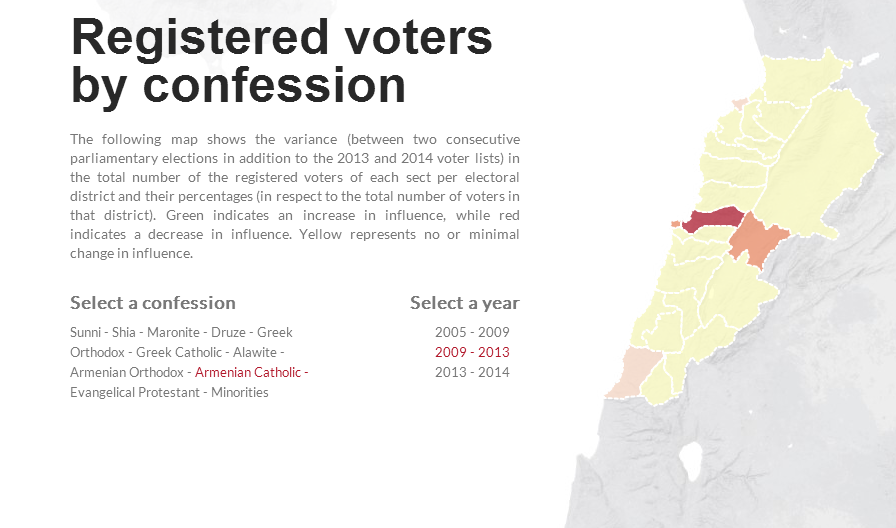
Armenian Catholic 2009-2013

Map 14: Armenian Catholic influence change between 2009 and 2013

Armenian Catholic 2013-2014

Map 15: Armenian Catholic influence change between 2013 and 2014

 f- Protestant
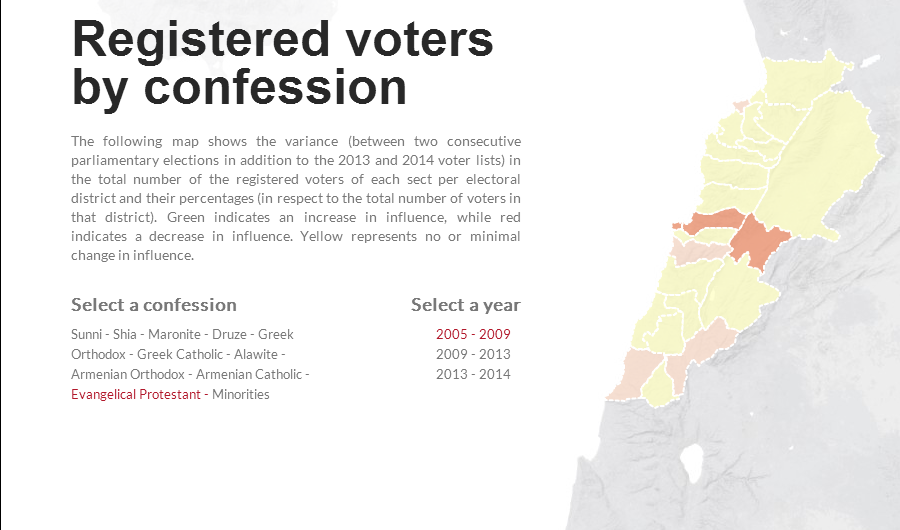
Protestant 2005-2009

Map 16: Protestant influence change between 2005 and 2009

Protestant 2009-2013

Map 17: Protestant influence change between 2009 and 2013
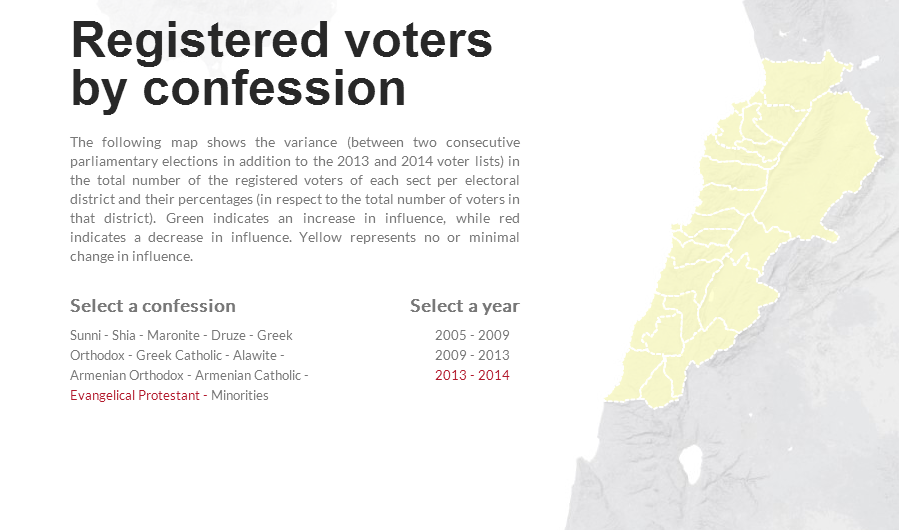
Protestant 2013-2014

Map 18: Protestant influence change between 2013 and 2014

 g- Christian Minorities
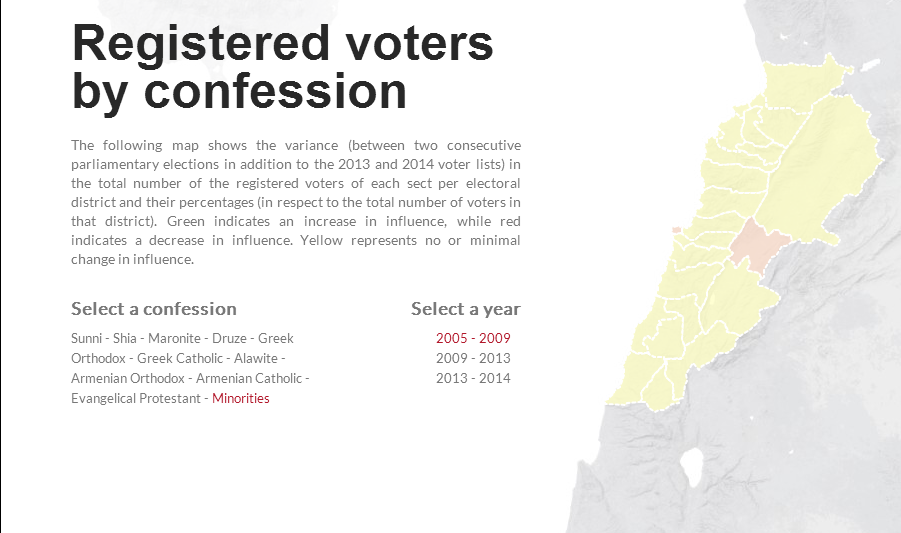
Minorities 2005-2009

Map 19: Minorities influence change between 2005 and 2009
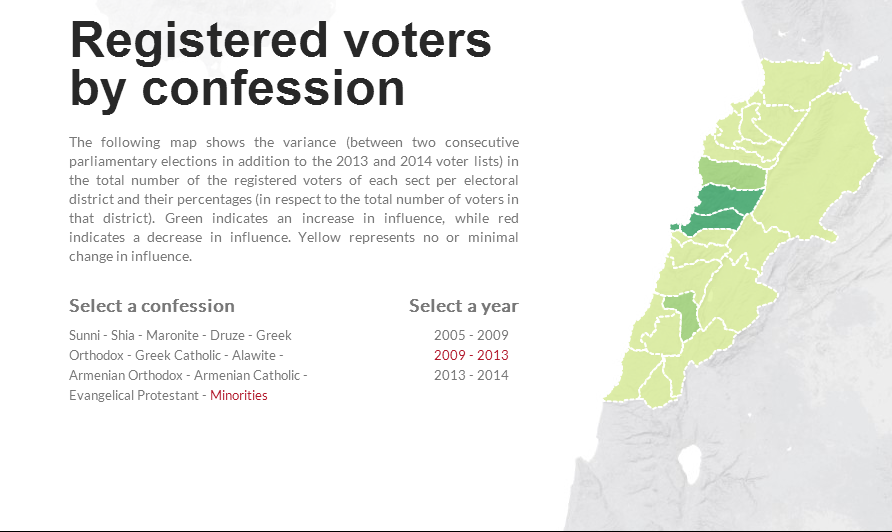
Minorities 2009-2013

Map 20: Minorities influence change between 2009 and 2013

Minorities 2013-2014

Map 21: Minorities influence change between 2013 and 2014

h- Sunni
Sunni 2005-2009

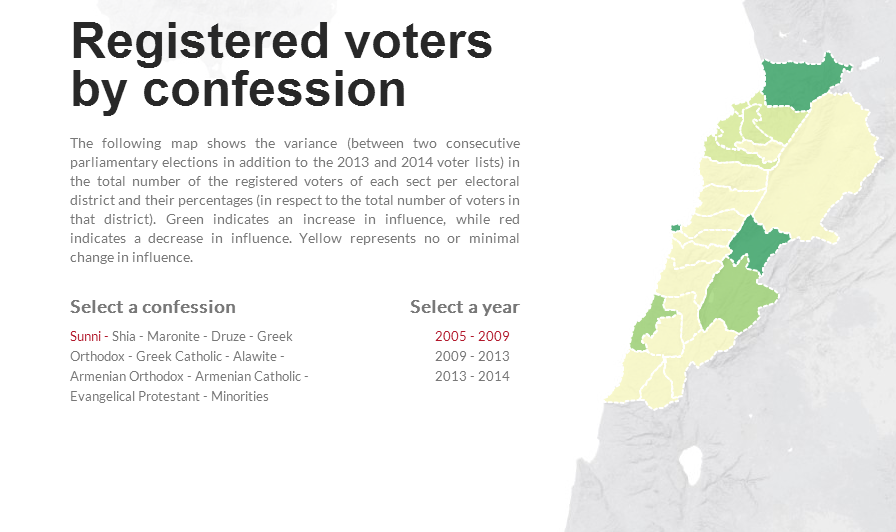
Map 22: Sunni influence change between 2005 and 2009

Sunni 2009-2013

Map 23: Sunni influence change between 2009 and 2013

Sunni 2013-2014

Map 24: Sunni influence change between 2013 and 2014

i- Shia
Shia 2005-2009

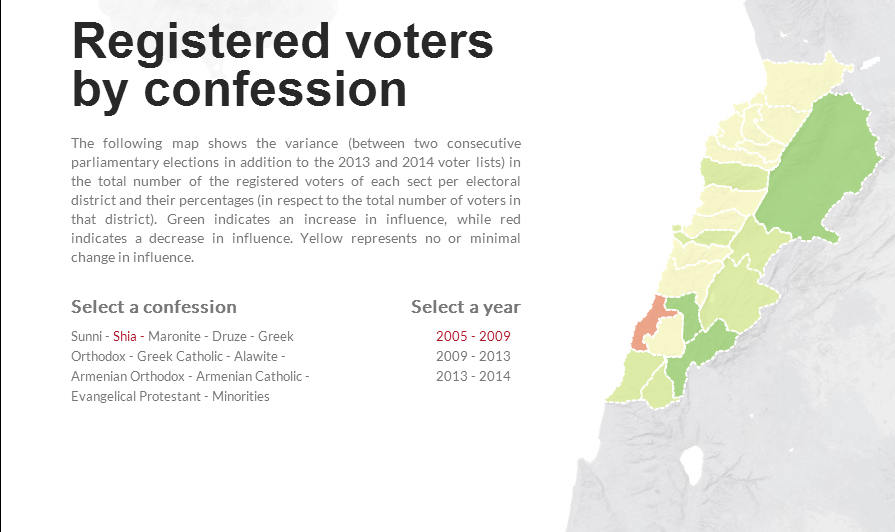
Map 25: Shia influence change between 2005 and 2009
Shia 2009-2013

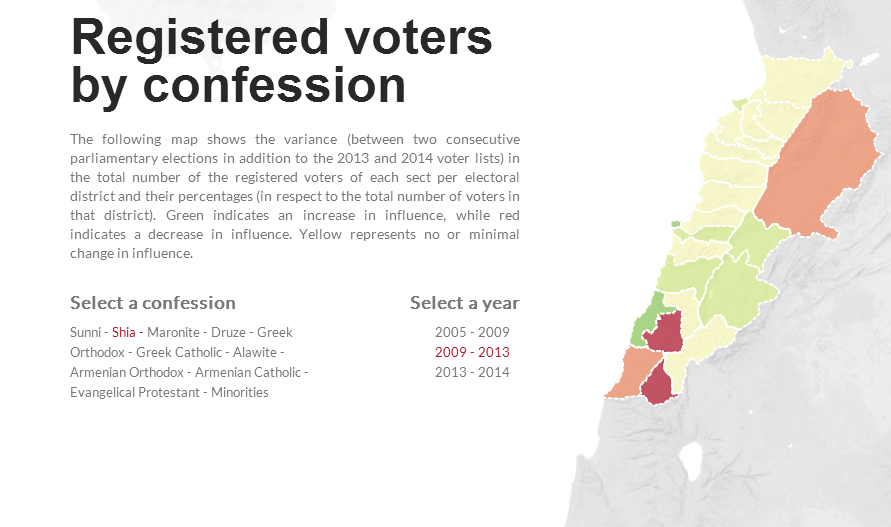
Map 26: Shia influence change between 2009 and 2013

Shia 2013-2014

Map 27: Shia influence change between 2013 and 2014

j- Druze

Druze 2005-2009

Map 28: Druze influence change between 2005 and 2009
Druze 2009-2013

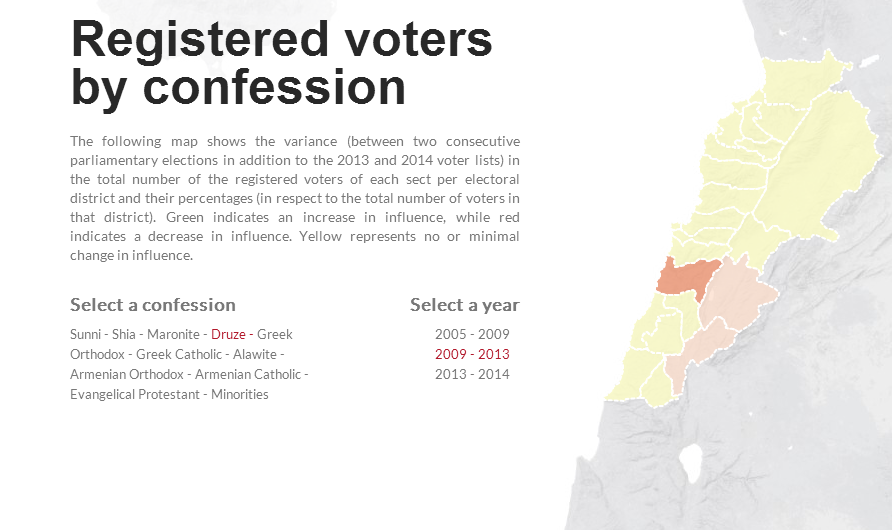
Map 29: Druze influence change between 2009 and2013

Druze 2013-2014

Map 30: Druze influence change between 2013 and 2014

k- Alawite
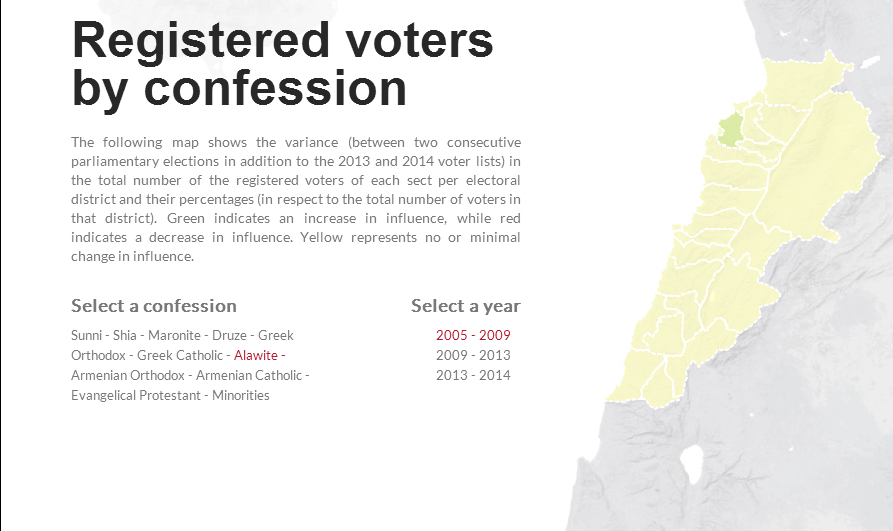
Alawite 2005-2009

Map 31: Alawite influence change between 2005 and 2009

Alawite 2009-2013

Map 32: Alawite influence change between 2009 and 2013
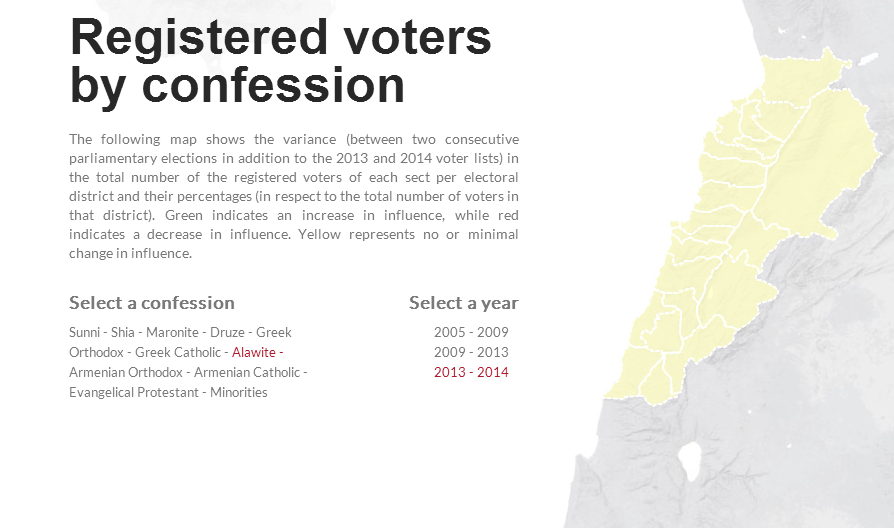
Alawite 2013-2014

Map 33: Alawite influence change between 2013 and 2014

B- Gender Trends

Gender Voter registration 2009

Map 34: Influence by gender based on the 2009 voter registration
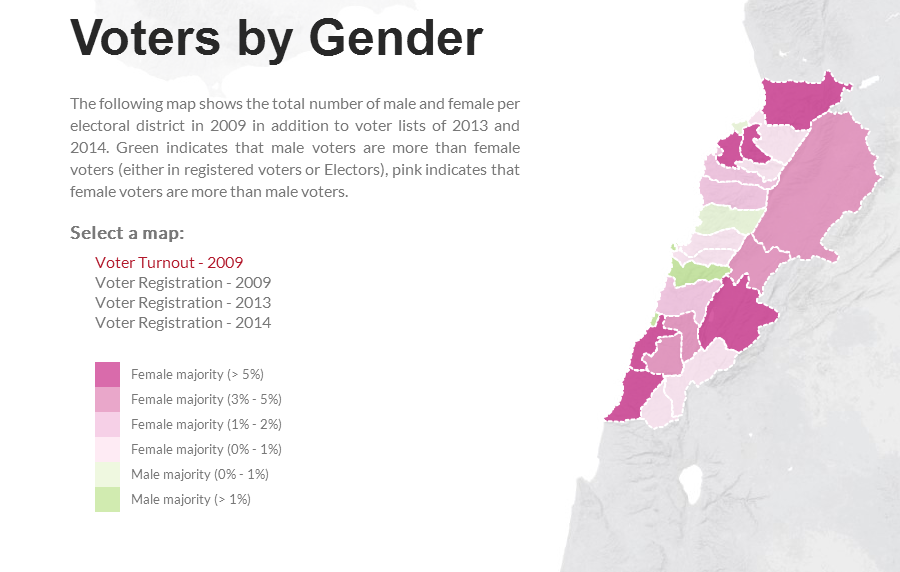
Gender Voter Turnout 2009

Map 35: Influence by gender based on the vote turnout of 2009
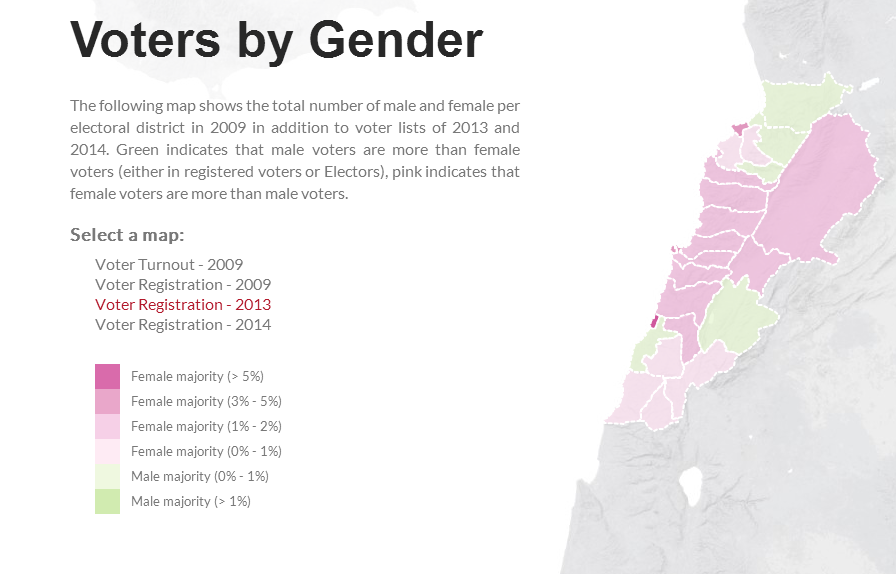
Gender Voter registration 2013

Map 36: Influence by gender based on the 2013 Voter registration

Gender Voter registration 2014

Map 37: Influence by Gender based on the 2014 voter registration

C- Vote Power (Number of registered voters/Number of MPs)
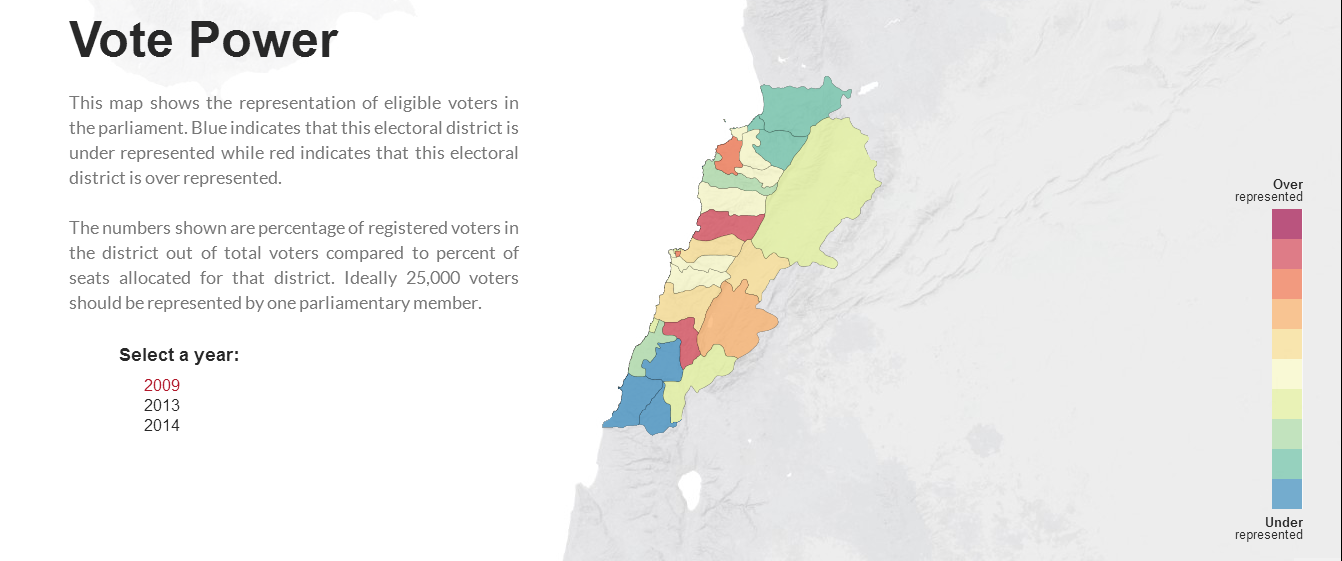
Vote Power 2009

Map 38: Vote Power in 2009

Vote Power 2013

Map 39: Vote Power in 2013

Vote Power 2014

Map 40: Vote Power in 2014

Les Grandes Lignes

This is too much data to analyze, and basically every map can be reviewed on its own. However there are general observations common to most of the maps:

(1) Female voters are by far more influential than male voters. If you take a look at maps 34,35,36 and 37, you’ll hardly find any green. According to map 35, the only districts where  the men were the majority of voters in 2009 are Aley, Beirut, Tripoli, Saida, and Keserwan.

(2) Christian percentages are mainly dropping everywhere (maps 1→21). And even when the percentages of a certain Christian sect in a certain district is rising, it usually reflects a much bigger drop by another Christian sect. For example, the Maronite percentage in Koura is the only one that became more important (the green spot in map 2), but this is only because the Greek Orthodox percentage of Koura is dropping even more (maps 4 and 5). Another interesting fact is that the Greek Catholics are having higher percentages in the Christian heartland (Northern Mount-Lebanon and the Southern parts of the North) while their percentages are massively dropping everywhere else (maps 7, 8 and 9). It could indicate that some Greek Catholics are changing their place of registration (which is the hometown) from the mixed districts to the Christian heartland.

(3) On the Muslim side, there’s an interesting trend among Shias and Sunnis. If you look at the maps 23 and 26, you realize that the Sunnis are becoming more populous in the Shia-majority districts (Look how much the south is green in map 23) while the Shias are having higher percentages in the Sunni dominated districts (Take a look at Beirut, Saida, Zahle, West-Bekaa and the Chouf in map 26).

(4) If you check maps 38→40, you’ll notice that the districts that are the most underrepresented are the Muslim and rural ones (mainly Akkar and the South).

(5) So to sum things up, on the long run, most of the districts tend to become more religiously mixed. For example take a look at the Greek Orthodox in map 5. The Greek Orthodox are having lower percentages in their heavyweight districts like Akkar, Marjeyoun, Koura, Tripoli, Aley and Beirut. Their percentages are however rising in the other districts where they are barely present (especially in the Christian heartland).

The Week Of Confusion (Or How All The Stances Suddenly Changed)

Tripoli in June 2009 (Agence France-Presse)

Tripoli in June 2009 (Agence France-Presse)

Remember Why The Government Collapsed? The Prime Minister resigned when the parties of the coalition couldn’t agree on the formation of the body that will supervise the elections (and to what this body represents: An official green light to the 1960 law). Mikati back then resigned (Link) because Michel Aoun rejected the formation of the body. Jumblatt however, was siding with the President and the Prime Minister, asking to hold elections on time according to the 1960 law.

The Irony

Walid Jumblatt, who always called on holding elections on time, now wants an extension of the parliament’s mandate. Michel Aoun, who once said that he will not run with his party in the elections should they be under the 1960 law, is now officially a candidate. That can only explained by the fact that the political maneuvering Michel Aoun has done with the Orthodox Gathering Law for the past few months clearly made him more popular among Christians than the Christian M14 parties three weeks before elections (Link). If 2000 to 3000 votes change side in each Christian district, the FPM will have the ability to win several more districts than 2009 like Batroun, Ashrafieh and Koura. 10 extra MPs on M8’s side mean that the majority changes side in the parliament. And that makes one understand why the Future Movement are currently Ok. with an extension of the Mandate. Hezbollah doesn’t have time for elections with what is happening at Qussair, and an extension to the Mandate also means that Berri gets to stay speaker for 6 extra months and even 2 extra years (Who knows). And why the big No from Jumblatt to elections? 68 MPs on the side of M8 without the Jumblatt votes make Lebanon’s kingmaker as powerful as the Kataeb. The man who was responsible of the last two governmental changes in 2011 and 2013, will not stay as influential as he is now if the Status Quo changes and an alliance gets able to hold more than 64 MPs without him.

And one can see why the government convenes today to vote for holding the elections on time (Update: That’s what just happened) : The government, of M8 has a chance of getting a majority with the 1960 law, after all. The worst thing that might happen is everyone keeping the same shares for the next four years

Meanwhile, a Blow To All Norms

  • Selon l’usage, the parliament never convenes to vote or discuss a law with a resigned government in power. In the Lebanese history, this has rarely happened as there are  three documented events: a vote to pass a budget in 1969 in the middle of the Cairo agreement crisis, several sessions after the assassination of Rachid Karami in 1987 in the middle of the civil war, and the session that set free Samir Geagea in 2005. In 2013 however, the parliament convened with no “extraordinary reasons”, breaking the rule, only to vote an amendment on the electoral law.
  • Now here’s the awkward part. A caretaker outgoing Prime Minister,  cannot theoretically sign a law the Parliament voted. Yet Mikati signed the law,  breaking another norm.
  • The government that resigned also decides to meet again and take decisions. Not only is it weird and very unconventional that a caretaker government convenes and takes decisions, but to meet in order to vote on the specific reason that brought the government down?
  • And now the parliament wants to extend its mandate. The parliament, elected by the people for 4 years and 4 only, wants an extension because “they couldn’t agree on an electoral law” (link to an earlier post). What kind of alibi is that? How can’t you feel democracy running in our veins?

Mother of All Deadlocks.

Extending the parliament’s mandate can be considered to be unconstitutional, and just in case the law finds itself on its way to the constitutional council, there’s a big chance that the parliament’s extension would be nullified. However, it takes some time, and there’s a high chance that the result would come too late (July). By then, there would have been no elections held, the outgoing parliament would have no authority and there wouldn’t be another 128 members to replace them. We’re left with a Prime Minister Designate who can’t have a vote of confidence from a parliament that doesn’t exist, with a caretaker government, and with a President leaving in 10 months. Meet the collapse of the Lebanese system.

The Curious Case of Tammam Salam

Tammam Salam doesn’t know what to do. He was supposed to form a government that supervises the elections. But now we seem to be heading to 2 options:

  • Apparently the resigned government would supervise the elections should they happen, now that it desires to name the body members. Meaning that Salam would not be Prime Minister on election day. What’s the use of Salam’s government if it won’t be there on the 16th of June?
  • If we’re going towards an extension of the parliament’s mandate, then there is no use anymore for Salam’s “elections government”.

Not only Salam doesn’t know what is required from him, but he also probably doesn’t know which side he is representing and should be thus negotiating with: March 14 parties? Or all the parliament? (taking into consideration that he got named by 124 MPs. (link))

There’s a Lebanese expression:  كثرة الطباخين بتحرق الطبخة. Between finding an electoral law, extending the mandate, organizing the elections in three weeks, adjourning elections, forming a government, the Lebanese parties are unable to know on what and with whom to negotiate.

Remember when the 1960 law was “never to be spoken of again”?

Waiting For The Electoral Law – March 14’s Hybrid Law: A Review

Lebanon's Electoral Map According To The March 14's Hybrid Law. The colored districts are the small winner-takes-all ones and the big ones within the white line are the big districts under proportional unlike in the picture.

Lebanon’s Electoral Map According To The March 14’s Hybrid Law. The colored districts are the small winner-takes-all districts and the big ones within the white line are the big districts under proportional representation.

The Lebanese Forces, Future Movement, and the PSP agreed on a hybrid electoral law last week. The law is very similar to the electoral law the Lebanese Forces proposed in February (Here’s the analysis on that law), with some exceptions. I’m going to use the same arguments I used when I reviewed the previous law, but comment on the new changes. Unlike the previous law that had an unclear criteria here, I didn’t find any criteria at all for this law

Here’s the number of voters by sects, in case you’re interested:

Number of voters (and percentage) in each district according to their religion.

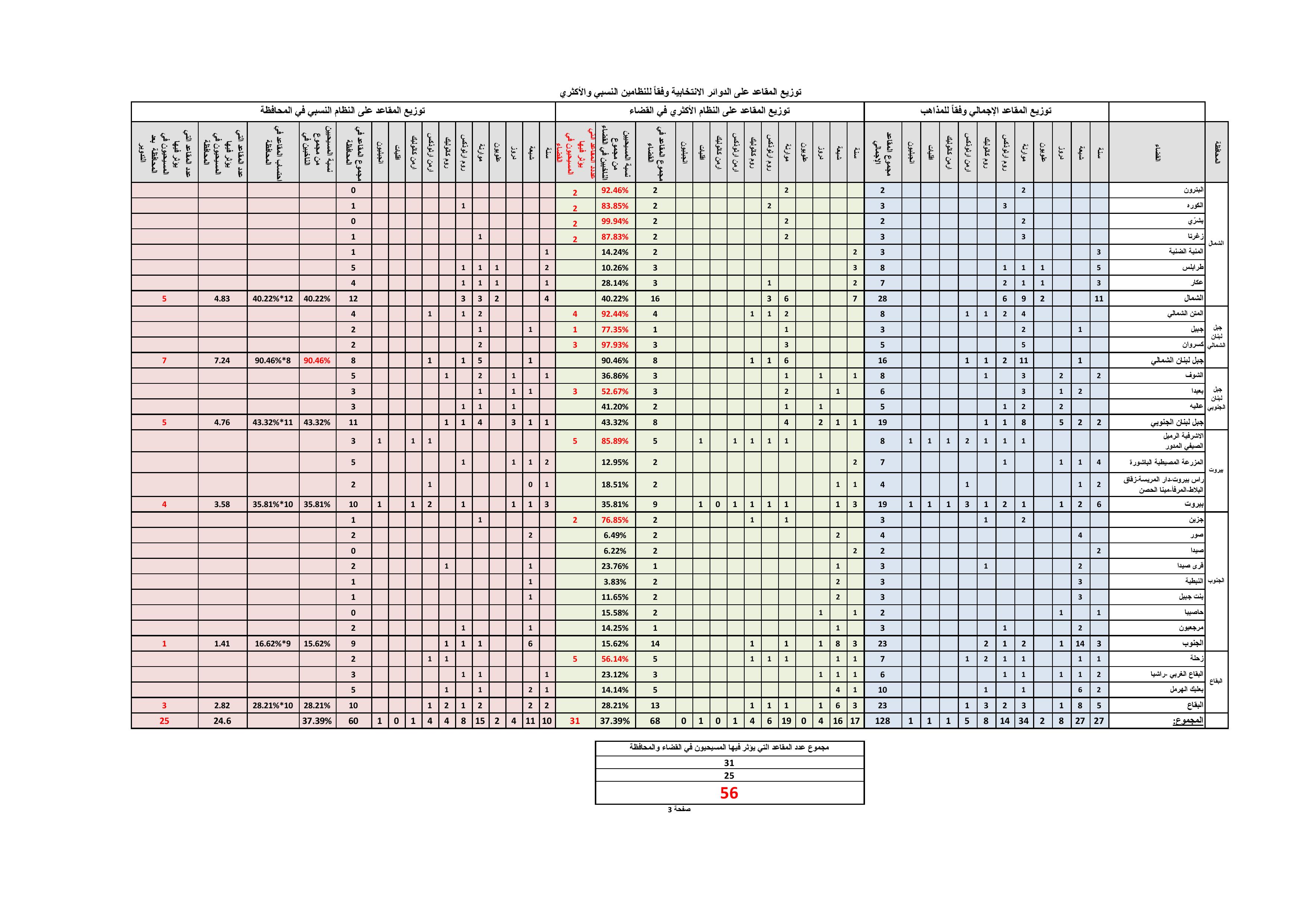
Also, here’s a table for the seat allocations:

Table of seats according to March 14's hybrid law

Table of seats according to March 14’s hybrid law (High Res)

In a nutshell, the law separates Lebanon into two types of constituencies: 26 small districts (Allocated 68 seats), that are in most cases cazas, under a winner-takes-all system and 6 big districts (Allocated 60 seats), that are in most cases the mohafazas, under a PR system. The main aim of the law is to get the biggest number of Christian-elected MPs to the parliament. The electoral constituencies are in most cases the administrative districts (Cazas, Governorates) of Lebanon. However, there are some few weird things: West Bekaa-Rashaya or Baalbek-Hermel aren’t separated. Also, on a bigger level, the Mohafaza of Mount-Lebanon is split to two districts: A northern bigger one and a southern smaller one (Aley-Chouf).

From Unclear Criteria To No Criteria At All (Or How It Keeps Getting Worse)

My criticism on the old law proposal:

The previous law proposal of the Lebanese forces allocated the seats on the basis of a certain criteria that you can see here. However, a big number of the districts don’t obey to any of the criteria. For example, in Jezzine the Greek Catholics aren’t considered to be a minor sect in the district so the seat stays in the caza and doesn’t shift to the governorate. That’s only one example, and there’s a lot more. Apparently the Christian seats are taken as one block and the minor Christian sects’ seats within a Christian district with a Maronite majority don’t go to the Mohafazas and stay in the caza. The lawmakers need to clarify a few things. Also, there are other districts where the criteria is missing something or doesn’t match the district’s seat repartition. For example, why is it that the Protestant seat gets transferred from Beirut I to the Governorate and not the Armenian Catholic one?

My new criticism: There seems to be no criteria at all in the allocation of seats. There are several small changes in a lot of districts (The Chouf gets 4 MPs instead of 3 in the old hybrid LF proposal. Baalbak gets 4 instead of 5. Tripoli gets for instead of 3, just as examples). Also, the law is clearly in favor of the March 14 parties, while giving the Christians a bigger influence than the 1960 law.

Unequal Voting (same criticism than before)

Among other things that makes this draft law odd is the disproportion of seats within the majoritarian system. For example, Akkar, where 120608 voted in 2009, has 3 seats, while Bcharre that had 17183 voters in 2009 has 2 seats. Bcharre voters are 4.55% of the North’s voters, while Akkar voters are 31.96% of the North voters. That means that on the Mohafaza scale, the Akkaris get to choose 31.96% of 11 MPs which is 3.51 MPs. A total of 3.51+3=6.51 MPs for the people of Akkar, while Bcharre gets to choose 4.55% of 11 MPs which is 0.50 MPs. A total of 2+0.50=2.50 MPs for Bcharre. the number of electors in Akkar are 7.01 times more than Bcharre, which means that Akkar should have 7 times more MPs. Ironically it only has 6.51/2.50= 2.6 times more than Bcharre.

That disproportion between the districts will be present in almost all hybrid laws, because some districts get to have more influence sometimes even though they have a smaller population. And after all, that’s how the law gives more influence to Christians. When the Akkar (66% Sunni) district should be as 7 times more influential than Bcharre (100% Christian) and is instead only 2.66 times more influential, you get to understand how the Christians, 38%, will be able to elect 52 MPs (40.62%). A big number of the small districts happen to be mainly Christian and that’s how the Lebanese Forces draft law can boost the number of the Christian-elected MPs.

The Analysis (The Small Differences That Made Future Movement and the PSP Accept The Law)

If you take a look at the previous electoral law proposed by the Lebanese Forces in February, you’ll quickly spot some interesting differences with the current consensual LF-PSP-FM law:

  1. Instead of having 3 seats, Tripoli gets one additional seat. That means that the Mikati Bloc will find it harder to run on the Mohafaza now that it has lost a Sunni MP there (The “proportional representation” North district has 4 MPs now instead of 5, making it hard for Mikati to get an extra MP using the M8 votes of the Mohafaza, while the FM will get an extra MP on the caza where they can easily win all the 4 seats of Tripoli because it’s under a majoritarian system)
  2. Instead of having 5 seats, Baalbak-Hermel ends up with 4 seats (1 gets transferred to the governorate) meaning that Hezbollah will lose an extra MP that will be put in the governorate where he will be subject to the influence of all of the governorate’s voting where the Shias are 42% thus lessening the Shia influence on that extra seat.
  3. Beirut: Instead of having a Beirut I of 5 MPs and a Beirut III of 2 MPs, the number of MPs becomes 4 for Beirut I that is up to 85% Christian and 4 to Beirut III that is 28% Christian. Meaning that the Christians lose the ability to elect en extra MP in Beirut I while also losing the ability to influence the election of 2 more MPs that were transferred from Beirut III to the Mohafaza (according to the previous LF law) where the Christians are 35%. That suits the FM by minimizing the Christian influence.
  4. Also, there’s a remake of Beirut I. It loses Mdawar (the Armenian district) to Beirut II, meaning that the Armenian population, that supports M8, would not be able to help M8 win Beirut I anymore.
  5. Instead of Having 3 MPs in the Caza and 2 in the Mohafaza for Kesserwan (like the previous LF law proposal), there are now 2 in the Caza and 3 in the Governorate. The LF has lost the 2 previous elections in Kesserwan. Minimizing the number of MPs on the Caza is a smart way from them to get a better result, so that they might win that extra MP in case they get better results in Northern Mount Lebanon.
  6. And now the Best part, the Chouf and Southern Mount-Lebanon: Baabda that has no more than  18% of Druze votes gets removed from Southern Mount Lebanon and added to Northern Mount Lebanon. Also, the Chouf gets an extra MP, making them 4. That can only mean that Jumblat will be able to directly control 6 seats on the majoritarian system (4 from Chouf, 2 from Aley), but also to influence the election on the “Proportional Representation district” of Chouf-Aley (Southern Mount-Lebanon), where the Druze will form around 40%, now that it’s deprived from the Christian-Shia heavyweight of Baabda. 40% of 7 MPs is somewhere around 3 MPs for Jumblatt (that’s if he’s running alone), giving him a total of 9 MPs. Jumblatt will thus be (more or less) able to keep the same size of his bloc.
  7. Northern Mount-Lebanon: Now that Baabda joined the others, the Shia vote will be somewhere around 15%. However, 2 of the 12 seats are Shia, meaning that 16% of the seats are Shia. There will be thus an overflow from the Christian votes toward the Shia seat, and the Christian influence (including the LF) would not be diminished in the PR district.
  8. Hasbaya-Marjeyoun aren’t separated anymore, and there is only 1 MP on the Caza scale and not 2 like before. This is clealry intended to maximize the number of seats on the Mohafaza (South) scale, where M14 hs a bigger chance of getting MPs, knowing that the Shias are a majority in Marjeyoun-Hasbaya meaning that M8 will still win anything there because of the winner takes-all system. The Shia still are a majority in the South, but with proportional representation and a big number of seats, M14 will surely do better.

How Much Christian-elected seats?

  • On The winner-takes-all districts: Beirut I (4), Baabda (3), Metn (4), Kesserwan (2), Jbeil (1), Batroun (2), Bsharri (2), Koura (2), Zgharta (2), Jezzine (2), Zahle (5). A total of 29
  • On the Proportional Reresentation districts: North (4.4 = 40% of 11), Northern Mount Lebanon (8.68 = 72% of 12), Southern Mount Lebanon (2.6 = 37% of 7), Bekaa (3.36 = 28% of 12), South (1.65 = 15.6% of 11), Beirut (2.8= 35% of 8). A total of 23.49 seats

That means that the Christians, under that draft law, would elect 52.49 seats. Under the previous hybrid law draft, the Christians were able to elect 56. The Lebanese Forces had  to please their allies somehow….

So Who Wins?

I’m going to consider that the Lebanese are reluctant to change, elect the same MPs again and again and apply the results of 2009 on the new Lebanese Forces law.

  • The Cazas

M14: Koura (2), Batroun (2), Bcharri (2), Meniyeh-Donieh (2), Tripoli (4), Akkar (3), Metn (1/4), Chouf (4), Aley (2), Saida (2),, Zahle (5), West Bekaa-Rashaya (3), Beirut (4,2,4). A total of 42/68 seats in the winner-takes-all districts for M14

M8: Zgharta (2), Metn (3/4), Jbeil (1), Kesserwan (2), Baabda (3), Jezzine (2),Tyre (2), Saida Villages(1), Nabatiyeh (2), Bint Jbeil (2), Marjeyoun (1), Baalbak-Hermel (5). A total of 26/68 seats in the Winner-takes-all districts for M8.

PS: For Beirut, I considered that the agreements of Doha splitting the Beirut 2 seats equally between M14 and M8 are now history. For the Governorate of Beirut (Proportional Representation), I use the same results as 2009.

  • The Governorates

I used the results of 2009,  and made these tables:

Results according to the hybrid law (1) Results according to the hyvrid law (2)

PS: I don’t know what the minimum threshold (The minimum percentage that a list should have so that it can get one of its candidates elected) will be, so I made the assumption that it would be somewhere around 10%. That’s why you will notice the presence of independent MPs.

That means that the final outcome is 68 (26+42) MPs  for M14, 55 MPs for M8 (29+26), and 5 Independent MPs.

As you can notice, we have an independent breach, but the results are clearly in favor of M14, even  almost the same results than 2009 (70-58).  A lot of things changed since 2009 and a number of alliances will probably change, but that’s approximatively how the results might look like.

With 9 seats for Jumblatt, and a difference of 70-58, the Bey of Mukhtara will still be Lebanon’s Kingmaker. That’s exactly why the Progressive Socialist Party gave its approval to this draft law.

Gerrymandering, Again.

The Reasons Behind Mikati’s Resignation

 Deputy Prime Minister Samir Moukbel and Mikati after the resignation (The Daily Star)

Deputy Prime Minister Samir Moukbel and Mikati after the resignation (The Daily Star)

The Lebanese government of June 2011 is now history. Najib Mikati resigned due to a lack of agreement on an electoral comitte to oversee the elections and Mikati’s failure to extend the the term of ISF chief Ashraf Rifi . You can see his resignation speech [here]. Such a move can be full of meanings, so why did Mikati resign? And more importantly, why now?

It’s all in the Speech

Mikati said that he thought about resigning twice before. The first time was about M8’s refusal to fund the Special Tribunal for Lebanon, and the second time was when Wissam Al-Hassan was assassinated. If Mikati had resigned when the STL wasn’t being funded, it would’ve been too early. Back then, M14 was still strong and he could’ve been easily replaced. If Mikati had resigned after Al Hassan’s funeral, it would’ve also been a fatal bullet for his political career (Resigning meant that his government was responsible for what happened). At both times, Mikati knew that if he would resign it will have negative consequences on him before everyone else. So why now? Mikati wanted an alibi to leave the government so that he can run in the elections. But he couldn’t simply leave. He wanted to leave in a context that makes him stronger, not weaker. And instead of giving him one reason to quit, they gave him two. It was the perfect moment for him. The first motive is a national one, while the second motive is about Sunni politics.

 A National Alibi

Mikati resigned because they wouldn’t let him organise elections. Read that sentence, (more…)

Extending the Lebanese Parliament’s Mandate

Lebanese Parliament (The Daily Star)

Lebanese Parliament (The Daily Star)

There has been a lot of talk recently on a draft law that would extend the parliament’s mandate six more months so that the lawmakers can reach an agreement on an electoral law. Some reports even suggested it might be two years instead of six months. And that means a lot.

Wages. Yes, we tend to forget that quite often, but a Member of the Parliament gets paid 7333$/Month (It actually gets higher with the new raise of 2012 and with the special allowances). That means that in six months, we are paying the lawmakers 7333×6×128 which is equivalent to 5.63 Million Dollars. So just in case the parliament’s mandate gets extended for the purpose of an electoral law, that law will cost 5.63 Million Dollars. And It’s not about paying wages to lawmakers. If we have elections, the 2013 MPs will get the wages instead of the 2009 ones anyway, and even the MPs that won’t be here in the 2013 parliament will still get at least 55% of their MP wage. What is frustrating is that people who were elected to work and get paid for 4 years, will now work and get paid for an extra time, while theoretically, they shouldn’t.

If They wanted a law they would have agreed on one. It doesn’t take that much (more…)

Lebanese Politics’ Double Standards

Michel Aoun (The Daily Star)

Michel Aoun (The Daily Star)

“We have suggested an electoral law based on proportional representation and to consider Lebanon as one electoral district  although we favor the Orthodox proposal, but we did not get any response.”

That’s the second time in one week that Michel Aoun endorses the single district with proportional representation electoral law. What is quite shocking here is that Aoun has been pushing for the Orthodox Gathering Law for quite a while, and that the two laws have compelete opposite consequences (See [here] for the single district law and [here] for the Orthodox law). Another major difference is that the single district law brings the Christians 38.4% of the MPs (The parliament quotas stay the same 50% -50%) while the Orthodox Law gives Christians the power to elect 50%. It’s really very weird to see Aoun endorsing the Single district law after refusing over and over again any electoral law that doesn’t give the power to Christians to elect all their MPs. But why is Aoun endorsing the single district law? (more…)

Waiting For The Electoral Law -The Lebanese Forces’ Hybrid Law: A Review

Lebanon's Electoral Map According To The Lebanese Forces Hybrid Law. The colored districts are the small winner-takes-all ones and the big ones within the white line are the big districts under proportional unlike in the picture.

Lebanon’s Electoral Map According To The Lebanese Forces Hybrid Law. The colored districts are the small winner-takes-all ones and the big ones within the white line are the big districts under proportional unlike in the picture.

There has been a lot of talk on a hybrid Proportional-Representation/ Winner-Takes-All electoral law in the past few weeks, and almost all the parties (PSP, Phalanges, Amal, Lebanese Forces) gave their proposals of hybrid laws in the electoral committees. The different hybrid draft laws are very similar to each other and mostly differ in the percentage of MPs elected by proportional representation (30%, 40%, 50%) but less in the constituencies’ boundaries (Small districts for the winner-takes-all seats and big ones for the PR seats). I’m going to review the draft law proposed from the Lebanese Forces. You can see the criteria of the law here.

Here’s the allocation of seats according to the law and the number of voters by sects:

Number of voters (and percentage) in each district according to their religion.

Allocations Of Seats According To The Lebanese Forces Hybrid Draft Law, Christian-Elected MPs Are In Red

Allocations Of Seats According To The Lebanese Forces Hybrid Draft Law, Christian-Elected MPs Are In Red. Click to enlarge. Taken from the Lebanese Forces website

In a nutshell, the law separates Lebanon into two types of constituencies: 27 small (more…)