14 March Alliance

A Closer Look At Lebanon’s New Policy Statement

Rebels loyal to Saeb Salam in the Basta section of Beirut - July 1958  (Hank Walker for LIFE Magazine)

Rebels loyal to Saeb Salam in the Basta section of Beirut – July 1958 (Hank Walker for LIFE Magazine)

You can find the full text in the bottom of the post (Arabic)

Although I’ve previously written two posts on Lebanon’s policy statement, I didn’t discuss it. The first one explains why it matters, the second why it doesn’t. Apparently, as a Lebanese political blogger, there’s some kind of moral obligation to review the cabinet’s policy statement, so here’s my comments.

Lebanese Citizens

Since Lebanese care about weapons more than they care about their own lives, and since this was the main issue postponing the governmental formation, I’m going to start with everything related to security. There’s two ways to look at this policy statement. It speaks of the state’s authority (Hooray, M14) while at the same time mentioning the right of any Lebanese to resist the occupation (Hooray, M8). However it’s not any Lebanese. The policy statement gives the resisting Lebanese the adjective of “citizen”. M8 and M14 both won by finding a compromise: The resistance and the state are still two separate groups although the resisting individuals (Hezbollah, in other words) are now regarded by the state to be Lebanese citizens, and are thus – in a way or another – citizens of the state and subject to its cabinet’s decisions. While the previous policy statement clearly separates the resistance from the state in the famous “People, Army, Resistance” formula, the current one doesn’t clearly mention the resistance and at the same connects and separates the two entities (Resistance/State). Compromise, huh?

Now time for the criticism. Even though the policy statement implies that the “resisting Hezbollah” men are citizens, it mentions something else very dangerous. Starting this week, any Lebanese citizen has a de facto right to resist Israel, and hence has an alibi to arm himself.  Things in Syria don’t look so good, and the recent fall of Yabroud brought tensions to an unprecedented level in the Bekaa. While Syrian refugees are not allowed to carry weapons (There’s the eliminating factor of being a Lebanese citizen in the policy statement), and while the state has committed itself to fight terrorism in the ministerial declaration, we all know that the situation can severely deteriorate at any moment. Giving all the Lebanese the right to arm themselves isn’t helping here.

What’s Missing?

Read the policy statement, and read it again. There is no sign of anything regarding the Special Tribunal for Lebanon. There’s also no sign of the Baabda Declaration. Instead of mentioning problematic issues, they were skipped and virtually mentioned by a sentence endorsing the previous decisions of the dialogue committees. In a way, the cabinet is skipping all the controversial issues when it’s possible. When it’s not possible, complex sentences that can be explained in 1532164 ways are the solution (check the previous paragraph).

What’s Not Supposed To Be There?

If you read the ministerial statement, you literally feel that Lebanon is going to war. The first paragraphs stress on the need to unite in these harsh moments. And when it’s not about fighting terrorism, arming the army, preserving stability, it’s about dealing with the refugees. No specific fiscal plan is mentioned, and the policy statement promises to support the economy in a very concise number of words. However, there is something in the policy statement that a 2 months-cabinet shouldn’t be even thinking of: A decentralization law. In two months, we’re supposed to change presidents. When you look at the achievements of the current president, you search and search and find nothing. Absolutely nothing. Lebanon even lost the basic democratic principle of elections during his rule. So what’s the decentralization law doing here? Michel Sleiman wants to make sure before he leaves that there was at least one big project that bears his name and his signature. What fits the criteria better than the decentralization law?

An exiting president, unity cabinet, parties boycotting its, calls for decentralization, terrorism, self-defense, refugees, and a regional spillover. In a way, Tammam Salam’s cabinet looks a lot like Karami’s 1975 cabinet.

68 days till the 25th of May.

I’ll be off the blog for the next few weeks. Anyway, here’s the full text of the policy statement:

البيان الوزاري لحكومة تمام سلام

دولة الرئيس، حضرة النواب الكرام،

رغم الظروف الاستثنائية التي طبعتها الهواجس الأمنية والهموم المعيشية، ورغم الضغوط المحلية والإقليمية القاسية كان لا بد للمصلحة الوطنية أن تسود. وها هي المصلحة الوطنية في شكل حكومة توافقية تتقدم من مجلسكم الكريم، آملة بنيل ثقته بعدما نالت ثقة القوى السياسية المشاركة فيه. وهي الحكومة التي رأى فيها اللبنانيـون بارقة أمل لتحسين أحوالهم وتعزيز أمنهم وأمانهم ومناعتهم الوطنية.

أبصرت الحكومة النور لتمهّد للاستحقاقات الكبرى وتواكبها. إنها لا تدّعي قدرة على تحقيق كل ما يطمح إليه المواطنون في الفترة القصيرة المتاحة لها، ولن نعد إلا بما هو منطقي وممكن ومُتاح وبما يحتل الأولوية القصوى في سلم الاهتمامات وفي مقدمة هذه الأولويات بلا منازع موضوع الأمن والاستقرار.

لذا فإن حكومتنا، تطمح لأن تشكل شبكة أمان سياسية من أجل تحصين البلاد أمنياً وسدّ الثغرات التي ينفذ منها أصحاب المخططات السوداء لزرع بذور الفتنة وضرب الاستقرار.

ان حكومتنا تشدد على وحدة الدولة وسلطتها ومرجعيتها الحصرية في كل القضايا المتصلة بالسياسة العامة للبلاد، بما يضمن الحفاظ على لبنان وحمايته وصون سيادته الوطنية كما تشدد الحكومة على التزامها مبادئ الدستور وأحكامه وقواعد النظام الديموقراطي والميثاق الوطني وتطبيق الطائف.

إن حكومتنا تولي أهمية استثنائية لمواجهة الأعمال الإرهابية بمختلف أشكالها واستهدافاتها بكل الوسائل المتاحة للدولة، وهي ستتابع تعزيز قدرات الجيش والقوى الأمنية لتمكينها من القيام بهذا الواجب، إضافة لواجباتها في حماية الحدود وضبطها وتثبيت الأمن. وفي هذا المجال، نؤكد اننا سوف نسرّع عملية تسليح الجيش وتجهيزه من خلال مختلف مصادر التمويل، وعلى وجه الخصوص بفضل المساعدة السعودية الكريمة بقيمة ثلاثة مليارات دولار.

دولة الرئيس، حضرة النواب

إننا نعتبر أن أهم التحديات الملحة أمام حكومتنا، هو خلق الأجواء اللازمة لإجراء الانتخابات الرئاسية في موعدها، احتراماً للدستور وتطبيقاً لمبدأ تداول السلطة الذي تقتضيه طبيعة نظامنا الديموقراطي.

كذلك، فإن الحكومة تتعهد السعي إلى إقرار قانون جديد للانتخابات النيابية، كما انها ستعمل على إنجاز مشروع قانون اللامركزية الإدارية وإحالته إلى المجلس النيابي لإقراره.

إن هذه الحكومة، بطبيعتها الجامعة وبأدائها، سوف تعمل على تأمين مناخات إيجابية للحوار الوطني الذي يدعو إليه ويرعاه فخامة رئيس الجمهورية، ولاستئناف النقاش حول الإستراتيجية الدفاعية الوطنية. كما ستعمل الحكومة على متابعة وتنفيذ مقررات جلسات الحوار السابقة.

ستسعى حكومتنا إلى التأكيد على مبدأ الحوار والتمسك بالسلم الأهلي وعدم اللجوء إلى العنف والسلاح والابتعاد عن التحريض الطائفي والمذهبي والحؤول دون الانزلاق بالبلاد إلى الفتنة بما يحقق الوحدة الوطنية ويعزز المنعة الداخلية في مواجهة الأخطار وذلك احتراماً ومتابعة لقرارات الحوار الوطني الصادرة عن طاولة الحوار في مجلس النواب وعن هيئة الحوار الوطني في القصر الجمهوري في بعبدا.

إن الصدى الطيب الذي تركه تشكيل هذه الحكومة انعكس إيجاباً على المناخ العام في البلاد. ونحن نأمل ان تكون هذه الأجواء، التي لمسنا نتائجها في أسواق المال، مدخلاً إلى مرحلة جديدة تشهد انتعاشاً للدورة الاقتصادية الوطنية بما ينعكس خيراً على المستوى المعيشي للمواطنين.

إن الحكومة تدرك مشاكل المالية العامة للدولة، وهي ستعمل على معالجتها وستتخذ كل الإجراءات الممكنة لتحريك القطاعات الاقتصادية الرئيسية وفي مقدمها قطاع السياحة الذي يعاني تدهوراً كبيراً، وسنتصدى بموازاة ذلك لمعالجة المسألة المعيشية بالحوار مع أرباب العمل والنقابات العمالية ومن ضمن الإمكانات المتاحة، وستواكب مشروعي قانون سلسلة الرتب والرواتب وقانون التقاعد والحماية الاجتماعية (ضمان الشيخوخة) الموجودين في مجلس النواب.

إن حكومة المصلحة الوطنية ستولي عناية خاصة لملف الطاقة، وتتعهد بالاستمرار والإسراع في الإجراءات المتعلقة بدورة التراخيص للتنقيب عن النفط واستخراجه، وهي تؤكد التمسك الكامل بحق لبنان في مياهه وثروته من النفط والغاز وتتعهد بتسريع الإجراءات اللازمة لتثبيت حدوده البحرية، خصوصاً في المناطق المتنازع عليها مع العدو الإسرائيلي.

إن ورشة العمل هذه تستوجب بالضرورة ضخ الحيوية في إدارات الدولة عبر ملء الشواغر الكثيرة في ملاكاتها. وهذا ما ستسعى الحكومة القيام به بشكل حثيث.

وفي جريمة إخفاء الإمام موسى الصدر وأخويه في ليبيا ستضاعف الحكومة جهودها على كل المستويات والصعد، ستدعم اللجنة الرسمية للمتابعة بهدف تحريرهم وعودتهم سالمين.

دولة الرئيس، حضرة النواب،

تطويراً للإجراءات المعتمدة ستعمل الحكومة على وضع آليات واضحة للتعاطي مع ملف النازحين السوريين الذين تجاوز عددهم قدرة لبنان على التحمل لانعكاساته على الأوضاع الأمنية والسياسية والاجتماعية والاقتصادية بما يسمح بمعالجة وجودهم المؤقت ونتائجه على مختلف الصعد وتحميل المجتمعَين العربي والدولي مسؤولياتهما بهذا الأمر ليتسنى للبنان القيام بواجباته الأخلاقية والإنسانية وبما يسهل عودتهم في الوقت عينه إلى ديارهم.

إن حكومتنا ستلاحق تنفيذ خلاصات مجموعة الدعم للبنان المقررة بتاريخ 25 أيلول 2013 التي تبناها مجلس الأمن لاحقاً وستواكب الاجتماعات المرتبطة بها في فرنسا وايطاليا وغيرها. وفي هذا الإطار ستقوم الحكومة بإقرار المشاريع والبرامج الهادفة للحد من الآثار الاقتصادية والاجتماعية الناتجة عن الأزمة السورية وآلية تمويلها عن طريق الهبات المودعة في الصندوق الائتماني الذي أطلقه البنك الدولي، على ان يتم ذلك وفقاًَ لأحكام الدستور والقوانين المرعية الإجراء.

دولة الرئيس، النواب الكرام،

إن حكومتنا حريصة على تعزيز العلاقات مع الدول الشقيقة والصديقة والتعاون معها والتأكيد على الشراكة مع الاتحاد الأوروبي في إطار الاحترام المتبادل للسيادة الوطنية. كما انها ستسعى إلى إقامة أفضل الصلات مع هيئات الشرعية الدولية واحترام قراراتها والالتزام بتنفيذ قرار مجلس الأمن الرقم 1701، للمساعدة على بسط السيادة اللبنانية على كامل أراضي البلاد، والتزام مواثيق الأمم المتحدة، وجامعة الدول العربية.

واستنادا إلى مسؤولية الدولة ودورها في المحافظة على سيادة لبنان واستقلاله ووحدته وسلامة أبنائه، تؤكد الحكومة على واجب الدولة وسعيها لتحرير مزارع شبعا وتلال كفرشوبا والجزء اللبناني من قرية الغجر، وذلك بشتى الوسائل المشروعة. مع التاكيد على الحق للمواطنين اللبنانيين في المقاومة للاحتلال الإسرائيلي ورد اعتداءاته واسترجاع الأراضي المحتلة.

دولة الرئيس، النواب الكرام

تقتضي الحكمة، في هذه الأوقات العصيبة التي تمر بها منطقتنا، أن نسعى إلى تقليل خسائرنا قدر المستطاع، فنلتزم سياسة النأي بالنفس ونحصن بلدنا بأفضل الطرق تجاه تداعيات الأزمات المجاورة ولا نعرّض سلمه الأهلي وأمانه ولقمة عيش أبنائه للخطر.

هذه هي «المصلحة الوطنية» كما نفهمها. وعلى هذا الأساس نتقدم من مجلسكم الكريم طالبين الثقة.

وشكراً.

Why Lebanon’s Policy Statement Doesn’t Matter

Lebanon's Government (1943)

Lebanon’s Government (1943)

The compromise formula was taken from Speaker Nabih Berri’s proposal concerning the resistance after the words “Lebanese people” mentioned in the proposal were replaced with “Lebanese citizens.” The amended version was apparently aimed to appease March 14 ministers who have long insisted that any resistance against Israel should be placed under state authority.

This is a sequel to a previous post on the Blog (Why Lebanon’s Policy Statement Matters) where I explain how a failure to draft the policy statement on time might create a constitutional crisis.

Let the world know: Lebanon solved all its problems this week. The different Lebanese factions found a solution to every single issue that has worried the Lebanese for the past 75 years. Today, sectarianism is gone. Today, we get efficient public transportation. Today, inflation ends. Today, we have electricity 24/7. Today, Lebanon is not a polluted country anymore. There are no more problems regarding the STL. The war in Syria doesn’t concern Lebanon anymore. Israel is no longer a threat to the republic. No need to worry about any kind of weapons. The economy is booming. Tourists are all over the place. We have a new, modern electoral law. The parliament is convening every 24 hours and is voting 1234567 laws every day. All censorship bureaus are now history. The cabinet is efficiently enforcing all the laws, and is making sure that there is not one post vacant in the state’s institutions. A new decentralization law divided Lebanon to 25 Governorates and 100 Cazas. Tomorrow, the parliament is expected to dissolve itself, so that Lebanon becomes a democracy again. The new national assembly is expected to elect Lebanon’s new president, a civilian, that will have three main objectives: Draft a better constitution, achieve economic well-being, and oversee the trial of all of Lebanon’s – self-pardoned – warlords and corrupt politicians. Did I mention that every single one of them willingly turned himself in?

How? Why? Because the word “people” was replaced with “citizens” in the policy statement . Voilà. All problems solved.

Rewind 72 years

On the 7th of November 1943, prime minister Riad Al-Solh read what was going to be the independent Lebanese republic’s first policy statement. I had previously talked about the policy statement of 1943, but I never included it in a post. I think now is the perfect time to read it. I couldn’t find an English version (sorry, readers). But here it is, anyway (at the bottom of the post). Focus on what’s in red.

Anyway, I’m going to sum it up. It mentions abolishing sectarianism in politics. It mentions keeping Lebanon out of regional conflicts. It mentions a new, modern, fair electoral law. It mentions a census (we still don’t have one since the 1930’s). It mentions reasonable cooperation with Arab countries. It mentions “Freedom, Independence, Sovereignty”. It mentions a successful foreign policy. It mentions  administrative reform. It mentions fair rights and wages for employees. It mentions the independence of the Judiciary. It mentions fighting inflation. It mentions encouraging tourism, agriculture, and industrial sectors. It mentions improving public transportation. It mentions fiscal reform. It mentions a plan for public works. It mentions fighting unemployment. It mentions supporting NGOs. It mentions freedom of speech. It even implies that it will change the History book, and enhance the native Arabic language. The only thing the cabinet refuses to endorse is women’s rights.

All of the problems mentioned in the previous paragraph are still present. Every single one of them. Lebanon had more than 70 cabinets headed by more than 20 prime ministers since 1943, and the same issues are still there.

Why Lebanon’s Policy Statement Doesn’t Matter

In the previous post (last week), I said that the policy statement matters because its absence can lead to a constitutional crisis and because it is likely to determine Lebanon’s official policy for many years to come.

But here we are again, with a new government expected to make promises, promises, more promises, and even more promises. Among all the governments in the history of Lebanon, this one took the most time to be formed. It took them 11 months (usually it takes around 11 days) to form a cabinet, and 28 days to write a policy statement (usually it should take 2 to 3 days). And the best part is that it’s a 2 months-cabinet.

What I’m trying to say here is that don’t expect anything from a government whose 12 months delay in formation was solved by replacing “people” with “citizens” and changing a sentence into another one that is equally meaningless. If anything, prepare yourselves for the worst…

The Lebanese should sue the new cabinet for libel and slander. After all, they are insulting your intelligence.

Here’s the 1943 policy statement (skip the first paragraphs)

بيروت في السابع من تشرين الثاني 1943

حضرات النواب المحترمين

لما رأيت ظروف الجهاد الوطني قد تبدلت فأصبحت تقتضي الاضطلاع بالتبعات والمهمات الرسمية، أقبلت على خوض المعترك الانتخابي وحمل رسالة الشعب إلى هذه الندوة الكريمة مع حضرات الأعضاء الزملاء المحترمين، ثم لبيت دعوة صاحب الفخامة رئيس الجمهورية إذ دعاني لتولي أعباء الحكم تحدوني إليه كما حدتني في كل ما عملت حتى اليوم، مصلحة بلادي العليا والفكرة الوطنية الغالية التي أعتنقها.

عهد الاستقلال

إن العهد الذي دخله لبنان اليوم، عهد دقيق خطير، لم يستقبل مثله من قبل. عهد تطلع إليه أحراره زماناً طويلاً، فهو عهد استقلال وسيادة وعزة وطنية توفرت له العوامل والامكانيات التي تجعله استقلالاً صحيحاً إذا شاء بنوه أن يخلصوا الخدمة وإذا عرفوا كيف يعملون بثبات وعزم، وباتحاد وفهم. فإنه فضلاً عن حقنا الطبيعي الأصيل في الاستقلال والعيش الحر تقوم لدينا عوامل دولية هي اعترافات الحلفاء باستقلالنا وميثاق الأطلنطيك وعهدة الأمم المتحدة وقد شفعت هذه العوامل كلها الانتخابات التي جعلت الشعب اللبناني هو مصدر السلطات لأول مرة منذ خمس وعشرين سنة، فنمت بذلك الأسباب التي تجعل الاستقلال الصحيح أمراً ممكناً. فالحكومة التي أتشرف برئاستها قد انبثقت مع مجلسكم الكريم عن إرادة الشعب، وهي لن تعرف لها غيره مرجعاً، كما أنها لن تستوحي في سياستها غير مصلحته الوطنية العليا، فهي منه وله وحده أولاً وأخيراً. وهي من أجل أن يكون هذا الاستقلال وتلك السيادة الوطنية الكاملة صحيحين وحقيقة واقعية ملموسة قد حملت عبء المهمة في هذا الدور الخطير.

أيها السادة

قبلت مهمة الحكم على أنها وسيلة وصيغة جديدة للجهاد في سبيل هذا الوطن تلائم هذا العهد الاستقلالي الدستوري الجديد. وأنا على ثقة أنكم تشاركونني في تقدير خطورة التبعة التي حملتها أنا وزملائي ونحن في مطلع عهد يتطلب منا قلب أوضاع تأصلت مع الزمن وتركت حتى في النفوس آثارها العميقة. إننا نريد هذا الاستقلال استقلالاً صحيحاً، ونريد سيادتنا الوطنية كاملة، نتصرف بمقدراتنا كما نشاء وكما تقتصي مصلحتنا الوطنية دون سواها. هذا هو عنوان سياسة هذه الحكومة التي كان لي الشرف بتأليفها ورئاستها، وهذه هي الغاية التي قبلت من أجلها هذه المهمة واضطلعت بأعبائها الجسيمة.

تنظيم الاستقلال

وعلينا قبل كل شيء أن ننظم هذا الاستقلال تنظيماً محكماً بحيث يصبح أمراً واقعياً، بل نعمة شاملة يتمتع بها اللبنانيون كافة. ولا يستقيم لوطن كيان واستقلال ما لم ينبض له قلوب بنيه جميعاً، فالقلوب الوطنية هي خير سياج للوطن، وهي ألزم لحفظه وصيانته من سلاح المادة مهما يمكن قوياً. فرائدنا الأول في تنظيم هذا الاستقلال سيكون إذن تأليف قلوب جميع اللبنانيين على حب وطنهم. ونحن نعلم أن في طليعة ما يحببه إلى النفوس أن تتوفر فيه معاني العزة والاباء القومي فسنعمد إلى كل ما فيه تحقيق هذه العزة سواء كان ذلك في النصوص والمظاهر أو في الوقائع والحياة العملية. فسنبادر نحن، وأنتم، متعاونين إلى اصلاح الدستور اللبناني بحيث يصبح ملائماً كل الملاءمة لمعنى الاستقلال الصحيح. فإن حضراتكم تعلمون أن في الدستور اللبناني مواداً لا يتفق وجودها وقيام الاستقلال وفيها ما يجعل لغير الشعب اللبناني وممثليه الشرعيين مشاورة في تسيير شؤونه. وستعمد الحكومة حالاً فتطلب إلى مجلسكم الكريم أن يجري في الدستور التعديلات التي تجرده من هذه القيود فيصبح دستور دولة مستقلة تمام الاستقلال.

وهنالك المادة الحادية عشرة المتعلقة باللغة العربية فقد جعلت لغة لبنان الرسمية وجعلت اللغة الفرنسية أيضاً لغة رسمية في المواضع التي يحددها القانون وهو قانون لم يصدر حتى اليوم. وسنسلك منذ الآن تلك الخطة المفترض تحديدها بذلك القانون بحيث تكون اللغة العربية لغة الدواوين الرسمية وذلك إلى أن يتم تعديل المادة الدستورية المشار إليها بما يتفق مع شروط الاستقلال والسيادة الوطنية وبما جرت عليه الأمم المستقلة في دساتيرها. وهنالك عدا الدستور، اتفاقات وأنظمة متعددة من شأنها أن تعطل بعض نواحي السيادة الوطنية. فستعمد الحكومة إلى معالجتها بما يكفل حق البلاد وسيادتها كفالة تامة.

ويقتضي تنظيم الاستقلال أن تعمد الحكومة إلى تسلم جميع صلاحياتها كحكومة دستورية شرعية لدولة مستقلة. وهي على ذلك ستقوم بالاتفاق مع شقيقتها سوريا على إدارة ما نعرفه اليوم بالمصالح المشتركة.

إن الاستقلال والسيادة الوطنية وديعة ثمينة وضعت بين أيدينا، وأن كل فرد من أفراد الوطن اللبناني العزيز مسؤول عنها كل بحسب ما بيده. وان الحكومة تتوجه من اليوم إلى كل من يتولى مهمة رسمية من أكبرها وأصغرها أن يتصرف على أنه فرد من شعب مستقل وأن يتحرر من كل قيد. ومرجع كل لبناني انما هي حكومته أو ممثلوها بالتسلسل ومجلس نوابه ورئيس دولته الأعلى. وليس لأحد من موظفي الدولة حق الاجتهاد في هذا الأمر.

والحكومة عازمة على أن تحاسب حساباً عسيراً كل من يفرط أي تفريط فيه مساس بمعنى الاستقلال.

تنظيم الحكم الوطني

وفيما تنظم الحكومة الاستقلال وتستكمل أسبابه بحيث يكون صحيحاً ستعمد إلى تنظيم الحكم الوطني حتى يصبح حكماً صالحاً تبرز فيه حسنات العهد الاستقلالي الدستوري، حتى تستقر له الهيبة المفروضة والثقة الضرورية له، الهيبة والثقة اللتان انتقصت منهما أساليب الماضي الشيء الكثير. فالاستقلال يجب أن لا يكون مجرد أنانية قومية وارضاء لعزة النفس الوطنية فحسب، بل يجب أن يكون نعمة تشمل حياة الشعب. ومن أجل ذلك تريد هذه الحكومة التي تفهم الاستقلال هذا الفهم أن يشعر كل لبناني بمزايا العهد الاستقلالي الدستوري وتريد أن يظهر أثره في كل ناحية. هذه هي الروح التي ستنفخها في كل مكان وعلى أساسها ستعمد إلى ادخال الاصلاحات المختلفة على آلة الحكم وعلى الحياة الوطنية السياسية العامة.

إنها لن تتعرف إلى السياسة الضيقة التي ألهت اللبنانيين بأمور محلية محدودة وأورثت الاختلافات والأحقاد بينهم بل هي ستبتعد بهم عنها كل الابتعاد لتخرج بهم إلى آفاق أوسع تليق بالذكاء اللبناني وبالنشاط اللبناني المشهورين. وأن الحكومة التي لي شرف رئاستها تريد أن تكون للبنان سياسة عليا يرتفع إليها ويساهم فيها كل لبناني فكراً وعملاً، على أن تلك السياسة من شروط ازدهار لبنان وقوته وتقدمه. وهي ستعمل بجد والاخلاص على جمع الصفوف وإزالة الاحقاد لا سيما التي اضطرمت في هذه المرحلة الانتخابية حتى تنصرف القوى والجهود إلى خدمة مصلحة البلد العليا الشاملة.

معالجة الطائفية والاقليمية

ومن أسس الاصلاح التي تقتضيها مصلحة لبنان العليا معالجة الطائفية والقضاء على مساوئها فإن هذه القاعدة تقيد التقدم الوطني من جهة وتشوه سمعة لبنان من جهة أخرى فضلاً عن انها تسمم روح العلاقات بين الجماعات الروحية المتعددة التي يتألف منها الشعب اللبناني. وقد شهدنا كيف أن الطائفية كانت في معظم الأحيان أداة لكفالة المنافع الخاصة كما كانت أداة لايهان الحياة الوطنية في لبنان ايهاناً يستفيد منه الأغيار. ونحن واثقون أنه متى غمر الشعب الشعور الوطني الذي يترعرع في ظل الاستقلال ونظام الحكم الشعبي يقبل بطمأنينة على الغاء النظام الطائفي المضعف للوطن.

إن الساعة التي يمكن فيها إلغاء الطائفية هي ساعة يقظة وطنية شاملة مباركة في تاريخ لبنان. وسنسعى لكي تكون هذه الساعة قريبة بإذن الله. ومن الطبيعي أن تحقيق ذلك يحتاج إلى تمهيد واعداد في مختلف النواحي، وسنعمل جميعاً بالتعاون تمهيداً واعداداً حتى لا تبقى نفس إلا تطمئن كل الاطمئنان إلى تحقيق هذا الاصلاح القومي الخطير.

وما يقال في القاعدة الطائفية يقال مثله في القاعدة الاقليمية التي إذا اشتدت تجعل من الوطن الواحد أوطاناً متعددة.

تعديل قانون الانتخاب

وترى الحكومة أن في قانون الانتخاب الحالي عيوباً لم تخف آثارها على أحد وكانت سبب شكاوى عديدة عادلة فهي لذلك ستتقدم قريباً من مجلسكم الكريم بتعديل قانون الانتخاب تعديلاً يضمن أن يأتي التمثيل الشعبي أصح وأكثر انطباقاً على رغبة اللبنانيين. وهي تعتقد أن في اصلاح هذا القانون سبيلاً لكفالة حقوق جميع أبناء الوطن دون تمييز بينهم.

الاحصاء العام

ومن الأمور التي يجب العناية بها لضمان تمثيل شعبي صحيح تمام الصحة اجراء احصاء عام شامل تشرف عليه هيئة تجمع إلى الكفاءة، النزاهة والتجرد. وسنبادر إلى هذا العمل قريباً أيضاً.

التعاون مع الدول العربية المجاورة

إن لبنان مدعو كغيره من بلدان العالم إلى التعاون الدولي تعاوناً يزداد وثوقاً يوماً فيوماً. والعصر يأبى العزلة التامة للدول كبيرها وصغيرها. ولبنان من أحوج الدول إلى هذا النوع من التعاون وموقعه الجغرافي ولغة قومه وثقافته وتاريخه وظروفه الاقتصادية تجعله يضع علاقاته بالدول العربية الشقيقة في طليعة اهتمامه. وستقبل الحكومة على إقامة هذه العلاقات على أسس متينة تكفل احترام الدول الغربية لاستقلال لبنان وسيادته التامة وسلامة حدوده الحاضرة، فلبنان وطن ذو وجه عربي يستسيغ الخير النافع من حضارة الغرب.

ان اخواننا في الأقطار العربية لا يريدون للبنان إلا ما يريده أبناؤه الأباة الوطنيون، نحن لا نريده للاستعمار مستقراً، وهم لا يريدونه للاستعمار إليهم ممراً، فنحن وهم إذن نريده وطناً عزيزاً مستقلاً سيداً حراً.

اعتراف مصر بالاستقلال

ويسرني أن أحمل إليكم رسمياً نبأ اعتراف الشقيقة الكبرى مصر بلبنان دولة مستقلة وأنتم ونحن جميعاً والشعب اللبناني كله يدرك مغزى هذا الاعتراف الذي امتنعت عنه مصر العزيزة من قبل ولم تقدم عليه إلا اليوم. فقد وثقت من أن استقلاله كائن هذه المرة استقلالاً صحيحاً، كما وثقنا نحن، فجاءت تعترف به بعد أن جئنا نوطده ونصونه. ونحن نقدر الربح العظيم الذي ربحه لبنان بهذا الاعتراف. فإذا نحن وجهنا من على هذا المنبر الشكر إلى الشقيقة مصر حكومة وشعباً، وعلى رأسها حضرة صاحب الجلالة الملك فاروق المعظم كما أتوجه بالشكر الخاص إلى حضرة صاحب الرفعة الصديق مصطفى النحاس باشا، رئيس الحكومة المصرية، الذي أعطى خير برهان على احترامه وحبه للبنان بهذا الاعتراف، فإننا نذكر في الوقت نفسه أن علينا لمصر الوفاء بهذا الفضل. وهو مبادلتها اخاء بأخاء، ووداً بود، والتعاون على ما فيه مصلحة البلدين الشقيقين المستقلين.

فائدة التعاون

وأنا واثق أن الحكومات العربية الأخرى ستحذو حذو مصر قريباً، فتكون النتيجة البديهية لذلك أن يتشبع لبنان من الاطمئنان إلى استقلاله واحترام حدوده. فيقبل مختاراً على التعاون الذي تدعوه إليه شقيقاته العربية على قدم المساواة والاحترام المتبادل لسيادة الفرقاء المتعاقدين التامة ويلبي كل دعوة إلى التعاون بينها وبينه ويشاركها في جهودها واعياً تمام الوعي أن تعزيزها يعود عليه بالخير.

علاقاتنا مع الحلفاء

أما مع فرنسا التي تربطنا وإياها روابط الصداقة ومع الدولة الحليفة بريطانيا العظمى والولايات المتحدة تلك الدول المجاهدة في سبيل حرية الشعوب فستتابع حكومتنا أحسن الصلات المبنية على الود والاحترام وهي تقدر المجهودات العظيمة التي تبذلها الأمم الديموقراطية الصديقة لاعلاء كلمة الحق والوصول إلى عالم أفضل تضمن فيه الحريات لجميع الناس كما أنها تحيي هذه الأمم وتعد بأن تظل هذه البلاد مساهمة لها في ذلك المجهود العظيم بقدر ما تسمح به طاقتنا وإمكانياتنا.

وتحيي بهذه المناسبة المساهمة السخية التي يساهمها مواطنونا من الجنود اللبنانيين المتطوعين الذين يجودون بدمائهم في سبيل نصرة قضية الحرية العالمية التي هي قضيتهم أيضاً، إلى جانب اخوانهم جنود الحلفاء. ونتمنى لهذه الأمم نصراً قريباً حاسماً يريح العالم من عودة مثل هذه العاصفة الهوجاء التي أسالت غالي الدماء وكادت تجتاح أسس المدنية والعمران.

وزارة الخارجية والتمثيل الخارجي

يهمني أن أشير هنا إلى وزارة الخارجية التي سنعتني بتنظيمها عناية تامة بعد أن أصبحت كل علاقاتنا بالدول ومخابراتنا لها تجري بواسطة هذه الوزارة. ومما سنخصه بالعناية أمر التمثيل الخارجي فسنبادر إلى تأسيسه على خير ما تقوم به مصلحة البلاد.

الاصلاح الإداري

إن الحكومة تريد أن يشعر بنعمة الاستقلال وفضائله كل فرد من اللبنانيين في كل مرافق الحياة فيلمس مميزاته في حسن الإدارة واستقامة العمل وشيوع المساواة وازدهار الاقتصاد الوطني، ومن أجل ذلك ستعمد في الادارة إلى ادخال اصلاحات جمة أولها توسيع صلاحيات الحكام الإداريين محافظين وقائمقامين بحيث يصبح قضاء مصالح الناس سريعاً قليل الكلفة.

الموظفون

وتريد الحكومة من موظفيها كافة أن يقدروا تبعاتهم في تنفيذ هذه السياسة الجديدة فإننا سنتقاضاهم ـ بالحزم الكامل ـ النزاهة والنشاط وصدق الخدمة وانتظام العمل واحسان معاملة الجمهور ونحن لقاء ذلك لن نألو جهداً في تحسين حالة الموظفين. ونحن نعرف ما يعانون في هذه الأزمة الشديدة ونشعر معهم ونعطف عليهم وعلى المتقاعدين كل العطف; عطفاً نعرف أنهم يرجون أن يتحول تحسيناً مادياً، عسى أن تمكنا الظروف من هذا التحويل. وقد قررنا أن نمونهم من القمح المخصص للتموين العائلي على أن يحسم الثمن تقسيطاً من مرتباتهم. وسنعمل على اصلاح الملاك بما يؤمن العدل والمستقبل للموظف ويكفل للكفاءات حقوقها.

القضاء

ومن أهم ما تعتزم الحكومة تحقيقه تنظيم القضاء اللبناني تنظيماً نهائياً يتفق مع مقتضيات الاستقلال الذي يتمتع به لبنان. وإذا كان العدل هو أساس الملك فهو كذلك دعامة أساسية من دعائم الاستقلال الصحيح.

فالحكومة ترى لزاماً عليها أن يؤمن التنظيم المقبل استقلال القضاء والقضاة على اختلاف درجاتهم ومراتبهم ليمارسوا واجباتهم المقدسة بروح العدل والتجرد والنزاهة والطمأنينة التامة. وستعيد النظر في ملاك القضاة اللبنانيين فترفع مستواهم إلى درجة يؤمن معها الاستقلال المادي الذي هو أساس الطمأنينة والاستقلال الأدبي وسنؤمن توزيع العدالة في شتى أنحاء الجمهورية بصورة تتفق مع رغبات وحاجات الأهلين ومنها تأمين سرعة الفصل في قضاياهم. وسنضمن لقضاة الملحقات ملاكاً يرفع مستواهم ويحول دون هجرة العناصر الصالحة منهم نحو العاصمة ومحاكمها.

هذه هي المبادىء الأساسية التي سيبنى عليها التنظيم القضائي الجديد. وسنتخذ هذه المبادىء شكل مشاريع قوانين تعرضها الحكومة على مجلسكم الكريم في دورته العادية المقبلة.

التموين

أما فيما يتعلق بالتموين فإن الوزارة قد اطمأنت إلى تأمين المقادير اللازمة من الحبوب لاستهلاك اللبنانيين مدة هذه السنة حتى الموسم المقبل. وقد بوشر تموين المؤسسات العامة والمعاهد العلمية والمستشفيات بالحبوب الصالحة للطحن لمدة ثلاثة أشهر أو ستة أو تسعة، وسيمون الأفراد عن ثلاثة أشهر دفعة واحدة. وستسعى الحكومة مع المراجع المختصة لزيادة كمية السكر والأرز المخصصة حالياً، وستعنى بتأمين الملابس للطبقة الفقيرة بواسطة المواد الأولية (من غزل القطن وغزل الصوف الموجودة لدى وزارة التموين).

التبادل التجاري

وستدأب الحكومة على تشجيع زيادة حركة التبادل التجاري بين لبنان والامم المتحدة وبلدان الشرق المجاورة وسائر الأقطار العربية وقد تحققت أخيراً حرية الاستيراد والاصدار بين لبنان وسوريا، وستشرف على طلبات تسهيل الاستيراد من الخارج عاملة على زيادة الاتصال بالأسواق العالمية.

مكافحة الغلاء

ومن الأمور التي ستبادر الحكومة إلى معالجتها بشدة وحزم، الغلاء. إنها ستدرس الأسباب فتعرف الحقيقي من المصطنع فتعالج الأول بالوسائل الممكنة وتحارب الثاني بالضرب على أيدي المستغلين وتفرض رقابة صارمة على التجارة لتمنع الاستغلال والاحتكار، ونحن في هذا الموضوع نفضل أن نفعل أكثر مما نقول. وسنعمل بالاشتراك مع الحكومة السورية للسيطرة على الأسعار نظراً لتماسك العلاقة الاقتصادية بين البلدين.

السياحة والاصطياف

وستعني الحكومة بمصلحة السياحة والاصطياف والاشتاء وستقدم إلى حضرات النواب مشروع قانون يقضي بتعزيز هذه المصالح وتنظيمها وتقوم بالدعاية الواسعة في مختلف الأقطار ولا سيما العربية لتعزيز هذا المورد.

تشجيع الصناعة

وستعني الحكومة بتشجيع الصناعة الوطنية لتستغني هذه البلاد عن كل الصناعات الغربية التي يمكن الاستغناء عنها. كما تعمل على تأمين المواد الأولية اللازمة لها.

تحسين المواصلات

وستولي شؤون المواصلات ما تستحقه من اهتمام، فتسعى لتأمين وسائل التنقل والنقل الكافية ولا سيما السيارات ولوازمها آملة أن تلقى من قبل الحلفاء التسهيلات اللازمة بهذا الشأن كما أنها ستعمل على اصلاح شبكات الطرق وزيادتها في جميع المناطق ولا سيما تلك التي ظلت مغبونة من هذه الناحية حتى اليوم.

اصلاح النظام المالي

وترى الحكومة القائمة أن النظام المالي يحتاج إلى اصلاح يكفل لفئات المكلفين المختلفة العدل والمساواة. وهي ستدرس أنواع الضرائب الموجودة وطرق الاصلاح التي تلائمنا. لتأخذ بأفضلها وتجعل الضرائب على أساسها آملة أن تحقق ذلك قريباً.

الزراعة

وقد أثبتت هذه الحرب أن الزراعة في طليعة العناصر التي ترتكز عليها حياة الأمة لذلك ستعمل الحكومة على اتخاذ جميع التدابير المؤدية إلى تنمية الانتاج الزراعي ومنها توسيع المساحات الصالحة للزراعة وامدادها بالآلات الزراعية وتعزيز وسائل الري وستبذل كل جهد لاستيراد هذه الآلات والمواد الزراعية كالأسمدة الكيماوية والأدوية لمكافحة الأوبئة والأمراض وتحسين البذار.

وستسعى لتعزيز الثروة الخشبية المحلية في البلاد للتعويض عما قطع منها حتى الآن بتعزيز التحريج العام وستواصل تشجيع الانعاش الزراعي بتعميم القروض الزراعية خصوصاً على صغار المزارعين وتشجيع انشاء الجمعيات التعاونية الزراعية في البلاد. كما تقوم بتعميم الارشادات الفنية على المشتغلين بالزراعة.

الصحة والاسعاف العام

وفي ناحية الصحة والاسعاف العام ستوفر التدابير الواقية من الأوبئة والأمراض حفظاً لصحة الأهلين ومن يقطن البلاد من أجانب وجيوش حليفة وستبذل جهداً خاصاً لمحاربة أزمة الأدوية وتموين البلاد بالأدوية والمصول واللقاحات وسائر العلاجات اللازمة وستخابر الدول لتسهيل استيراد هذه المواد وتخصيص لبنان بما يحتاج إليه منها.

تنظيم العمل

وستواجه الحكومة مشاكل العمل والعمال رغبة منها في أن تكفل للعامل خبزه مع كفالتها لحريته. وأن تكفل له مستقبله وحقوقه المشروعة، على أن يتفهم العمال مصلحة الوطن وضرورة التضامن مع صاحب العمل في سبيل تلك المصلحة. وستسهر على القوانين الموضوعة لحماية العامل وتضع منها ما ينقص. وهي منذ الآن ستسعى لإيجاد حلول تقيها خطر المشاكل المرتقب حصولها من انتهاء الحرب وانتشار البطالة.

المشروع الانشائي العام

فستضع مشروعاً إنشائياً عاماً واسع النطاق ينطوي على عدة مشاريع مختلفة كالري وشق الطرق وتجديد المدن وانعاش القرى، تفرض تحقيقه في مدة خمس سنوات. وستتقدم قريباً جداً إلى مجلسكم الكريم بهذا المشروع وتخصص له موازنة مستقلة. على أن يكون قانوناً تتقيد به الحكومات المتعاقبة وسياسة عامة تتبعها دوائر الدولة.

كفالة العدل الاجتماعي

ولا بد أن نلتفت إلى نتائج الغلاء وآثاره ولا سيما بين الطبقات الفقيرة. وستبادر إلى معالجة الفاقة والبؤس الناشئ عنهما بما أمكن من وسائل الاسعاف وهي لذلك ستمد المؤسسات الخيرية والإنسانية بأوفر ما يمكن من المعونة.

وستدرس الحكومة بكثير من الدقة والاهتمام المشاريع العالمية الموضوعة في هذه الحرب لتحسين حال المجتمع ولإقامة العدل الاجتماعي فتأخذ منها ما يلائم طبيعة هذه البلاد وما فيه كفالة القضاء على البؤس بألوانه.

مجهود المرأة

ولا يمكن ذكر العمل الخيري والإنساني دون الاشارة إلى مجهود المرأة وإمكانياتها في هذا السبيل. إن حكومتنا تنظر بكثير من العطف إلى النشاط الإنساني والوطني الذي تبذله نساؤنا، وإذا هي لم تعد بتوسيع حقوق المرأة السياسية برغم عطفها على روح الاقدام التي أوحت لبعض سيدات لبنان المطالبة بهذه الحقوق، فإنها تعد وعداً ثابتاً بأنها ستشجع كل حركة اجتماعية تقوم بها السيدات لخدمة الوطن والإنسانية.

الصحافة

وستخصص الحكومة للصحافة العناية اللائقة بها، كمدرسة للشعب ومرآة لشعوره. وهي تريد لهذه الأداة المدنية الفكرية الخطيرة أن ترتقي إلى الذروة لكي تكون فائدة الوطن منها وفيرة. وستدرس الحكومة أسس التنظيم الذي من شأنه أن يبلغ بالصحافة هذه المرتبة مع أصحاب العلاقة وهي تعلم أن من بعض أسسها ايجاد نقابة للعاملين فيها، وامدادها بالمساعدات الأدبية والمادية المشروعة، فيجب أن تكون لصحافة لبنان وصحافييه المنزلة اللائقة بهم. وترجو الحكومة أن تتمكن من حل مشاكل الصحافة الحالية حلاً مريحاً فيتمتع الصحافيون بقدر أوفر من الحرية والورق.

التربية الوطنية

وتتجه أنظار الحكومة الحاضرة نحو التبعات الجسام التي يفرضها عهد الاستقلال الحالي في شتى مبادئ التربية الوطنية.

فستسعى الحكومة بأن تربي النشء تربية وطنية صحيحة وبأن يوجه منذ الآن توجيهاً صريحاً نحو الحرية والعزة والاستقلال. وستتخذ الوسائل اللازمة لتعزيز اللغة العربية ـ لغة الوطن اللبناني ـ في جميع المعاهد الموجودة في بلادنا وفي جميع فروع التعليم. وتاريخ البلاد وجغرافيتها وما إلى هاتين المادتين يجب أن ترعى حرمته المفروضة بحيث لا يخرج أبناؤنا وهم أعرف ببلاد غيرهم منهم ببلادهم، فنحن نريد أن نخرج نشأ واحداً موحد الهدف والشعور والوطنية.

وستجعل التعليم الابتدائي اجبارياً وتعمل على نشره وتعميمه في القرى اللبنانية حتى يقضي على الأمية قضاء تاماً.

وستعنى الحكومة بوضع منهاج خاص بالتعليم الثانوي تتمشى عليه جميع المعاهد الخاصة.

وترى الحكومة أن توجد للشباب اللبناني آفاقاً جديدة غير التعليم العالي والمهن الحرة التي تضخمت في السنين الأخيرة. وذلك بتعزيز التعليم الزراعي والتعليم الصناعي ليبقى النشء مرتبطاً بالأرض ومعتنياً باستثمارها لما فيه خيره الخاص وخير البلاد عامة. وليكون لديه من الحرف الصناعية ما يحول دون البطالة ويحوله عن تيار الوظائف ويضمن له عملاً مفيداً ويسد فراغاً كبيراً في حياتنا الاقتصادية.

الشباب والرياضة

وستعني عناية خاصة بالتربية الوطنية في المدارس الرسمية وفي أوساط الشباب. وستخص الشباب على اختلاف فئاته بالعناية الكاملة، فتعمل على تقويته روحاً وجسداً، حتى تكفل للوطن أجيالاً قوية معنوياً ومادياً والحكومة تنتهز هذه الفرصة للتوجه في هذا العهد إلى الشباب وهي تعلم حماسته وحبه لوطنه معلنة اعتمادها على نشاطه واخلاصه في بناء الصرح الوطني اعتماداً كبيراً.

المهاجرون

وستتصل حكومة لبنان بشطره المغترب الضارب في آفاق المعمور، وراء الحياة والمجد، فنحن لا ننس أن أولئك المهاجرين الكرام قد تلفتوا إلى كل نهضة وطنية قامت هنا وأمدوها بما ملكوا، بل انا لا أستطيع أن أنسى تأييدهم لنا أيام كنا ندعوهم إلى نصرة الوطن والدفاع عن حقوقه. ذلك فضلاً عن الذكر الرفيع الذي أقاموه لبلادهم حيث حلوا وأقاموا. وستسعى الحكومة إلى توثيق الاتصال بيننا وبينهم حتى في زمن الحرب فإذا ما وضعت أوزارها قام اتصال مباشر يعود على لبنان وعلى مهاجريه بالنفع الجزيل وتبادل المنافع المعنوية والمادية.

المعتقلون

وأما اهتمام حكومتنا بأمر المعتقلين والمبعدين فقد سبق كل اهتمام. ومن أعرف مني بما يقاسيه المعتقلون، من بؤس وألم وما يكابدونه من عناء وسقم، وأنا الذي قضى من حياته في المعتقلات شطراً وفي المنافي شطراً. وقد وفقنا الله إلى نجاح المسعى وبدأت قوافل المعتقلين تغادر المعتقلات وتتمتع بنعمة الحرية الكبرى. ونخن لن تغمض لنا عيون حتى يعود آخر معتقل إلى وطنه وأهله. وعلى أني آمل أن لا يمضي قليل حتى يكون جميع المعتقلين قد استعادوا حريتهم وسكنوا إلى ديارهم وذويهم.

أيها الزملاء الكرام

   لقد جاهدت هذه البلاد جهاداً طويلاً، وصبرت على الآلام صبراً جميلاً وقدمت من التضحيات قدراً جزيلاً لكي ترى الاستقلال والسيادة ينشران على قممها البيضاء وسهولها ظلاً ظليلا.

   وها هي أمانيها محققة بأذن الله وبنعمة الألفة والاتحاد المكين بين أبنائها، والوعي القومي النامي بين ناشئتها، بفضل أولئك الذين جاهدوا وصبروا وكابدوا وضحوا حتى بالنفوس.

   فعن هذا المنبر العالي أبعث إلى أولئك جميعاً بتحية الولاء، وأبعث بتحية الوفاء إلى ذكرى الشهداء، معاداً الله والشعب وممثليه الكرام على أن نعمل بعزم وجهد وقوة على أساس هذا البرنامج الذي قدمته بين يديكم والذي أرجو أن تمنحونا عليه أنا وزملائي الوزراء ثقتكم أخذ الله بيدنا جميعاً لما فيه للخير والعزة للوطن وبنيه.

Why Lebanon’s Policy Statement Matters

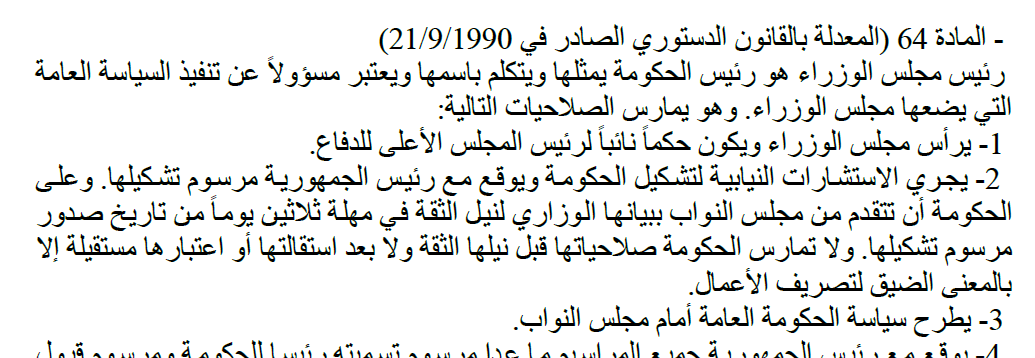
Article 64 Constitution

When the March 8 Alliance considered the government to be illegitimate in 2006 (following the resignation of all Shia ministers) and subsequently requested Siniora to leave the Grand Serail, the speaker of the parliament Nabih Berri concluded that Lebanon lacked a proper executive power, and hence – selon l’usage – decided to shut the door of the parliament until Lebanon’s  politicians had reached an agreement on a new government. The March 14 Alliance back then declared that the speaker’s move was political blackmail, and that it was illegitimate, asking him to call for regular parliamentary sessions instead.

5 years later, in 2011, the March 8 Alliance was finding difficulties in forming its unilateral government. After 5 months of inter-M8 deadlock, when the speaker decided to call for a parliamentary session, the March 14 Alliance stood firmly against his move. “How can the parliament convene when there is no cabinet in power?” was M14’s response.

In 2013, 2 months after the resignation of Prime Minister Mikati – and with no cabinet in power, both of the March 8 and 14 Alliances would attend a legislative session destined to postpone the parliamentary elections.

In 2006, M14 wanted to break the rule. 5 years later, M8 tried to break the same rule.  Two years after that, when both parties had the same motives (of keeping the status-quo) they will successfully break that same rule, together, unquestioned. The point of this long intro is to clarify one simple undeniable fact. Lebanon’s politicians will interpret the constitution and the customs (Like “no legislative sessions with no cabinet in power”) the way they want to, whenever they are able to do so. The same thing that was wrong for M8 in 2006, was right in 2011 and 2013. The same thing that was wrong for M14 in 2011, was right in 2006 and 2013.

Now back to 2014.

According to the constitution, article 64 clause 2, “The government must present its general statement of policy (بيان وزاري) to the Chamber to gain its confidence within thirty days of the date of issuance of the Decree in which the government was formed”. Like 2006, 2011 and 2013, everyone can explain the constitution the way it suits him since the constitution does not say what happens in case the cabinet fails to draft its policy statement. However the constitution also determines the cases that force the cabinet to resign (article 69). The 30 days-deadline isn’t there.

This loophole/ambiguity in the constitution, just like the “No legislative sessions with no cabinet in power” custom, can be used both by M8 and M14 in their political maneuvers regarding the presidential elections.  Let me elaborate.

M8 considers that the government is a resigned one after the 30 days deadline (مهلة اسقاط) . M8 says that article 69 does not specify the only conditions that force the cabinet to resign. Article 64 also indirectly implies an extra reason for the government to resign. For M8 the president  has to start the process from scratch (new parliamentary consultations to name the next PM, etc.).

M14 refuses M8’s decision and considers that the 30 days’ sole function is to motivate the cabinet and pressure it to work faster on its policy statement (مهلة حث). M14 considers that the cases regarding the resignation of the government are only demonstrated in article 69, and article 64 of the constitution has nothing to do with forcing the cabinet to resign. For M14 the government doesn’t fall after the 30 days, and once it finishes drafting its policy statement, life continues normally (vote of confidence).

The most dangerous scenario lies in both sides taking unilateral decisions (Unilateral policy statement, unilateral withdrawal from the cabinet, boycott of the presidential elections). In case the current deadlock doesn’t change anytime soon, on the 16th March (30 days after the 15th of February), Lebanon would be welcoming the spring season with a new dilemma: Is Tammam Salam’s “policyless” government legitimate? What happens if the two coalitions fail to agree on a common path to approach the crisis?

It’s 2008 All Over Again.

The problem with having two points of view regarding the legitimacy of the cabinet is that:

  1. In case the parliament agrees on a consensual president, it will probably need to amend the constitution (for example if it’s the commander of the army). The prime minister can’t sign the constitutional amendment due to the fact that he would be considered by M8 to be a caretaker PM. It’s the same deadlock that Lebanon faced in 2008 when the parliament wanted to elect Michel Sleiman, but M8 just couldn’t digest the idea that Siniora would be signing a constitutional amendment. “How can Siniora sign the constitutional amendment if he’s considered to be an illegitimate PM?”
  2. In case the parliament fails to agree on a president, a caretaker cabinet that lacks legitimacy would have to assume the presidential powers. How can the president hand in his powers to a cabinet that lacks legitimacy?
  3. In case the M8 ministers manage to bring the cabinet down by resigning from it, it would be a race against time: Relations would deteriorate to an unprecedented level between M8 and M14, Tammam Salam would have been politically humiliated, they’ll have to agree on a PM, on the government formation, and draft the policy statement. All that, in a couple of weeks while it previously took them 11 months to accomplish half of the work. In 2 words: Mission impossible.

The Importance Of This Particular Policy Statement

Usually you don’t go to war unless you have a weapon and an enemy to fight him with it. I’d like to imagine Lebanon’s next president as the gun, and the policy statement as the trajectory of the bullet. We all know that Lebanon’s next president is more likely to be the result of an agreement between M8 and M14. Since the (current) cabinet that is supposed to prepare the elections is a consensual one, it seems logical that the ideals the current government would stand by are going to be – more or less – the core of the president’s inaugural speech and his policies for the next 6 years. In other words, the state’s general policy for the next 6 years lies in this piece of paper. Explains the violent discourse happening between the president and Hezbollah, no? No side wants to give concessions that the next president might consider de facto ones during his rule.

This isn’t a fight for a 2 months cabinet. This is a fight for the next six years. So don’t expect any side to concede defeat easily.

The Time For Moderation

1984...

1984…

For a country that took 11 months to get out of the deadlock, the events of the past few days are revealing. Sleiman Frangieh will not run for the presidential elections: It’s official. In his interview with Al-Mayadeen, the leader of the Marada party endorsed the candidacy of Michel Aoun. The FPM leader on the other hand was busy commending Saad Hariri’s speech “characterized with moderation“. On the other side of the political spectrum, Amine Gemayel was praising the Iranian policies in the regions, only days after Hariri promised the Patriarch that the presidential elections would be held on time.

M8 Unified

Although it might be hard to believe, Frangieh’s withdrawal makes sense. For M14, he is the most despised Christian leader out there. For Hezbollah and Amal, he is a minor Christian politician. For the FPM, he is a local ally that mustn’t get stronger under any circumstances, especially that he is more likely to answer to Damascus than to Rabieh in case something goes bad between the Syrian regime and its biggest Christian ally. Frangieh hence has no shot at all to become president in 2014: Even if he runs as the sole candidate backed by M8, his name can never become a consensual one, and M14 pressure on Jumblatt would eventually prevent the latter of voting for the Marada candidate. By running for office in 2014, Frangieh would have angered the FPM, lost the elections, and found himself isolated. Patience is a virtue. Out of the “Maronite four” (Gemayel, Geagea, Aoun and himself), Frangieh is by far the youngest, and the very fact that in 2020 Amine Gemayel would be 78, Michel Aoun 86 and Samir Geagea 67 makes him the perfect candidate for the elections. By then, he would have become M8’s number one, the Syrian crisis would have probably ended, and he’ll get to have  6 years to adapt to any new situation, make new alliances, or switch sides. In 2020, the odds can be in his favor. In 2014, they’re not.

Michel Aoun on the other hand understood the rules of the game (after years of experience). The president is practically always a consensual one, especially in times of crisis. Fouad Chehab was elected for refusing to engage the army in the conflict. Charles Helou was elected because he was one of Chehab’s closest men to the opposition. Sleiman Frangieh was elected for his pro-Nasserist history and his anti-Palestinian tendencies. Elias Sarkis was elected for staying neutral throughout the first year of the civil war. In Lebanese politics, if you don’t compromise, you lose it all: Raymond Edde stayed 50 years in the opposition and never made it to the presidential palace. And for the millionth time (see here, here, herehere and here), this is what Michel Aoun is trying to achieve. Even though he might never become a consensual candidate in the matter of a year’s effort, he can still become M8’s most moderate politician. And how do we know it works? Because his new moderate attitude made Frangieh withdraw for lack of support from M8 and M14, forced the different M8 factions to pamper him more (so he doesn’t defect) and eventually unified M8 behind him while turning him into a more acceptable candidate to M14. After spending most of 2012 and 2013 accusing Hariri of being an extremist politician supporting rogue Islamist militants, he describes Hariri in 2014 of being the voice of moderation. There is no such thing as a coincidence. Everyone hoping to succeed has to be a moderate ahead of the presidential elections. For Michel Aoun, being a moderate means that he’ll have to praise the Future Movement.

M14 Unified

When I say everyone, I include M14’s candidate. And while we’re at it, there will be one,  and only one candidate coming from the ranks of M14. Hariri reiterated in his meeting with the Patriarch on Friday that the March 14 coalition would field one presidential contender. Meanwhile in the Christian camp of M14, the Kataeb – now strong of their huge share in the cabinet – are preparing their comeback. Among the possible candidates for the presidency, there’s LF leader Samir Geagea (head of the biggest Christian M14 party) , popular independent MPs such as Boutros Hareb, and last but not least former president Amine Gemayel, leader of the Kataeb party.

M14 needs a candidate that is in full harmony with its policies while being at the same time acceptable by M8. Samir Geagea, while being the strongest Christian in M14, doesn’t fit the criteria. The majority of independent MPs , although enjoying some support and prestige from the parliament – Boutros Hareb has been in the parliament for the past 42 years – are also too violent for M8.

One has to see it from a very particular perspective. Aoun is popular, was a commander of the army and a former prime minister,  is seen as protector of Christian interests (due to his stances on the cabinet formation and the electoral law), has strong allies, is currently establishing ties with various parties – notably the Future Movement, and is fashioning himself as a moderate. If M14 wants a serious competitor, the first name coming to mind is Amine Gemayel. He leads Lebanon’s oldest and most prestigious Christian party, had the same stances regarding the electoral law and the cabinet, has good ties with most of the parties and is at the core of M14. Also who’s better to compete with Aoun than the president who appointed him as commander of the army and later prime minister?

The Kataeb are aware of their sudden power in the executive power and of the precious value of their leader: Amine Gemayel asked for the elections to be held on time, dismissed any other consensual candidate by requesting the parliament to elect a strong president (hinting at “the Maronite Four”), nominating himself to the presidency and finally starting to laud some of the M8 rivals, namely Iran. Like Michel Aoun, he is showing his moderate side. While rumors on the streets say that Hariri is likely going to endorse the leader of the Kataeb, Gemayel’s relation with Lebanon’s kingmaker Walid Jumblatt isn’t very good (due to civil war-related issues). Since Jumblatt isn’t a fan of Aoun either, we might probably see a third consensual name endorsed by the centrists. The press is circulating the names of Jean Obeid (who apparently also enjoys the support of Berri and Hariri) and the usual “two Maronites” : the commander of the army and the governor of the central bank.

2014 Is Not 2008 (Or Is It?)

Even if the elections are held on time, and even if the M8 and M14 alliances do not boycott the elections and everything goes according to the plan (no lack of quorum), there is still one problem: None of both alliances can secure 65 votes (absolute majority) to support its candidate. While it is more obvious by the day that M14 and M8 would be each supporting one candidate to the presidency, it remains unclear what side Walid Jumblatt and Mikati’s parliamentary blocs would back. If the Jumblatt-Mikati duo decides not to participate in the elections, neither M8 nor M14 will be able to secure the post for its candidate. Without Jumblatt and Mikati, M14 has around 58 MPs while M8 has a bit less than that (around 57).

The constitution stipulates that a 2/3 majority is necessary to elect a president in the first round, while an absolute majority would be needed for all the rounds after that. unlike 2007, when the presence of M8 and M14 in the parliament would have probably ended in an M14 candidate as a president (since they held the majority), the elections of 2014 are different. Even if everyone shows up, the elections would be like a play. The MPs will keep voting for the same candidates, and since no camp can secure 65 votes, the elections can go on forever. In other words, none of the two coalition will take it upon itself to boycott the parliamentary session and get treated with disregard from the public for “paralyzing the states’ institutions”. Because unlike 2008, there is no coalition holding the majority of votes in the parliament which means that the minority coalition doesn’t need to boycott and block quorum in order to prevent the majority of electing a president of its ranks.

While nothing is official or definite, we are approaching the elections with 2 candidates, Michel Aoun of M8 and Amine Gemayel of M14 that are – unlike 2007 – fighting to get the support of the rival camp by playing the moderate card, while the name of the third consensual candidate is soon to be determined.

Reminder: The government didn’t win the confidence vote yet.

Eleven Months Later: Who Won?

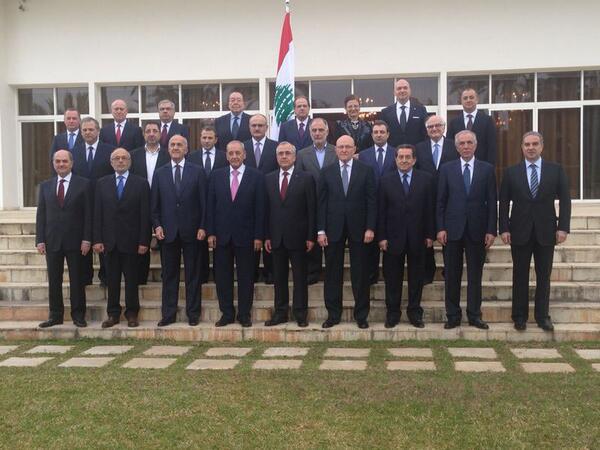
Lebanese Cabinet Of 2013

1,2,3,4,5,6,7,8,9,10,11,12,13,14,15,16,17,18,19,20,21,22,23,24,25,26,27,28,29,30,31,32,33,34,35,36,37,38,39,40,41,42,43,44,45,46,47,48,49,50,51,52,53,54,55,56,57,58,59,60,61,62,63,64,65,66,67,68,69,70,71,72,73,74,75,76,77,78,79,80,81,82,83,84,85,86,87,88,89,90,91,92,93,94,95,96,97,98,99,100,101,102,103,104,105,106,107,108,109,110,111,112,113,114,115,116,117,118,119,120,121,122,123,124,125,126,127,128,129,130,131,132,133,134,135,136,137,138,139,140,141,142,143,144,145,146,147,148,149,150,151,152,153,154,155,156,157,158,159,160,161,162,163,164,165,166,167,168,169,170,171,172,173,174,175,176,177,178,179,180,181,182,183,184,185,186,187,188,189,190,191,192,193,194,195,196,197,198,199,200,201,202,203,204,205,206,207,208,209,210,211,212,213,214,215,216,217,218,219,220,221,222,223,224,225,226,227,228,229,230,231,232,233,234,235,236,237,238,239,240,241,242,243,244,245,246,247,248,249,250,251,252,253,254,255,256,257,258,259,260,261,262,263,264,265,266,267,268,269,270,271,272,273,274,275,276,277,278,279,280,28,282,283,284,285,286,287,288,289,290291,292,293,294,295,296,297,298,299,300,301,302,,303,304,305,306,307,308,309,310,311,312,313,314,315,316,317,318,319,320,321,322,323,324,325,326,327,328,329,330.

330 days. I wanted to write 11 months, but it surprisingly seemed so normal, so I decided to count the days since Mikati resigned. It took the politicians 330 days to form a cabinet. Just to make it clear, it usually takes 0, 3, 30 or 33 days to form one. But no, it had to be 330 days. 330.

But that’s ok, it’s not even like we missed important events. Only democratic parliamentary elections, an electoral law, laws and democracy in general, oh and everything related to governing a country. But then again, that’s ok, because instead, we got a Syrian spillover, burned books, suicide bombers and a new local record in forming governments (yep, Salam broke Rachid Karami’s record of 1969 – Tamam, right?).

Anyway, enough nagging, and here’s a small analysis.

The Two Surprises

I know it’s a very long time ago, but let’s rewind 11 months. Tammam Salam was nominated as M14’s candidate to the premiership, and in order to to prevent Jumblatt from shifting back to M14, and M14 from taking power again, M8 made a brilliant move and decided  to endorse Tammam Salam. The “If you can’t beat them, join them” policy resulted in 8 to 9 months of political confusion.  M14 didn’t risk forming a government without M8. When M8 shocked everyone again in January and declared that they were ready to join M14 in an 8-8-8 cabinet lineup, Future Movement found their way out of the impasse: It would apparently seem that M8 gave up the blocking third and lost the battle, and at the same time, M14 wouldn’t be angering Hezbollah.

A Quick Look At The Names

Change and reform bloc : Gebran Bassil  (FPM) for the foreign ministry, Elias Abou Saab (FPM) for the education ministry, Arthur Nazarian (Tachnag) for the energy ministry, Rony Araiji (Marada) for the  culture ministry.

Hezbollah: Hussein Hajj Hassan for the ministry of industry, Mohamad Fneish as a minister of state.

Amal: Ali Hassan Khalil for the ministry of finance, Ghazi Zaiter for the ministry of public works and transports.

PSP: Wael Abou Faour for the ministry of public health, Akram Chehayyeb for minsitry of agriculture.

Presidential share: Samir Mokbel  as minister of defense and vice-PM, Alice Chabtini as minister of the displaced, Abdel Motleb Hannawi as minister of sports.

PM’s share: Tammam Salam as prime minister, Mohamad Machnouk as minister of environment.

Future Movement: Ashraf Rifi for the  justice ministry, Nohad Machnouk for the interior ministry, Rachid Derbas for the ministry of social affairs, Nabil De Freij as minister of state for administrative reform (yes, apparently such a ministry exists).

Kataeb: Sejaan Kazzi for the ministry of labor, Alain Hakim for the ministry of economy, Ramzi Jreij for the ministry of information.

M14 independent Christians: Michel Faraoun for the ministry of tourism, Boutros Hareb for the ministry of telecommunications.

A total of 4 ministers for the FM,  4 for the FPM bloc, 3 for the Kataeb, 2.5 for the president ( apparently Abdel Motleb Hannawi is more of a consensual candidate between Berri and Sleiman), 2.5 for Amal, 2 for Hezbollah, 2 for the PM, 2 for the PSP and 2 for the M14 independent Christians.

Start Counting

Although it might seem at first that this is an all-embracing cabinet where centrists, M8, and M14 have equal shares of 8 seats, it’s not actually an 8-8-8 cabinet. Technically, M8 didn’t give up the blocking third, since Jumblat is now more or less considered  to be part of the M8 sphere. Also technically, M14 are controlling the majority in the government since the president hasn’t quite been a Hezbollah fan for the past 6 months and most importantly because Tammam Salam – just as a reminder-  is Future Movement’s Beirut Member of the parliament more than he is a centrist.

Also, this is very weird, but M14 didn’t actually get 8 ministers: The FM has 4, the Kataeb 3, and the M14 independents 2. A total of 9 ministers, not 8 (hence an exception to the 8-8-8 accord). But this can be explained by the fact that Hezbollah was trying to make it up for the FM (because of the rejection of Rifi as interior minister). Also Hezbollah shouldn’t care a lot since the two PSP ministers and Abdel Motleb Hannawi are likely to be closer to M8, which means that the 8-8-8 government formula eventually turned out to be a 9-8-7 one – or to be more realistic, a 13-11 one (If you count Hannawi and the PSP ministers as M8 ministers)

Did The Kataeb Just Win The Lottery?

With approximately 5 members out of 128 in the parliament (3.90%), the Kataeb are receiving 3 out of 24 seats in the cabinet (12.5%). That’s not all: They  received the  key economic ministries; the economy and labor ministries. The official spokesman of the government (information ministry) is also apparently an FM/Kataeb consensual candidate. So why are they being  treated so well? Because the FM needed to reward them twice: The first time for accepting to extend the term of the parliament in June, and the second time for entering the government when the Lebanese Forces boycotted it against the will of the FM. The FM also needs to spoil them for two other reasons: The first one is to create tension between them and the LF ahead of the presidential elections by giving them an unreasonable share and throwing – even if it’s in an indirect way –  the Lebanese Forces outside. It would hence look as if the FM have a more “docile” Christian ally that is also representative of the Christian community. It would also give the impression that the FM is not hijacking Christian ministries anymore – like the Aounist propaganda says. The other reason of allocating the 3 ministries to the Kataeb  is to deny the FPM the courtesy of being the most important Christian party in the cabinet. If you haven’t noticed, there are only 2 pure Aounists in the government (the two others belong to the aounist allies, Marada and Tachnag), while there are actually 3 Kataeb in the cabinet. The kataeb – believe it or not – somehow suddenly became the second biggest party represented in the cabinet and the biggest Christian one.

2.5,3,3.5 or 4 Seats For The President?

When I counted the number of ministries for the first time, I found 25 seats, not 24. So I counted again, and again, and again, until I realised something very important: Even though the president has 3 ministries (I did not count Hannawi), he has 2 ministers (Samir Mokbel has two portfolios but votes once). So basically, the president gets a big share of ministries – the biggest he ever had –  but with only two ministries. Because theoretically the president has 4 portfolios: A sovereign one (Defense), a prestigious one (VP of the PM), and two minor ones. But when the time comes, Hannawi will probably side with Nabih Berri while Samir Mokbel – even though he has two ministries –  can only vote once.

By giving the president a big share of ministries but a small voting power, the political class is strengthening the centrist president but at the same time denying him too much decisive voting power that might  influence the post-Sleiman era in case the parliament fails to elect a president.

Bassil And Rifi: Equality?

If you take a quick look at the names of the new ministers, you notice two separate things: Gebran Bassil is there, and so is Ashraf Rifi. But Rifi is not interior minister, and Bassil is not energy minister. Interestingly enough, Rifi is for the FPM what Bassil is for the FM: The most annoying politician of the rival party. So if you think of it this way, there’s some kind of an undeclared compromise: Both politicians get to stay in the cabinet, but both don’t get what they want. Bassil is not energy minister and Rifi is not interior minister.

Two Generals

Speaking of the growing number of military men getting involved in Lebanese politics, we have two newcomers: Abdel Motleb Hannawi and Ashraf Rifi.

M8

Amal got two ministries, including the very important finance ministry. There were always talks that the finance minister according to Taef should belong to the Shia community- since the finance minister signs all the decrees along with the Christian president and the Sunni PM – and Berri managed to secure the post for one of his protégés. For the change and reform bloc, they got to keep the strategic energy ministry – even though it’s with the Tachnag now, like the 2008 cabinet – while Bassil is now the number 2 man in the cabinet, holding the foreign ministry. The FPM did not only receive a sovereign portfolio (foreign ministry) for the first time in the history of all embracing cabinets: The minister of education is also a member of the FPM and a Christian party member for the first time since ages. Even though Hezbollah only has one portfolio (but two votes since there’s a minister of state that is pro-Hezbollah) they got what they wanted: They weren’t forced out of the cabinet, they control the blocking third (via Jumblatt) in the government, and they pleased their allies ahead of parliamentary and presidential elections – hence making a potential FM-FPM alliance harder.

M14

The FM got 4 seats (+ Salam’s 2). So there shouldn’t be too much Hezbollah weight in the cabinet while at the same time the FM would be running the interior ministry again.  The M14 independents- Boutros Hareb and Michel Faraoun are also supposed to be close to the FM, giving the party a more or less share of 8/9 ministers (4+Salam’s 2+Hareb+Faraoun+ the Kataeb/FM  consensual information minister) out of 24. They also managed to please the Christian minorities by naming a Roman Catholic (Latin) Christian as a minister (They rarely get represented).

Walid Jumblatt, by making sure that the coalitions stayed the same and that his Kingmaker position in the center was hence still secure, also won from the formation of this new government.

So who won? Everybody won – except the Lebanese Forces qui désormais boudent tout seuls dans l’opposition.

Mikati’s resignation happened the day after mother’s day, while the government was formed the day after valentine’s day. That is obviously why they waited for 330 days: They care about our feelings.

Playing The Sectarian Card

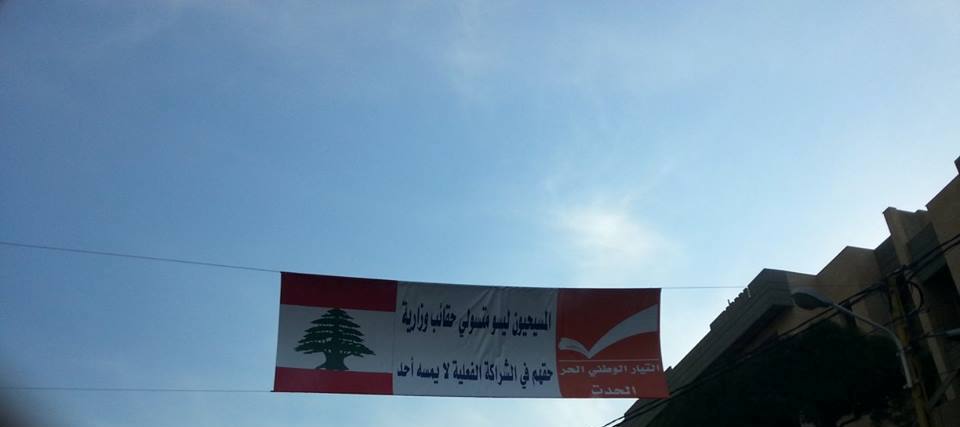
FPM government Ad

“We should reduce the difficulties in forming a new Cabinet such as the agreement to postpone discussion on the government’s policy statement rather than adding more obstacles such as the rotation of ministerial portfolios. […] The principle of rotating ministerial portfolios is a sound policy if it is adopted by consensus and consultations (and) at the beginning of a new Parliament or presidential term. […] It is strategic for Lebanon and Christians because it entails international relations stolen from the Christians 25 years ago. It also includes a balanced development that was absent from Christian [areas] for 25 years.  […] Therefore, it is a primary ministry par excellence and should not be a target of exclusion and it is the right of this sect [Christians] to be trusted with Lebanon’s oil for an interim period. […] Is it acceptable to allocate the Interior Ministry to a sect in order to reassure it, allocate the Finance ministry to a specific sect to compensate for it or allocate the Defense ministry to [a party] to protect a grant for the Army?”

In case you didn’t guess, that’s Gebran Bassil talking about the energy ministry two weeks ago. Since this is apparently the primary problem preventing the government formation (for the moment), I thought it would be nice if I tackled the issue.

The Offer

According to media reports, Michel Aoun’s bloc was offered 4 ministers in the government (apparently two for the FPM, one for the Tachnag and another for the Marada) in exchange for the ministries – especially the energy ministry – held by Aounists for the past few years. The FPM would be getting one of the four sovereign portfolios – the foreign ministry – along with the ministry of education. Now the ministry of education might seem as a very minor portfolio, but for the first time since ages, a Christian political party would be handling the education portfolio. There were always fears that the history book might be changed in case a Christian party held the post – in the FPM circles you always hear how the Future Movement would never give it to the Lebanese Forces or the Kataeb – so basically this can be seen as some kind of concession by the Future Movement. Michel Aoun is also being offered one of the most important posts in the cabinet. The ministry of Foreign affairs is a quadruple offer: M8 gets to keep the post it held for the few past years, a Christian gets to be foreign minister for the first time since 2004 and the second time since 1998, a Christian party would be holding the ministry for the first time since the civil war, and most importantly, Michel Aoun would be given a sovereign portfolio for the first time in the history of the all-embracing cabinets (he never had any of the Finance, Interior, Defense or Foreign ministries in any of the previous unity cabinets).

But why do the concessions seem so big, and why is the FPM refusing the offer?

The Diversion

To quote Gebran Bassil:

We should reduce the difficulties in forming a new Cabinet such as the agreement to postpone discussion on the government’s policy statement rather than adding more obstacles such as the rotation of ministerial portfolios.

In other words, Gebran Bassil is basically offering – if one reads between the lines – some sort of compromise including concessions from both M8 and M14 regarding the two remaining obstacles: The policy statement and the ministerial rotation. M8 can use the energy ministry issue in order to get what it wants. A deal would be giving up the ministry in exchange for a more suiting ministerial declaration, or vice versa.

The Strategic Importance Of The Energy Ministry

The energy ministry for the FPM is of a very strategic importance. First, it’s a ministry that has been held by the FPM for the past 5 years. All the achievements of the Aounist ministers, including the Oil plan – among other things –  would go with the wind . Let me quote Bassil again:

“The principle of rotating ministerial portfolios is a sound policy if it is adopted by consensus and consultations (and) at the beginning of a new Parliament or presidential term.”

Also in other words: What matters the most is that the ministry stays under FPM control before the November elections. The moment another minister X replaces Bassil, it would seem on the eve of the parliamentary elections that it was X – not Bassil – that was responsible for everything that previously happened. Thus it would be harder for the Aounists to base their campaign on the energy ministry achievements since what people remember the most after a while are the corruption accusations, not the achievements .

Second, the amount of income the ministry will generate soon (because of the gas fields on the shore) is too damn high. Controlling a ministry that provides the biggest income is in the advantage of FPM, and allows him to use the ministry in order to strike better deals with M14 and increase the number of projects – especially that the elections are very near.

The third reason of keeping the energy ministry under Aounist control is because M8 makes sure that the Oil project is alive and kicking, and hence Hezbollah ensures that the Lebanese government would be entering an oil dispute with Israel regarding the maritime region bordering Israel. Hezbollah will gain a legitimacy boost by declaring that he is here to protect Lebanon’s resources.

It’s not only about the ministry

What is really shocking in Gebran Bassil’s speech is the amount of sectarianism used in order to keep the energy ministry.

“It is strategic for Lebanon and Christians because it entails international relations stolen from the Christians 25 years ago. It also includes a balanced development that was absent from Christian [areas] for 25 years.  […] Therefore, it is a primary ministry par excellence and should not be a target of exclusion and it is the right of this sect [Christians] to be trusted with Lebanon’s oil for an interim period.”

There’s a reason for all that. Michel Aoun’s presence in the government is vital for its creation. When the Lebanese Forces decided to boycott the all-embracing cabinet, the FPM suddenly became the only major Christian party represented in it. Gebran Bassil’s sectarian speech is a reminder to all the cabinet factions that the FPM’s Christian identity is crucial for the government formation. If the Aounist ministers resign because the portfolios aren’t good enough for the FPM, the only Christian political parties remaining in the government would be the Kataeb, the Tachnag, and the Marada. And since the Marada and Tachnag are pro-aounist and are members of the FPM’s change and reform parliamentary bloc , there’s a very big possibility that they would resign too. That leaves the Kataeb alone in the government. I seriously doubt that the Kataeb would take the responsibility of being the only Christian party in the government (and get looked upon by the Christian population with distrust 4 months before the elections) , and there’s an enormous chance that their ministers would resign for lack of Christian representation. Hezbollah, due to fears of a possible alternative FM-FPM alliance that is starting to appear, are likely to exit the government as a sign of solidarity with Aoun.

The Future Movement knew what they were doing when they gave up the Finance ministry to Berri: The Finance minister – it is said – was supposed to be a Shia according to the Taif agreement (since he signs all the decrees along with the president and PM and hence has some kind of veto power). By giving the Finance ministry to a minister loyal to Nabih Berri, the FM made it hard for the speaker to withdraw his ministers from the government in solidarity with Aoun. We still don’t know if the maneuver worked or not, but it surely made Berri think again.

We end up with an all-embracing government that lacks Christian representation and Hezbollah participation. Among the bad scenarios ahead for M14:

1) The government will somehow see light – despite the resignations, but due to the lack of Christian representation, it becomes ethically impossible for the government to assume the powers of the (Christian) president when Sleiman exits in May. This maneuver forces all political factions to elect a president hailing from a Christian political party or face a constitutional crisis. Since the Muslim factions of M8 and M14 would have united the FPM and the LF in the opposition, it becomes harder for the political class to extend the terms of the current president because it would bring the LF and FPM even closer to one another and lead to massive Christian discontent.

2) The government collapses just after its formation. New parliamentary consultations lead to events similar to the ones leading to Mikati’s cabinet, with Safadi – Michel Aoun’s  favori – being nominated to the post of Prime Minister.

One thing is sure though : If you think Michel Aoun is negotiating from a weak spot, don’t.

Reminder: We still don’t have a government.

Is There A Tripartite Alliance In The Making?

Hariri, Berri and Nasrallah

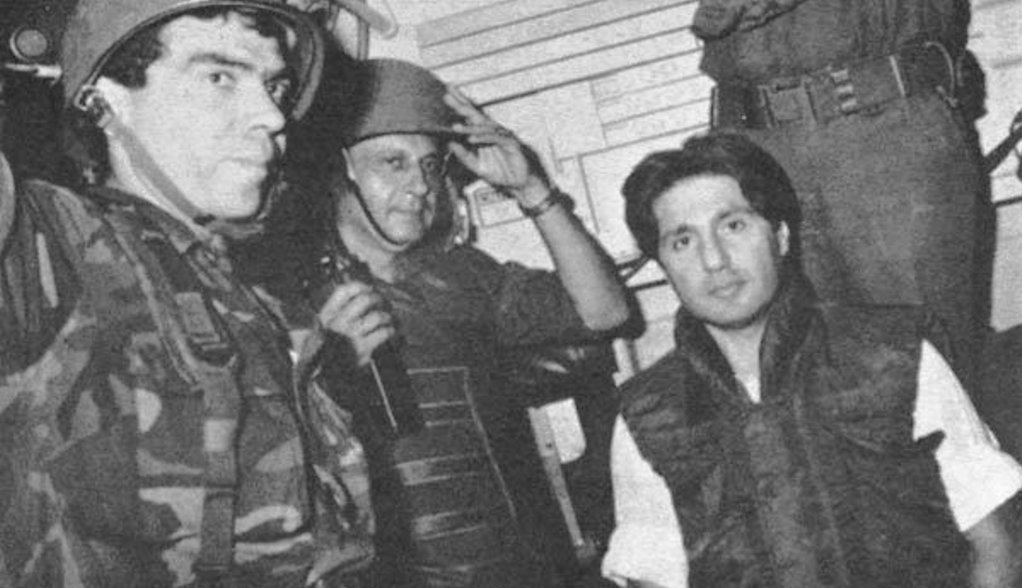
Back In Time… (Picture found on the internet)

An FPM-FM alliance is probably the most logical alliance one can think of in Lebanon. Together, they hold the absolute majority in the parliament. They both started as secular parties, they both have a certain sectarian identity, and they are the parties that least participated in the 1975-90 civil war. Also, they do not have the same electoral clientele, with the FM gathering its strength in the main three cities and the rural Sunni regions, and Aoun mainly controlling the seats of Northern Mount-Lebanon, which means that they will not compete with each other and there will be no rivalry: Aoun is appealing to the Christian electorate and Hariri to the Muslim one.  Aoun can use the extra Sunni votes in Batroun, Beirut, Koura and Zgharta and Zahle to tip the balance in his favor, while Hariri can use the FPM power in several regions especially southern Mount-Lebanon to hold the precious 8 seats of the Chouf. Electorally speaking, if both enter an alliance, they will probably control all the districts except Bcharri, Baalbak-Hermel, Hasbaya-Marjeyoun, Nabatieh, Zahrani, Aley, Bint Jbeil, and Tyre. That’s roughly 90 Members of the parliament under FPM/FM control. 70% of the Parliament. No LF, no PSP, no Kataeb, no Amal, no Hezbollah needed. 70% via the votes of the FPM and the FM, only.

That’s me, in November. (see the full post here)

4 months ago, the Free Patriotic Movement and the Future Movement were having their first meeting since 2005. 7 months ago, the transition had already started. 6 months ago, Nabih Berri, in one of his political maneuvers, declared the March 8 alliance dead. The turning point – apparently – was the day the elections were postponed. M14 made M8 abandon Aoun. But what no one saw back then was that M14 didn’t only make Hezbollah abandon Aoun. It forced Aoun to go on a quest to find a new, stronger ally.

We’re not talking anymore about FPM and FM members having a meeting. We’re not talking anymore about small statements or speculations. We are talking about Michel Aoun meeting  Saad Hariri in Rome and the partisan media being shy about it. We are talking about Aoun congratulating Hariri on his stances. We are taking about Ahmad Al Hariri getting confused and changing the subject when Marcel Ghanem asked him if Michel Aoun was the FM’s candidate to the elections.

We are talking about a brutal change in Lebanese politics. But what are the benefits of such a potential alliance between Aoun and Hariri?

Isolate

Here’s a fun fact: The Future Movement doesn’t need Aoun. Within M14, GMA would be a pain in the ass. They’ll have to share power with yet another ally, keep the rivalry between the FPM, the LF, and the Kataeb under control, and eventually – whether they like it or not – deal with a unified empowered confederation of Christian political parties. The FM would have created a stronger Christian bloc within M14. However, here’s another fun fact: Hezbollah without Aoun, is a Hezbollah that’s all alone (Yeah, it rhymes 😀 ). So, the plan from the FM – I believe – isn’t simply allying with Aoun. It’s isolating Hezbollah, or at least, forcing Hezbollah to enter a tripartite alliance with the FPM and the FM where Hezbollah would have to agree to some of FM’s terms. Aoun mentioned two important things in his latest television interview: That he’s on the same political wavelength with Saad Hariri, and most importantly, that he wishes to include the Sunnis in his memorandum of understanding with Hezbollah. Sums everything up I guess?

The road to Baabda

Aoun learned from his lessons in the previous presidential elections. In 2008, they were 2: If you’re a minority, you lose. If you’re not in the middle, you lose. Remember the words “tripartite alliance” in the previous paragraph? Memorize them well. Aoun knows how to count.  The tripartite alliance, with some help from M14’s pro-FM allies, is likely to form Lebanon’s new parliamentary majority. I believe that some parties – risking electoral annihilation from the FM and FPM alliance – would also join that alliance. For the first time, Aoun would simultaneously be:  (1) In the Middle (2) With a parliamentary majority behind him and (3) The strongest Christian leader backed by the Strongest Muslim allies available. Mabrouk: we have a candidate that meets and even exceeds the criteria.

The Rivals from within

Michel Aoun and Saad Hariri both have one thing in common: The rise of rivals. Let me take the simple example of Saad Hariri:  Najib Mikati and Mohamed Safadi are the masters of their own fate in Tripoli and no longer answer to the FM. In Beirut is rising the bey of Beirut Tammam Salam, while in Saida, Siniora is strong enough to question the supremacy of Saad Hariri. In Akkar and the North in general, the FM’s MPs are not hesitating to take more extremist stances in order to appeal to the local population – sometimes criticizing Hariri himself. Michel Aoun on the other hand faces the existential threat of M8 nominating the more loyal Frangieh instead of him. After all, Frangieh has the age factor on his side. Things are not looking good on both sides, and they both need each other in order to remind their junior allies in the upcoming elections that they remain the strongest among all.

The Lebanese Forces in denial

I have been following Lebanese politics for some time now, and as you can clearly see, I rarely comment on the stances or political strategies of the Lebanese Forces. And it’s not because of love or hate. It’s because there is hardly anything to comment on. It’s always the same stances, the same way, in the same tone. And the monotony isn’t only political. Parliamentary speaking, they hold a number of seats that is way too small to change anything. Electorally speaking, they depend on others practically everywhere while no one depends on them. And they have been absent from the executive power for the past 3 years. In other words – excuse my French and geeky medical terms – ils ont un rôle épidémiologique nul.

But something changed lately (see here, here, here). Geagea is refusing to enter a government that includes Hezbollah, and is going against the all-embracing government decision of Saad Hariri. Hariri can’t brutally change sides and flush his alliance with Geagea in the toilet after 9 years. Apart from turning the Christian population against him, it’s ethically bad for him to be seen as the man that might compromise on everything, including his longtime allies. By boycotting Hezbollah’s presence in the government, the Lebanese Forces are making the impossible to force the FM not to enter the government along with M8 so that the FM would never have the opportunity of gaining a more centrist position that would entitle them to be one step closer to an agreement with Aoun.

8-8-8 and the end of M8?

Suddenly, out of nowhere, Hezbollah agreed in January to the 8-8-8 formula. In a way, Hezbollah succumbed to fear: The fear that if Tammam Salam’s attempt (of  forming an independent cabinet) failed for lack of parliamentary confidence, GMA would name Saad Hariri as new Prime Minister (the same way Jumblatt was supposed to name M8’s candidate  in 2013 but named Salam instead). That’s probably why M8 is trying to please Aoun by giving him important ministries in the government such as the Foreign ministry.

Because of the war in Syria, Hezbollah needs a strong Christian ally on his side more than ever, and both Hariri and Aoun realize that. And that is how and why a deal pleasing the three parties might eventually see light: Hezbollah wants to keep his ally, Aoun wants the presidency, and Hariri wants to go back to the Grand Serail.

Reminder: We still don’t have a government.