Lebanese Politics

2013’s Last Political Maneuver

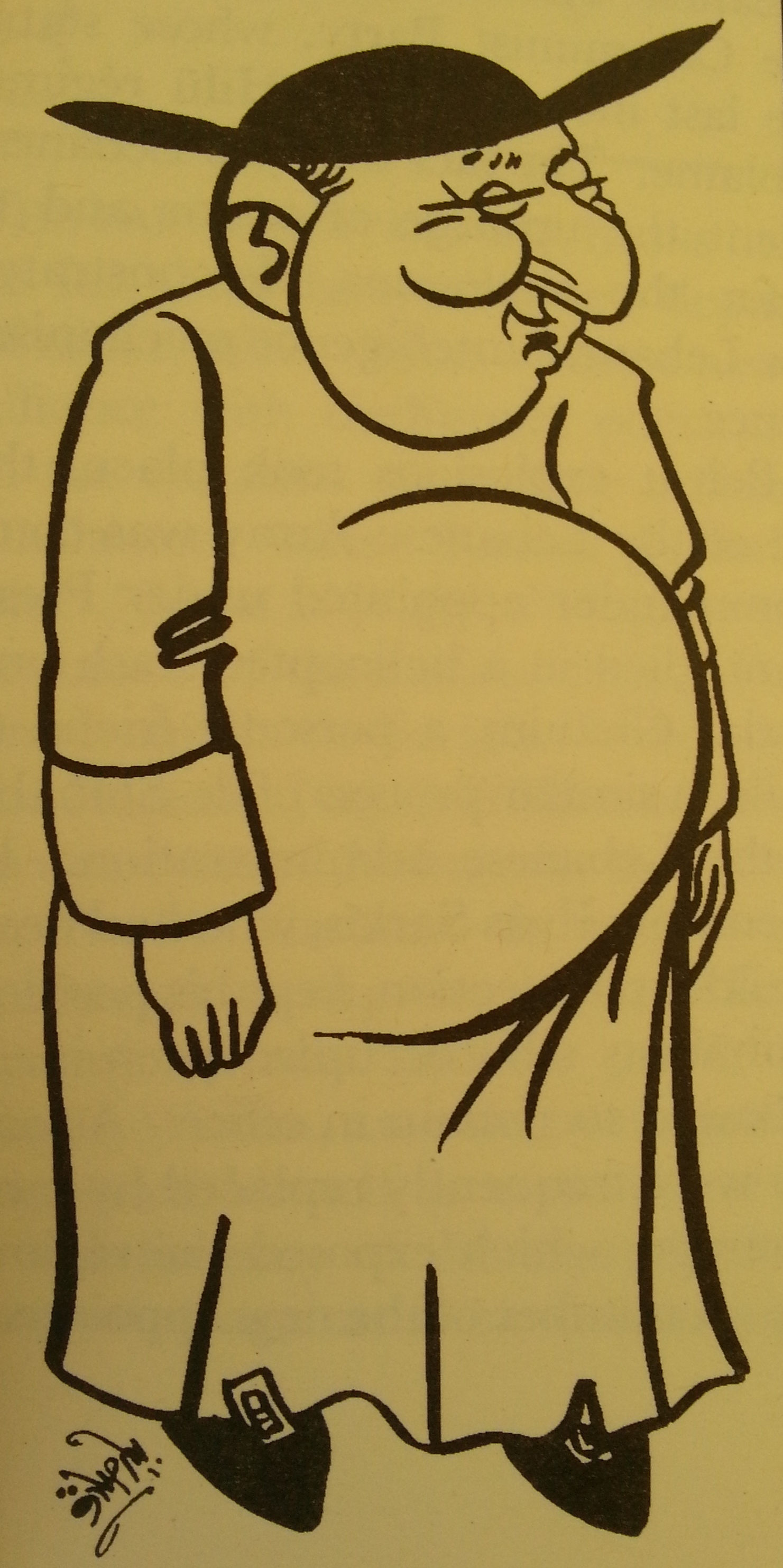
Charles Helou’s Caricature as a Jesuit priest by Pierre Sadek

Pure Chaos. That’s what the past two weeks have been all about. Hezbollah is having a more aggressive tone by the day. This week Nasrallah compared March 14’s Tripoli declaration to a declaration of war. The Syrian regime is accusing the Lebanese cabinet (that is ironically pro-Syrian regime) of interfering in Syrian affairs. Jumblatt lashed out at Aridi after the latter resigned from the caretaker cabinet. Relations are  deteriorating between Future Movement and the president who apparently gave his blessing to the 9-6-6 governmental formula. At the same time, relations between M8 and the president aren’t very good with the rumors that Sleiman might ask Salam to form a de-facto cabinet. Christian leaders are distancing themselves from each other ahead of the presidential elections while awkwardly  unifying their stances against the extension of the president’s current term. Nabih Berri stood up for the president and announced that the latter did not ask him for an extension of his term.

But is it total chaos or something is actually cooking out there? Let’s state the facts again.

The Example Of Charles Helou

It is said that Charles Helou, Lebanon’s fourth president (1964-1970) was rather a weak president. Helou felt that Fouad Chehab was still the one controlling everything, and that he was no more than his puppet in the presidential palace, so he resorted to several tricks by strengthening the anti-Chehabist opposition then by  inciting the two camps against each other, hence slightly reinforcing his position. This “Jesuit” strategy (Charles Helou went to a Jesuit school and a Jesuit University) even led the late caricaturist Pierre Sadek to draw him in his caricatures as a Jesuit priest. Why am I mentioning this? Because Michel Sleiman acted exactly the same as Helou this week.

Back To 2013

Michel Sleiman is stuck between M8 and M14. The designated prime-minister Tammam Salam broke a few weeks ago Rachid Karami’s 43 year old record in forming a government. Today marks the ninth month since Mikati resigned from premiership. We kind of got used to vacuum in power, but 9 months is really, really too much. 9 Months is how long it takes a pregnant woman to deliver a child. Meaning that some Lebanese babies actually spent their whole intra-uterine life while there was absolutely no functioning cabinet. How cool are these Babies ? (In other words, Fi ahla men Lebnen?).

Meanwhile, in 3 months, the parliament will have to convene to elect a president that will replace Sleiman 2 months after that date. Sleiman is causing panic. He’s not officially denying the rumors that he will form a de-facto government of M14 or independent figures, while at the same time telling Fouad Siniora that he has no problem with a 9-6-6 formula. So what really happened this week and why the sudden aggressive stances from everyone? It’s because each camp thinks that the other is far more closer to forming the government. And the Aridi-Jumblatt issue, along with the Syrian regime’s frequent criticism of Jumblatt and of Mikati’s caretaker cabinet indicate that even the Syrians – that supported the Mikati government (at least preferred it on Hariri’s one) in 2011 – want it gone for good.

The President’s Brilliant Maneuver

Now that the Mikati caretaker cabinet is falling apart (topped with the Aridi-Safadi raw), it is a lot more likely for a government to be formed, especially ahead of a probable presidential vacuum. With no elected president to succeed him, Sleiman will transfer his powers to the interim cabinet in power putting him in a far better negotiating position. The only remaining piece of the puzzle – and that’s what the president did this week, à la Charles Helou, is giving the impression to M8 that they are fighting a lost battle because he’s pro-M14, and to M14 that he doesn’t care about them because he’ll do what M8 wants. That should make them both (M8 and M14) more malleable concerning their governmental demands (due to fear of a cabinet solely composed from members of the other camp) and hence accelerate the formation of the government.

Between the Christian leaders’ veto on the extension of the president’s term and their inability to decide on the name of the new president, Michel Sleiman found himself in a stronger position on the negotiation table. If he won’t see his term extended, he’ll make sure to use the M8/M14 rift (along with the probable presidential vacuum) in his advantage regarding the government’s formation.

The Presidential Race Begins

Naharnet Michel Aoun Nominates Geagea For Presidency

In what is probably the most misleading article title since the beginning of time, Naharnet tells us that “Aoun Links Cabinet with Presidential Elections, Says he Nominates Geagea“. In the same context, Berri apparently said that he won’t deal with the matter before March 25, when the 60-day Constitutional deadline for the election of a new president starts. But since every possible politician is talking about the presidential elections, I find it hard how he’ll manage to do that. So what is exactly happening 5 months before the 25th of May? 

Mini-heart attack yet? Don’t panic. Aoun isn’t actually going to nominate Geagea (Naharnet forgot to put the word mockingly before says in the title). However, Aoun said that he wants a strong president and he clearly won’t nominate Geagea  (since he mockingly nominated him). On the opposite side, he is distancing himself from his ally (and apparently presidential rival) Sleiman Frangieh by asking for the election of a president from the first round (requiring the two-thirds of votes) while Frangieh previously said that he had no problem in electing the president with absolute majority (Here’s a nice post from October explaining why). Meaning that Aoun is likely to nominate someone from the FPM (him?).

Khabsa within M8

Frangieh and Aoun are endorsing two different electoral strategies, meaning that they will probably not be endorsing each other. This small competition is only the beginning. There will come a time where other M8 parties will have to choose between Frangieh and the Aounist candidate . So with who will side Hezbollah? The whole confusion emerging from within the March 8 coalition also means that the other centrist parties would have a much more free hand and will be more able to distance themselves from the March 8 camp or put conditions on the shattered M8 alliance. Jumblatt and Mikati in stronger positions also means that the president would be in a better place in case he wishes to extend his mandate. March 14’s silence and Tammam Salam’s passivity show us that the deal – if a consensus is to be reached – won’t strictly be about the government but rather the whole crisis, and its recent newcomer: The presidential elections.

Too Much USJ And No Jumblatt

Did I miss anyone? Correct! Jumblatt’s quiet attitude for the past few weeks – only 3 weeks earlier he was engaged in a violent media war against M14 and M8 – indicates that everyone is considering his options. After all, Jumblatt is still the kingmaker, and his stances will with no doubt influence everything. In fact Jumblatt’s silence is probably behind most of the parties’ cautiousness. No one wants to rush to the losing side. And the identity of that side will be clearer once Jumblatt takes a decision. 

If you’ve been following the news this week you’d be aware of the student elections in USJ and their violent aftermath (see here, here, here). One must keep in mind that USJ is one of the biggest and most prestigious universities in Lebanon, and its political relevance comes from the fact that it is a Christian University mostly attended by Christian students. Other than the demographic cause, the campus where most of the trouble happened is in the heart of Ashrafieh, while the University itself is the Alma mater of roughly half of the Lebanese presidents. That’s why the university elections at USJ matter more – strategically speaking – to the Christian leaders than the elections at the Lebanese University, AUB, LAU or any other university. Although the tensions are more of a yearly tradition now, this year I can’t but relate the unusually high tensions (Classes were suspended for two days in Huvelin campus)  to the near presidential elections. For the reasons stated above, whoever the winner is at USJ , it’s a huge boost for him ahead of the presidential elections. Probably explains why Aoun lashed out at Geagea and why Samy Gemayel entered in a media / propaganda war against Michel Aoun and M8 following the elections.

Reminder: We still don’t have a government.

Don't forget to follow @moulahazat on Twitter for updates on new posts!

Lebanon’s Founding Fathers: Who’s Who

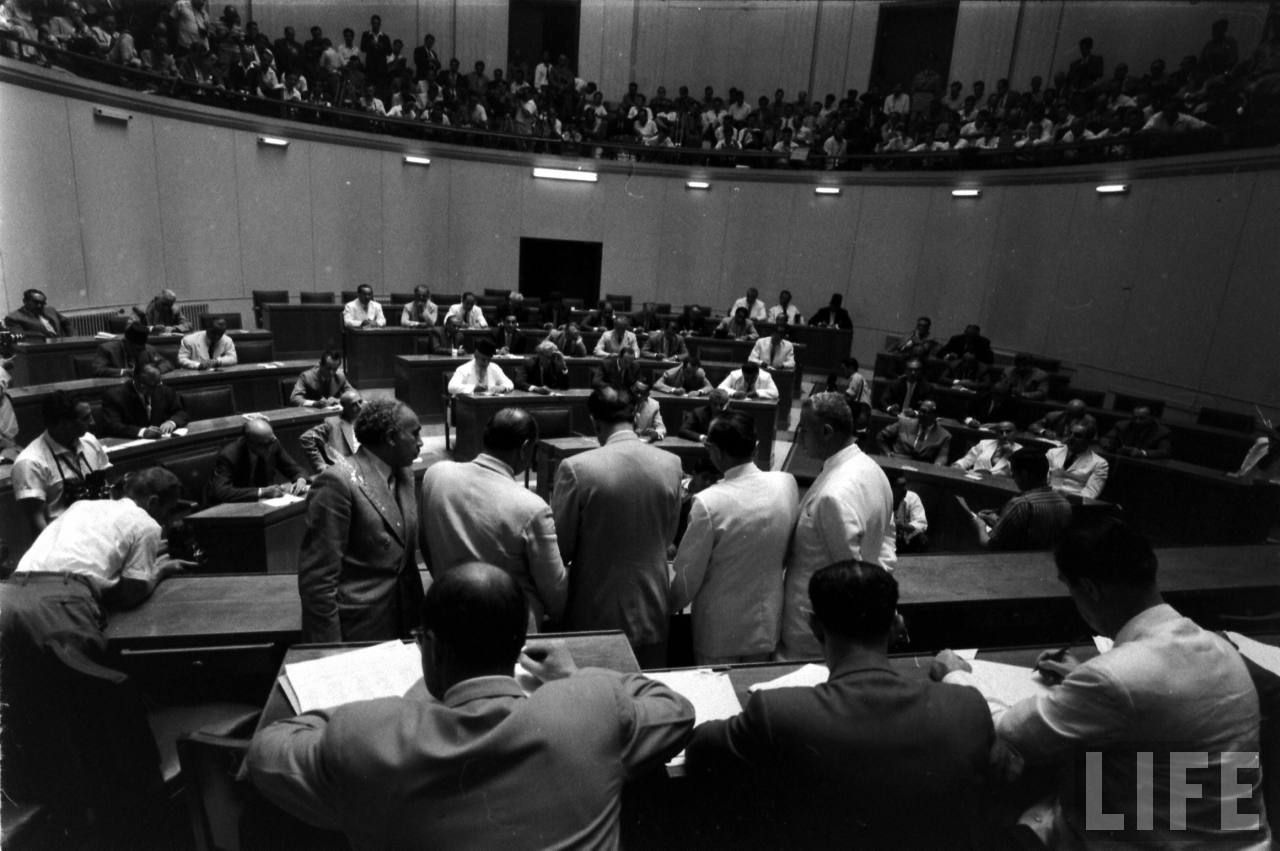
Members of the parliament counting the votes - Presidential elections,1958

Members of the parliament counting the votes – Presidential elections, 1958 (Archive -LIFE Magazine)

Today is the Lebanese Independence Day, and I wanted at first to write how we aren’t that independent, and how we’re in fact under the mercy of every foreign nation you can think of in the universe. But that’s more like the job of Beirut cab drivers these days.

So instead I’m going to talk a bit about some of Rijal Al Istiqlal (An Arabic word used to describe the men who fought for the independence in 1943)

1- The Dictator

History – unlike the Lebanese history book – does not stop at 1943.  True, Bechara El-Khoury made us an independent  country, but he later abused of his powers as president and of his status as the first among Rijal Al Istiqlal. Bechara El-Khoury’s administration was so corrupt that his brother, Salim El Khoury was often referred to in the press as the Sultan Salim. But that’s not the only abuse of power. Bechara El-Khoury will organize one of the worst parliamentary elections in the 70 years-history of our republic. Massive electoral fraud would bring him a parliamentary majority in 1947, and in 1949, the very man who changed the Lebanese constitution in 1943 for the sake of the independence, will amend the constitution again (with the help of the fake parliament), but this time for personal reasons. Instead of setting an example to the others by protecting the democratic principles in the new country, Bechara El Khoury will make sure that the constitution – that forbids reelection –  gets amended and that he gets reelected for another term (6 years).  Theoretically, he was supposed to stay till 1955 after his reelection, but in 1952 Lebanon would revolt and the white revolution (protests and strikes) along with political pressure from the opposition will force him to resign and abandon politics.  Who knows, if it weren’t for the protests, he might have stayed again from 1955 till 1961. And then from 1961 till 1968. And then till 1974. And 1980. And 1986 and 1992 and 1998 and 2004 and 2010 and 2016. Who knows, he might have been the one giving the Independence speech this week. Because you know he deserves to be dictator. After all, he made us independent.

2- The Assassinated

Every year, we have hundreds of gatherings for tens of martyrs. Every year, people remember them. But who cares about Riad Al-Solh. He’s not very important. He’s not a warlord, and he’s not a sectarian leader. If it weren’t for him, the Muslim regions of Lebanon would’ve been part of Syria, and the French army would still be in Beirut. But really, he’s not very important, he’s just that guy that was behind the independence, and the fact that the Muslim population decided to stop the boycott of the Lebanese state that lasted from the 1920s to the 1940s. He’s not even a martyr. Wait. What? He’s a martyr?!

 Riad Al-Solh, to refresh your memories, Lebanese, is the most important martyr in this country, because he’s the founder. He was assassinated in 1951 by the SSNP in Amman. That’s how he miraculously disappeared from Lebanese politics in case you one day wondered. Two times prime minister under Bechara El-Khoury, he made life easier for the corrupt regime men, even though he wasn’t  corrupt himself – apparently he was broke and in debt when he was assassinated. One of the mistakes of the regime was the  killing of SSNP leader Antoun Saade with no proper trial. When you don’t apply justice properly, justice won’t apply to you either. La loi de la jungle. No need to tell you the rest of story.

3- The Tyrant

Who would’ve thought that the same minister of interior trapped in his cell in Rashaya in 1943 for the sake of the independence would be in 1975 the same minister of interior that will let everyone arm themselves and destroy the very country he helped build? Who knew that this very man, Camille Chamoun, would destroy the national pact – that he helped to forge in 1943 – by allying with the west in 1956, paving the way for the first civil war in 1958? Who knew that the same man that turned against his party leader in 1952 because he extended his term, would try to do the same thing 6 years later? Who knew that the same man that fought for the French army to leave Lebanon, will ask the marines to enter Beirut in 1958, before calling for the Syrian army to occupy in 1976 and then welcoming the Israelis afterwards? Who knew that the man that fought for the independence of the Lebanese state in 1943 would secretly support the 1961 SSNP coup attempt? Who knew that the man that criticized the electoral fraud of 1947 in 1952 would create the most gerrymandered electoral law Lebanon has ever seen – ten years after the first elections after the independence were rigged by Bechara El-Khoury – throwing 3 of the 5 opposition leaders outside the parliament? There’s one big difference between Chamoun and El-Khoury. El-Khoury understood that he did something wrong, and he gave up power peacefully and immediately. Chamoun was ready to burn Lebanon with him every time he had to give up power. You can thank his selfishness and stubbornness for being the indirect reason behind of all our civil wars, sectarian problems (That we barely had before he decided to show up), and all the foreign armies that came to our country.

4- The Rebels And Counter-Rebels

“Repulse the enemy with your breasts! Fight them with your spears! Kill them with your bullets!” Saeb Salam promised a fight in “every block, every house, every room” – TIME, July 28, 1958

Men loyal to Kamel El Assaad were burning the Lebanese flag in Tyre during the revolution of 1958, while  Saeb Salam, the man whose house was the very place where that flag was designed, was now leading the insurgency against the Lebanese state in Beirut. Sabre Hamade – who convened members of the parliament in his house during the independence struggle – was the commander of the revolution in the Bekaa. Simultaneously in Tripoli, the son of AbdulHamid Karami – One of the six men that were imprisoned in Rachaya –  was now the leader of the revolt in Tripoli. On the other hand, Pierre Gemayel’s Kataeb party, whose paramilitary forces were essential in the struggle of 1943, was now used as a militia answering to a president abusing of his powers. Half of the politicians that were one day opposing the French  would side with the Americans, while the other half would side with the Egyptians. And what compromise was finally reached? Ironically electing Fouad Chehab – who will ally with Gaullist Frances during his rule – as president, 15 years after our independence from France.

See? I ended up talking how we’re under the mercy of foreign powers after all. Who knew.

The same men who fought for the independence of Lebanon will soon fight each others in 1958 and 1975. Don’t  get me wrong, some of  Rijal El Istiqlal are corrupt and some aren’t. Some are warlords and some aren’t. Some are good and some are bad. Some are bad and some are worse. And some are worthy of that name and deserve all the honor they should have, and even more.

Maréchal Pétain led the French to victory in WWI but allied himself to the enemy in WWII. Do you see the French paying too much respect to Pétain?

It’s not about 1943 that our  parties and deceased political leaders should be judged. It’s about everything that followed. The denial should end. If they screwed up afterwards, we should say that they screwed up, not just hide the facts and feel so lucky that we had them.

You know you’re independent when 70 years after the mandate, you can’t officially spell independant independent in the colonial language.

Reminder: We still don’t have a government. But who cares, we’re independent.

Abdallah Azzam Brigades And Three Different Reactions

Image Credits :Mohamed Azakir / Reuters

Image Credits: Mohamed Azakir / Reuters

Abdallah Azzam Brigades (AAB) – An Al-Qaida affiliated group that carries the name of Abdallah Azzam, a.k.a. The Father Of Global Jihad – launched two rockets on an Israeli town, and in response, the Israeli Army attacks the Popular Front for the Liberation of Palestine – General Command (PFLP-GC) in Nehmeh south of Beirut.

That’s me, 3 months ago. Back then, we all heard about this mysterious Abdallah Azzam Brigades launching rockets on the Israeli town. The Israelis responded by attacking a pro-Syrian regime party.  Yesterday, the same Al-Qaida affiliated group claimed responsibility for the twin suicide bombings against the Iranian embassy.

Three Different Reactions

For the Iran-Syria-Hezbollah axis, this is very awkward. Iran decided to blame Israel for the bombings while Syria’s government said that the “attacks reek of petrodollars” – in other words accusing the gulf monarchies of the twin blasts. As for Hezbollah, an official of theirs at the site of the explosion said it was a message of blood and death to Iran and Hezbollah for standing by Syria, vowing they would not change their position.

While we are used to such accusations towards Israel in (sadly) similar  circumstances, there are some surprising reactions  this time. Syria is accusing Saudi-Arabia of being responsible, which is something rather new in Syria’s foreign policy in Lebanon. On the other side of the axis, Iran and Hezbollah kept  a usual tone, with Hezbollah staying rather silent, and Iran pointing the finger to Israel with no direct or indirect reference to the west.

Three Different  Contexts

Iran is heading this week to the nuclear negotiations in Geneva, and the blasts can used positively by the Rouhani administration. The rise of a mutual enemy, Al-Qaida, in a country that was for decades mainly under the west and Iran’s influence is a good reason for the two countries to work together. The proof? David Cameron called Rouhani yesterday and became the first U.K. prime minister to do that in a decade. And the nuclear negotiations weren’t apparently the only thing they spoke of. The embassy blasts were also included in the conversation.

For Syria, Saudi-Arabia’s military and financial support to the rebels is no longer a matter of local affair. The S/S (Saudi-Syria) equation that once administrated Lebanese politics is history. The more Saudi-Arabia grows its influence in Syria, the more Bashar Al-Assad will play his cards in Lebanon and diminish the Saudi influence in the neighboring country, starting by an escalated propaganda war against Saudi-Arabia. To accuse Saudi-Arabia of working against the “resistance” is something quite normal these days, but to blame them for a suicide bombing on an embassy is something far worse, and a very important change of discourse that is nevertheless not very surprising. We’re witnessing an unprecedented diplomatic crisis between the countries of the Middle East, and Lebanon is a natural playground for foreign powers. Iran and the U.S. are getting closer, Syria is on fire, and practically everyone – in a way or another – is now involved in Syria. The battles in Syria’s Qalamoun along with the blurry diplomatic alliances are the reasons behind Hezbollah’s cautious response and accusations regarding the blasts.

Abdallah Azzam Brigades

AAB’s founding father , Salih al-Qar’awi, was arrested by the Saudis and the AAB is known for having anti-regime stances in Saudi-Arabia. In Lebanon, the AAB launched several times rockets at Israel and recently attacked the Iranian embassy. In Syria the group is involved in the insurgency against Bashar Al-Assad. Unlike the Tripoli bombings and the southern suburb’s  August bombings, the two attacks against the embassy were suicide attacks which is kind of new to Lebanon. the AAB are clearly adopting a new strategy, and seem non affiliated (till now) to any foreign country, since they are launching attacks against everyone. So funnily enough, unlike the August bombings, no country is apparently (directly) involved in the embassy bombings, but everyone is using the blasts to reinforce his position.

Once again Lebanon is a mailbox. But this time, the mail is not the explosions per se, but the type of reactions and the accusations that followed the blasts.

The War For Centrism

Jumblatt And Hariri

Last week was a week of surprises.  The Daily Star (close to March 14) told us that Jumblatt has sent a Letter to Bashar Al-Assad. Jumblatt denied it violently on Tuesday, and attacked The Daily Star by comparing it to Al-Akhbar (close to March 8). Al-Akhbar struck back at Jumblatt by confirming the Daily Star story and indirectly siding with the other newspaper. Regardless if Jumblatt sent a letter to Al-Assad  (asking him to re-enroll two Druze defected officers in the Syrian Army) or not, Jumblatt’s reaction to the news carries several messages. Jumblatt was criticized by newspapers close to the two coalitions and chose not to stay silent.

1-The Action

As I have noted earlier in summer, the FPM and the FM are getting closer and closer. Ahead of the May 2014 elections, Michel Aoun had started since June a (very) slow but steady change in his stances.  New rivalries, such as the one with Sleiman Frangieh are seeing light. His weekly criticisms of the Future Movement, Fouad Siniora and Saad Hariri are now exceptions. Instead, his new targets seem to be Berri, Jumblatt, and to some extent Hezbollah.

Hezbollah?!?!

Yes. Hezbollah. A couple of months ago, the FPM criticized Hezbollah for setting up/repairing a telecom network near the city of Zahle. In 2006, when Basmet Watan impersonated Nasrallah in the satirical show, Charbel Khalil, the director of the show – known for his close ties with the Free Patriotic Movement – apologized for his sketch. Last week, Charbel Khalil impersonated Hassan Nasrallah for the first time since 2006. While the timing of the criticism is to be noted, the most important thing about the sketch is that Charbel Khalil will not apologize this time.

FM And FPM

Last week, while everyone was talking about Jumblatt’s letter, something very important went unnoticed: The FPM and the FM were having their first meeting since 2005. That’s not even a major progress. That’s a huge one.  And why is it huge? Because apparently the Saudis are pressuring the M14 parties to halt their negotiations with M8 parties in the light of better American-Iranian relations. So for the Aounists and Harirists to meet in such a hostile context is a strong indicator that perhaps after all, there can be an agreement between the two political foes.

2-The Reaction

Any agreement between Future Movement and the Free Patriotic Movement is bad for all the other parties. Nabih Berri might never become speaker again. The Lebanese Forces and the Phalanges would be even more marginalized in the M14 coalition. Mikati would lose it all. M14 would control the majority of the MPs, leaving M8 with less than 30% of the seats in the parliament. M8 wouldn’t be able to constitutionally block the presidential elections by lack of quorum, while the major Christians parties, united under the banner of March 14, would choose their president without questions of his legitimacy. After all, he has the backing of practically all the Christians and half of the Muslims. Hariri might become Prime Minister again – and who knows, under the presidency of a Aounist president?

An FPM-FM alliance is probably the most logical alliance one can think of in Lebanon. Together, they hold the absolute majority in the parliament. They both started as secular parties, they both have a certain sectarian identity, and they are the parties that least participated in the 1975-90 civil war. Also, they do not have the same electoral clientele, with the FM gathering its strength in the main three cities and the rural Sunni regions, and Aoun mainly controlling the seats of Northern Mount-Lebanon, which means that they will not compete with each other and there will be no rivalry: Aoun is appealing to the Christian electorate and Hariri to the Muslim one.  Aoun can use the extra Sunni votes in Batroun, Beirut, Koura and Zgharta and Zahle to tip the balance in his favor, while Hariri can use the FPM power in several regions especially southern Mount-Lebanon to hold the precious 8 seats of the Chouf. Electorally speaking, if both enter an alliance, they will probably control all the districts except Bcharri, Baalbak-Hermel, Hasbaya-Marjeyoun, Nabatieh, Zahrani, Aley, Bint Jbeil, and Tyre. That’s roughly 90 Members of the parliament under FPM/FM control. 70% of the Parliament. No LF, no PSP, no Kataeb, no Amal, no Hezbollah needed. 70% via the votes of the FPM and the FM, only.

Now back to reality. 

As stated above, the FPM and the FM are together invincible. Maybe after a decade of rivalry, the FPM and the FM are starting to understand that the two parties were meant to rule together. But the scenario above is highly unlikely today and in the near future. Hezbollah, Nabih Berri and the Lebanese Forces would be panicking if they would even feel that such an alliance is even in its embryo form.

We do not see panic. Instead we see a bit of denial from Walid Jumblatt who is strengthening his ties with M8 by supporting the 9-9-6 governmental formation, attacking one of M14’s newspapers (after being its traget), and sending a letter to Bashar Al-Assad (?). Let’s face it, if The Daily Star is criticizing him (regardless if the letter is a rumor or not), things are not well between the FM and the PSP.

The truth is, Walid Jumblatt is a minor political player. He has a relatively small bloc. His glory resides in the fact that he’s in the middle while M8 and M14 have roughly equal parliamentary sizes (no one can seize power alone). If any of the above conditions change, Jumblatt has to adapt  so he can still be kingmaker.

While there is still hostility between the FPM and the FM – Abdel Mounem Youssef and Nicolas Sehnaoui attacked each other in the same week the meeting happened – things are very (again, very) slowly starting to change. Jumblatt is sending a clear message to Hariri: He is willing to sacrifice his position in the middle in favor of M8 if he will one day be abandoned by a FPM/FM memorandum of understanding destroying what’s left of his influence.

The closer the FPM and FM ties will be, the more Jumblatt will have to ally himself to the other M8 parties, so that he can still be – to some extent – the man controlling everything in the middle. With Aoun in the middle (to maximize his chances for the presidential elections), the Jumblatist centrist influence will be useless and Jumblatt can only try to counter this Aounist maneuver by nullifying Aoun’s new role and siding with one of the two blocs. When Aoun will side with M8, expect Jumblatt to support M14. When the FPM will start negotiations with the FM , expect Jumblatt to side with M8 (What happened last week). You might not notice it, but there’s a struggle from Jumblatt to keep the status quo. He is fighting some kind of political war so he can stay the only one in the middle and keep the size of both sides intact at the same time.

Jumblatt only remains Kingmaker by making sure that there is at no time a decisive majority in the parliament without his 7 votes. If he feels there’s a bloc (M8 or M14) getting bigger because someone from the other side is “defecting”, he’ll quickly create another majority by joining one of the two blocs before the party from the other side finishes the “defection”. The coalition will thus be in no need of the other party now that Jumblatt is on its side and the parliamentary majority is secured. After successfully aborting the political migration of a party to the other coalition, Jumblatt slowly distances himself from the new majority making it weaker and highly depending on him. That’s how he makes sure that his role of kingmaker is still intact and he is as powerful as the largest bloc in the parliament. Variants of this scenario happened in 2009 when Jumblatt became a centrist, in 2011 when he picked a side, in 2013 when he picked the other side, and in a less apparent way, last week. And the Jumblattist strategy is actually working: If I’m not mistaken, the PSP is the only party that participated (without resigning) in all the governments, with the same share, since 2005.

So What Really Happened?

Aoun decides to distance himself a bit from M8 and strengthen his ties with the FM so he can maximize his chances for the presidential elections in May. The FM falls into the trap (Perhaps Aoun didn’t do it on purpose, but it worked): Jumblatt has no choice but to side with M8 so that he can counter anything that might happen. But theoretically Aoun is still with M8 (the transition is slow). M8 hence gets Jumblatt’s support (and the definite support for the 9-9-6 governmental formula?).

M8 wins the round (unintentionally). For now.

Reminder: We still don’t have a government.

Lebanon Is Not A Democracy

Ostrich

Lebanese are like a big fat ostrich. Whenever they feel threatened – or realize that something isn’t right- they go and hide their heads in the ground. They act as if nothing’s wrong, and start imagining that  they live in a paradise. Lech Fi a7la Men Lebnen?

The sad part? While the head in the ground is happy creating the illusions, the  ostrich’s body is turning into yummy Machewe.

Guess what! Beirut isn’t among the world’s best cities and Tripoli isn’t the most peaceful city in the Middle East. I’m also very sorry to be the one that breaks the news but Lebanon – unless it’s the American town you’re searching for – is not a democracy.

Constitution? What Constitution?

I really don’t know what I’m talking about.  I mean really! We have a constitution?! But what does it actually say? It says that the Lebanese parliament shouldn’t be based on religious quotas (Article 95). It says that we should have a senate (article 22). It says that each year at the beginning of the October session, the general budget must be submitted to the chamber of deputies for a vote (article 83). In democracies, constitutions are respected. Lebanon is not a democracy.

Are Women Slaves?

You know what the constitution also says? it says that all citizens are equal before the law. But wait, Lebanese men are allowed to pass on their nationality while Lebanese women can’t. That means that Lebanese women and Lebanese men are not equal before the law. Hence women are not citizens, and are far from being equal to men. In democracies everyone is equal. Lebanon is not a democracy.

Electoral Waw

We have hundreds of electoral law drafts ( Have fun reading the blog’s reviews herehereherehereherehereherehereherehere ) but not one decent electoral law. Our electoral law is outdated, dates from the sixties, and was an indirect cause of the Lebanese civil war. The districts (and the whole electoral system in general) are shaped in a way that allows no one to win and destroys every chance of having a new opposition to the ruling class. And if you think that the drafts are any better, think again. In democracies they don’t have gerrymandered electoral laws. Lebanon is not a democracy.

Elections, anyone?

Here I am talking about an electoral law, as if we even had elections. The parliament, that spent 33% of its term trying to form 3 governments, did not even discuss one state budget, barely convened 4 times per year, hardly made any laws, and failed to pass an alternative electoral law, decided to reward itself with an (Unconstitutional) extension of its mandate of 17 months (Because 3 is too mainstream) by voting under no government in power, hence breaking that norm for the fourth time since 1943. Meaning the Lebanese would be paying an extra 16 Million Dollars from taxes to persons who were elected to stay 48 months, and 48 only. Enough said. In democracies they have elections. Lebanon is not a democracy.

Where are the Judges?

Don’t ask me. I’m not the one that didn’t convene in order to see if the parliament’s mandate extension was constitutional or not. I mean seriously now, half the constitutional council is appointed by the parliament, and the other half by the government (which is under the mercy of the parliament). Is that what the constitution meant  by separation of powers (Preamble, E)? In democracies they have a separation  of powers. Lebanon is not a democracy.

Censorship Everywhere

Wait, what? We Lebanese have freedom of press! Unless you know, you go beyond the limits of the law (Article 13, Constitution). In democracies, they have absolute freedom of speech. Lebanon is not a democracy.

Please, Take Your Time

Really, take all the time in the world. It’s OK, we can stay 7 months without a president, 6 months without a government, 14 months without elections. I mean who needs presidents and governments and elections anyway. We’re too cool to have such things here. You see, in democracies, forming governments is a matter of days. Not weeks, not months, not centuries. Lebanon is not a democracy.

The Lebanese Time Machine

Living in Lebanon is like using a time machine. No matter how old you grow up, the speaker of the parliament stays the same person year, after year, after year. Same applies for half of the members of the parliament. In democracies they have alternation of power and laws enforcing that process. Lebanon is not a democracy.

Nepotism and Neo-Nepotism.

Also known as the son-in-law who becomes minister, the wife that becomes parliamentarian, the son that becomes prime minister, the whole family that invades politics and sticks there for the next 8 decades, and the entire village that gets employed in some institution. In democracies, politicians who use their power (while in office) to provide favors for their entourage in an unfair way usually face charges. Lebanon is not a democracy.

The Last Bey

Welcome to the last bastion of the feudal lords. A land where the Beys, Sheikhs and Emirs still believe in their supremacy over the regular citizens and even treat them like they own them. Feel free to cry/laugh while watching the video. Like I said earlier, in democracies everyone is equal. Lebanon is not a democracy.

Look Who’s Talking About Ahmad Al-Assir

Here’s the logic in Lebanon. You kill thousands of Lebanese in a civil war, but instead of spending your days in a cell somewhere under ground, you spend them in the parliament. When Ahmad Al-Assir did whatever he did, everyone got mad. But why? Some of the leading politicians were/are militia leaders and were rewarded for their actions with political positions, and you ask why he tried to reach a higher political level by starting a militia, leading it and killing people? Just because they wear ties, dress sexier and shave their beards doesn’t mean they’re any better. In democracies there’s justice, not a pardon law. Lebanon is not a democracy.

Look! Another General!

 Lebanon’s president is a General. His predecessor was also a General. The interior minister is a General. The head of one of the biggest parliamentary blocs is a General. Few months ago, a General, the former head of the ISF, was on the verge of being a Prime Minister-Designate. I don’t have anything against generals, but they shouldn’t normally be in power because the consequences are usually disastrous. In democracies, generals might rarely and briefly take power. Lebanon is not a democracy.

Illusion.

Frangieh’s Presidential Election Reform And What It Means

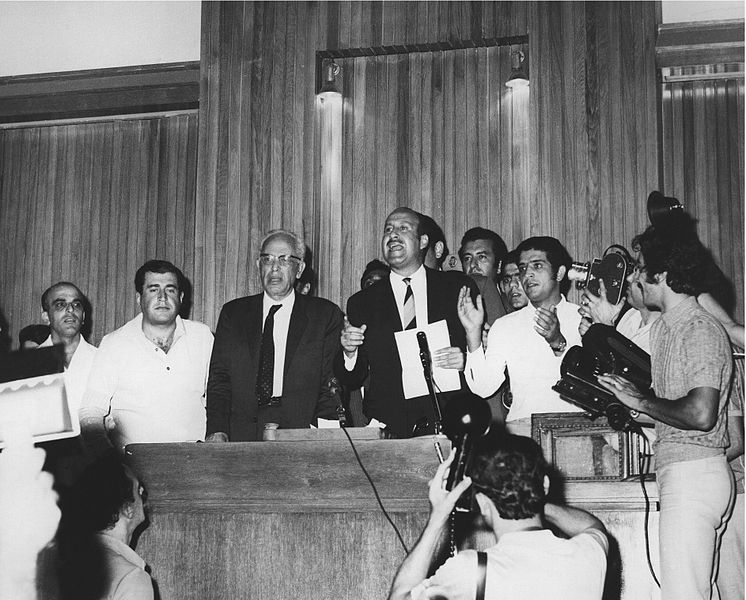
Deputy Speaker Michel Sassin declaring Suleiman Frangieh (The Grandfather) President in 1970

Deputy Speaker Michel Sassine declaring Suleiman Frangieh (The Grandfather) President in 1970

With Tammam Salam’s inability to form a government, the parliament’s failures to convene – which is unconstitutional anyway – and the electoral law impasse forgotten, I find myself obliged to talk about something new to Lebanese politics this month: The presidential elections.

Apparently on Thursday, Marada Movement leader Suleiman Franjieh warned of a presidential vacuum as the conflict over Syria continues and suggested that Lebanon adopts the 50 percent plus one vote formula to secure the office.

Wait What

Let alone the fact that Frangieh’s allies took advantage of that particular constitutional clause (Of having the two thirds quorum in the Presidential elections) in order to block the election of an M14 candidate in 2008, the very fact that Frangieh is asking for a modification of that electoral process is very weird. Why? Let’s see why. Because Frangieh belongs to a coalition in the parliament that holds between the third and half of the MPs in the parliament. That means that under the current constitutional rules, Frangieh – Let’s suppose for a while that he will be M8’s candidate – can block the electoral process by instructing his allies to boycott the session. Just to make it clear – and more complicated for you –  Frangieh said that a 50% plus one vote should be adopted. Thus Theoretically, Frangieh spoke nothing about the quorum.  He only mentioned what the number of votes for the winner should be once there is quorum. So if Frangieh doesn’t want to change the quorum rule in the constitution but only the voting rule, nothing makes sense. Is Frangieh suggesting that we change the quorum or the winning vote number? Let’s see.

M8 has 40% of the votes, M14 45%, and the others (Mikati, Jumblatt …)15%  (The numbers aren’t exact, but you get the point)

Case 1: Our lovely non functioning system (Quorum 66%, First round 66%, Second round 50%+1). Frangieh wants to run, but M14 and the others won’t vote for him. Frangieh instructs his allies to boycott. 40%>33% which means that there will be no quorum, thus no elections. In case the others will vote for him, that means he will have 55% of the votes. M14 boycotts, 45%>33%, meaning that there will also be no quorum.

Case 2: Quorum remains untouched with Frangieh’s amendment (Quorum 66%, First round 50%+1). Frangieh wants to run, but M14 and the others won’t vote for him. Frangieh instructs his allies to boycott. 40%>33% which means that there will be no quorum, thus no elections. However, Frangieh is saying that he is making the amendment to make life simpler and easier for the parliament to elect the president. Which means that the amendment doesn’t make any sense (See, I told you!) because the quorum boycott is still here and if he wishes not to boycott and elect the president with 50%+1 he can simply wait for the second round and keep the constitution like it was (see Cas 1)

Case 3:  Frangieh was actually talking about the quorum!  (Quorum  50%+1%, First round 50%+1).  40%<50% which means that Frangieh can’t freeze the process if he boycotts and has a very high chance of losing because 40%<50%. Unless…

Unless What?

Unless Frangieh is sure he can secure 65 MPs to vote for him. In politics you don’t actually propose something you might lose in, so there’s something fishy about this. If Frangieh meant cas 1 (or cas 2), he was probably just saying things to fill in the blanks of his speech. But if what Frangieh meant was cas 3, then something very dangerous is going on here.

Dangerous How?

If Frangieh can bring 65 votes, but not 86 (the 66% quorum that he wishes to remove in his reform) that can mean only few things. That means he isn’t a consensual candidate because he doesn’t have 66% of the votes (shocking, right?), that he will be running with M14 (See what I mean by dangerous?) against Aoun, or that Jumblatt and Mikati, along with Amal and Hezbollah and someone else will choose him as their sole candidate to the elections and throw Aoun outside which will probably make the latter closer to M14 than M8.

While the theory of having Frangieh and M14 as allies is unimaginable, the very fact that Jumblatt and Hariri have engaged in a media war lately, that Jumblatt is starting to prefer M8’s 9-6-6 formation over M14’s 8-8-8 one and that Aoun is actually getting closer to the Future Movement makes the second theory absurd yet executable.

However the most plausible explanation to this whole reform question is that Frangieh doesn’t want to extend to Suleiman for 6 years. Knowing that a boycott would create another revolutionary vacuum (Expired parliament, no president, no government, Yay!) he is probably paving the way for a small consensual amendment: only 1 (or 2?) extra year for Suleiman while implementing the reform of 50%+1 (M14 and the others should be enough to elect Suleiman), in exchange of something else for M8 (their formula for the government gets adopted? A consensual electoral law?). M8 will be theoretically still boycotting the elections – except this time it’s harmless to the electoral process.

Oh, and speaking of 50%+1, Frangieh’s Grandfather was actually elected by exactly 50%+1 of the votes. Actually, it was 50%+0.5, (he got 50 out of 99 votes. 99/2=49.5 which means he got 50%+0.5) and that is why in the picture, it’s not the speaker Sabre Hamade – his political rival who considered 50%+0.5 instead of the absolute majority (50%+1) to be unconstitutional – proclaiming him president, but Hamade’s deputy.

And look at us, complaining about the 66% quorum.