Lebanese Politics

Understanding Lebanon’s Electoral Demographics With 40 Maps

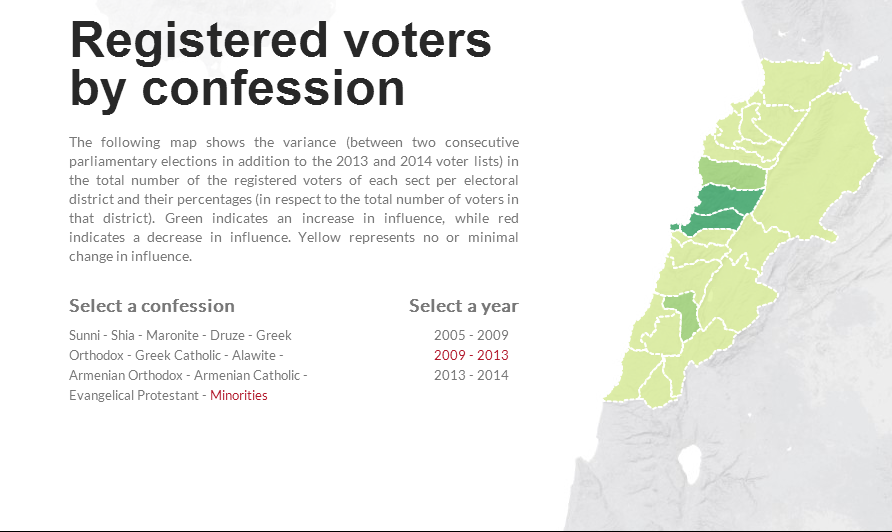
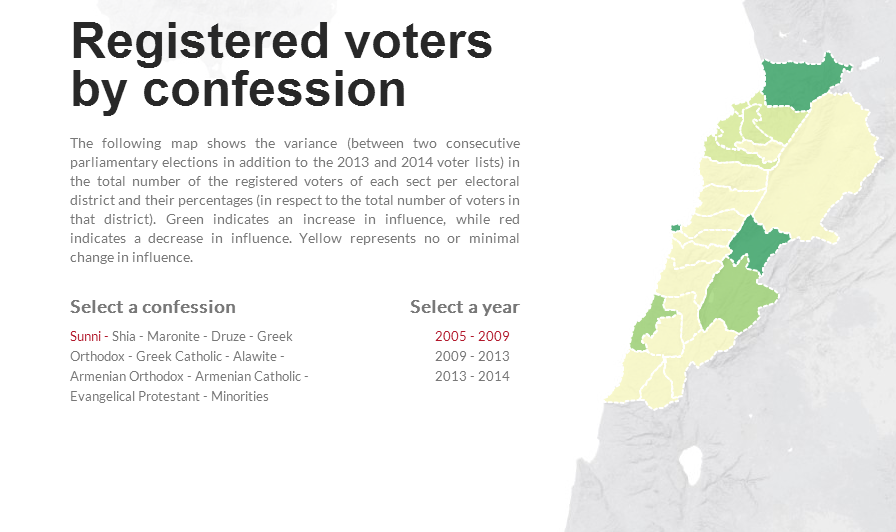
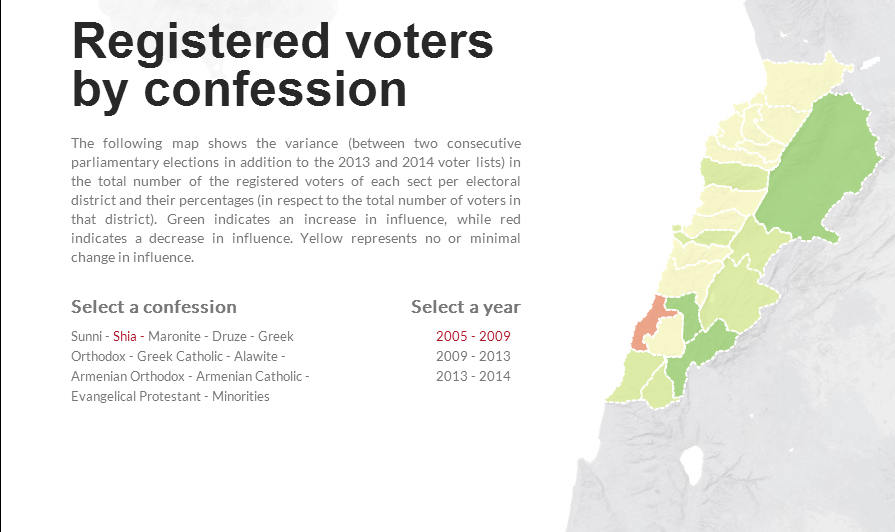
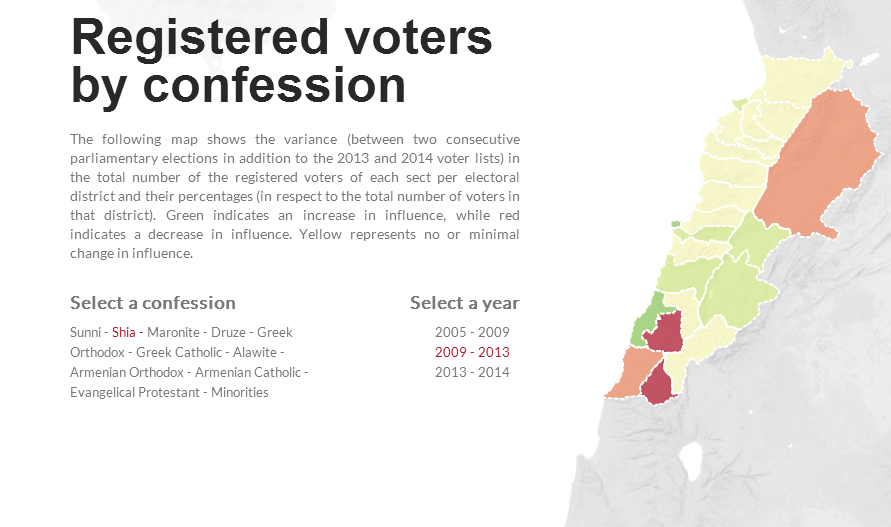
Electoral map of Lebanon according to the modified 1960 law of 2008

Electoral map of Lebanon according to the modified 1960 law of 2008

Lebanese like four things: Speculation, religion, percentages, and rankings. What is the fastest growing sect? In 25 years, what religious group will be the biggest? What religious groups are shrinking in size? Where? Every Lebanese citizen asked himself at least once these questions. Perhaps because of a trans-sectarian fear of becoming a minority, or perhaps because of simple curiosity. For a country with no census since 1932, the closest thing officially available and that is constantly updated is the electoral data. The Lebanese Association for Democratic Elections (LADE) created an amazing and extremely useful website, lebanonelectiondata.org where you’ll find visualizations on trends in voter registration by confession, gender, as well as white ballots cast and voter representation in parliament. The amount of information offered is too huge but it’s also extremely organized and simple.

All the following maps are taken from the website, and in case you’re interested to know the exact percentage for every district – the maps are based on the modified 1960 electoral law of 2008 – don’t hesitate to check their website (simply click on the district of your choice in the interactive map). And for those of you who prefer Excel tables instead of maps, you can find what you’re searching for here.

A- Confession Trends

a- Maronite

Maronite 2005-2009

Map 1: Maronite influence change between 2005 and 2009

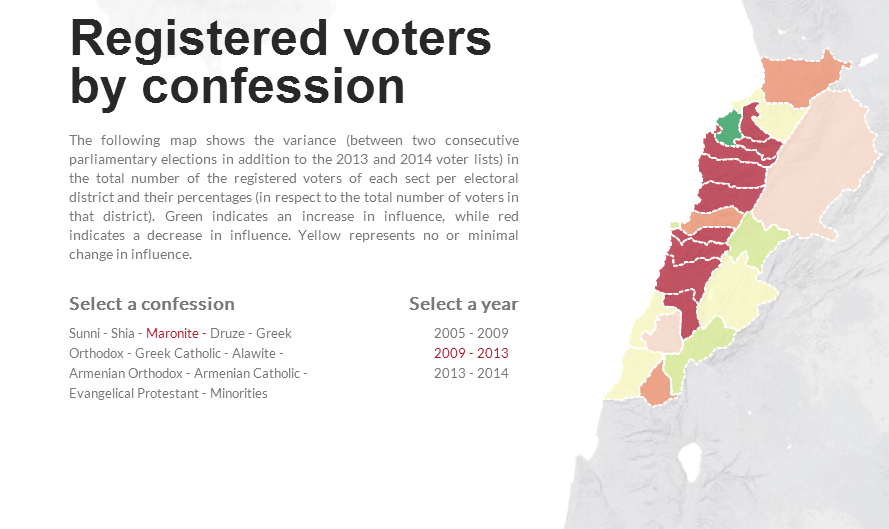
Maronite 2009-2013

Map 2: Maronite influence change between 2009 and 2013

Maronite 2013-2014

Map 3: Maronite influence change between 2013 and 2014

b- Greek Orthodox

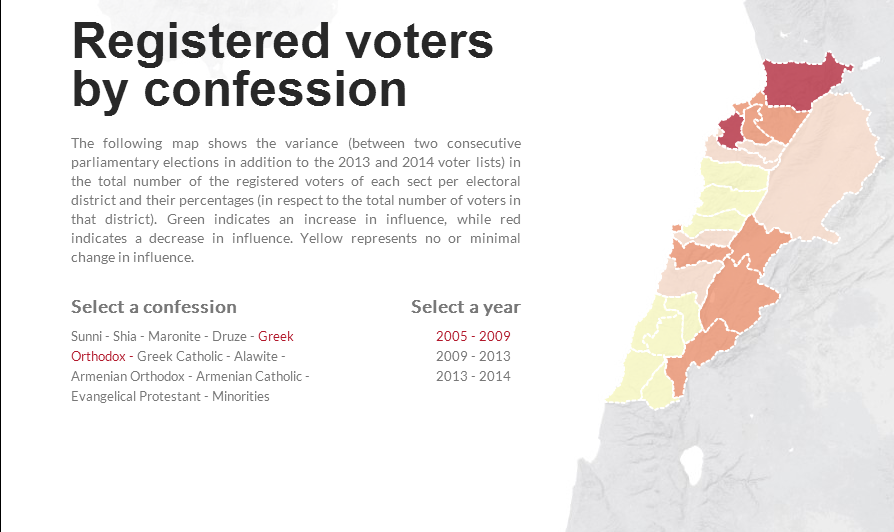
Greek Orthodox 2005-2009

Map 4: Greek Orthodox influence change between 2005 and 2009

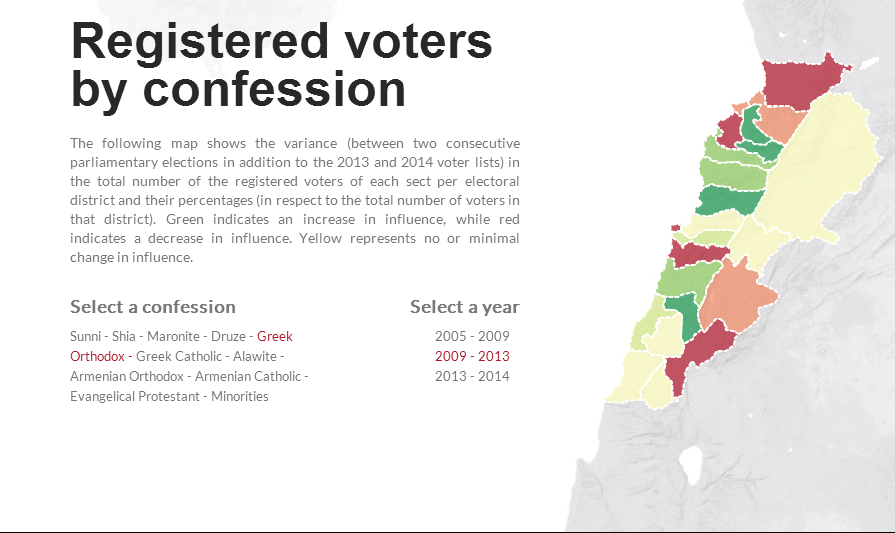
Greek Orthodox 2009-2013

Map 5: Greek Orthodox influence change between 2009 and 2013

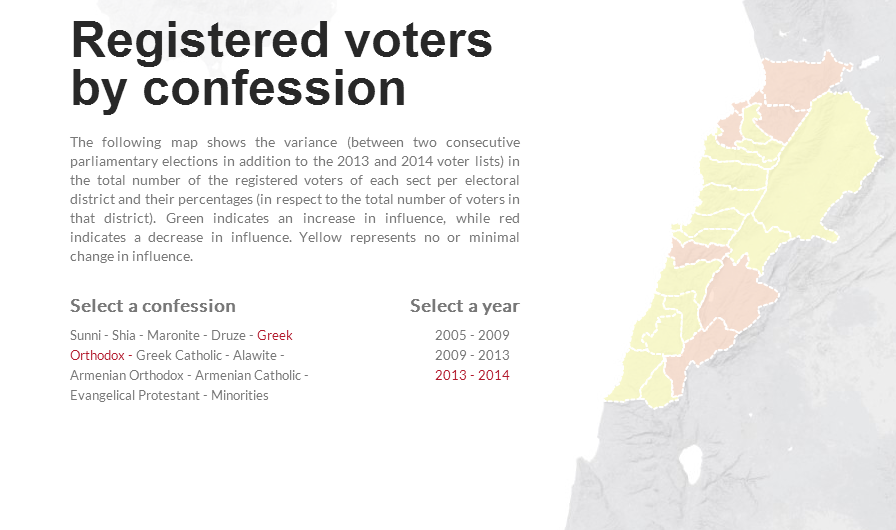
Greek Orthodox 2013-2014

Map 6: Greek Orthodox influence change between 2013 and 2014

c- Greek Catholic

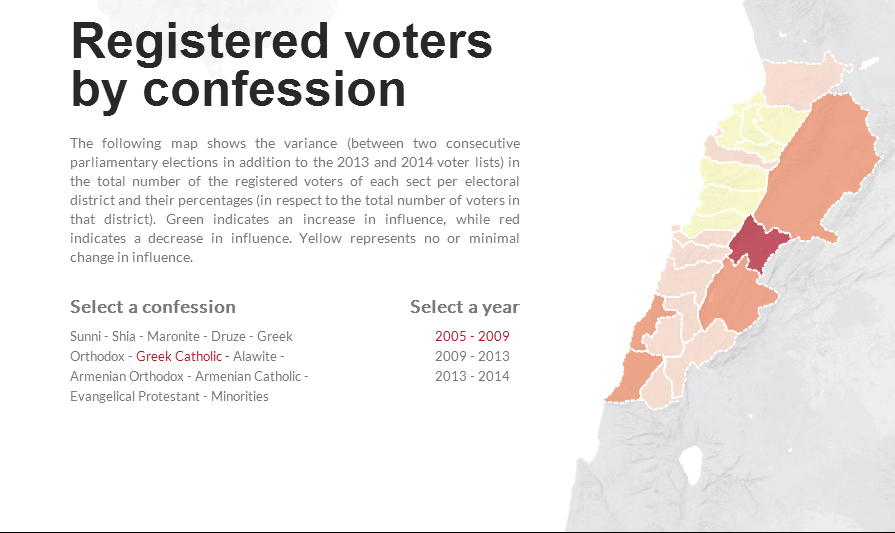
Greek Catholic 2005-2009

Map 7: Greek Catholic influence change between 2005 and 2009

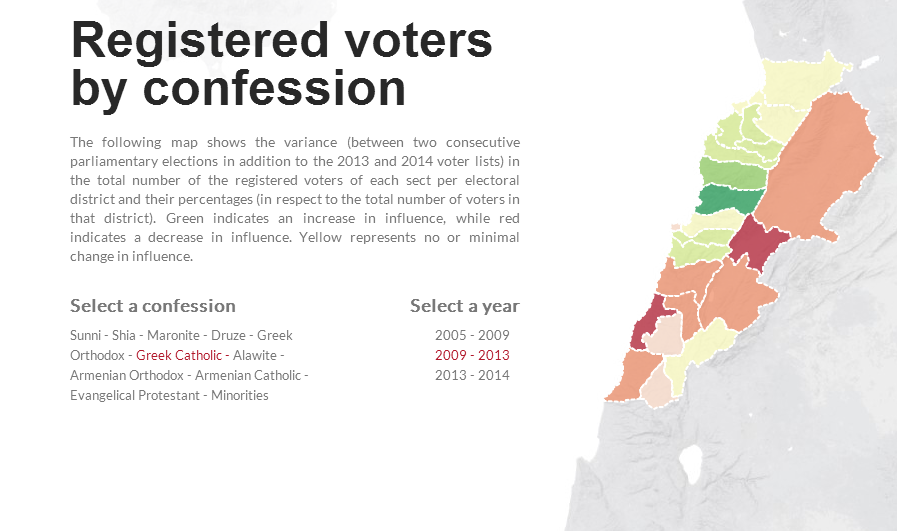
Greek Catholic 2009-2013

Map 8: Greek Catholic influence change between 2009 and 2013

Greek Catholic 2013-2014

Map 9: Greek Catholic influence change between 2013 and 2014

d- Armenian Orthodox

Armenian Orthodox 2005-2009

Map 10: Armenian Orthodox influence change between 2005 and 2009

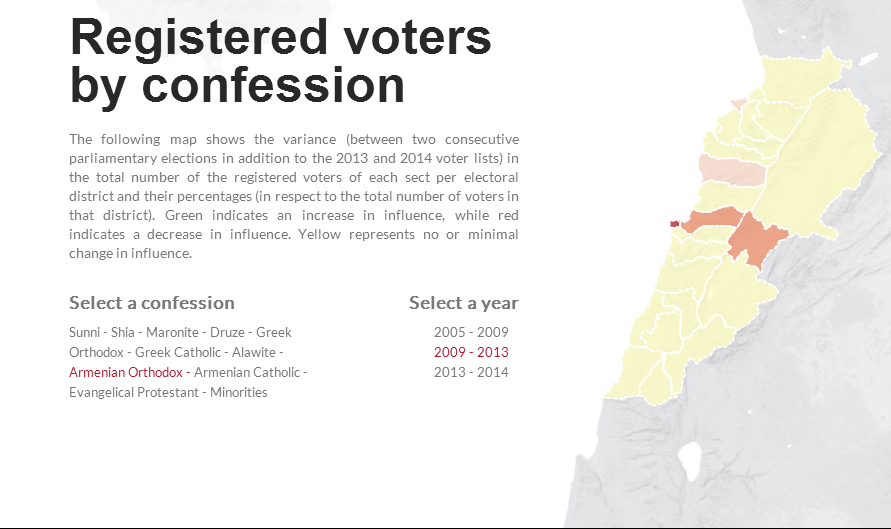
Armenian Orthodox 2009-2013

Map 11: Armenian Orthodox influence change between 2009 and 2013

Armenian Orthodox 2013-2014

Map 12: Armenian Orthodox influence change between 2013 and 2014

e- Armenian Catholic

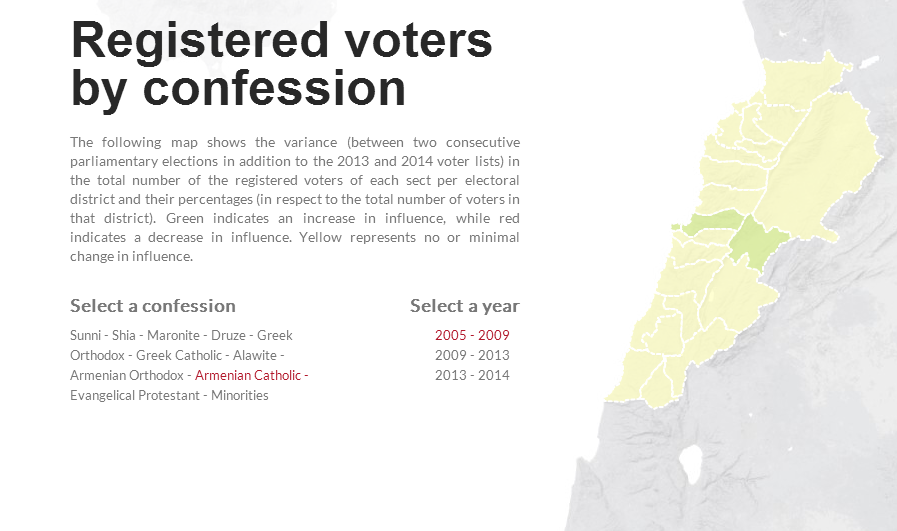
Armenian Catholic 2005-2009

Map 13: Armenian Catholic influence change between 2005 and 2009

Armenian Catholic 2009-2013

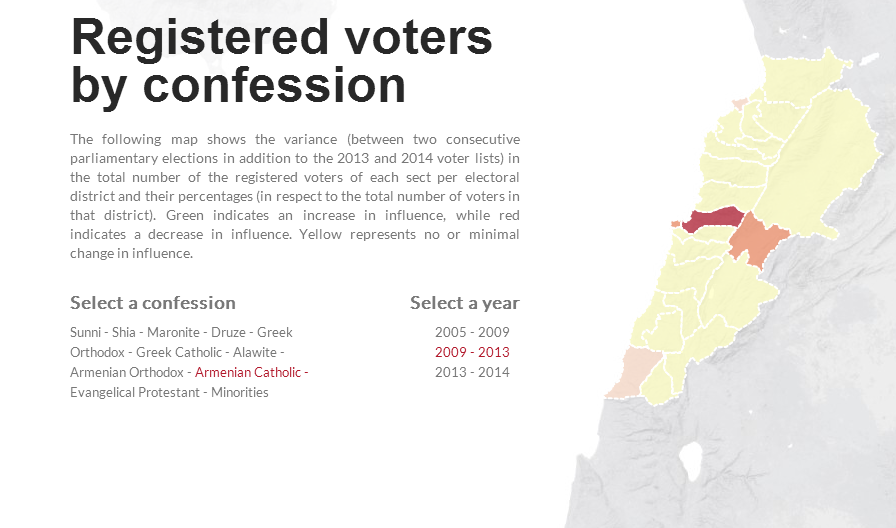
Map 14: Armenian Catholic influence change between 2009 and 2013

Armenian Catholic 2013-2014

Map 15: Armenian Catholic influence change between 2013 and 2014

 f- Protestant

Protestant 2005-2009

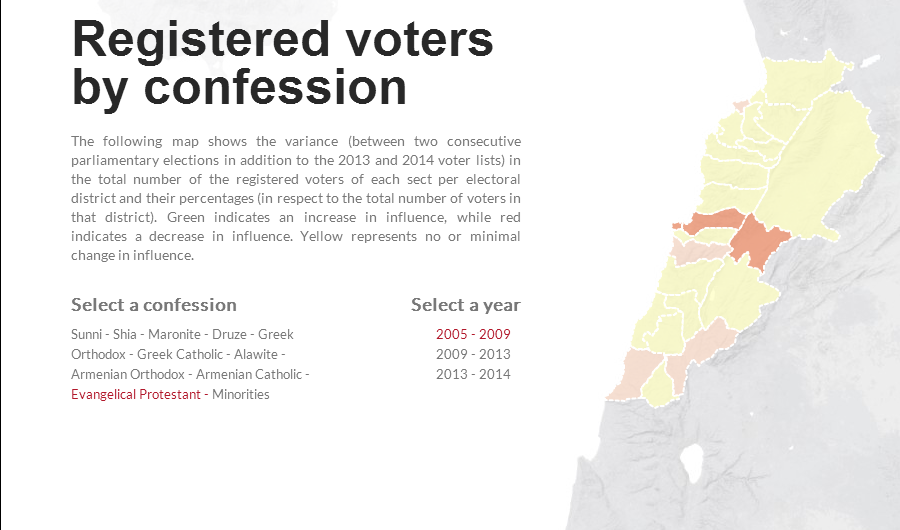
Map 16: Protestant influence change between 2005 and 2009

Protestant 2009-2013

Map 17: Protestant influence change between 2009 and 2013

Protestant 2013-2014

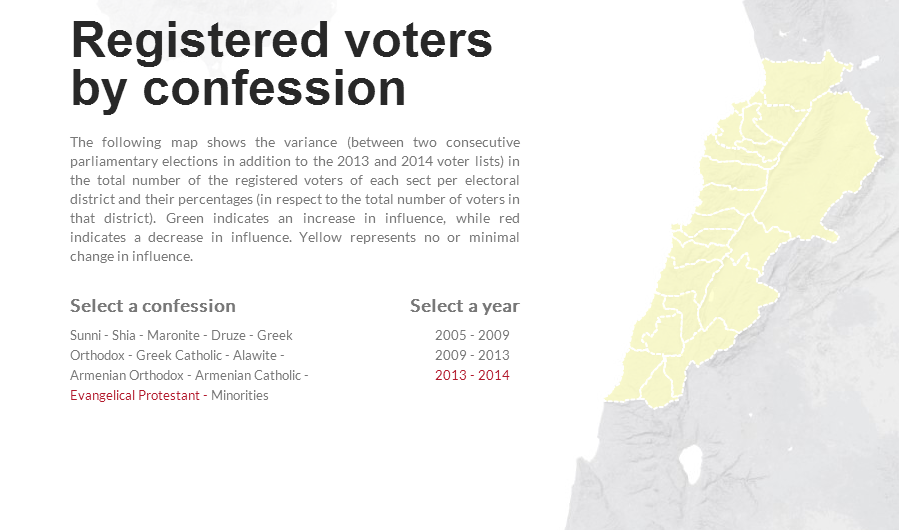
Map 18: Protestant influence change between 2013 and 2014

 g- Christian Minorities

Minorities 2005-2009

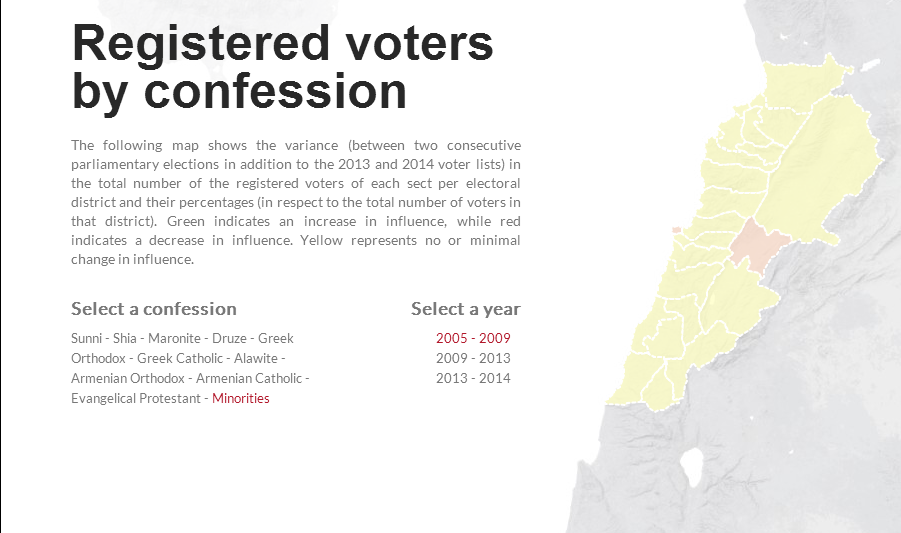
Map 19: Minorities influence change between 2005 and 2009

Minorities 2009-2013

Map 20: Minorities influence change between 2009 and 2013

Minorities 2013-2014

Map 21: Minorities influence change between 2013 and 2014

h- Sunni

Sunni 2005-2009

Map 22: Sunni influence change between 2005 and 2009

Sunni 2009-2013

Map 23: Sunni influence change between 2009 and 2013

Sunni 2013-2014

Map 24: Sunni influence change between 2013 and 2014

i- Shia

Shia 2005-2009

Map 25: Shia influence change between 2005 and 2009

Shia 2009-2013

Map 26: Shia influence change between 2009 and 2013

Shia 2013-2014

Map 27: Shia influence change between 2013 and 2014

j- Druze

Druze 2005-2009

Map 28: Druze influence change between 2005 and 2009

Druze 2009-2013

Map 29: Druze influence change between 2009 and2013

Druze 2013-2014

Map 30: Druze influence change between 2013 and 2014

k- Alawite

Alawite 2005-2009

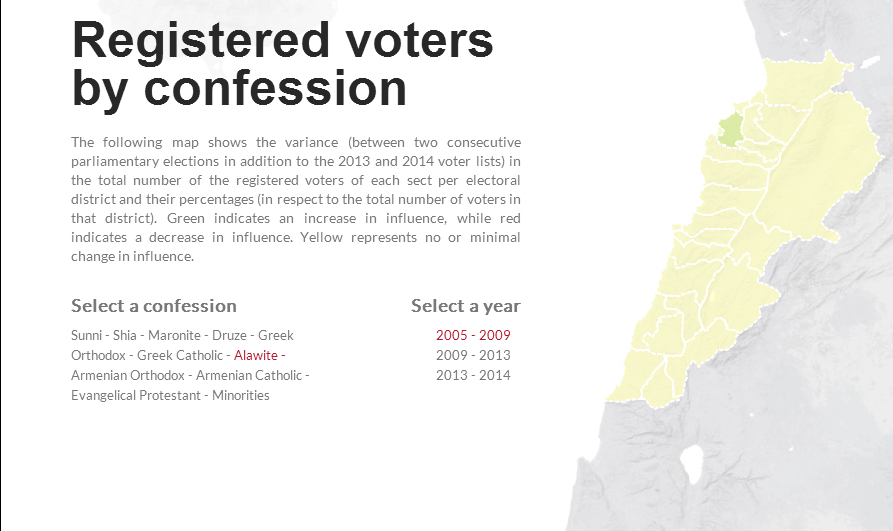
Map 31: Alawite influence change between 2005 and 2009

Alawite 2009-2013

Map 32: Alawite influence change between 2009 and 2013

Alawite 2013-2014

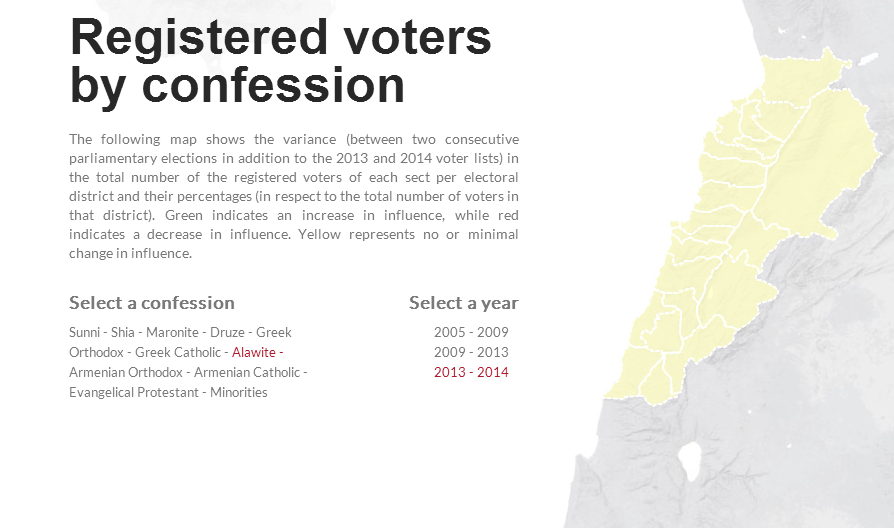
Map 33: Alawite influence change between 2013 and 2014

B- Gender Trends

Gender Voter registration 2009

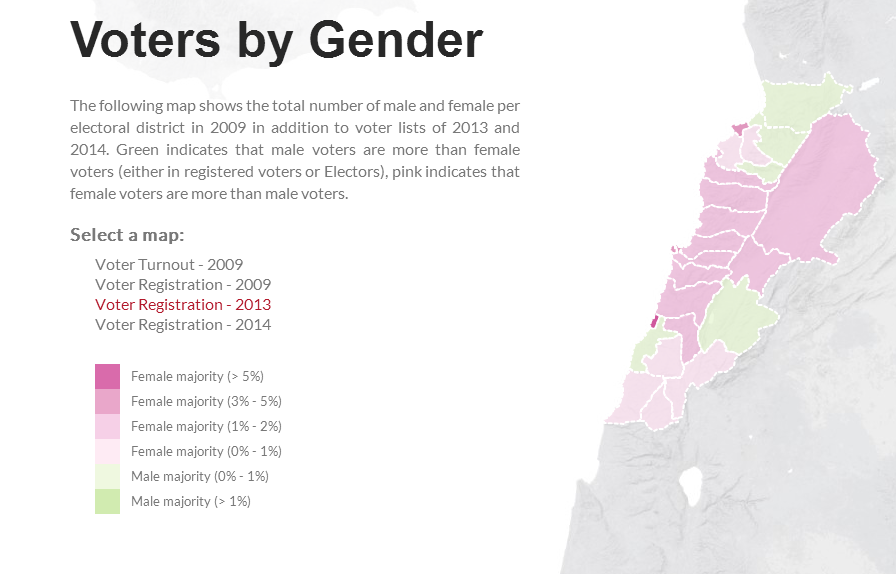
Map 34: Influence by gender based on the 2009 voter registration

Gender Voter Turnout 2009

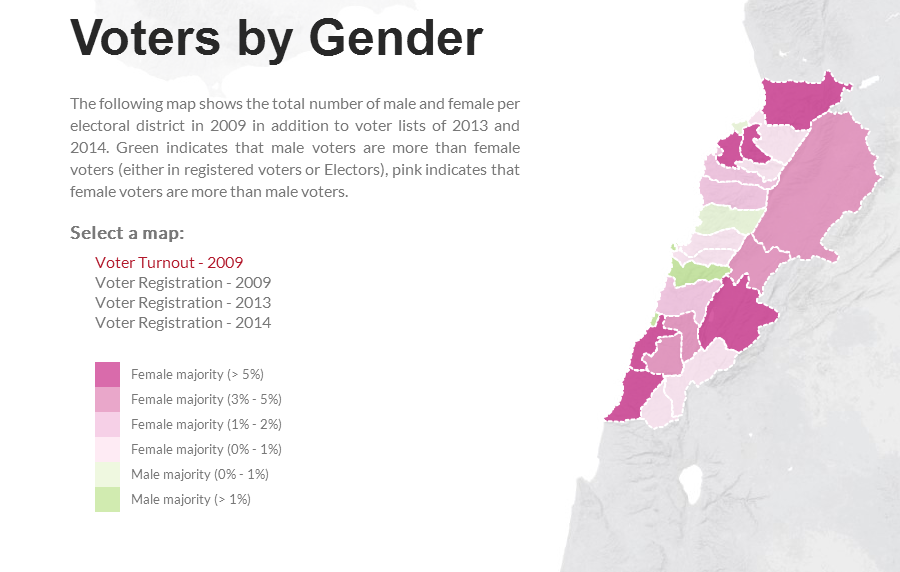
Map 35: Influence by gender based on the vote turnout of 2009

Gender Voter registration 2013

Map 36: Influence by gender based on the 2013 Voter registration

Gender Voter registration 2014

Map 37: Influence by Gender based on the 2014 voter registration

C- Vote Power (Number of registered voters/Number of MPs)

Vote Power 2009

Map 38: Vote Power in 2009

Vote Power 2013

Map 39: Vote Power in 2013

Vote Power 2014

Map 40: Vote Power in 2014

Les Grandes Lignes

This is too much data to analyze, and basically every map can be reviewed on its own. However there are general observations common to most of the maps:

(1) Female voters are by far more influential than male voters. If you take a look at maps 34,35,36 and 37, you’ll hardly find any green. According to map 35, the only districts where  the men were the majority of voters in 2009 are Aley, Beirut, Tripoli, Saida, and Keserwan.

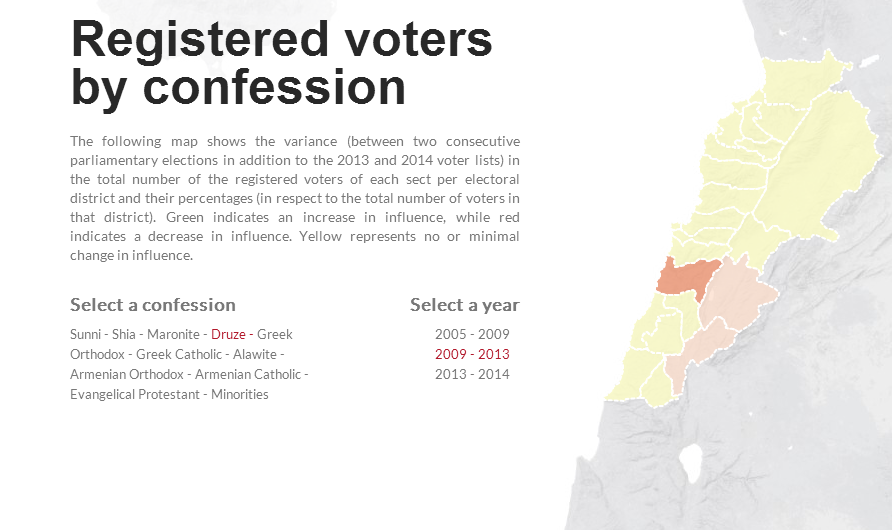
(2) Christian percentages are mainly dropping everywhere (maps 1→21). And even when the percentages of a certain Christian sect in a certain district is rising, it usually reflects a much bigger drop by another Christian sect. For example, the Maronite percentage in Koura is the only one that became more important (the green spot in map 2), but this is only because the Greek Orthodox percentage of Koura is dropping even more (maps 4 and 5). Another interesting fact is that the Greek Catholics are having higher percentages in the Christian heartland (Northern Mount-Lebanon and the Southern parts of the North) while their percentages are massively dropping everywhere else (maps 7, 8 and 9). It could indicate that some Greek Catholics are changing their place of registration (which is the hometown) from the mixed districts to the Christian heartland.

(3) On the Muslim side, there’s an interesting trend among Shias and Sunnis. If you look at the maps 23 and 26, you realize that the Sunnis are becoming more populous in the Shia-majority districts (Look how much the south is green in map 23) while the Shias are having higher percentages in the Sunni dominated districts (Take a look at Beirut, Saida, Zahle, West-Bekaa and the Chouf in map 26).

(4) If you check maps 38→40, you’ll notice that the districts that are the most underrepresented are the Muslim and rural ones (mainly Akkar and the South).

(5) So to sum things up, on the long run, most of the districts tend to become more religiously mixed. For example take a look at the Greek Orthodox in map 5. The Greek Orthodox are having lower percentages in their heavyweight districts like Akkar, Marjeyoun, Koura, Tripoli, Aley and Beirut. Their percentages are however rising in the other districts where they are barely present (especially in the Christian heartland).

The Maronite-Zionist Treaty Of 1946 (Text)

May 30th 1946

We, the undersigned:

1. His Beatitude Antoine Arida, the Maronite Patriarch of Lebanon, acting on behalf of the Church and the Maronite community, the largest community in the Lebanese Republic with citizens residing in other countries, represented by Cheikh Toufic Aoud, ex-minister by virtue of authorization addressed to the President of the Jewish Agency, Professor Weizmann on May 24th 1946,which hereinafter shall be in this treaty addressed as “first party”.

2. Dr. Bernard Joseph , acting on behalf of the Jewish Agency for Palestine which is known in International Law as the representative of Jewish people around the world aimed at creating the Jewish National Home in Palestine,which hereinafter shall be in this treaty addressed as “first party” [NOTE : This is clearly an error as the Jewish Agency for Palestine is afterwards addressed in this treaty as “second party”].

ART.1: The first party expressly and fully recognizes the historical link uniting the Jewish people to Palestine, the Jewish people’s aspirations in Palestine, and the Jewish people right to a free immigration and independence in Palestine. It also declares its approval on the Jewish agency’s declared current political program including the establishment of a Jewish state.

ART.2: The second party expressly and fully recognizes the independence of Lebanon and the right of its inhabitants to choose the regime they deem as appropriate. The second party also declares that its extending and widening program does not include Lebanon. On the contrary, it respects the state of Lebanon in its current form and borders. The Jewish immigration does not include Lebanon.

ART.3: The two parties commit themselves reciprocally to abstain from undermining their respective aspirations and status; the so-called commitment has a binding obligation restraining the representatives of both parties – officials and non officials – in the country, abroad, in international conferences whether occidental or oriental, from expressing any kind of support to decisions or actions that may harm the other party. Also do their utmost to avoid taking such decisions or undertaking such actions.

ART.4: The two parties commit themselves to provide mutual help at the following levels: political, commercial, security and social in order to promote the position of the first party and realize the aspirations of the second one. This engagement includes:

a) Raise the awareness of public opinion in the Orient and the Occident on the cause of each party, according to the spirit of the treaty hereby.

b) Concert their efforts to open the doors of each country with view to deepen cultural and social rights and promote commercial trades and the exchange of liaison officers to forge good neighboring relationships between one another.

c) The first party recognizes the right of every Jewish to immigrate to Palestine commits itself to help as much as possible in the realization of this immigration in the event that it shall pass through Lebanon.

d) The second party commits itself, after the creation of the Jewish state, to respect the sacred character of the holy sites in Palestine and commits itself as well after retaining the command of power to consider the treaty hereby as an integral part of the government program.

e) The two parties commit themselves to provide help, if requested, to one another in order to maintain security in their respective countries. This engagement has the binding obligation to take all necessary measures to block the entrance or exit of hostile elements capable of sowing public disorder and the obligation to refrain from providing any kind of help for such elements.

f) The two parties commit themselves to exchange information on all issues such as the politics of their countries, their economy, security, and relations with third parties.

g)At the industry, agriculture and scientific research levels, the two parties commit themselves to exchange information and advice in order to synchronize the Lebanese and Jewish efforts with a view to ensure the best development of their respective industries (including the tourism sector), agriculture and research on the basis of mutual cooperation.

h)After creating the Jewish state, the second party commits itself to reserve a friendly treatment to the representatives of the Maronite Patriarch, to facilitate the buying of a land and the construction of a Patriarchate worthy of the Maronite community.

i)The second party commits itself to require from its offices all over the world to support the cause of the first party and back its representatives in Washington, London, and Paris and in international conferences.

ART.5: In order to achieve the afore-mentioned obligations, and additional practical means of collaboration and mutual aid, the two parties will hold direct or indirect (through representatives) talks depending on the relevant advancement and circumstances. The first party has already chosen Cheikh Toufic Aouad to be its authorized representative till further notice.

ART.6: The treaty hereby takes effect upon signature. Each party has the right to terminate it within six months notice.

In witness whereof the two parties have signed this treaty.

Double original copy, Jerusalem, May 30th 1946.

On behalf of His Beatitude His Grace Antoine Pierre Arida, Toufic Aouad

On behalf of the Jewish Agency for Palestine, Bernard Joseph

Source: Central Zionist Archives 525/3269

Just to make things clear here, I’m not accusing anyone of anything. I had always heard and read rumors about such a treaty so when I found the text on the internet I thought of republishing it. Be it good or bad, Lebanese need to know their history and such a treaty should be as accessible to the Lebanese public as the 1983 agreement between Lebanon and Israel. Keep in mind the importance of the treaty’s timing, less than 3 years after the independence of Lebanon and 2 years before the 1948 Nakba.

A Month Of Vacuum

Baabda Palace Chair

The last time I wrote a blog post, Michel Sleiman was leaving office. One week before that, vacuum was more probable than ever. And here we are, one month after the 25th of May, with no president, with a caretaker cabinet, and with a parliament whose term expires in November. What a lovely way to start the summer. Not much has changed since last month. Michel Aoun is still trying to strike a deal with Hariri – the latest maneuver was his vow to protect him if he’s elected as a president – while Geagea is still maintaining his candidacy in order to block any possible agreement. The PSP – and to a greater extent Nabih Berri and the Kataeb – are enjoying the show, hoping that a centrist closer to one of them might emerge as a consensual candidate.

Welcome to Lebanon, the only republic in the world that – instead of actually electing a president – spends huge amounts of time trying to figure out how a caretaker cabinet should handle the presidential powers.

A new maneuver…

Michel Aoun made a strategic mistake on the 21st of May. While he was trying – in one of his interviews – to convince the Future Movement of electing him as a president, he said something that would probably haunt him for the next few months. “Former Prime Minister Saad Hariri, Sayyed Hassan Nasrallah and I should be a three-sided triangle, and triangles cannot be broken up”. Unless Aoun is a fan of political suicide, he meant that a tripartite alliance between Hezbollah, the FPM, and the FM would be the best for the three. The three parties form a majority in the parliament, wouldn’t compete with each other – they do not appeal to the same religious electorates, and would destroy any rival alliance in most of the mixed districts.

But in Lebanese politics, you don’t mention the names of one Christian and two Muslims in the same sentence. Especially if one of the Muslims is a Shia and the other is Sunni. M14 took advantage of Aoun’s political faux-pas, successfully accusing him of trying to establish a 33% Shia – 33% Sunni – 33% Christian formula instead of the existing 50% Christian – 50% Muslim one. On the eve of the 25th of May, Aoun wasn’t anymore the man who was willing to send the country to vacuum in order to become president: He became the man who was willing to challenge Christian interests and even the very foundation of the Taef regime for personal gains.

…and a fast response

“We extremely regret recent remarks accusing our camp, especially the Shiite duo, of seeking tripartite power-sharing, and someone is trying to say that we want a presidential void because we want to reach tripartite power sharing. […] Years ago, the French were the first party to raise this issue in Tehran. They told the Iranians that the Taef Accord had become outdated and asked them about their opinion regarding tripartite power-sharing. The Iranians had never thought of this matter, but they asked us about it and we said that it is totally out of the question.” Nasrallah clarified.

A media campaign by M14 accusing Aoun of trying to implement a tripartite power sharing agreement would have destroyed Aoun and the FPM in the Christian camp. Hezbollah’s response was fast – it had to be. Nasrallah scored several mini-victories in his speech:

(1) By using the words “Shiite duo” he sent a message to Aoun reminding him that Berri – who was excluded by Aoun in his interview as Aoun only mentioned Nasrallah, Hariri and himself – would not under any circumstances be excluded in any deal regarding the presidential elections.

(2) Nasrallah distanced M8 from this controversy and threw it on the French. You know he succeeded when in the following morning the Kataeb had the “moral Christian political obligation” to ask the French embassy for clarifications.

(3) Nasrallah knows how to use his words. The Iranians had never thought of this matter, but they asked us about it and we said that it is totally out of the question. In a Middle-Eastern context where M14 accuses Hezbollah of following the orders from Iran’s Qassem Suleimani, Hezbollah’s secretary-general gave the impression to the Lebanese public that Hezbollah does not receive orders from Iran and always has the last say in local politics.

So how bad is the vacuum? It’s so bad that on the 22nd of June, we’re still tackling events that happened between the 21st of May and the 6th of June…

When the fear of not broadcasting the world cup makes a nation panic more than the fear of not electing a president, know two things: (1) The Lebanese president is as relevant as a soccer ball, and (2) we have been so accustomed to power vacuum that even a football game is more interesting for a Lebanese than the prospect of electing a new president.

At least in the world cup, a team is expected to win. In the matter of a month. And It’s not a consensual winner.

Reminder: We still don’t have a president – 29 days since the 25th of May.

Michel Sleiman, 2008-2014: The Legacy (Full)

Mr. Speaker, esteemed members of the parliament,

I would have been extremely delighted to begin this mandate with moments of joy; nevertheless, I am confident that our silence will be praised by the souls of our martyrs who are close to God Almighty, since this mandate will be laying the foundations for a new promising phase, for the citizens of our beloved country which is rising from this stumble, thanks to the Lebanese people’s awareness, their refusal to fall the victims of fratricide, and the efforts our loyal friends and brethren have undertaken to mitigate the effects of these unfortunate events and to eliminate their consequences.

Today, by taking the oath, I am calling upon you all, political parties and citizens, to start a new phase which title is Lebanon and the Lebanese people, where we commit ourselves to a national project agreed upon with a futuristic mentality in order to serve the interests of our homeland and prioritize them over our sectarian and confessional interests, and over all the others’ interests.

On the 25th of May 2008, when Michel Sleiman assumed his responsibilities as Lebanon’s new president, he gave an inaugural speech in front of the parliament.  The speech (This is the official English version) includes the president’s plan for the next six years, and the goals he plans on achieving before leaving office on the 25th of May 2014.

Today, the 25th of May 2014, is judgment day. You’ll find the whole speech below, in italics, with comments on what was achieved in order to fulfill the promises of 2008.

1. Activating the role of constitutional institutions

The desired political stability makes incumbent upon us to activate the role of the constitutional institutions where the political ideas and dissimilarities will be dealt with, in order to reach common denominators which secure the interests of the homeland and the people.

The political disagreement and the resulting constitutional problematic we have encountered should motivate us, not only to find the solutions to the problems that we might face in the future, but also to achieve the proper balance required between the competences and responsibilities in a way to enable the institutions and the Presidency of the Republic included to assume the role they are entrusted with.

Between the 25th Of May 2008 and the 25th of May 2014, the Lebanese president had 2191 days to rule. His first cabinet (Siniora) took a total of 79 days (25 May 2008 – 12 August 2008) to be formed and receive the vote of confidence. The second cabinet (Hariri) took a total of 187 days (7 June 2009 – election day, 10 December 2009) to be formed and receive the vote of confidence. The third cabinet (Mikati) took a total of 177 days (12 January 2011 – resignation of the M8 ministers, 7 July 2011) to be formed and receive the vote of confidence. The fourth cabinet (Salam) took a total of 364 days (22 March 2013 – Mikati’s resignation, 20 March 2014) to be formed and receive the vote of confidence. 79+187+177+364=807 days. 807/2191= 36%.

So to sum things up, 36% of Michel Sleiman’s time in power lacked a functioning executive power. Needless to say that the Lebanese parliament cannot legislate with no government in power, and cannot meet in summer, which means that during Sleiman’s 6 years, the parliament had a  maximum of 3 years to pass laws and amendments (around 50% of the time).

In his inaugural speech, Sleiman spoke of two things regarding the deadlock: 1) Activating the role of constitutional institutions, and 2) Finding solutions to the time-consuming deadlocks. Never in its whole history has Lebanon seen such time-consuming government formations. Tammam Salam and Najib Mikati both broke Rachid Karami’s 1969 record (7 months) in 2014 when they became the new record holders for tardiness in forming cabinet and acting as caretaker PM. The Lebanese parliament had been previously shut down by Berri for 17 Months (2007-2008) during the rule of the first Siniora cabinet, but relatively speaking, the parliament only stopped legislating at the very end of Lahoud’s mandate. The paralysis in the legislative branch was by far more pronounced during Sleiman’s tenure. The low productivity of the parliament is frightening: between June 2009 and March 2013, the parliament convened 21 times only, and voted laws 13 times out of 21. (The numbers are from the official parliamentary gazette, Al Hayat Al Niyabiya). Only 183 laws were voted (a very low number), and the vast majority of these laws are either useless or minor. And if you think that productivity increased after 2013, don’t. The parliament actually didn’t even meet to legislate for more than a year after the last session of 2013. Aslan min elo jlede.

And how was the president concerned with the demise of the constitutional institutions? The president has failed twice here. True, the president has little or no power concerning Lebanese politics. But he – unlike the popular hearsay- still has a lot of powers that he is not using. (1) The president had the power – according to article 33 of the constitution –  to “summon the Chamber to extraordinary sessions by a decree that specifies the dates of the opening and closing of the extraordinary sessions as well as the agenda.” In other words, the Lebanese president could have forced the parliament to meet in Summer – hence compensating  for wasted time. The deputies would’ve probably stayed home, but at least the president would have managed to expose them as lazy greedy elected officials. (2) The president could have pushed for a constitutional amendment setting a maximum of 60 days for a designated prime minister to form a cabinet. The Lebanese president is also one of the two individuals concerned with forming the government. Instead of wasting hundreds of days to form them, the president could have easily issued a deadline for the politicians to agree. Such maneuvers would have accelerated the process of policy making while making it easier. But no, it had to be 807 days.

2. Reform? What reform?

Lebanon, the country of mission, crossroad of civilizations and haven of pluralism, prompts us all to endeavor and engage ourselves in political, administrative, economic and security reforms. This will enable us to restore our country’s exemplary role on the international scene.
Lebanon has chosen to conform to the “Taef” agreement, and it is called to safeguard and consolidate this choice because it stems from a united national will, which is imperative to immunize any political decision.

Between 2008 and 2014, the country was supposed to witness political, administrative, economic and security reforms. Politically speaking, only one main reform was worked upon to achieve: the electoral law of 2008. However, this law plummeted in an exceptional way and was regarded as an epic failure by all the politicians – to the extent that elections were postponed in order to avoid it in 2013, and since the 2008 electoral law lacked most of the recommendations for reform suggested by the Boutros Commission  (such as official pre-printed ballots, partial proportional representation, a 30% women’s quota, an independent electoral commission, lowering the voting age from 21 to 18, out of country voting, access for people with special needs – only holding the election on one day and campaign finance and media regulations were taken into consideration) the 2008 electoral law can barely be considered as political reform. Even the new electoral proposed in 2012 was a very biased one.

Economically speaking, the country’s economy is today in one of its worst days. The 4 Lebanese cabinets under Michel Sleiman did not even make the effort to appoint a new general assembly for the economic and social council, whose mandate had expired in December 2002. On another more depressing and alarming note, the Lebanese parliament failed to pass the state’s budget since 2005, officially making Michel Sleiman the first president in the history of the republic to rule without an up-to-date budget. Again, the Lebanese president should not be judged for the failure of the parliament, but pressure from the president – like refusing to sign decrees and laws that are crucial for the well-being of Lebanon’s politicians before the parliament had passed a new budget – would have been a welcomed gesture. After all, the public debt has never been so high, public strikes – revealing popular discontent from the situation – have never been so frequent while the main economic reform championed by the parliament was a law destined to give a pay raise for the MPs. Further, another example of Michel Sleiman’s bad economic policies also appeared at the very  end of his mandate, when he didn’t sign the new rent law (approved by parliament) that provided a breakthrough regarding the stalemate between landlords and old tenants after more than three decades of deliberation.

3. National pacts

Furthermore, it is the national pact which is analogous to the constitution that joins the Lebanese together based on their own will. It proved to be stronger and far more sublime than any other external will.

Our external relations will be most effective and adequate if they were based on this pact, and thus the interests of Lebanon will be safeguarded and its particularity will be respected; this will enable our country to regain its effective role in the Arab world and the International Community as the living example of the coexistence between the cultures.

The national pact isn’t only about power sharing between Lebanon’s sects. What matters the most in this unwritten accord is the oath Lebanon’s main politicians took to abstain from inviting foreign intervention. While the pact is mostly viewed as a Muslim-Christian deal to split the country’s top posts,  it’s far more than that. Christians gave up French protection while Muslims gave up Pan Arab Union aspirations. The biggest irony in Michel Sleiman’s inaugural speech is that he was publicly praising the national pact  – a symbol of rejecting foreign interference – after being elected due to a Qatari mediated deal in Doha between France, U.S., Syria, and Iran. Even the constitution Michel Sleiman was taking an oath to protect actually carried the name of a Saudi city were it was written, 19 years earlier: Taef. The same regional players would also massively intervene in Lebanese politics during the next 6 years. The formation of governments did not happen without regional consensus and in the 2009 elections parties were massively funded by foreign states. No measure was taken between 2008 and 2012 to reduce foreign influence in Lebanese politics which finally resulted in the 2013 Syrian spillover.

4. Dialogue

Esteemed members of the parliament,

The people have placed their confidence in us to accomplish their ambitions, and not to confuse them with our political differences.

Probably the most dangerous threat which rose in the last years manifested itself in a political speech based on a treason language and mutual accusations, which paved the way to a state of divergence and discord especially among youth. This is the reason why it is essential to realize this fact, to work on fortifying our country and our coexistence through dialogue and to avoid transforming the country into an open arena for conflicts.

Although Sleiman was elected in a consensual deal, and although his 6 years in power were expected to be years of stability – Lebanon witnessed a revolution in 2005, an Israeli war in 2006, a political crisis in 2007 and a mini civil-war in 2008 – this stability was far from true. The problems appeared again with Syria’s civil war spillover in Lebanon since 2012, along with the 2 cabinet crisis of 2011 and 2013 and the comeback of assassinationsexplosions and regular clashes. Lebanon was far from being on the path of stability.

5. Rotation of what again?

The main characteristic of democracy resides in the rotation of power through free elections. It is certainly essential to adopt an electoral law which ensures the sound representation, consolidates the relation between the citizens and their representatives, and guarantees the mirroring of the choices and ambitions of the people, however, it is also important to accept the results of these elections and to respect the popular will.

Furthermore, the independence of the judicial authority consolidates justice which constitutes a safe haven to all people whose rights are violated, and secures a public order to all the public utilities. Hence, the effects of this independence will not be restricted to judgments rendering, since justice is safe hands, it is the pillar of all powers.

The main characteristic of democracy resides in the rotation of power through free elections. Furthermore, the independence of the judicial authority consolidates justice and secures a public order to all the public utilities.” The fun part? Exactly 5 years later, the Lebanese parliament decided that there was no need for free elections and rotation of power was too mainstream for a country such as Lebanon. The Lebanese president tried to stop the parliament by calling on Lebanon’s most prestigious judicial authority – the constitutional council – to convene and study the constitutionality of the 17-months extension. However, and since five of council judges are voted by the parliament and the other five are designated by the cabinet – because, as the president said, independence of  the judicial authority secures a public order to all the public utilities – the politically dependent council refused to convene and the extension of the parliament’s mandate became a de-facto decision to deal with.

The Lebanese president did what was expected of him, but there was more he could have done. The parliament voted the law extending its mandate on the 31st of May 2013. Elections were due in June. According to the Lebanese constitution, article 59 “The President of the Republic may adjourn the Chamber for a period not exceeding one month. He may not do so twice during the same session.” If the president had used this power the constitution gave him, the parliament wouldn’t have convened to vote the extension law, and the June elections would have happened anyway. Even if the parliament did manage to pass the law somehow, the president still could have refused to sign it and publish it into the official gazette for a certain period of time. And even if the president was eventually entitled by the constitution to sign it, he could have considered it unconstitutional – since the constitutional council was too coward to discuss it and since the constitution names the president as the “protector of the constitution” – which means that there was no possible way for the parliament’s extension law to pass if the president wanted to block it. Perhaps the president thought that an extension of the parliament’s mandate also meant an extension to his mandate or making his weak power look as surpassing a weaker parliament… Anyway, three things to remember from all this: no justice, no elections, no democracy. And with generals assuming more and more political responsibilities, Lebanon was starting to look like a military state. Perhaps the president should be admired for his decision to refuse any extension of his mandate – his two predecessors stayed 9 years in office – but then again, it was his constitutional duty to leave after 6 years.

The president’s idea of justice was also the appointment of Ashraf Rifi as justice minister – He was ironically being sued by the Lebanese government for refusing to abide to his superior’s orders.

6. “You are asking questions I am not really aware of, about details that are not really important.” (Gebran Bassil)

Moreover, national responsibility imposes upon us to encourage the youth generation capacities to accede to the public sector institutions in a way to prevent its decline and enables us to establish a younger and more competent administration. This responsibility also makes it inevitable to rely on the good choices and decisions, to consolidate the surveillance organisms and thus to reward the meritorious, set right the negligent, and remove the corrupted from office.

Michel Sleiman’s idea of removing the corrupted from office was accepting the appointment of  controversial figures in top posts. Fouad Siniora headed his first cabinet in 2008, and Gebran Bassil – infamous for answering the question of what happened with 34 Million dollars of public money with “You are asking questions I am not really aware of, about details that are not really important  remained a minister in all four cabinets. And that’s only the beginning of a long (very long) list of names. True, the ministers probably never represented Sleiman in the government, but he still had the upper hand in the cabinet formation, and vetoing the names of controversial politicians or even freezing the formation because of their nomination would have sent a big message. By the end of his term even the president himself was accused with several corruption scandals.

7. “The youth generation is our promising future

Gentlemen,

We will achieve the objective of dissipating the suspicions of the youth by building a country they will be proud to belong to; a country to rise by their capacities, expertise and participation in finding the solutions. Let us all allow them to guide us where we have failed, on the grounds that the youth generation resisted the occupation and terrorism and fought for the independence. The youth generation is our promising future, the wounds thickened them but made them stronger and some of them became handicapped and thus their rights should be guaranteed according to the laws and regulations.

The idea of encouraging the youth to accede to the public sector eventually ended up in the failure to pass a constitutional amendment giving the right to vote to Lebanese citizens between 18 and 21 and a Lebanese average age in the cabinet of…60 years old. Apparently 60 years and Sheikh El Chabeb are the same thing.

8. “Reformative educational policy in our schools

It is noteworthy to bear in mind the importance of a reformative educational policy in our schools and universities, a policy which will restore their significant role in this region.

Just to make things clear here, in 2008, the Lebanese history school books stopped in 1946 because there is no consensus on what happened next.  In 2014, the Lebanese history school books still stop in 1946 because there is no consensus on what happened next. But yeah, it is noteworthy to bear in mind the importance of a reformative educational policy in our schools. El mhemm el niyye.

9. Diaspora, Tourism, Economy Wel Shabeb

The Lebanese communities in the Diaspora are looking up and hoping to see their homeland rising from underneath the ashes once more and therefore we should acknowledge the rights of the Lebanese immigrants and proceed with the measures which will reinforce their adhesion and interaction with Lebanon. We should also resort to their capacities and engage them in a way that will make them feel as actual citizens and far more worthy of the Lebanese nationality than those who acquired it illegitimately.

Emerging from the state of recession and activating the economic cycle necessitate political and security stability as well as the patronage of the State to encourage the competitive production process. Thereupon, the plans of attracting investments and securing a friendly environment can fight against unemployment and immigration.

This fact also leads to the necessity of attaching great importance to our productive economy in the industrial, agricultural, and services fields and the importance of spreading the environmental culture and emphasizing on this country’s aspects of tourism.

For the president, acknowledging the rights of Lebanese immigrants was of high importance. Since  late 2008 Law gives expatriates the right to vote in the elections. However the elections didn’t happen, and even if they did happen, a failure of the Lebanese Foreign Ministry to raise awareness of the registration process would have made it impossible for Lebanese abroad to vote in the parliamentary elections.

Sleiman also made sure to visit every possible country in the world, in order to strengthen the ties with the Lebanese abroad. The trips – that costed the state 9 million dollars, more than it actually spends on industry, culture, or sports – were useless. One might understand visiting France once or twice like in 2008 and meeting foreign leaders. One might even understand the Cyprus, SyriaQatar, Iran and Saudi Arabia trips. The U.N. New York trips are a must. But Michel Sleiman ‘s trips were too many, and there was always useless leisure time. Armenia. Mexico. Brazil. Russia. Spain. Great Britain. Australia. The Czech Republic. Romania. Uruguay. Argentina. Switzerland. Canada. Italy. Vatican. Egypt. Germany. Jordan. Kuwait. Bahrain. U.A.E. Oman. Turkey. And there’s a lot more (West Africa..). Perhaps the president may do as he wishes, but for millions of times, the cabinet formation was delayed because the president was touring abroad. And that’s only an example of the trips’ repercussions. The whole point of these paragraphs in the inaugural speech was to bring the Lebanese back home and stimulate tourism, not send the president abroad. Although tourism in Lebanon flourished in 2010, tourist traffic at Beirut airport is down at 40% since 2010. Of course, the Syrian Civil war is to blame here, but there were lots of things that could have been done to save the tourism seasons. But instead of enacting reforms reinforcing stability and promoting tourism, politicians opted to travel abroad.

 10. Decentralization

The balanced development is an essential pillar of the country’s unity and the regime’s stability; we consider that the implementation of the wide administrative decentralization constitutes an important factor for this development to achieve the required reform in the field of social, economic and cultural disparity between the Lebanese regions. Furthermore, it is imperative to attach a great importance to the return of the displaced in a way to close this file permanently.

Michel Sleiman had 6 years to pass a decentralization law, and to apply it. He could have taken 1 year to prepare the draft, another to push for it in the parliament, and 4 other years to make sure it’s successfully implemented. But no, the draft law had to be presented to the parliament 1 month before he left office. You know, because one should take his time to implement crucial, long-awaited reforms.

11. STL, People, State and Armies

Gentlemen,

Our abidance by the charters of the United Nations and our observance of its resolutions are due to our firm conviction in the International legitimacy based on the principles of justice and right. Consequently, we would like to confirm our participation in the establishment of the International tribunal with regard to the assassination of the martyr Prime Minister Rafik Hariri and his companions, as well as the assassinations which followed in order to bring justice.

The evolution of the Resistance was a need during the impotence of the state and the persistence of this Resistance was achieved by virtue of the support granted by the Lebanese people, the State, and the Lebanese Army.

The success of the Resistance in the mission of vanquishing the israeli occupier springs from the courage and greatness of its martyrs and yet, the farms of “Shebaa” which are still occupied and the enemy’s persistence in threatening to violate our sovereignty impose upon us to elaborate a defensive strategy that will safeguard the country concomitantly with a calm dialogue to benefit from the capacities of the resistance in order to better serve this strategy. Accordingly, we will manage to avoid depreciating the achievements of the resistance in internal conflicts and subsequently we will safeguard its values and national position. This day coincides with the National Day of liberation and victory and therefore I hope that this occasion prompts us to be more and more conscious of the dangers that are threatening us and to renew our adherence to freedom and democracy to which we have suffered and sacrificed in order to ensure and safeguard our homeland.

The Lebanese president, in his inaugural speech, insisted on the importance of the people, army, resistance formula (The evolution of the Resistance was a need during the impotence of the state and the persistence of this Resistance was achieved by virtue of the support granted by the Lebanese people, the State, and the Lebanese Army). The president also assured his support to the Special Tribunal for Lebanon (the Hariri Tribunal). Just as an interesting fact, his last cabinet did not include both statements in the ministerial declaration – showing a clear change of policy between 2008 and 2014, and the defensive strategy that was expected to see light during his rule never did, probably due to the fact that he started taking sides – although it was constitutionally unwise to do so (The constitution clearly says in article 49 that “The President of the Republic is the head of the state and the symbol of the nation’s unity. He shall safeguard the constitution and Lebanon’s independence, unity, and territorial integrity). Apparently countering the Israeli threat meant rewarding the Judge that let go some of the Israeli spies with ministerial positions. Who knew.

12. …For The Homeland Embraces All Of Its Sons

In this context we should dedicate ourselves wholeheartedly to the mission of freeing the prisoners and the detainees as well as revealing the destiny of the missing persons in addition to recovering our sons who sought refuge in Israel, for the homeland embraces all of its sons.

There has been no progress in freeing the detainees in Syrian prisons, and a law passed  in 2011 still assured punishment for the former members of the Southern Lebanese Army (although it did allow their families to come home without being arrested).

13. Fraternity

Lebanon has and will always persist in strengthening the relations with the Arab brethren and thus we are looking forward to achieve a relation of fraternity between Lebanon and Syria in the framework of mutual respect to the sovereignty and the border of both states, and diplomatic relations which will serve the interests of the two countries.
What is most important in this concern resides in the perfect implementation of the equal relations which will be lacking all past flaws, and accordingly we will benefit from the past experiences to avoid any upcoming problems and to ensure the interests, the prosperity and the security of the two brother countries.

Syrian-Lebanese mutual respect became so intimate that by the end of 2013, most of the Lebanese were either pro-Syrian opposition or pro-Syrian regime. In other words, the whole republic suddenly became pro-Syrian during Michel Sleiman’s rule.  Lebanon became so Syrian that rival Lebanese parties decided to go into Syria and help their brothers in the faith. Welcome to the Semi-Autonomous Lebanese Republic of Syria, I guess. And the way to counter this was playing the March 8 and 14 alliances one against the other and destabilizing the country even more. In this regard the Baabda declaration was rather a good decision, although its application turned out to be a nightmare.

14. 50% Yes, 50% No

Fellow compatriots,

The State can not disregard any security violation and shall never allow in any case using a certain party as a source to reinforce terrorism or to advance the Palestinian cause as a pretense to purchase weapons, the thing that might destabilize the country. This type of incidents occurred last year when the Lebanese Army was attacked.

Let us work all together to deal with the repercussions of these incidents by remedying the wounds and reconstructing what has been destroyed. Pains are overwhelming but let us cling to hope. The weapons should always be pointed at the enemy and we will not allow any side to point them elsewhere.  Our firm rejection of the settlement does not mean that we object to host our brother Palestinians and to take care of their humanitarian rights, this rejection stems from our will to preserve the right of their return to their homeland until the establishment of the viable Palestinian State and that is why Lebanon insists on the content of the Arab initiative which was launched from its Capital Beirut in the year 2002.

The last 3 years were the worst. Weekly clashes in Lebanon’s second biggest city, two assassinations, dozens of rigged cars exploding in a small time frame and a million Syrian refugees stepping into Lebanon with little government control dominated Lebanese politics. But the best part was Marwan Charbel, Sleiman’s minister of interior between 2011-2013. The minister’s probably one of the best, but the fact that every time an explosion happened his answers were either ” I don’t know” or “50% yes, 50% no” showed a clear administrative chaos regarding security issues during Sleiman’s rule.

15. Equip These Troops?

The Armed Forces, and especially the Lebanese Army, have gained the confidence of the Lebanese people during the last years in consequence of achieving great and historic accomplishments starting with the protection of democracy and civil peace and the deployment of the Lebanese Army units in the South after an absence of more than three decades, in addition to confronting the enemy and the terrorist threat, and have subsequently offered many brave men on the altar of the homeland.

Moreover, the recent security incidents gave the impression that the Armed Forces did not assume the complete and required role. In this regard, it is noteworthy that the issue of ensuring the minimum level of agreement and securing the required political cover contribute to ward off such incidents in the future. In addition to this, it is essential to reinforce the morale of the Armed Forces on the national level, to equip these troops and to encourage the educated and promising youth to join the Army.

A plan to equip the Lebanese army with 1.6 billion dollars was implemented during Sleiman’s rule, but 1.6B. dollars, militarily speaking, is nothing. A Saudi-French-Lebanese deal in 2013 to equip the army with a 3 Billion dollars Saudi donation was more about the French and Saudis boosting their relation and increasing their influence in Lebanese politics by funding the Lebanese army (and hence controlling its weapon flow) than arming the LAF for modern warfare.

16. Shoukran Qatar

Gentlemen,

On this occasion, I would like to express my gratitude to the league of Arab Nations and its Secretary General for embracing the crisis which devastated the country and for undertaking productive efforts to elaborate the appropriate solution.

On behalf of the Lebanese people, I would also like to express the deepest feelings of gratitude to the State of Qatar, to His Highness the Prince, to the Prime Minister and to the Arab Ministerial Committee for their sincere efforts and their national commitment in launching and hosting the Lebanese National Dialogue which has succeeded by virtue of their initiative, and was crowned by the Doha agreement.

On this occasion, I would like to express my appreciation to the brother and friendly countries which helped Lebanon overcome the ordeals and to the States which are participating in the UNIFIL deployed in the South to implement resolution 1701, for their distinguished performance in complementarily with the Lebanese Army. We should also point out to the importance attached by this International Force to the development and social aspects in the areas of deployment and to the satisfaction of the citizens.

Even the national dialogue collapsed by the end of Sleiman’s mandate, and the president that came via a consensual deal failed to keep neutral stances, despite the violent repercussions previous biased presidential stances had on Lebanon.

17. Commitments and Freedom Of Speech

Fellow compatriots,

Much work lies ahead; my oath is a commitment I made, just as your will is also a commitment. Let us avoid drowning in promises, let us make an approach to reality and its various fields, within our capabilities, and let us enjoy the support of brothers and friends to overcome the difficulties. Let us be united in solidarity, let us walk along together towards a deep-rooted reconciliation in order to plant the seeds of hope in the hearts of our sons, to launch pioneering, creative and brave initiatives, to establish the foundation of the capable and civil State, based on the respect of public liberties, the freedom of expression and religion. Our national unity has cost us a lot, so let us preserve it together, hand in hand; God is with the community.

The same man that wanted to establish the foundation of the capable and civil State, based on the respect of public liberties and the freedom of  expression ended up suing his critics and throwing angry twitter users in jail. Not a golden age for the Lebanese freedom of speech, that’s for sure. And the very fact that this post wasn’t published before Sleiman left office (the law forbids criticizing the president) while militia leaders travel the country unscathed reveals something more: The president made the wrong men fear him.

To sum up this post, Michel Sleiman’s term can be described as a major disappointment. Bechara El Khoury’s undermining of democracy, Camille Chamoun’s biased moves, Fouad Chehab’s repression and military policies, Charles Helou’s weakness, Sleiman Frangieh’s awful way of managing conflicts, Elias Sarkis’ hesitation, Bachir Gemayel’s illusions de grandeur, Amine Gemayel’s corruption, a number of achievements similar to Rene Mouawad’s 17 days in power, and Elias Hraoui and Emile Lahoud’s dependence on foreign powers. In a unique way, Michel Sleiman combined the bad qualities of all the previous Lebanese presidents, while artificially glueing the state together: even the last cabinet’s official photo was photoshopped.

Even in his legacy, Michel Sleiman would be setting the stage for Lebanon’s least legitimate president since 1943. Due to the postponement of the parliamentary elections, Lebanon’s next president will stay till 2020 and would have been elected by the parliament of June 2009.

Reminder: We still don’t have a president.

[NOTE: THIS POST PREVIOUSLY APPEARED IN TWO SEPARATE ENTRIES ON THE BLOG (PART I, PART II). THIS IS THE FULL POST]

Michel Sleiman, 2008-2014: The Legacy (Part II)

Michel Sleiman

Mr. Speaker, esteemed members of the parliament,

I would have been extremely delighted to begin this mandate with moments of joy; nevertheless, I am confident that our silence will be praised by the souls of our martyrs who are close to God Almighty, since this mandate will be laying the foundations for a new promising phase, for the citizens of our beloved country which is rising from this stumble, thanks to the Lebanese people’s awareness, their refusal to fall the victims of fratricide, and the efforts our loyal friends and brethren have undertaken to mitigate the effects of these unfortunate events and to eliminate their consequences.

Today, by taking the oath, I am calling upon you all, political parties and citizens, to start a new phase which title is Lebanon and the Lebanese people, where we commit ourselves to a national project agreed upon with a futuristic mentality in order to serve the interests of our homeland and prioritize them over our sectarian and confessional interests, and over all the others’ interests.

On the 25th of May 2008, when Michel Sleiman assumed his responsibilities as Lebanon’s new president, he gave an inaugural speech in front of the parliament.  The speech (This is the official English version) includes the president’s plan for the next six years, and the goals he plans on achieving before leaving office on the 25th of May 2014.

This post is a sequel to an entry previously published on the blog. (In part I you’ll find the blog’s comments on the first 8 promises given in the inaugural speech)

In this second part, You’ll find the other half of the speech below, in italics, with comments on what was achieved in order to fulfill the promises of 2008.

9. Diaspora, Tourism, Economy Wel Shabeb

The Lebanese communities in the Diaspora are looking up and hoping to see their homeland rising from underneath the ashes once more and therefore we should acknowledge the rights of the Lebanese immigrants and proceed with the measures which will reinforce their adhesion and interaction with Lebanon. We should also resort to their capacities and engage them in a way that will make them feel as actual citizens and far more worthy of the Lebanese nationality than those who acquired it illegitimately.

Emerging from the state of recession and activating the economic cycle necessitate political and security stability as well as the patronage of the State to encourage the competitive production process. Thereupon, the plans of attracting investments and securing a friendly environment can fight against unemployment and immigration.

This fact also leads to the necessity of attaching great importance to our productive economy in the industrial, agricultural, and services fields and the importance of spreading the environmental culture and emphasizing on this country’s aspects of tourism.

For the president, acknowledging the rights of Lebanese immigrants was of high importance. Since  late 2008 Law gives expatriates the right to vote in the elections. However the elections didn’t happen, and even if they did happen, a failure of the Lebanese Foreign Ministry to raise awareness of the registration process would have made it impossible for Lebanese abroad to vote in the parliamentary elections.

Sleiman also made sure to visit every possible country in the world, in order to strengthen the ties with the Lebanese abroad. The trips – that costed the state 9 million dollars, more than it actually spends on industry, culture, or sports – were useless. One might understand visiting France once or twice like in 2008 and meeting foreign leaders. One might even understand the Cyprus, SyriaQatar, Iran and Saudi Arabia trips. The U.N. New York trips are a must. But Michel Sleiman ‘s trips were too many, and there was always useless leisure time. Armenia. Mexico. Brazil. Russia. Spain. Great Britain. Australia. The Czech Republic. Romania. Uruguay. Argentina. Switzerland. Canada. Italy. Vatican. Egypt. Germany. Jordan. Kuwait. Bahrain. U.A.E. Oman. Turkey. And there’s a lot more (West Africa..). Perhaps the president may do as he wishes, but for millions of times, the cabinet formation was delayed because the president was touring abroad. And that’s only an example of the trips’ repercussions. The whole point of these paragraphs in the inaugural speech was to bring the Lebanese back home and stimulate tourism, not send the president abroad. Although tourism in Lebanon flourished in 2010, tourist traffic at Beirut airport is down at 40% since 2010. Of course, the Syrian Civil war is to blame here, but there were lots of things that could have been done to save the tourism seasons. But instead of enacting reforms reinforcing stability and promoting tourism, politicians opted to travel abroad.

 10. Decentralization

The balanced development is an essential pillar of the country’s unity and the regime’s stability; we consider that the implementation of the wide administrative decentralization constitutes an important factor for this development to achieve the required reform in the field of social, economic and cultural disparity between the Lebanese regions. Furthermore, it is imperative to attach a great importance to the return of the displaced in a way to close this file permanently.

Michel Sleiman had 6 years to pass a decentralization law, and to apply it. He could have taken 1 year to prepare the draft, another to push for it in the parliament, and 4 other years to make sure it’s successfully implemented. But no, the draft law had to be presented to the parliament 1 month before he left office. You know, because one should take his time to implement crucial, long-awaited reforms.

11. STL, People, State and Armies

Gentlemen,

Our abidance by the charters of the United Nations and our observance of its resolutions are due to our firm conviction in the International legitimacy based on the principles of justice and right. Consequently, we would like to confirm our participation in the establishment of the International tribunal with regard to the assassination of the martyr Prime Minister Rafik Hariri and his companions, as well as the assassinations which followed in order to bring justice.

The evolution of the Resistance was a need during the impotence of the state and the persistence of this Resistance was achieved by virtue of the support granted by the Lebanese people, the State, and the Lebanese Army.

The success of the Resistance in the mission of vanquishing the israeli occupier springs from the courage and greatness of its martyrs and yet, the farms of “Shebaa” which are still occupied and the enemy’s persistence in threatening to violate our sovereignty impose upon us to elaborate a defensive strategy that will safeguard the country concomitantly with a calm dialogue to benefit from the capacities of the resistance in order to better serve this strategy. Accordingly, we will manage to avoid depreciating the achievements of the resistance in internal conflicts and subsequently we will safeguard its values and national position. This day coincides with the National Day of liberation and victory and therefore I hope that this occasion prompts us to be more and more conscious of the dangers that are threatening us and to renew our adherence to freedom and democracy to which we have suffered and sacrificed in order to ensure and safeguard our homeland.

The Lebanese president, in his inaugural speech, insisted on the importance of the people, army, resistance formula (The evolution of the Resistance was a need during the impotence of the state and the persistence of this Resistance was achieved by virtue of the support granted by the Lebanese people, the State, and the Lebanese Army). The president also assured his support to the Special Tribunal for Lebanon (the Hariri Tribunal). Just as an interesting fact, his last cabinet did not include both statements in the ministerial declaration – showing a clear change of policy between 2008 and 2014, and the defensive strategy that was expected to see light during his rule never did, probably due to the fact that he started taking sides – although it was constitutionally unwise to do so (The constitution clearly says in article 49 that “The President of the Republic is the head of the state and the symbol of the nation’s unity. He shall safeguard the constitution and Lebanon’s independence, unity, and territorial integrity). Apparently countering the Israeli threat meant rewarding the Judge that let go some of the Israeli spies with ministerial positions. Who knew.

12. …For The Homeland Embraces All Of Its Sons

In this context we should dedicate ourselves wholeheartedly to the mission of freeing the prisoners and the detainees as well as revealing the destiny of the missing persons in addition to recovering our sons who sought refuge in Israel, for the homeland embraces all of its sons.

There has been no progress in freeing the detainees in Syrian prisons, and a law passed  in 2011 still assured punishment for the former members of the Southern Lebanese Army (although it did allow their families to come home without being arrested).

13. Fraternity

Lebanon has and will always persist in strengthening the relations with the Arab brethren and thus we are looking forward to achieve a relation of fraternity between Lebanon and Syria in the framework of mutual respect to the sovereignty and the border of both states, and diplomatic relations which will serve the interests of the two countries.
What is most important in this concern resides in the perfect implementation of the equal relations which will be lacking all past flaws, and accordingly we will benefit from the past experiences to avoid any upcoming problems and to ensure the interests, the prosperity and the security of the two brother countries.

Syrian-Lebanese mutual respect became so intimate that by the end of 2013, most of the Lebanese were either pro-Syrian opposition or pro-Syrian regime. In other words, the whole republic suddenly became pro-Syrian during Michel Sleiman’s rule.  Lebanon became so Syrian that rival Lebanese parties decided to go into Syria and help their brothers in the faith. Welcome to the Semi-Autonomous Lebanese Republic of Syria, I guess. And the way to counter this was playing the March 8 and 14 alliances one against the other and destabilizing the country even more. In this regard the Baabda declaration was rather a good decision, although its application turned out to be a nightmare.

14. 50% Yes, 50% No

Fellow compatriots,

The State can not disregard any security violation and shall never allow in any case using a certain party as a source to reinforce terrorism or to advance the Palestinian cause as a pretense to purchase weapons, the thing that might destabilize the country. This type of incidents occurred last year when the Lebanese Army was attacked.

Let us work all together to deal with the repercussions of these incidents by remedying the wounds and reconstructing what has been destroyed. Pains are overwhelming but let us cling to hope. The weapons should always be pointed at the enemy and we will not allow any side to point them elsewhere.  Our firm rejection of the settlement does not mean that we object to host our brother Palestinians and to take care of their humanitarian rights, this rejection stems from our will to preserve the right of their return to their homeland until the establishment of the viable Palestinian State and that is why Lebanon insists on the content of the Arab initiative which was launched from its Capital Beirut in the year 2002.

The last 3 years were the worst. Weekly clashes in Lebanon’s second biggest city, two assassinations, dozens of rigged cars exploding in a small time frame and a million Syrian refugees stepping into Lebanon with little government control dominated Lebanese politics. But the best part was Marwan Charbel, Sleiman’s minister of interior between 2011-2013. The minister’s probably one of the best, but the fact that every time an explosion happened his answers were either ” I don’t know” or “50% yes, 50% no” showed a clear administrative chaos regarding security issues during Sleiman’s rule.

15. Equip These Troops?

The Armed Forces, and especially the Lebanese Army, have gained the confidence of the Lebanese people during the last years in consequence of achieving great and historic accomplishments starting with the protection of democracy and civil peace and the deployment of the Lebanese Army units in the South after an absence of more than three decades, in addition to confronting the enemy and the terrorist threat, and have subsequently offered many brave men on the altar of the homeland.

Moreover, the recent security incidents gave the impression that the Armed Forces did not assume the complete and required role. In this regard, it is noteworthy that the issue of ensuring the minimum level of agreement and securing the required political cover contribute to ward off such incidents in the future. In addition to this, it is essential to reinforce the morale of the Armed Forces on the national level, to equip these troops and to encourage the educated and promising youth to join the Army.

A plan to equip the Lebanese army with 1.6 billion dollars was implemented during Sleiman’s rule, but 1.6B. dollars, militarily speaking, is nothing. A Saudi-French-Lebanese deal in 2013 to equip the army with a 3 Billion dollars Saudi donation was more about the French and Saudis boosting their relation and increasing their influence in Lebanese politics by funding the Lebanese army (and hence controlling its weapon flow) than arming the LAF for modern warfare.

16. Shoukran Qatar

Gentlemen,

On this occasion, I would like to express my gratitude to the league of Arab Nations and its Secretary General for embracing the crisis which devastated the country and for undertaking productive efforts to elaborate the appropriate solution.

On behalf of the Lebanese people, I would also like to express the deepest feelings of gratitude to the State of Qatar, to His Highness the Prince, to the Prime Minister and to the Arab Ministerial Committee for their sincere efforts and their national commitment in launching and hosting the Lebanese National Dialogue which has succeeded by virtue of their initiative, and was crowned by the Doha agreement.

On this occasion, I would like to express my appreciation to the brother and friendly countries which helped Lebanon overcome the ordeals and to the States which are participating in the UNIFIL deployed in the South to implement resolution 1701, for their distinguished performance in complementarily with the Lebanese Army. We should also point out to the importance attached by this International Force to the development and social aspects in the areas of deployment and to the satisfaction of the citizens.

Even the national dialogue collapsed by the end of Sleiman’s mandate, and the president that came via a consensual deal failed to keep neutral stances, despite the violent repercussions previous biased presidential stances had on Lebanon.

17. Commitments and Freedom Of Speech

Fellow compatriots,

Much work lies ahead; my oath is a commitment I made, just as your will is also a commitment. Let us avoid drowning in promises, let us make an approach to reality and its various fields, within our capabilities, and let us enjoy the support of brothers and friends to overcome the difficulties. Let us be united in solidarity, let us walk along together towards a deep-rooted reconciliation in order to plant the seeds of hope in the hearts of our sons, to launch pioneering, creative and brave initiatives, to establish the foundation of the capable and civil State, based on the respect of public liberties, the freedom of expression and religion. Our national unity has cost us a lot, so let us preserve it together, hand in hand; God is with the community.

The same man that wanted to establish the foundation of the capable and civil State, based on the respect of public liberties and the freedom of  expression ended up suing his critics and throwing angry twitter users in jail. Not a golden age for the Lebanese freedom of speech, that’s for sure. And the very fact that this post wasn’t published before Sleiman left office (the law forbids criticizing the president) while militia leaders travel the country unscathed reveals something more: The president made the wrong men fear him.

To sum up this post, Michel Sleiman’s term can be described as a major disappointment. Bechara El Khoury’s undermining of democracy, Camille Chamoun’s biased moves, Fouad Chehab’s repression and military policies, Charles Helou’s weakness, Sleiman Frangieh’s awful way of managing conflicts, Elias Sarkis’ hesitation, Bachir Gemayel’s illusions de grandeur, Amine Gemayel’s corruption, a number of achievements similar to Rene Mouawad’s 17 days in power, and Elias Hraoui and Emile Lahoud’s dependence on foreign powers. In a unique way, Michel Sleiman combined the bad qualities of all the previous Lebanese presidents, while artificially glueing the state together: even the last cabinet’s official photo was photoshopped.

Even in his legacy, Michel Sleiman would be setting the stage for Lebanon’s least legitimate president since 1943. Due to the postponement of the parliamentary elections, Lebanon’s next president will stay till 2020 and would have been elected by the parliament of June 2009.

Reminder: We still don’t have a president.

Michel Sleiman, 2008-2014: The Legacy (Part I)

Michel Sleiman

Mr. Speaker, esteemed members of the parliament,

I would have been extremely delighted to begin this mandate with moments of joy; nevertheless, I am confident that our silence will be praised by the souls of our martyrs who are close to God Almighty, since this mandate will be laying the foundations for a new promising phase, for the citizens of our beloved country which is rising from this stumble, thanks to the Lebanese people’s awareness, their refusal to fall the victims of fratricide, and the efforts our loyal friends and brethren have undertaken to mitigate the effects of these unfortunate events and to eliminate their consequences.

Today, by taking the oath, I am calling upon you all, political parties and citizens, to start a new phase which title is Lebanon and the Lebanese people, where we commit ourselves to a national project agreed upon with a futuristic mentality in order to serve the interests of our homeland and prioritize them over our sectarian and confessional interests, and over all the others’ interests.

On the 25th of May 2008, when Michel Sleiman assumed his responsibilities as Lebanon’s new president, he gave an inaugural speech in front of the parliament.  The speech (This is the official English version) includes the president’s plan for the next six years, and the goals he plans on achieving before leaving office on the 25th of May 2014.

Today, the 25th of May 2014, is judgment day. You’ll find the whole speech below, in italics, with comments on what was achieved in order to fulfill the promises of 2008. Since the blog post was very big, I’ve decided to split it in two.

1. Activating the role of constitutional institutions

The desired political stability makes incumbent upon us to activate the role of the constitutional institutions where the political ideas and dissimilarities will be dealt with, in order to reach common denominators which secure the interests of the homeland and the people.

The political disagreement and the resulting constitutional problematic we have encountered should motivate us, not only to find the solutions to the problems that we might face in the future, but also to achieve the proper balance required between the competences and responsibilities in a way to enable the institutions and the Presidency of the Republic included to assume the role they are entrusted with.

Between the 25th Of May 2008 and the 25th of May 2014, the Lebanese president had 2191 days to rule. His first cabinet (Siniora) took a total of 79 days (25 May 2008 – 12 August 2008) to be formed and receive the vote of confidence. The second cabinet (Hariri) took a total of 187 days (7 June 2009 – election day, 10 December 2009) to be formed and receive the vote of confidence. The third cabinet (Mikati) took a total of 177 days (12 January 2011 – resignation of the M8 ministers, 7 July 2011) to be formed and receive the vote of confidence. The fourth cabinet (Salam) took a total of 364 days (22 March 2013 – Mikati’s resignation, 20 March 2014) to be formed and receive the vote of confidence. 79+187+177+364=807 days. 807/2191= 36%.

So to sum things up, 36% of Michel Sleiman’s time in power lacked a functioning executive power. Needless to say that the Lebanese parliament cannot legislate with no government in power, and cannot meet in summer, which means that during Sleiman’s 6 years, the parliament had a  maximum of 3 years to pass laws and amendments (around 50% of the time).

In his inaugural speech, Sleiman spoke of two things regarding the deadlock: 1) Activating the role of constitutional institutions, and 2) Finding solutions to the time-consuming deadlocks. Never in its whole history has Lebanon seen such time-consuming government formations. Tammam Salam and Najib Mikati both broke Rachid Karami’s 1969 record (7 months) in 2014 when they became the new record holders for tardiness in forming cabinet and acting as caretaker PM. The Lebanese parliament had been previously shut down by Berri for 17 Months (2007-2008) during the rule of the first Siniora cabinet, but relatively speaking, the parliament only stopped legislating at the very end of Lahoud’s mandate. The paralysis in the legislative branch was by far more pronounced during Sleiman’s tenure. The low productivity of the parliament is frightening: between June 2009 and March 2013, the parliament convened 21 times only, and voted laws 13 times out of 21. (The numbers are from the official parliamentary gazette, Al Hayat Al Niyabiya). Only 183 laws were voted (a very low number), and the vast majority of these laws are either useless or minor. And if you think that productivity increased after 2013, don’t. The parliament actually didn’t even meet to legislate for more than a year after the last session of 2013. Aslan min elo jlede.

And how was the president concerned with the demise of the constitutional institutions? The president has failed twice here. True, the president has little or no power concerning Lebanese politics. But he – unlike the popular hearsay- still has a lot of powers that he is not using. (1) The president had the power – according to article 33 of the constitution –  to “summon the Chamber to extraordinary sessions by a decree that specifies the dates of the opening and closing of the extraordinary sessions as well as the agenda.” In other words, the Lebanese president could have forced the parliament to meet in Summer – hence compensating  for wasted time. The deputies would’ve probably stayed home, but at least the president would have managed to expose them as lazy greedy elected officials. (2) The president could have pushed for a constitutional amendment setting a maximum of 60 days for a designated prime minister to form a cabinet. The Lebanese president is also one of the two individuals concerned with forming the government. Instead of wasting hundreds of days to form them, the president could have easily issued a deadline for the politicians to agree. Such maneuvers would have accelerated the process of policy making while making it easier. But no, it had to be 807 days.

2. Reform? What reform?

Lebanon, the country of mission, crossroad of civilizations and haven of pluralism, prompts us all to endeavor and engage ourselves in political, administrative, economic and security reforms. This will enable us to restore our country’s exemplary role on the international scene.
Lebanon has chosen to conform to the “Taef” agreement, and it is called to safeguard and consolidate this choice because it stems from a united national will, which is imperative to immunize any political decision.

Between 2008 and 2014, the country was supposed to witness political, administrative, economic and security reforms. Politically speaking, only one main reform was worked upon to achieve: the electoral law of 2008. However, this law plummeted in an exceptional way and was regarded as an epic failure by all the politicians – to the extent that elections were postponed in order to avoid it in 2013, and since the 2008 electoral law lacked most of the recommendations for reform suggested by the Boutros Commission  (such as official pre-printed ballots, partial proportional representation, a 30% women’s quota, an independent electoral commission, lowering the voting age from 21 to 18, out of country voting, access for people with special needs – only holding the election on one day and campaign finance and media regulations were taken into consideration) the 2008 electoral law can barely be considered as political reform. Even the new electoral proposed in 2012 was a very biased one.

Economically speaking, the country’s economy is today in one of its worst days. The 4 Lebanese cabinets under Michel Sleiman did not even make the effort to appoint a new general assembly for the economic and social council, whose mandate had expired in December 2002. On another more depressing and alarming note, the Lebanese parliament failed to pass the state’s budget since 2005, officially making Michel Sleiman the first president in the history of the republic to rule without an up-to-date budget. Again, the Lebanese president should not be judged for the failure of the parliament, but pressure from the president – like refusing to sign decrees and laws that are crucial for the well-being of Lebanon’s politicians before the parliament had passed a new budget – would have been a welcomed gesture. After all, the public debt has never been so high, public strikes – revealing popular discontent from the situation – have never been so frequent while the main economic reform championed by the parliament was a law destined to give a pay raise for the MPs. Further, another example of Michel Sleiman’s bad economic policies also appeared at the very  end of his mandate, when he didn’t sign the new rent law (approved by parliament) that provided a breakthrough regarding the stalemate between landlords and old tenants after more than three decades of deliberation.

3. National pacts

Furthermore, it is the national pact which is analogous to the constitution that joins the Lebanese together based on their own will. It proved to be stronger and far more sublime than any other external will.

Our external relations will be most effective and adequate if they were based on this pact, and thus the interests of Lebanon will be safeguarded and its particularity will be respected; this will enable our country to regain its effective role in the Arab world and the International Community as the living example of the coexistence between the cultures.

The national pact isn’t only about power sharing between Lebanon’s sects. What matters the most in this unwritten accord is the oath Lebanon’s main politicians took to abstain from inviting foreign intervention. While the pact is mostly viewed as a Muslim-Christian deal to split the country’s top posts,  it’s far more than that. Christians gave up French protection while Muslims gave up Pan Arab Union aspirations. The biggest irony in Michel Sleiman’s inaugural speech is that he was publicly praising the national pact  – a symbol of rejecting foreign interference – after being elected due to a Qatari mediated deal in Doha between France, U.S., Syria, and Iran. Even the constitution Michel Sleiman was taking an oath to protect actually carried the name of a Saudi city were it was written, 19 years earlier: Taef. The same regional players would also massively intervene in Lebanese politics during the next 6 years. The formation of governments did not happen without regional consensus and in the 2009 elections parties were massively funded by foreign states. No measure was taken between 2008 and 2012 to reduce foreign influence in Lebanese politics which finally resulted in the 2013 Syrian spillover.

4. Dialogue

Esteemed members of the parliament,

The people have placed their confidence in us to accomplish their ambitions, and not to confuse them with our political differences.

Probably the most dangerous threat which rose in the last years manifested itself in a political speech based on a treason language and mutual accusations, which paved the way to a state of divergence and discord especially among youth. This is the reason why it is essential to realize this fact, to work on fortifying our country and our coexistence through dialogue and to avoid transforming the country into an open arena for conflicts.

Although Sleiman was elected in a consensual deal, and although his 6 years in power were expected to be years of stability – Lebanon witnessed a revolution in 2005, an Israeli war in 2006, a political crisis in 2007 and a mini civil-war in 2008 – this stability was far from true. The problems appeared again with Syria’s civil war spillover in Lebanon since 2012, along with the 2 cabinet crisis of 2011 and 2013 and the comeback of assassinations, explosions and regular clashes. Lebanon was far from being on the path of stability.

5. Rotation of what again?

The main characteristic of democracy resides in the rotation of power through free elections. It is certainly essential to adopt an electoral law which ensures the sound representation, consolidates the relation between the citizens and their representatives, and guarantees the mirroring of the choices and ambitions of the people, however, it is also important to accept the results of these elections and to respect the popular will.

Furthermore, the independence of the judicial authority consolidates justice which constitutes a safe haven to all people whose rights are violated, and secures a public order to all the public utilities. Hence, the effects of this independence will not be restricted to judgments rendering, since justice is safe hands, it is the pillar of all powers.

The main characteristic of democracy resides in the rotation of power through free elections. Furthermore, the independence of the judicial authority consolidates justice and secures a public order to all the public utilities.” The fun part? Exactly 5 years later, the Lebanese parliament decided that there was no need for free elections and rotation of power was too mainstream for a country such as Lebanon. The Lebanese president tried to stop the parliament by calling on Lebanon’s most prestigious judicial authority – the constitutional council – to convene and study the constitutionality of the 17-months extension. However, and since five of council judges are voted by the parliament and the other five are designated by the cabinet – because, as the president said, independence of  the judicial authority secures a public order to all the public utilities – the politically dependent council refused to convene and the extension of the parliament’s mandate became a de-facto decision to deal with.

The Lebanese president did what was expected of him, but there was more he could have done. The parliament voted the law extending its mandate on the 31st of May 2013. Elections were due in June. According to the Lebanese constitution, article 59 “The President of the Republic may adjourn the Chamber for a period not exceeding one month. He may not do so twice during the same session.” If the president had used this power the constitution gave him, the parliament wouldn’t have convened to vote the extension law, and the June elections would have happened anyway. Even if the parliament did manage to pass the law somehow, the president still could have refused to sign it and publish it into the official gazette for a certain period of time. And even if the president was eventually entitled by the constitution to sign it, he could have considered it unconstitutional – since the constitutional council was too coward to discuss it and since the constitution names the president as the “protector of the constitution” – which means that there was no possible way for the parliament’s extension law to pass if the president wanted to block it. Perhaps the president thought that an extension of the parliament’s mandate also meant an extension to his mandate or making his weak power look as surpassing a weaker parliament… Anyway, three things to remember from all this: no justice, no elections, no democracy. And with generals assuming more and more political responsibilities, Lebanon was starting to look like a military state. Perhaps the president should be admired for his decision to refuse any extension of his mandate – his two predecessors stayed 9 years in office – but then again, it was his constitutional duty to leave after 6 years.

The president’s idea of justice was also the appointment of Ashraf Rifi as justice minister – He was ironically being sued by the Lebanese government for refusing to abide to his superior’s orders.

6. “You are asking questions I am not really aware of, about details that are not really important.” (Gebran Bassil)

Moreover, national responsibility imposes upon us to encourage the youth generation capacities to accede to the public sector institutions in a way to prevent its decline and enables us to establish a younger and more competent administration. This responsibility also makes it inevitable to rely on the good choices and decisions, to consolidate the surveillance organisms and thus to reward the meritorious, set right the negligent, and remove the corrupted from office.

Michel Sleiman’s idea of removing the corrupted from office was accepting the appointment of  controversial figures in top posts. Fouad Siniora headed his first cabinet in 2008, and Gebran Bassil – infamous for answering the question of what happened with 34 Million dollars of public money with “You are asking questions I am not really aware of, about details that are not really important  remained a minister in all four cabinets. And that’s only the beginning of a long (very long) list of names. True, the ministers probably never represented Sleiman in the government, but he still had the upper hand in the cabinet formation, and vetoing the names of controversial politicians or even freezing the formation because of their nomination would have sent a big message. By the end of his term even the president himself was accused with several corruption scandals.

7. “The youth generation is our promising future

Gentlemen,

We will achieve the objective of dissipating the suspicions of the youth by building a country they will be proud to belong to; a country to rise by their capacities, expertise and participation in finding the solutions. Let us all allow them to guide us where we have failed, on the grounds that the youth generation resisted the occupation and terrorism and fought for the independence. The youth generation is our promising future, the wounds thickened them but made them stronger and some of them became handicapped and thus their rights should be guaranteed according to the laws and regulations.

The idea of encouraging the youth to accede to the public sector eventually ended up in the failure to pass a constitutional amendment giving the right to vote to Lebanese citizens between 18 and 21 and a Lebanese average age in the cabinet of…60 years old. Apparently 60 years and Sheikh El Chabeb are the same thing.

8. “Reformative educational policy in our schools

It is noteworthy to bear in mind the importance of a reformative educational policy in our schools and universities, a policy which will restore their significant role in this region.

Just to make things clear here, in 2008, the Lebanese history school books stopped in 1946 because there is no consensus on what happened next.  In 2014, the Lebanese history school books still stop in 1946 because there is no consensus on what happened next. But yeah, it is noteworthy to bear in mind the importance of a reformative educational policy in our schools. El mhemm el niyye.

Part II for tomorrow.

[Update: Link for Part II]
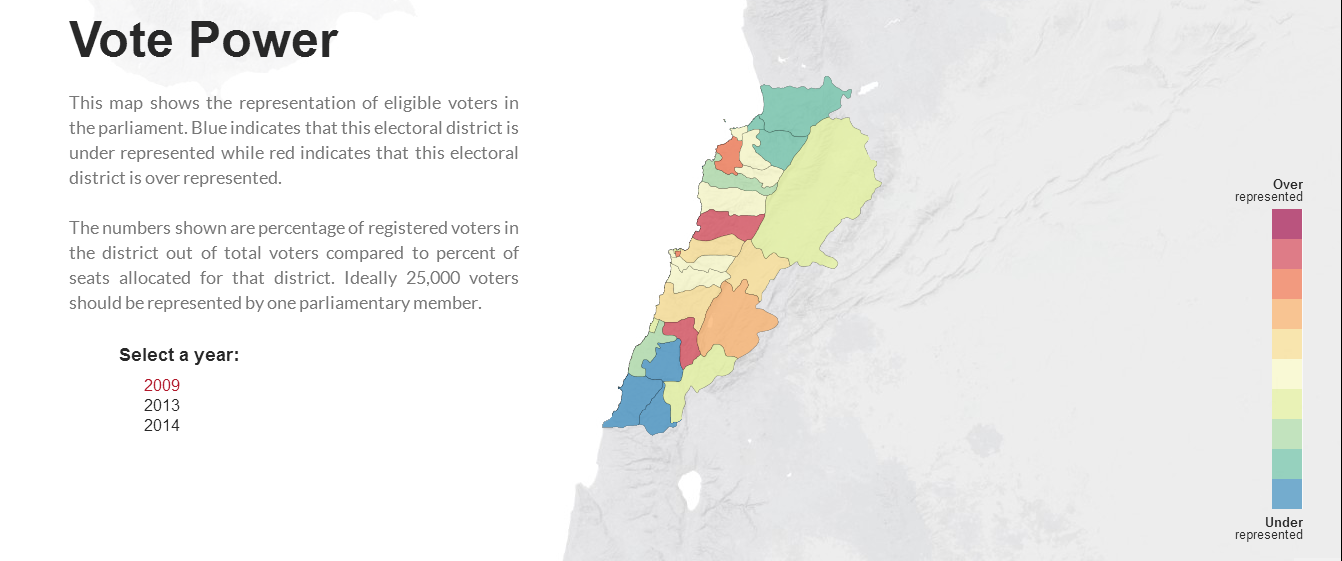
When Warlords Become Presidential Candidates

Warlord Collage

Reading and watching Geagea give press statements on his candidacy, I remember the space of terror he used to occupy for myself and my friends in Tariq al-Jadidah. I remember watching mortars explode from a window with a view of the northern coast with my grade school classmates during the Aoun-Geagea war. I remember a year spent in a mountainous Beirut suburb, away from school and from an apartment untenably close to “the Green Line.” Today, I try to imagine what a Palestinian in Lebanon thinks when she sees Geagea on TV confidently lay out why he should be president. Does her heartbreak as one by one, journalists fail to ask Geagea about his involvement in war time massacres? Has her heart been broken too many times in Lebanon, and does she simply change the channel? No one asks Geagea, or his rival Gemeyyel, about their wartime alliances with Israel, or their complicity in the siege of West Beirut, or their wars with rival Maronite leaders that left thousands dead and maimed.

I remember listening to the news with my family on the way to school the day that Gemeyyel left Beirut for Paris—It was a happy day. Years earlier, my five-year-old self had found an unexploded ordinance on our balcony in Tariq al-Jadidah. Amin Gemeyyel was President and he had ordered the army to shell the area. Many refused the order and deserted. I like to think that the unexploded ordinance on our balcony was the result of a soldier consciously removing explosive materials from mortal shells, knowing that his act would save the lives of residents. In reality, however, we have no idea why that shell did not explode. We were just lucky.

We were lucky again when the Lebanese army shelled our neighborhood during Aoun’s “War of Liberation” against the Syrian army, a war which apparently required the Lebanese army to shell heavily congested civilian areas in West Beirut. One particularly terrifying night, as my family was clustered in our foyer where we had been sleeping for days, my mother spread her arms across a wall and kissed it. This is the first memory I have of my parents as ordinary people; fragile, afraid, vulnerable. I have never been as profoundly shaken in my life as I was in that moment, watching my mother hug a concrete wall during a night of heavy shelling.

(Link)

Brainwashing

Goebbels would have been proud. If you repeat a lie often enough, people will believe it, and you will even come to believe it yourself. 

The war is over. The war is over. The war is over. The war is over. The war is over. The war is over. The war is over. The war is over. The war is over. The war is over. The war is over. The war is over. The war is over. The war is over. The war is over. The war is over. The war is over. The war is over. The war is over. The war is over. The war is over. The war is over. The war is over. The war is over. The war is over. The war is over. The war is over. The war is over. The war is over. The war is over. The war is over. The war is over. The war is over. The war is over. The war is over. The war is over. The war is over. The war is over. The war is over. The war is over. The war is over. The war is over. The war is over. The war is over. The war is over. The war is over. The war is over. The war is over. The war is over. The war is over. The war is over. The war is over. The war is over. The war is over. The war is over. The war is over. The war is over. The war is over. The war is over. The war is over. The war is over. The war is over. The war is over. The war is over. The war is over. The war is over. The war is over. The war is over. The war is over. The war is over. The war is over. The war is over. The war is over.

It is ok for the warlords who slaughtered your families, burned your houses, raped your women, enslaved your sons and brothers to fight their wars, and collaborated with the neighbors in the east or/and south to rule you. It is ok for the warlords who slaughtered your families, burned your houses, raped your women, enslaved your sons and brothers to fight their wars, and collaborated with the neighbors in the east or/and south to rule you. It is ok for the warlords who slaughtered your families, burned your houses, raped your women, enslaved your sons and brothers to fight their wars, and collaborated with the neighbors in the east or/and south to rule you. It is ok for the warlords who slaughtered your families, burned your houses, raped your women, enslaved your sons and brothers to fight their wars, and collaborated with the neighbors in the east or/and south to rule you. It is ok for the warlords who slaughtered your families, burned your houses, raped your women, enslaved your sons and brothers to fight their wars, and collaborated with the neighbors in the east or/and south to rule you. It is ok for the warlords who slaughtered your families, burned your houses, raped your women, enslaved your sons and brothers to fight their wars, and collaborated with the neighbors in the east or/and south to rule you. It is ok for the warlords who slaughtered your families, burned your houses, raped your women, enslaved your sons and brothers to fight their wars, and collaborated with the neighbors in the east or/and south to rule you. It is ok for the warlords who slaughtered your families, burned your houses, raped your women, enslaved your sons and brothers to fight their wars, and collaborated with the neighbors in the east or/and south to rule you.

Now repeat, we are a democracy.

Carefully watch as Lebanon’s parliament speaker, a former warlord, calls for presidential elections where three of the four main candidates – also former warlords – are competing with the fourth candidate, who happens to be the grandson of the president that led Lebanon into civil war in 1975. While the parliamentary ‘swing votes’ depend on the opinion of yet another warlord, the next Lebanese president will be the most illegitimate one since 1943: In 2020, he would have been elected by the parliament of 2009 – a parliament that ironically extended its term for failing to vote a law. As the civil war rages in Syria, the presidential elections happen at a time when in the executive power rules no one other than the son of the prime minister whose last irresponsible years in power saw the beginning of what would later become a civil war.

This is Lebanon’s biggest irony. Not the power vacuum, not the civil war, not even this play they call the presidential elections. I tried to find a detail concerning the presidential elections that doesn’t involve civil-war related issues. En vain. The candidates are of the civil war era, their programs are of the civil war era, the parties are of the civil war era, the lawmakers are of the civil war era, the absence of parliamentary elections is of the civil war era, and even our former overlord to the East is in a civil war.

What scares me most isn’t a warlord ruling from Baabda. What scares me is the idea that a young sous-lieutenant would one day manipulate the army as he wishes so that he can become president. What scares me is the idea that a failed president and warlord can become president again. What scares me is the idea that someone can become president for the simple fact that his grandfather was once one. What scares me is the idea that a Medical student who dropped out of medical school in order to commit war massacres might one day become president.

So while you’re happily watching the presidential elections on TV, my dear reader, think of the following: When the war comes – God forbid – do you want a president whose election inspires the medical student to carry his rifle and slaughter you, or save your children in the hospitals?

This isn’t about what these men want. It’s about what their election represents.

When war comes, the Lebanese will cry for peace. But always remember: They were the ones who worshiped the gods of war in times of peace.

30 days till the 25th of May.