Parliamentary Elections

Waiting for the Electoral Law- Future Movement’s Proposal Or The 37 Districts Law- Part II

Ahmad Fatfat (The Daily Star/Mohammad Azakir)

Ahmad Fatfat (The Daily Star/Mohammad Azakir)

[Part I]

In part I, I analyzed the districts of Beirut and Mount-Lebanon. I will now continue with the other districts.

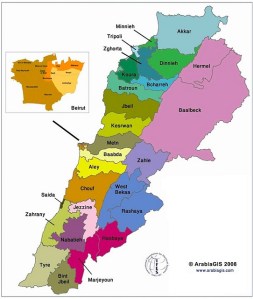
The 7 Districts Of The Bekaa. Baalbek and Zahle are separated each to two districts while Hermel, West Bekaa and Rashaya become independent constituencies.

  • Baalbek-Hermel. Baalbek is separated to two regions, Baalbek 2 (1 Maronite, 1 Greek Catholic, 1 Sunni, 1 Shia) including the Christian towns with some Sunnis and Shias, and Baalbek 1 (3 Shias, 1 Sunni) that is predominantly Shia. M14 would thus be able to compete in a Baalbek 2 stripped from the Shia heavyweights of Baalbek 1. Hermel had to be separated because the largest size of a constituency should be a Caza. Being able to control 4 of 10 seats in Hezbollah’s stronghold will be a major breakthrough for M14.
  • Zahle. Zahle is separated into two districts, (more…)

Waiting for the Electoral Law- Future Movement’s Proposal Or The 37 Districts Law- Part I

Ahmad Fatfat (The Daily Star/Mohammad Azakir)

Ahmad Fatfat (The Daily Star/Mohammad Azakir)

The number of electoral draft laws being discussed is too damn high. And to make things a bit more complicated than they are, Future Movement just added another draft law, and Ahmad Fatfat (among many other Future Movement MPs) are trying to make sure the draft reaches the electoral committee . The law is in the middle between the 1960 law and the 50 districts law the Lebanese Forces proposed in 2012.

The key feature of the law is that it uses small districts that can have a maximum of 5 MPs and can not be larger than a caza. The districts happen to primarily serve the interests of Future Movement, Jumblatt and in a way the Phalanges and (more…)

A Closer Look At The Orthodox Gathering Law- Part III: A Political Maneuver

Lawmakers meet to discuss a new electoral law in Parliament, Beirut, on Tuesday, Jan. 8, 2013. (The Daily Star/Mahmoud Kheir)

Lawmakers meet to discuss a new electoral law in Parliament, Beirut, on Tuesday, Jan. 8, 2013. (The Daily Star/Mahmoud Kheir)

[Part I]
[Part II]

What happened in January is quite interesting. It seems that the Orthodox Gathering law is being used not only for electoral purposes, but also for political ones.

Michel Aoun’s strategy. The OG law is the perfect electoral change for him. It gives him the chance to compete on 64 seats, and to win up to 40 of them. It makes him less dependant on his Shia allies, and permits an emergence of a Sunni opposition. But it’s not the law in itself that’s only reinforcing Michel Aoun. Michel Aoun has two goals before the elections: To separate whatever is left of M14 parties, but also to make sure the Free Patriotic Movement stays more powerful than the other parties on the Christian scene. There is no doubt that the FPM was losing popularity on the Christian side for the past few years. (more…)

A Closer Look At The Orthodox Gathering Law- Part II: Why It’s Frightful

Orthodox Gathering Law -The Reasons

Orthodox Gathering Law – The Reasons

[Part I]

Electoral laws should always be viewed with a pessimistic point of view. In the 1950s, we thought we had a modern electoral law (Women were eligible to vote for the first time), yet we went for a civil strife in 1958, which was partly caused by the fact that the gerrymandered districts threw major Muslim leaders outside the parliament. In the 1960s, the law was also considered to be a major breakthrough. The numbers of MPs was higher than ever, the administrative cazas became electoral constituencies, and creating relatively bigger constituencies with significant multi-sectarian representation was a huge achievement that was supposed to weaken sectarianism by making it harder for a sectarian MP to make it in mixed districts, and easier for a cross-sectarian candidate to make it by getting a significant number of votes from each sectarian group. (more…)

A Closer Look At The Orthodox Gathering Law- Part I: Why It’s Unconstitutional

Elie Ferzli

I usually publish another post on the electoral law where I say if it has chances to pass. This time, I won’t publish. It’s obvious, the law won’t pass because there’s an unconditional general Muslim veto on it.

That’s me, 8 months ago. As you can notice, events evolve quite fast in this country. Who would’ve thought that the Orthodox Gathering law would be actually considered as an alternative to the 1960 law? There have been lots of talk on the issue (and even a Promotion and its Parody), so I’m going to bombard you with several posts on the Orthodox Gathering Electoral law. Just as a reminder, the OG law makes Lebanon one single district in which each sect can only vote for its coreligionists MPs under proportional representation.

I hereby leave you with the first part, an analysis on the unconstitutionality of the law.

Article 7 All Lebanese shall be equal before the law. They shall equally enjoy civil and political rights and shall equally be bound by public obligations and duties without any distinction.

One of the problems of the law is that it gives the Christians, 38%, the right to vote for 50% of the MPs.  Under the 1960 law, the Christian and Muslim votes are equal in their influence. (more…)

Waiting for the Electoral Law- Comparing The 1960 Law To Its Opposite

Electoral map of Lebanon according to the modified 1960 law

Electoral map of Lebanon according to the modified 1960 law

It seems we’re heading to the elections with the 1960 modified electoral law of Doha. Most of the politicians blame the law for the problems Lebanon is facing. But few are the ones than understand why the 1960 electoral law is an unrepresentative law that promotes sectarianism, vote-buying and neo-feudalism. I’m going to compare our current law – Small Districts and Majoritarian Representation – with its complete opposite, a virtual law promoting Lebanon as one single district under proportional representation, and perhaps, things might get a bit clearer.

Vote Buying. Take the example of the Metn district. The competition is always very close in that district, and the margin can be as narrow as 194 votes like in 2009. Which means that if you buy 98 votes, you can win the elections in the district by one vote. (more…)

Why Wouldn’t Jumblatt Leave The Coalition?

Saad Hariri on Walid Jumblatt- Twitter

After the Ashrafieh explosion, one of the loudest accusations to the Syrian Regime came from Walid Jumblatt. Everyone expected the Jumblatti ministers to resign from the government , but until this very moment, the PSP didn’t leave the governmental coalition yet, and Hariri made an issue out of it on twitter. The moment Jumblatt leaves, Mikati will have to resign. The seven PSP MPs are enough to make a no-confidence vote successful. Walid Jumblatt is afraid of two things: a governmental vacuum, or an alternate efficient government. (more…)