Michel Aoun

The End Of The March 8 Alliance?

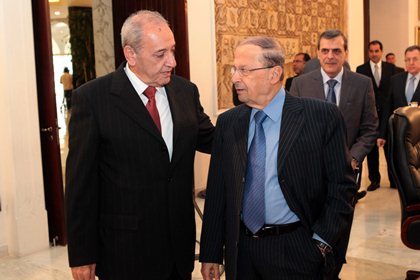
Berri and Aoun

“There is no such thing as the March 8 alliance anymore, Berri told The Daily Star.”

That quote from the Daily Star article (entitled March 8 finished, Aoun out in the cold) sums it up. But Is really Aoun out in the cold? Or is it some kind of an ingenious Berri tactic?

Between The Lines

The key ministerial portfolio held by an Amal movement minister in the last government was the foreign ministry (of Adnan Mansour). If one reads between the lines, Berri says at some point that  “On the domestic level, our choices differ and each will follow their own course”. In other words, Berri is a political genius that just made a bluff. While saying that he will not support the FPM in their struggle for their governmental share, he implicitly states that the FPM are obliged to support him to keep the foreign ministry under Amal control because both have the same choices on a non-domestic level. And Gebran Bassil fell in the trap by agreeing with Berri that “We support Speaker Berri’s saying that we diverge on domestic matters and converge over strategic issues.” In other words, Aoun would be backing a Berrist for the Foreign ministry post but Berri would not be backing Aounists to occupy the domestic-related ministries (All the ministries currently held by Aounists such as the telecom and energy ministries)

No More Sacrifices For Allies?

Rewind to June 2011: A small dispute (Called back then العقدة السنية, meaning “the Sunni Knot”) between Hezbollah’s Sunni allies (Mikati and Karami) over the number of posts that should be held by each of them delays the government’s formation. In a government of 30 ministers, there should usually be 6 Sunnis and 6 Shias; Mikati’s government eventually had 7 Sunnis and 5 Shias. It was  Berri back then who untied the knot by sacrificing one minister of his share for Ahmad Karami. This time, Berri made his preemptive move as the Salam cabinet formation is clearly facing difficulties. By declaring the 8 March Alliance dead, Berri is dissociating himself from his allies: He will no longer be  pleasing them from his share should they want an extra minister. He is making it clear for Tammam Salam that he is not letting go a minister so that the coalition doesn’t collapse like he did in 2011.

Zoom Out

According to Gebran Bassil, “Political lineups have been shattered”. By getting too busy analyzing the small details, the big picture became unnoticed. While Michel Aoun was busy shattering the March 14 Alliance into pieces via his Orthodox Gathering Law, the other side was preparing to strike back. March 8 knew what was March 14’s Achilles’ heel, but the opposite is also true. March 14’s counter-attack didn’t take long. After the May electoral confusion that nearly destroyed the ties between Gemayel, Geagea and Hariri, March 14 made their move. It was clear that Aoun wanted elections  he was going to win, while Berri saw the extension as an alibi to stay 17 extra months as a speaker. It was clear that Aoun wanted his son-in-law Shamel Roukouz to succeed Jean Kahwagi as a Commander of the army, while Berri had no interest in it. It was also clear that there was a tense atmosphere between Berri and Mikati that developed into a constitutional crisis. The plan was very simple: Let time play its role: Postpone the governmental formation until the M8 Alliance collapses. With no government, the extension of the parliament’s terms was an easier job while the constitutional crisis became evident with the appearance of certain deadlines that were irritant to Aoun and Mikati: One doesn’t want an extension of Kahwaji’s term, the other doesn’t want to see the parliament legislating in the presence of a caretaker government (probably to appear as the protector of the Sunni interests in Lebanon). Thus M14 played it smart : They stood by Berri when he wanted to extend the parliament’s term, then blocked all the speaker’s attempts to hold a session by standing with Aoun and making sure that there will be a lack of quorum. All it took was 1 month of conflicting interests between the M8 members to (apparently) end a 7 year alliance. All it took was letting the M8 alliance rule and fail due to the lack of chemistry between its parties.

No Electoral Ground

Political alliances are usually built on the foundations of the electoral alliances. In no electoral district the FPM and Amal find themselves forced to ally with each others to win. No Aounist is elected in a region having Amal votes, while no Amal MP is elected due to Aounist help. In fact, the two parties were an exception in 2009 when they ran against each other in Jezzine (while they were allies), making it easier for M14 to have a seat in the district (even if it didn’t eventually win any MP in the constituency). Once they don’t need each other to get into the parliament, the two parties won’t stick together till life in the parliament. Geagea needs Hariri to secure him MPs in Zahle and Akkar. Jumblatt and Hariri need each other to prevail in the Chouf. Baabda is ideal for an FPM-Hezbollah electoral alliance, and the Kataeb need the small Sunni and Druze votes to prevail in certain constituencies. Out of all the alliances, the easiest one to break was the Berri-Aoun one, because it had no electoral basis.

À La Adnan Sayyed Hussain?

Berri is apparently distancing himself from the Hezbollah-FPM duo and getting closer and closer to the “centrists”, comprising Jumblatt, the President, Mikati and  – who knows – Salam. Salam was trying for the past 4 months to get his formula of 8/8/8 ministers (8 for centrists, 8 for M8, 8 for M14)  accepted. Once M8 ceases to exist, Hezbollah and Aoun may get their share of 8 ministers independently from Berri, who would be taking a part of the centrists’ share. Once again, Rewind to 2011: A minister supposedly centrist resigns from the Hariri government (That included 10/30 of the ministers from the opposition). The resignation of the eleventh minister, Adnan Sayyed Hussein, who was theoretically a minister loyal to the president, brought the government down (after more that the third of the ministers resigned). Berri might be planning the same strategy again: By announcing the end of the March 8 alliance, he is in fact trying to ensure the blocking third in the government for the “ex-M8” members (by pushing himself to the center away from Aoun). M8 might be playing dead in a last attempt to maximize its share in the government.

So Is It The End?

If you consider that the March 14 coalition doesn’t exist anymore, than you are right to consider the March 8 coalition destroyed. Perhaps it is true: Nobody knows where Jumblatt stands – actually nobody ever knew – while Mikati and Berri are distancing themselves from everyone. On the two other sides: Hezbollah and the FPM struggle alone while the OG law spread confusion and cautiousness between Geagea, Gemayel and Hariri. One thing is sure though: If M14 and M8 are truly from the past now, than they fought themselves till collateral damage prevailed.

Only know you love her when you let her go. Time to see what alliance members truly love each others.

Is Lebanon Turning Into A Military State?

Image from 2011 (Associated Press)

Image from 2011 (Associated Press)

There were days when the director of the General Security wasn’t an officer. There were days when even the presence of a General as a democratically elected president would be criticized. These days are over.

For Lebanon’s president Michel Suleiman is a General. His predecessor Emile Lahoud was also a General. The interior minister Marwan Charbel is a General. The head of one of the biggest parliamentary blocs, Michel Aoun, is a General. The new interior minister is likely to be a General. A month ago, a General, Ashraf Rifi, the former head of the ISF, was on the verge of being a Prime Minister-Designate

When Tammam Salam was tasked to form a government, Foreign Policy had a great article on how the same families in Lebanon get to stay in power democratically while the rule of families is being toppled everywhere else in the Arab World. The Frangiehs, the Jumblatts, the Hariris, the Gemayels are few examples. Even when you think it’s not present, you quickly realize that Gebran Bassil is Michel Aoun’s son-in-law, that Marwan Hamade is Gebran Tueni’s uncle, and that  Setrida Geagea is Samir Geagea’s wife

Though Lebanese tend to forget that quickly, political inheritance is not the only thing we have in common with the neighboring Arab countries. We also have ruling generals. True, the Arab spring was made to prevent Jamal Mubarak and Seif El Islam Gaddafi of inheriting power, but it was also  Colonel Gaddafi and General Mubarak that were the targets. In the same way the Lebanese don’t view the election of the same families to the parliament as a wrong matter, they don’t view the presence of Generals in power as a bad thing.

It is also not possible to elect judges, Grade One civil servants, or their equivalents in all public institutions to the Presidency during their term or office or within two years following the date of their resignation and their effective cessation of service, or following retirement.

Article 49 in the constitution prohibits the commander-in-chief of the army of being a president (unless he’s elected two years after he resigns) for a reason. However the constitution was amended several times in Lebanon’s history to let Grade One civil servants serve as Presidents.

The problem of amending the constitution and letting a commander-in-chief of the army be a president is that one day, like all the countries in the world, we might have a coup – as unlikely as it might sound – and the General can pressure the members of the parliament to amend the constitution and elect him, making his rule look legitimate. If the amendment hadn’t been done several times before, the move would have made him an illegitimate ruler. But now that it’s done, each time he gets criticized for being elected under a constitutional amendment, his response would be: “It was done before. Are you suggesting that Fouad Chehab and Michel Suleiman were illegitimate rulers? They were democratically elected by the parliament, under a constitutional amendment. And you’re telling me that there’s an opposition? Do I need to remind you that the Lebanese Forces did not vote for Suleiman  in 2008 and that Raymond Edde was a presidential candidate in 1958?”

But for a coup to succeed in Lebanon, with all the sectarianism and without splitting the army in two armies (or ten, or twenty), it would likely take three centuries. So the main problem of having generals in power isn’t primarily because of a possible coup, but rather because of the nature of the Lebanese system. I’ll make it clearer.

A and B are both represented in the parliament. A and B elect the president, have a say in everything else and can even veto some positions. A and B also have armed wings. On one sunny summer day, A and B clash. The army receives orders to stop the fighting between A and B. There are three possible scenarios:

1) If the officer slightly sides with A, he might get a favor from A. If he sides with B, he might get favors from B.

2) If he stands in the middle, stops the fighting, without actually hunting the armed men down, he gets praised by A and B.

3) If he stands in the middle, stops the fighting and hunts every armed man down, he gets vetoed by A and B.

When Fouad Chehab refused to follow Camille Chamoun’s orders to fight the revolution in 1958, it was scenario 2. When Michel Suleiman did not stick to the orders of the government on banning protests on the 14th of March 2005, it was scenario 2. Emile Lahoud, Michel Aoun and Ashraf Rifi are other examples of the scenario 1 (Who needs scenario 2 when – even if for a while – there’s an A that’s stronger than B?)

That’s why generals become politicians in Lebanon. They take sides, or stand in the middle, depending on the context. But do not be fooled, for there are two types of men standing in the middle: The man who stands between A and B, and the man who stands against A and B (While following the orders of course, that are to stop A and B from fighting)

The “Amn Bel Taradi – الامن بالتراضي”, or consensual security, the fact of stopping the fighting between A and B without actually disarming A and B and punishing them for the instability they are causing, is mainly due to the fact of having officers in power. As you can see, Scenario 3 is missing,  not because it’s too good to be true, but because officers in Lebanon made it to top posts due to the scenarios 1 and 2. So why would an officer risk  his career by going for scenario 3 while he can get easily rewarded and have all the glory he wants via scenarios 1 and 2? Even when he has the political approval from everyone to go for scenario 3, Scenario 2 for an officer stays the preferred scenario, because it doesn’t get him too much problems. The battles between Jabal Mohsen and Bab El Tabbaneh are a perfect example.

When A and B know that there will not be a response from the army, it’s always an escalation of fighting that follows. Scenario 2 usually goes like that:

1) stop a fight by standing in the middle.

2) But the fighting resumes, and it’s a more brutal battle, because the fighters know there is no punishment.

3) Stand in the middle again and stop the bigger fight.

4) Repeat step 2 and 3 several times. Eventually, it’ll be too big to control and it will be more than a small local battle.

It’s not the fault of the army, and  I’m not saying the work some officers are doing in power is bad. Fouad Chehab delayed the civil war 17 years, and Michel Suleiman is probably doing the same thing. But when Generals are democratically given power, it’s for the purpose of keeping things under control. However what happens next is an instability due to the scenario 2 – الامن بالتراضي – that will eventually lead to a total loss of control.

In a nutshell, by bringing neutral generals to power, you think you are doing good, but the scenario 2 – and its consequence, consensual security – will begin, and in order to solve it, you bring more neutral generals to power making things even worse.

Lebanese Politics’ Double Standards

Michel Aoun (The Daily Star)

Michel Aoun (The Daily Star)

“We have suggested an electoral law based on proportional representation and to consider Lebanon as one electoral district  although we favor the Orthodox proposal, but we did not get any response.”

That’s the second time in one week that Michel Aoun endorses the single district with proportional representation electoral law. What is quite shocking here is that Aoun has been pushing for the Orthodox Gathering Law for quite a while, and that the two laws have compelete opposite consequences (See [here] for the single district law and [here] for the Orthodox law). Another major difference is that the single district law brings the Christians 38.4% of the MPs (The parliament quotas stay the same 50% -50%) while the Orthodox Law gives Christians the power to elect 50%. It’s really very weird to see Aoun endorsing the Single district law after refusing over and over again any electoral law that doesn’t give the power to Christians to elect all their MPs. But why is Aoun endorsing the single district law? (more…)

A Closer Look At The Orthodox Gathering Law- Part III: A Political Maneuver

Lawmakers meet to discuss a new electoral law in Parliament, Beirut, on Tuesday, Jan. 8, 2013. (The Daily Star/Mahmoud Kheir)

Lawmakers meet to discuss a new electoral law in Parliament, Beirut, on Tuesday, Jan. 8, 2013. (The Daily Star/Mahmoud Kheir)

[Part I]
[Part II]

What happened in January is quite interesting. It seems that the Orthodox Gathering law is being used not only for electoral purposes, but also for political ones.

Michel Aoun’s strategy. The OG law is the perfect electoral change for him. It gives him the chance to compete on 64 seats, and to win up to 40 of them. It makes him less dependant on his Shia allies, and permits an emergence of a Sunni opposition. But it’s not the law in itself that’s only reinforcing Michel Aoun. Michel Aoun has two goals before the elections: To separate whatever is left of M14 parties, but also to make sure the Free Patriotic Movement stays more powerful than the other parties on the Christian scene. There is no doubt that the FPM was losing popularity on the Christian side for the past few years. (more…)

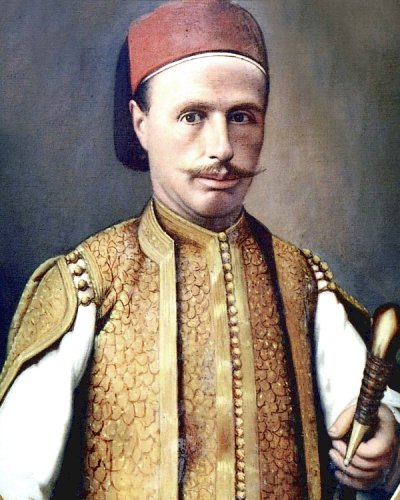
The Example Of Youssef Bey Karam

Youssef Bey Karam

Whenever in my childhood I had to change my name in a game, I usually used the pseudonym of Youssef Bey Karam.

That’s what a friend told me, a couple of weeks ago. Youssef Bey Karam is a paragon. He is considered by many to have led the struggle against the Turks. He is by far an independence symbol, and was always viewed as the defender of the Christians in the events of 1860.

If you go back in time, back to 1861, and ask the people of Zahleh what they think of this hero, the answer will be trenchant and limpid: He sold us out. (more…)