8 March Alliance

Hezbollah’s Retaliation: Is It The Perfect Time And Place?

A map of the Shebaa Farms (Shukran Wikipedia)

A map of the Shebaa Farms (Shukran Wikipedia)

In a very unexpected move, Hezbollah fighters attacked an Israeli military convoy in the occupied Shebaa Farms, in south Lebanon, killing two soldiers and wounding seven, in retaliation for Israel’s recent airstrike in the Golan Heights that killed Hezbollah fighters and an Iranian General.

A (Politically) Smart Move

Hezbollah needed to retaliate. For the past 3 years, the party has been constantly criticized for participating in the Syrian civil war and mainly for directing its weapons away from Israel and towards Syria. Even before Syria, Hezbollah faced a similar criticism in the wake of the May 7 events. “Hezbollah’s weapons are being used for political ends and are no longer directed at Israel”. M14 based its electoral campaign in 2009 on this discourse, and it eventually led to its victory in the 2009 parliamentary elections. M14 accused Hezbollah again of using its weapons in internal conflicts after the collapse of the Hariri government in 2011, and after Wissam Al-Hassan’s assassination in 2012. In 2011, it almost led to a fitna, and in 2012, it almost led to the downfall of the ruling M8 coalition.

Hezbollah tried to respond to this discourse by proving that it was still engaging in indirect combat with Israel, but it just wasn’t too convincing for the Lebanese public. The proof? almost no one remembers the drone that Hezbollah sent into Israel in October 2013. What everyone remembered however was Imad Mughaniyye’s assassination. Hezbollah didn’t respond to the attack properly back then, and it made them look weak. A lack of response over last week’s attacks would have made Hezbollah look even weaker (An Iranian General and Mughaniyye’s son were targeted), and it would have given the impression that Hezbollah cares more about its fight in Syria than its fight with Israel, even when Israel targets them inside Syria. Such loss of prestige would have been devastating for the party’s morale.

It was the time for payback. In fact, it was the perfect time for payback.

The Perfect Timing…

There’s a weird alliance going on between Middle Eastern rivals, with the United States and Hezbollah fighting together a common enemy called the Islamic State: Not long ago, the US provided actionable intelligence that probably saved lives in Dahiyeh. This indirect rapprochement was also followed by tense relations between Israel and the United States. Obama said that he will not meet with Netanyahu when the Israeli PM will come to the U.S. in March. One should not forget that for the United States, a possible deal with Iran is on the line here, and that the Israeli elections are in 45 days.  Should the Israeli army escalate, Hezbollah could drag Israel into two months of skirmishes, which wouldn’t be a perfect situation for Israel’s electoral process. No one wants to vote while Katyusha rockets are flying around the Israeli north. Even if Israel wants war, it would be a tough call in this particular timing: Hezbollah and Iran always said that “they would choose the perfect time and place” to strike back after every Israeli aggression (while M14 laughed at this sentence and accused them of cowardice). So if Hezbollah wanted to prove a point without suffering major Israeli consequences, now was the time. Such an opportunity doesn’t come twice.

… And A Perfect Location

Hezbollah chose the perfect place to strike. The attack happened in the Shebaa farms:

  • From the Lebanese point of view, Shebaa is an occupied Lebanese territory. By attacking Shebaa – and Shebaa only – Hezbollah is preemptively turning down an M14 political maneuver accusing Hezbollah of avenging the death of an Iranian General: Hezbollah could counter this maneuver by simply saying that they were not only avenging the death of their commanders, but also trying to pressure Israel into retreating from occupied Lebanese territory: A proxy battle suddenly becomes a liberation war.
  • From the Israeli point of view – Technically speaking – Israel considers the Shebaa farms to be part of the (annexed) occupied Syrian Golan, not Lebanon. So in a way, Hezbollah retaliated very accurately, in the Golan (from the Israeli point of view), where they were attacked in the first place. Hezbollah did not escalate, and only treated Israel like Israel treated the party. Hezbollah also did not make any abduction (like 2006) which means that it does not want to engage with Israel and start an all-out war. If there was a desire for war, you would have seen an abduction and probably an attack on the Israeli-Lebanese border, not on the Golan-Lebanese border or on disputed territory. Today was about deterrence. About red lines (assassinating Hezbollah’s leaders is apparently no longer acceptable). About changing the rules of the game. It was not a declaration of war (yet). Hezbollah wanted to send a message and at the same time strengthen its political presence in Lebanon while giving Israel the choice of not escalating (since the attack happened in disputed territory)
  • From an “international” point of view, the attack happened inside disputed Syrian-Lebanese-Israeli territory. So good luck trying to speak of a violation of U.N resolutions, or even accusing one side of hostilities clearly enough to justify an all-out war such as the July 2006 one.

M18/M14’s Discourse: What To Expect

For the next few weeks, M14’s propaganda would be mainly directed at demonstrating how Hezbollah dragged (or tried to drag, depending on the Israeli reaction) Lebanon into another proxy war, while at the same time criticizing Hezbollah for involving Lebanon in the Syrian civil war. But that, Hezbollah should be able to handle. It is the loss of prestige and the impression that Hezbollah was abandoning the Israeli conflict for good while slowly “moving into Syria” that was killing the party politically. Now the party would gain momentum (especially if Israel’s response isn’t strong enough) and most importantly would be able to put the Syrian opposition, the Islamic State, and the Israeli Defense Forces in the same box. It would force Lebanon to rally behind Hezbollah – at least momentarily while/if Israel responds – and it will eventually make Hezbollah look like a victor which should help M8 gain the upper hand  in Lebanese politics after eight months of political vacancy and deadlock. The Lebanese cabinet’s slow response to today’s crisis (seriously, why hasn’t the cabinet met yet?) is the perfect proof that there is indeed a political void in Lebanon. A political void that M8 could easily fill should Hezbollah’s Shebaa ambush turn into a military/political victory. Of course, everything depends of Israel’s reaction, and the aftermath of today’s skirmishes, so we’ll have to wait and see.

In the meantime, the only thing we can do is to be grateful we have a wise president guiding us in these times of trouble.

Eight Months Of Vacuum

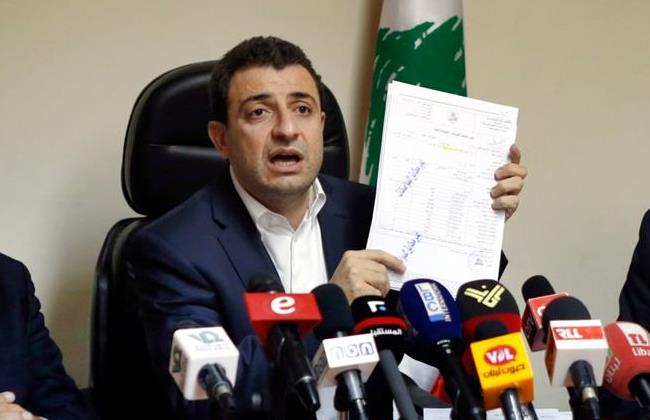
Wael Abou Faour

December was by far – politically speaking – the most boring month of 2014. So Let’s take a look at the very first maneuvers of 2015, and see how they are linked to the events of the last months of 2014.

Abou Faour’s Health Campaign

Now as you can all remember, PSP minister of health Wael Abou Faour started a food health campaign in November, revealing to the Lebanese endless lists of restaurants and supermarkets which sell commodities that do not meet food criteria. While there are technical reasons for being skeptical about the campaign (the minister stakes this entire crusade on a very shaky foundation: Trust in government), this is not the subject of this post. Nothing isn’t political in Lebanon, and after all, Abou Faour is a minister representing a political party in the cabinet. Although there might be few exceptions of politicians who actually purely work for benefit of their citizens, I will not give Abou Faour the benefit of the doubt – almost everyone else has already given him that. In this post, Abou Faour’s food health campaign will be analysed as a political maneuver, and as a political maneuver only.

It’s All About Elections 

Two questions come to mind here:

  • Why now? (Jumblatt had ministers in almost every cabinet for the past decade, so why would the reforms start now?)
  • Why Abou Faour, and not Akram Chehayyeb? (the PSP-affiliated minister of agriculture)

Every Lebanese probably asked himself the two questions and subsequently made up a weird conspiracy theory including Shawarma, Taymour, and a nuclear war with Salmonella infected Falafels.

Now the first thing to know about Abou Faour is that he is not only a minister, but a member of the parliament too. And not only is he a member of the parliament, he is an MP representing the districts of Rashaya – West Bekaa. For those of you who don’t know that yet, Rashaya – West Bekaa might be the turning point in the next parliamentary elections.

Traditionally, when the PSP heads to elections, it has always 6 districts in mind: Only one of those districts, Aley (5 seats), has a Druze majority (53%). Jumblatt would always have to compete with Talal Arslan over there, but it should be an easy win even if the PSP decides to run without its allies. The next key district for Jumblatt is the Chouf, the third largest constituency in Lebanon with 8 MPs. In the Chouf, the Druze are around 31%, the Sunnis are approximately 28%, while around 40% of the electorate is Christian. The Chouf would become a fierce electoral battle if Jumblatt decides to run against Hariri in the elections. In the end, the outcome would depend on the Christian votes, but it is more likely for Jumblatt to win once he allies himself with 3 or 4 powerful local Christian politicians (most probably the mayors of the biggest towns). However, Jumblatt has a lot to risk here, especially if he’s not allied with the M8 Christians, and an LF-FM alliance could eventually outnumber him in votes in case he’s all by himself.

The four other districts are minor ones for the PSP, where the Druze have only one MP representing it. In the Beirut III district, the Future Movement is in charge and Jumblatt would for sure lose Ghazi Aridi’s seat if he’s all by himself over there. In Baabda, the only way Jumblatt might dream of getting back the Druze seat is by allying himself with M8 (Christians≈52%, Shias≈24%, Druze≈17%, Sunnis≈6%). I know that it might look at first that the Sunnis and the Druze might together outweigh the Shias, but they don’t: If there was any chance for an LF-FM-PSP alliance to emerge victorious in Baabda, it would have done it in 2009. In Hasbaya-Marjeyoun, the Shias are 57% of the electorate. You all know what that means for the southern Druze seat (currently in the hands of Berri’s Amal Movement).

The only minor district that the PSP can effectively manipulate is the West Bekaa – Rashaya one. With 6 MPs representing it (two of them are members of Jumblatt’s bloc), this is the district that is likely to change the identity of the winning coalition in the next parliamentary elections: Walid Jumblatt’s political power is not only defined by his 7 or 11 MPs that are in the middle: It is also defined by the 14 MPs of the Chouf and West Bekaa-Rashaya that he is able to provide for the coalition that allies with him.

So Why Abou Faour, And Not Akram Chehayeb?

It’s because Aley is in Jumblatt’s hands no matter what happens. The West Bekaa – Rashaya constituency isn’t. Abou Faour represents the district of West Bekaa – Rashaya, one of the most mixed districts of Lebanon. The Sunnis are 48% of the electorate, the Shias and the Druze are each 14.5%, while the rest are Christians (around 22%). Now, although it might seem at first that a Sunni-leading party such as the Future Movement would always control this constituency (because of the large Sunni electorate), it’s not the case at all. In fact, in 2009, M14 – That included Jumblatt back then – only managed to win by a relatively small margin of (more or less) 5000 votes. Which means that M8 only needs 2500 ballots to switch allegiance in the next elections for them to win those 6 seats – provided (of course) that people would still vote for the same parties they voted for in 2009. This is where Jumblatt and the PSP votes come in. The 14.5% Druze votes are more than enough to provide a victory for M8. And the more popular Abou Faour is, the more the Christian electorate over there would be friendly towards him, the more it would be an easy win for M8. In the worst case scenario (Like a Hezbollah – Future Movement alliance), Jumblatt could always make use of a popular Abou Faour in order to strengthen his position among the Christians or the Sunnis of the Chouf and try to control his home district all by himself.

Abou Faour also represents the Bekaa which means that no matter how much Jumblatt “strengthens” him, it would be impossible for the minister of health to challenge Jumblatt’s  influence in the Druze heartland of southern Mount-Lebanon. The next few years are a transition period for the PSP as Taymour, Jumblatt’s son, is expected to become the first in command in the PSP. Strengthening any member of the old guard in this particular timing, such as the traditional MPs of Aley or the Chouf, would be a risky strategy for Jumblatt. Hence the choice of Abou Faour.

And Why Now? (The Hezbollah –  Future Movement Dialogue, You Fools!)

Abu Faour clearly loves the conflict. He describes his work as “battles” and the food scandal as an “invasion,” although he constantly reiterates that he could not have achieved this without the support of his party leader Walid Jumblatt. According to him, it was during their recent trip to Moscow, when he began to receive the results of their investigation that Jumblatt gave him the green light to go ahead.

It was his idea that we have to open this fight. He told me OK, go on. I’ll be with you, I’ll protect you.

(Taken from Abou Faour’s interview with the Daily Star)

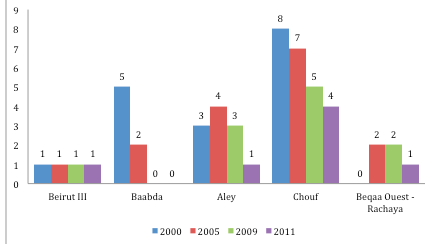
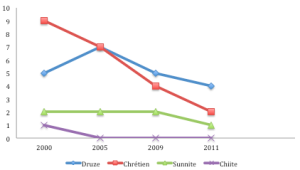
Rumors of a Hezbollah – FM dialogue started in November, approximately at the same time when Abou Faour’s campaign had started. The meeting eventually happened in December, and was apparently successful. More sessions were scheduled, and the Christian parties of both camps also decided they wanted to have a dialogue of their own (I’ll come back to that later). Like I said earlier, the power of the PSP comes from their 11 MPs in the middle but also from the ability of the party to provide any of the two coalitions with a victory in two key districts: The Chouf, and WB – Rashaya. Jumblatt is only strong as long as the M8 – M14 conflict is strong. Once both rival coalitions strike a deal, they can easily dictate their own terms and throw Jumblatt out of the political equation. A Sunni – Christian (LF/FPM) alliance could easily control the Chouf by reaching out to the two-thirds of its electorate that aren’t Druze, and a Sunni-Shia-Christian alliance could also throw Jumblatt’s two Bekaa MPs outside the parliament. The only district that Jumblatt would control is Aley, and that’s only if the electoral law stays the same. Joining the districts of Baabda and Aley (like in the 2000 electoral law) would mean the end of the PSP’s presence in the parliament. Now of course, it is highly unlikely that any of the two coalitions – even if allied together – would take such drastic measures, but Jumblatt knows that his role will be marginalized after any kind of M8-M14 rapprochement. The size of his bloc has also shrunk from 16 MPs in 2000 to 7 in 2011 (although 4 MPs rejoined his bloc in 2014). Here are some images that illustrate the downfall of Jumblatt’s political power over the past few years. (Source)

Evolution of Jumblatt's bloc by district - WL Evolution of Jumblatt's bloc by sect - WL

Bottom line: Jumblatt knows that he is getting weaker. It is no longer 2000 for him, and he has to change his tactics. The stronger and more popular Abou Faour is, the more Jumblatt can manipulate both alliances with the battle of West Bekaa Rachaya (in case M8 is running against M14) and the more can Jumblatt hope to electorally defend his home district of Chouf (in case M8 and M14 make peace and eventually decide to curb his influence by throwing him outside of the parliament).

And I know what you’re thinking: It’s still too early for elections. But it won’t be too early once M8 and M14 strike a deal that might include an electoral law, a president, and early elections. No one likes the man in the middle. Especially when there is no middle anymore.

Lebanese Forces – Free Patriotic Movement

While Lebanon was busy these past two weeks tweeting #jesuischarlie or #jenesuispascharlie and discussing Mia Khalifa and Miss Lebanon’s selfie, it missed the event of the decade: Aoun was tasting Geagea’s chocolate truffles. The moment Hezbollah and the Future Movement wanted to start their dialogue, their Christian allies decided to do the same. Now the tricky part here is to know whether the inter-Christian meeting is to support the HA-FM dialogue or to hinder it. The Christian parties aren’t concerned with HA-FM agreements, as long as their Muslim allies don’t abandon them as candidates in the presidential elections. Which is why the Christian leaders are rushing to meet each other after it was said that the first HA-FM dialogue session was successful. Deep down, Aoun and Geagea’s biggest fear is that the Future Movement and Hezbollah agree on a consensual presidential candidate. And their maneuver to counter this possibility was smart: Geagea’s sources hinted that he was ready – if certain conditions are met – to vote for Aoun in the presidential elections. Geagea knows that it is impossible for Aoun to make it through – Aoun would never accept Geagea’s conditions, and even if Aoun accepts Geagea’s terms, we still don’t know if Berri and Jumblatt would provide quorum – but he eventually forces Hezbollah to stick with Aoun now that the FPM’s candidate is supported by the LF. In other words, he forces the Mustaqbal to stick with him, while appearing as a kingmaker. Aoun looks like the most powerful (yet not powerful enough) candidate, and eventually any consensual FM-HA candidate loses momentum – even if it’s for a short period of time.

Connecting The Dots

So in one paragraph, here’s everything that happened in the past two to three months: Hezbollah and the Future Movement decided to have a dialogue. As soon as the rumors started, everyone panicked: Aoun agreed to sit with Geagea, Geagea agreed to support Aoun, and Jumblatt decided – via Wael Abou Faour – to preemptively mark his electoral territory.

Reminder: We still don’t have a president. (It’s been eight months)

242 days since the 25th of May. 78 days since the 5th of November. Three million years till the next parliamentary elections.

Lebanese Politics – 2014 In Review

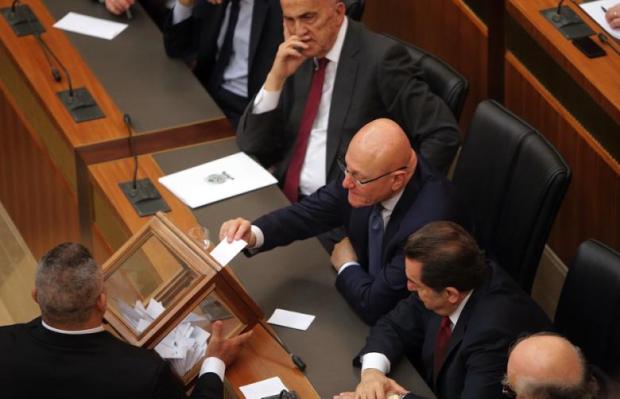
Lebanese Prime Minister Tammam Salam casts his vote to elect the new Lebanese president in the parliament building in downtown Beirut on April 23 2014 (AFP-Joseph Eid)

The two most important political events of 2014: A new cabinet, and presidential elections. Lebanese Prime Minister Tammam Salam casts his vote to elect the new Lebanese president in the parliament building in downtown Beirut on April 23 2014 (AFP-Joseph Eid)

2014 was a very busy year in Lebanon. It started with no cabinet in power, ended with no president in power, and saw a postponement of the parliamentary elections. But there’s a lot more than that, so I decided to make a compilation of all of Lebanon’s political events in 2014, while linking them to one another. Voila.

After 8 Months Of Pressure, M8 Yields (Well, Not Really): Introducing The 8-8-8 Formula (January 2014)

(And yes, I’m aware that there are five eights in the sentence above)

2013 ended very badly for M8. In the last two weeks of December, and after several months of “divorce with M8”, the president threatened to form a neutral independent cabinet excluding M8 and M14. In the same time frame, one of Future Movement’s most prominent politicians was assassinated. With every step forward in Syria, Hezbollah was facing increasing pressure in Lebanon. The designated prime minister  could have been seen as an M14 member or as a centrist, but one thing was for sure: He was definitely not a member of the March 8 alliance. By the first week of January, it was too much to handle for the party: The March 8 alliance conceded to M14’s demands and accepted M14’s 8-8-8 government formation even though they had previously vetoed it. By January 2014, M8 hadn’t only lost its Mikati government: It was now deprived – and via the 8-8-8 formula – from the blocking third in the executive power. The president was at the time getting closer to M14, which means that the 8-8-8 deal had one consequence for M8: they were theoretically out of the executive power. However, and since Jumblatt was still closer to them at that point, it would have seemed like a smart maneuver for M8: They would give all the responsibilities to M14 by granting them an indirect majority (Sleiman and Salam would be considered centrists) while at the same time keeping a certain degree of control (one of the centrists was supposed to be mutually pro-Berri and Sleiman and the Jumblati share among the centrist seats was sort of an “M8 garantee”. And in the end, even if M14 had won the government, it would have been still accountable to a pro-M8 parliament – Jumblat was aligned with March 8 at the time: Win-Win for everyone. But something else was also developing at the time: The Free Patriotic Movement had already started a slow but steady transition towards the Future Movement, hoping to strengthen Aoun and to declare him as a consensual presidential candidate 6 months before Sleiman left office.

Two things to remember from January: M8 were (not really) losing the battle for the government, and its seemed for a while that a tripartite Hezbollah-FPM-FM alliance was in the making.

Lebanon’s Longest Governmental Vacancy Ends (February 2014)

After 11 months of stalemate, and weeks of sectarian discourse, the government was finally formed on the 15th of February. The FPM finally managed to turn the ministerial rotation into a weird victory: Gebran Bassil was proudly transferred from the energy ministry to the ministry of foreign affairs, and the defense and interior ministries were officially out of M8’s influence. Rifi became minister of justice, and Berri’s aide got hold of the ministry of finance. The Kataeb were thriving with 3 ministers in the cabinet (even more than the FPM) while the boycotting Lebanese Forces were abandoned by their M14 allies and were left all by themselves in the opposition. And Walid Jumblatt was still holding on to his kingmaker position: Officially, the cabinet was an 8-8-8 one. But in reality, it was more like a 9-8-7 cabinet or even a 13-11 one. After all, Salam and Sleiman’s ministers were closer to M14, and Hannawi was a common Berri/Sleiman representative, making Jumblatt’s rather small share an equally important one for everyone. And speaking of the president, he was given 3 portfolios but only 2 votes: In other words, the political class was trying to reinforce his prestige while at the same time denying him any power after the post-Sleiman era. ٍIt was an early sign that the six-year term that started in 2008 was ending.

The cabinet formation had a clear impact on the presidential elections: the biggest winners of the all-embracing cabinet were the FPM and the Kataeb: Strong with their big shares in the executive power and their “moderate” decision to participate with the rival parties in the same cabinet, Amine Gemayel and Michel Aoun would soon seem as the most likely candidates among the Maronite Four to win the presidential elections.

The War For The Policy Statement (March 2014)

The cabinet had been formed, but it wasn’t yet functional. The M8 and M14 alliances managed to split the cake but still had to agree on a common ground for the cabinet: The policy statement. After weeks of bickering, an agreement was finally reached at the last moment between the two coalitions: M14 abandoned their “commitment to the Baabda declaration” clause and replaced it with a vague “commitment to all the decisions of the dialogue committee”. In exchange, Hezbollah agreed to remove the famous “Army, People, Resistance” clause and put instead of it a very weird sentence about “the right of Lebanese citizens to resist the occupation”. The rest of the policy statement was particularly normal – involving calls for unity among other things – except for the part where a plan for a decentralization law was mentioned. Michel Sleiman was trying to achieve something / anything at all before the end of his term. And out of the five cabinets he formed, he chose the cabinet with the least life expectancy to start the reforms.

Forget About The Cabinet – The Presidential Elections Have Begun* (April 2014)

By April, Lebanon felt the presence of a functioning cabinet for the first time since ages. But the new government’s decrees were overshadowed by a war starting in the parliament: The main four Maronite candidates (Aoun, Gemayel, Geagea, Frangieh) met and decided than no one other than them was entitled to become president. The maneuver was clear: The Christian parties of M14 and M8 don’t trust their allies so they decided to preemptively meet and put a Maronite veto on any other “weak” candidate the Muslim parties might nominate (They were trying to keep Kahwaji and Obeid and everyone else out of the race).  The Christian parties didn’t want anyone but the Maronite Four – while not agreeing on any one of them. Each Muslim party vetoed half of the candidates, and Jumblatt vetoed them all. In an attempt to end any Hariri-Aoun rapprochement before it even happened, Samir Geagea nominated himself very early as a presidential candidate, ending any hope that he had of winning, but at the same time ending the possibility of a Mustaqbal-Aoun deal. It was a smart maneuver.

But M8 were even smarter. At first, they spread rumors that Emile Rahme, a very minor pro-Hezbollah Maronite from Aoun’s bloc would be facing Geagea in the first round. Then, they realised that it would even be more humiliating for Geagea to lose the first round without having a candidate competing against him: There were more white ballots than Geagea ballots. The first round of the presidential elections gave us an idea about M8’s strategy for the next few months: They had destroyed Geagea’s candidacy and were now intending to sponsor and elect Aoun as a consensual candidate, or else they would not let the parliament meet again by denying quorum. At the same time, Jumblatt was reuniting his bloc, “the democratic gathering” (That collapsed in January 2011) and fielding his own “centrist” candidate, Henri Helou.

*And The Presidential Elections Shall Never End (May 2014)

By the end of April, there were three things to keep in mind: Jumblatt was yet again confirming his Kingmaker position, M8 had won a symbolic victory, but M14 had time on their side: The longer M8 postponed the elections, the longer the people would turn against them. M8 had no problem shutting down the parliament as long as it didn’t lead to the election of an anti-M8 president, and M14 had no problem letting them shut down the parliament since they knew that eventually the trick would make Aoun very unpopular ahead of the parliamentary elections in November. May ended with no president in power and four warlords aspiring to fill the empty spot.

Meet Our Old Friend – The Presidential Vacancy Is Back (June 2014)

Aoun’s presidential victory in April did not last long enough: In June, the leader of the FPM made a major strategic mistake by suggesting that he – alongside Hariri and Nasrallah – represented a triangle of salvation that could not be broken up. Naturally, March 14 would start the Summer of 2014 with an original propaganda : “Aoun wanted to give up the 50-50 Christian-Muslim representation in exchange of his elections as president.” Nasrallah quickly countered M14’s offensive by (1) reminding Aoun that the triangle included Berri, (2) throwing this controversy on the French, and (3) confirming that he had vetoed the 33% Christians -33% Sunnis – 33% Shia representation deal when the Iranians asked Hezbollah about it. Once again, Nasrallah saves the day.

Aoun Wants To Change The Constitution And The Patriarch Wants To Explain It Differently (July 2014)

July was weird. Aoun, who had previously spent a whole year getting closer to the Future Movement while trying to fashion himself as a consensual, all-embracing candidate, suddenly decided – and probably because of the M14 June maneuver – that it wasn’t worth it anymore, and threw in a political bomb: He wanted to amend the constitution and let the president be elected by universal suffrage. The irony here is double: Aoun, who had spent the last two years lobbying for an electoral law maximizing Christian representation in the parliament, was now letting a Muslim majority decide the fate of the top Christian post. Moreover, it would also mean that the winning candidate would in no way be a consensual one, showing Aoun as a political opportunist that would do anything to become president, even if it meant being a consensual and a non-consensual candidate at the same time. While M8 tried to show him as a politician that believed in true democracy, M14 described him as an opportunist that would easily change the constitution and his convictions to win the elections. So it was a tie in July between M8 and M14 – and Jumblatt was taking advantage of this tie and maximizing his political gains. Rumors about a deal including a two-year presidency for Aoun started circulating in Beirut. Finally, the tie between M8 and M14 ended in late July, when the Maronite Patriarch launched three maneuvers against the M8 alliance. M14 were eventually right in their long-term maneuver: The longer M8 freezed the presidential elections, the faster it would lead to their downfall. July 2014 saw Rai’s first violent stances against M8. And for a Patriarch that has been for long considered as pro-M8, that’s not something good at all for M8: Rai’s first move was considering the boycott unconstitutional and declaring that a half+1 vote would be enough to elect a president. Rai then decided to undermine Hezbollah’s anti-ISIS propaganda by calling for dialogue with the group. Rai’s third move was saying that the president should come from outside M8 and M14. For the first time since March, M8 was starting to lose the presidential race.

Hariri Is Back, Arsal Is On Fire, And Rifi Ruins M14’s Comeback (August 2014)

With M8 having their first major setback since Mikati resigned, Hariri decided to rise to the occasion and maximize M14’s gains. In the beginning of August, Islamist militants from Syria seized the border town of Arsal. The Lebanese army hence started a campaign to regain control of the town. There were two consequences: a political one, and a military one. Militarily speaking, the commander of the army was proving once again that he was capable of handling tough situations. In a way, Arsal 2014 was for Kahwaji what Nahr El Bared 2007 was for Sleiman in 2008. Politically speaking, the chaos on the border was a huge asset for Hezbollah: The Syrian civil war was no longer only across the border, and Hezbollah had now a legitimate reason to crush the rebels on the other side of the mountains. In the same week, four FM politicians – in confusion – revealed four completely different stances regarding Arsal. For a while, it seemed like a propaganda boost for M8. Until Hariri decided to seize the moment, and returned to Beirut with a billion dollar to arm the army. In 48 hours, the rhetoric would completely shift: Hariri was yet again the moderate, the chaos among the FM disappeared, and Hezbollah’s presence in Syria – now with a Lebanese army that should be more capable of defending the border – was no longer justified (at least from M14’s point of view). What would’ve been a massive win for M8 turned out to be whopping political victory for M14. At least until Rifi decided at the end of the month to make a very stupid decision of banning the burning of ISIS flags because they had religious scripture. M8’s propaganda would thrive because of this story and M14’s short yet powerful comeback would end.

Forget About The Presidential Elections – We’re Heading To Parliamentary Elections (September 2014)

September began with the following dilemma: What is the most important priority, the presidential elections, or the parliamentary elections?

And September ended with the following answer: We should head to parliamentary elections.

So what happened in September? For the first time since ages, the Lebanese Forces realized that they were not in a weak spot. And they decided to manipulate everyone – including their allies.

In early September, M8’s parties were all in favor of parliamentary elections – after all, what do they have to lose? On the other hand, the Future Movement was struggling with the idea of heading to parliamentary elections: Hariri warned that the FM would boycott the elections should they happen, while at the same time the FM minister of interior handled the idea very badly and made sure no effort was spared to prevent elections. Hezbollah’s anti-ISIS propaganda would have won M8 the parliamentary elections and made the presidential battle far easier for Hezbollah and their allies. But there was one slight problem for the FM: They didn’t have enough votes to pass a parliamentary extension in the parliament. The FM and the PSP were the only parties embracing the parliamentary extension at the time, and the FM badly needed the Lebanese Forces’ votes to make sure that Lebanon wasn’t going to parliamentary elections. The LF were for the first time in control. For a while, it seemed that they decided the fate of the parliamentary elections. So they decided to manipulate everyone, including their own allies. Their early decision to vote for elections meant two things: They were willing to punish the Mustaqbal for leaving them on their own outside the cabinet in February, and they were willing to strike a deal without the O.K. of their allies. After 10 years, the Lebanese Forces had finally understood how to play the game of Lebanese politics. With the parliamentary elections getting closer, Lebanon also witnessed a media war between Al-Akhbar and Al-Mustaqbal.

Lebanon Has A New Presidential Favorite: The Rise of Jean Kahwaji (October 2014)

In October, the commander of the army’s (undeclared) candidacy was gaining momentum. After the Arsal clashes in August, Everyone suddenly wanted to arm the army: Iran was going to donate military equipment to the army, Lebanon was going to get Russian helicopters, the army received a new U.S. arms delivery, and France/Saudi Arabia confirmed Sleiman’s 3 Billion $ deal. This meant two things for the commander of the army: He was locally getting very popular, and he was also gaining the trust of the international community. And for an officer that was rumored to be “Hezbollah’s hidden candidate”, the support he got from the United States and Saudi Arabia made him look like Lebanon’s most likely candidate to fill the presidential vacancy. Berri – whose secret rumored candidate is Jean Obeid – had to counter any possibility of electing a relatively stronger president. The result was a couple of days of bickering with the LAF commander about the wage hike details regarding the officers, and a change of stance by Berri regarding the parliamentary extension: With Berri’s decision not to go to elections, The Future Movement didn’t need the LF votes anymore which meant that yet again the LF’s decision to vote for elections was meaningless (and they would eventually go with the flow and vote with the FM since their decision didn’t matter in the end).

They Were Just Kidding. We’re Not Heading To Parliamentary Elections (November 2014)

By the end of October: M8’s official candidate, Michel Aoun was no longer an option. Hezbollah’s “hidden candidate”, the commander of the army, was the favorite, and Berri’s “hidden candidate”, Jean Obeid, was at the bottom of the list. Meanwhile, M14 was still recovering from M8’s attempt to shatter it by turning the LF and the FM against each other regarding the matter of the parliamentary extension.

It is in this context that most of the political parties headed in early November to the extension session. Now that Berri’s bloc was voting Yes, the Lebanese Forces felt that the wise thing to do (since they now needed the FM more than the FM needed them) was to vote alongside their Sunni ally. The Kataeb, who usually always go against the flow, did the same again and voted No. On the other side of the political spectrum, Hezbollah decided to go against the FPM on this matter and pleased the FM by voting for the extension: It was an indicator that Hezbollah were avoiding – at any cost – any possible Sunni discontent in Lebanon. The direct consequence of the extension session would eventually be a rapprochement between Hezbollah and the FM. Rumors of a dialogue between the two parties would soon start circulating and the meetings would eventually start in late December.

But 10 days after the extension session, M14 was preparing its counter attack and intended to sow discontent among M8’s members, the same way M8 tried a month earlier to manipulate the FM – LF relations. Suddenly, and out of nowhere, Frangieh became an acceptable candidate for the Future Movement. The irony here is that Frangieh was far more pro-Syrian/pro-Hezbollah than Aoun. In other words, this was a trap for Hezbollah: Once Hezbollah accepts the Frangieh candidacy (instead of Aoun), the Hezbollah-FPM relation should end, and the M8 alliance would eventually be shattered. The victorious FM would have gained a president, who – while being pro-M8 – was the weakest among the Maronite Four. But Frangieh saw the trap, and so did Aoun: Frangieh was quick to confirm that he would only run if Aoun withdrew. Aoun, on the other hand, had a smart response: He invited Geagea to a face-off in parliament: M8 would allow the parliament to convene only if the two candidates were Geagea and himself: Aoun was trying to preemptively end Frangieh’s hopes, while effectively destroying Helou’s candidacy. Jumblatt’s natural response was to call Aoun undemocratic, and it helped us learn something very important: M8’s biggest fear was that M14 would go to parliament in order to elect Geagea, and eventually elect Helou instead of him. After all, the centrists and M14 together controlled more than 50% of the seats, and Helou did leave Jumblatt when Jumblatt abandoned Hariri in 2011. It wasn’t Geagea that scared Aoun. It was Helou. And it wasn’t the presence of an M14 president by itself that scared M8. Once an M14 president would be elected, M8 would lose the only power it has (The power to deny quorum in the presidential elections). M14 could then form a government on its own, and vote for an electoral law that might be terrible for M8.

So, to sum up November in 8 words: M8 wants a deal, and Aoun fears Helou.

Total Vacuum (December 2014)

In December, nothing happened. Seriously, nothing. Not one political maneuver. Any hope to end the deadlock depends now on the Mustaqbal – Hezbollah dialogue.

You might also like 2013’s review.

See you in 2015!

Seven Months Of Vacuum

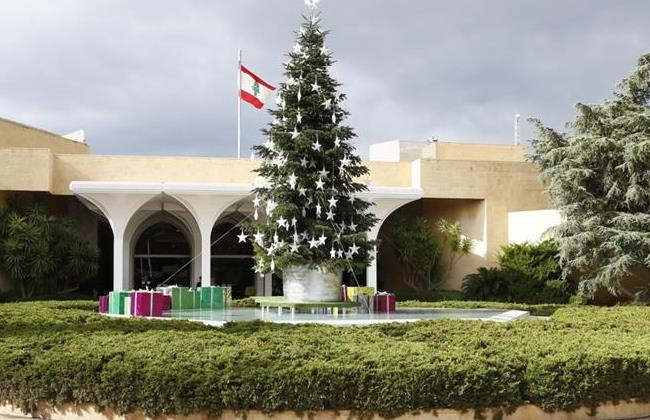
A Christmas tree is set in front of the Baabda Presidential Palace, Friday, Dec. 13, 2013. (The Daily Star/Dalati Nohra, HO)

A Christmas tree is set in front of the Baabda Presidential Palace, Friday, Dec. 13, 2013. (The Daily Star/Dalati Nohra, HO)

6 months. That’s all it took for the previous parliament to elect Michel Sleiman president. Now that we’re finishing the seventh month of presidential vacancy, I think it is safe to say that we are now living in a historical era: This is officially the second longest presidential vacancy the republic has ever seen (and the longest post-Taif one!). Hooray!

The record is 409 days. It’s a lot of time, but hopefully our politicians would be wise enough to guide us through 7 more months of vacancy. After all, breaking that record might be the only achievement this parliament has made since 2009.

2014 is clearly not 2008. Because seven months have already passed, and we still don’t have a president. Actually, it gets even better. Seven months have passed, and the political class forgot* about the presidential elections.

*completely forgot:

Unlike the past six months that were full of political maneuvers and surprises, December was most probably the calmest month among them all (Here’s a compilation of the monthly events for June, July, August, September, October, and November in case you’re interested). In December, nothing – relevant to the deadlock – happened. Other than the fact that Gemayel tried to fashion himself as a consensual candidate by paying a visit to the South (Gemayel’s a bit late for that phase of the game, since the battle is now about choosing a truly consensual candidate rather than one of the Maronite four), the only other political activities of this month were the government’s (epic fail) negotiations to end the Arsal fiasco alongside the attempt at distracting the people from the fiasco, the parliamentary extension and the presidential deadlock with the health ministry’s food campaign whose timing is suspicious: Food is not a political priority (actually, it is, but you get the point). The Islamic State is on the gates of the Bekaa, Israel is threatening from South, the hypocrite parliament extended its term without showing any intent to solve the presidential deadlock, and the government should be acting like a caretaker cabinet but instead, and as they say in Arabic, اخد مجدو.

And the Hezbollah – Future Movement dialogue that was supposed to be held “soon” last month, is also supposed to be held “very soon” one month later. So by this rate, should we expect a press conference in January telling us that the dialogue will be held very, very, very soon? (although it is supposed to kick off today :P)

Dear Santa, we want a president.

213 days since the 25th of May. 196 days left to break the 409 days record.

48 days since the 5th of November. 900 days till the next the parliamentary elections.

Six Months Of Vacuum

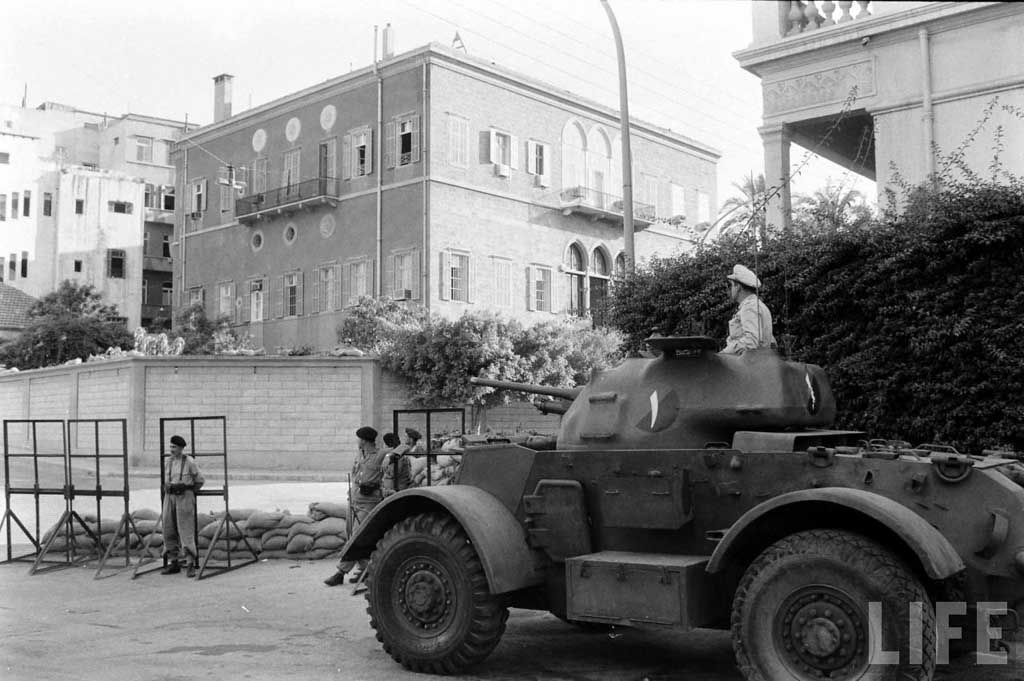
A Lebanese Staghound securing the presidential palace in Kantari, Beirut (1958)

A Lebanese Staghound securing the presidential palace in Kantari, Beirut (1958)

It’s already been six months since Michel Sleiman left office. And this month has been the most active one so far: The parliament approved its 2 years and seven months extension, the Future Movement hinted at the possibility of a presidential breakthrough, Aoun responded with an innovative counter-attack, and most importantly, there are renewed talks about the electoral law.

How the FM tried to break the vicious circle

Two weeks ago, one of the most shocking and unexpected maneuvers of the year broke the five months status-quo we had since Michel Sleiman left office: The Future Movement – via an interview with a Beirut MP – hinted that Sleiman Frangieh could be an accepted presidential candidate. The maneuver was surprising, yet brilliant:

If the FM – according to MP Shab’s hints – are seriously considering Frangieh’s candidacy, it would make Hezbollah look like a hypocrite in case they insist on Aoun or a consensual candidate, and it would create problems between the Marada and the FPM and between M8′s Christians and M8′s Muslims. A Frangieh presidency might seem like a March 8 victory, but on the long run, it will probably lead to the downfall of that alliance.

Such a maneuver from M14 would kill two candidacies with one stone: Aoun’s candidacy and Kahwaji’s candidacy. And in the process, it would kill the M8 alliance.

How Frangieh responded

So to sum things up here , Frangieh in his interview ended the Future Movement’s maneuver while it was still in its early stage and proved that he wouldn’t go behind his allies’ back in order to secure the presidency for himself. But he also indirectly gave the names of M8’s three presidential favorites: Aoun, Obeid (rumored to be Berri’s favori), and Kahwaji (rumored to be Hezbollah’s favori) while at the same time blacklisting two other possible consensual names: Georges Khoury (Who used to be the head of Lebanon’s intelligence service), and the governor of the central bank (Riad Salameh).

How Aoun responded

Aoun however was more subtle in his counter-attack. While he didn’t directly comment on M14’s maneuver, he said (in an interview with MTV) that he was ready to face off with Samir Geagea in parliament provided that there was no other candidate running in the presidential elections. The maneuver here is pretty much obvious: As demonstrated by the first round of the presidential elections, Samir Geagea could never get more than 50% of the votes needed to be elected. Walid Jumblatt, among other non-affiliated M8 politicians would never elect him as president. While Michel Aoun would also never get more than 50% of the votes (since the Jumblatt and Mikati blocs are hardly going to prefer him over Geagea), Michel Aoun – via his face off proposal – would have made sure that other presidential candidates would be surely gone from the race: Two names quickly come to mind here: Sleiman Frangieh and Henri Helou.

By making sure that it would be either Geagea or himself in Baabda, Aoun would have achieved a big win here and would have stopped two major M14 maneuvers from happening: The first one – electing Frangieh – was a long shot and its main goal was shattering the M8 alliance rather than securing the election of Frangieh – and it didn’t work anyway. The second maneuver is M8’s biggest fear: Should there be quorum, if M14 decides to support Jumblatt’s candidate – Henri Helou –  then he would become Lebanon’s next president since M14’s votes alongside Jumblatt’s ones are more than 65.
Aoun – and by getting everyone else to agree to his face off deal – Would have ruled out the possibility of M14 showing up to vote for Geagea but instead voting for Helou and electing him as president.

The FPM was trying to hit two birds with one stone: Keeping Frangieh outside the presidential race – independently of what Frangieh has to say- and at the same time preventing M14 from voting for Helou and electing him as president. This is why M8 won’t let the parliament meet to elect the president: It’s not because they fear that Geagea would be elected (Which is surreal). It’s because they fear that M14 would change their mind at the last minute and elect Helou after a deal with Walid Jumblatt. What confirms this theory is Jumblatt’s rejection of Aoun’s proposal (He called it undemocratic):

How the Lebanese Forces responded

The Lebanese Forces had two interesting reactions on the maneuvers of this month: The first one was their sudden interest in the electoral law and their reinvigorated support to a law they had previously agreed to (in May 2013) with the PSP and the FM. This is probably a reminder to the PSP and the FM that they are still an integral part of M14 and that they can give them concessions other parties would never give (Like on the electoral law). The second one was their approval of Aoun’s face-to-face competition with Geagea. After all, how can it harm the Lebanese Forces if Frangieh and Helou are out from the presidential race?

How vacancy in the presidency is in favor of M8

Now that the stances of every party is becoming clearer by the day, it would be interesting to see the bigger picture here, that is a lot similar to 2007 and 2008: March 8 is blocking the presidential elections because it gives them a tactical advantage: If they let it happen, there’s a possibility that M14 could eventually rally around Helou and elect him as president. Once Helou is elected president, M14 could – with the help of Jumblatt – form a government that is purely M14 and pass an electoral law that has the consent M14 (and M14 only). And the very fact that such a draft law already exists (It’s the one the LF mentioned) scares M8 even more. While M8 are more or less sure by now that Aoun’s chances are next to nil, Hezbollah’s ultimate goal of electing a consensual candidate that isn’t hostile towards its politics is becoming more likely. The delay in the presidential elections also gives M8 another advantage: By blocking the election of any president whatsoever, M8 could extort M14 into agreeing to their own terms: Just like 2008, the war for the presidential elections is the minor one. The main issue here is the deal that would include the name of the Lebanese president, and not the Lebanese president himself. There has been a lot of talk lately about a possible dialogue between Hezbollah and the Future Movement: While the dialogue in itself is likely to be useless, what is really important here is the FM’s precondition that the dialogue should start by solving the presidential deadlock before anything else: M14 wants to prevent M8 – via the preconditions of the dialogue – from asking for a deal (including the name of the president among other things). On the other hand, M8 needs guarantees that it wouldn’t be ousted from the next Lebanese government, and that an electoral law wouldn’t be voted without its consent. Deep down, the Aoun candidacy isn’t the will. It’s the way. After all, the only power M8 has (politically) is their “presidential blocking third”. So if they want to survive till the next parliamentary elections and if they want to make sure that their blocking third in the government is still there, now would be the smart time to take advantage of their number in parliament.

185 since the 25th of May. 21 days since the 5th of November. One million years till the next parliamentary elections.

Endorsing Frangieh: March 14’s New Maneuver?

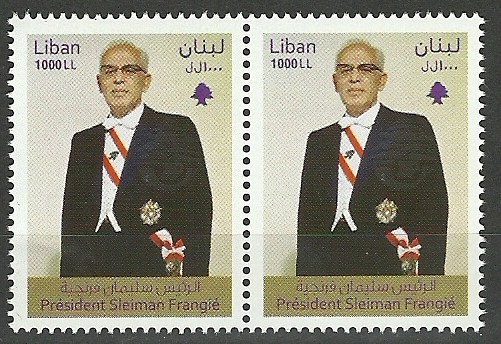
Sleiman Frangieh Timbre

Accordingly, [Future MP] Shab foresees serious negotiations taking place within “weeks, not months” to agree on a candidate “who can navigate a Sunni-Shiite conflict and who has the confidence of both parties […] someone with a certain degree of legitimate representation, but who is also agreeable to both sides.”

Asked by NOW who might fit that profile, Shab cited the leader of the 8 March-aligned Marada Movement, MP Sleiman Frangieh. When NOW queried how Frangieh, a staunch ally of Syrian President Bashar al-Assad, could be acceptable to 14 March, Shab hinted at a hypothetical agreement by which Frangieh’s presidency would be paired with Future leader MP Saad Hariri as prime minister.

(Source)

This is the beauty of Lebanese politics: Just when you thought that there would be no political maneuvers after the parliamentary extension and that we would enjoy at least three or four months of political silence, the Future Movement decides to throw this time bomb. The leading party of the March 14 alliance is apparently ready to strike a deal that involves the election of Syria’s man in Lebanon, Sleiman Frangieh, as president. True, Shab’s remarks don’t necessarily mean that there’s a consensus on the election of Frangieh among all the members of M14 (or even the FM), but even the idea of the Future Movement electing Frangieh is extremely shocking. So shocking that it might ironically be their best move since this presidential thing started.

A Thank You Note To Hezbollah?

Endorsing Frangieh might be a thank you note to Hezbollah. The party gave three gifts to the FM in the past three weeks: The first one was the official endorsement of Aoun that ended the FPM’s “Aoun is a consensual candidate” campaign. The second one was Hezbollah’s early decision to extend the parliament’s term although his main Christian ally opposed it and although it might have probably led to a decisive M8 victory – Due to the ISIS propaganda and the Christian fears. And the third one was Nasrallah’s friendly remarks about the Future Movement in his speech two weeks ago. These three stances indicated that there might be a rapprochement between the two parties (Similar to the one the FPM and the FM had in the autumn of 2013). Hezbollah had let down its main Christian ally three times in less than 3 weeks (And it’s in a context of presidential elections, making it worse for Aoun and even better for the FM). Perhaps accepting a Frangieh presidency might be a way of saying thank you to Hezbollah for postponing the elections, destroying Aoun’s last presidential hope, and not making a big deal out of the extension. And the very fact that Frangieh’s men were the only MPs from the change and reform bloc (27 MPs) that voted for the extension means that Frangieh is (1) fully independent from Aoun and (2) might as well be the intermediary between Hezbollah and the FM.

Perhaps Not A Thank You Note After All.

But how on earth would the Syrian regime’s oldest and closest ally, and Hezbollah’s primary ally in the North become an accepted consensual candidate? No matter how much you think about it, it’s surreal. Here’s something I wrote about the Frangieh presidency in October 2013 (Link for the full post):

Apparently on Thursday, Marada Movement leader Suleiman Franjieh warned of a presidential vacuum as the conflict over Syria continues and suggested that Lebanon adopts the 50 percent plus one vote formula to secure the office.

[…]

Let alone the fact that Frangieh’s allies took advantage of that particular constitutional clause (Of having the two thirds quorum in the Presidential elections) in order to block the election of an M14 candidate in 2008, the very fact that Frangieh is asking for a modification of that electoral process is very weird. Why? Let’s see why. Because Frangieh belongs to a coalition in the parliament that holds between the third and half of the seats in the parliament. That means that under the current constitutional rules, Frangieh – Let’s suppose for a while that he will be M8’s candidate – can block the electoral process by instructing his allies to boycott the session. Just to make it clear – and more complicated for you –  Frangieh said that a 50% plus one vote should be adopted. Thus theoretically, Frangieh spoke nothing about the quorum.  He only mentioned what the number of votes for the winner should be once there is quorum. So if Frangieh doesn’t want to change the quorum rule in the constitution but only the voting rule, nothing makes sense. Is Frangieh suggesting that we change the quorum or the winning vote number? Let’s see.

M8 has 40% of the votes, M14 45%, and the others (Mikati, Jumblatt …)15%  (The numbers aren’t exact, but you get the point)

Cas 1: Our lovely non functioning system (Quorum 66%, First round 66%, Second round 50%+1). Frangieh wants to run, but M14 and the others won’t vote for him. Frangieh instructs his allies to boycott. 40%>33% which means that there will be no quorum, thus no elections. In case the others will vote for him, that means he will have 55% of the votes. M14 boycotts, 45%>33%, meaning that there will also be no quorum.

Cas 2: Quorum remains untouched with Frangieh’s amendment (Quorum 66%, First round 50%+1). Frangieh wants to run, but M14 and the others won’t vote for him. Frangieh instructs his allies to boycott. 40%>33% which means that there will be no quorum, thus no elections. However, Frangieh is saying that he is making the amendment to make life simpler and easier for the parliament to elect the president. Which means that the amendment doesn’t make any sense (See, I told you!) because the quorum boycott is still here and if he wishes not to boycott and elect the president with 50%+1 he can simply wait for the second round and keep the constitution like it was (see Cas 1)

Cas 3:  Frangieh was actually talking about the quorum!  (Quorum  50%+1%, First round 50%+1).  40%<50% which means that Frangieh can’t freeze the process if he boycotts and has a very high chance of losing because 40%<50%. Unless…

Unless What?

Unless Frangieh is sure he can secure 65 MPs to vote for him. In politics you don’t actually propose something you might lose in, so there’s something fishy about this. If Frangieh meant cas 1 (or cas 2), he was probably just saying things to fill in the blanks of his speech. But if what Frangieh meant was cas 3, then something very dangerous is going on here.

Dangerous How?

If Frangieh can bring 65 votes, but not 86 (the 66% quorum that he wishes to remove in his reform) that can mean only few things. That means he isn’t a consensual candidate because he doesn’t have 66% of the votes (shocking, right?), that he will be running with M14 (See what I mean by dangerous?) against Aoun, or that Jumblatt and Mikati, along with Amal and Hezbollah and someone else will choose him as their sole candidate to the elections and throw Aoun outside which will probably make the latter closer to M14 than M8.

Read the last paragraph from last year’s post (emphasis on the words in green), and read it well. A Frangieh candidacy endorsed by M14 would ironically put Hezbollah in a very though position.

It’s as if a very poor person (Let’s call him Michel) asked for a loaf of bread, and instead, you give his other not-so-needy friend (Let’s call him Sleiman) a Burger that he can’t split – because it’s your only option. There’s nothing wrong about eating the Burger, except that Michel would hate you (and Sleiman) for it and you’ll eventually lose Michel as a friend.

You are Hezbollah, and the burger/loaf is obviously the presidency (I don’t think I need to clarify who Michel and Sleiman are).

Sleiman Frangieh had previously confirmed that he wasn’t anymore a presidential candidate and endorsed Michel Aoun. The problem here is that if March 14 endorses Frangieh, it would be highly tempting for Hezbollah and Frangieh to abandon the Aoun campaign. For Hezbollah, Aoun is silver but Frangieh is gold. Frangieh – unlike Aoun who has 18 MPs representing solely the FPM – doesn’t have a big bloc (4 MPs, including himself and Emile Rahme who is much more pro-Hezbollah than he is pro-Frangieh). Frangieh also has a limited electorate that he can rely on. And by limited, I mean it in a geographical, demographic, and sectarian way. Most (If not all) of Frangieh’s popular base is Christian, mostly Maronite, from the Zgharta Caza (Which is one of the smallest in terms of parliamentary representation with 3 MPs) and some of the surrounding villages in Koura. Frangieh doesn’t have foothold outside the North, belongs to a feudal family – and most importantly – faces continuous competition from other renowned political families established in Zgharta (Such as the Mouawads). In other words, Frangieh is too weak and can be manipulated by Hezbollah / Future Movement while Aoun (as a comparison) is much, much harder to keep under control. If Aoun switches sides, his ~ 22/23 MPs would be enough to change the status quo and throw a party outside the cabinet – be it Hezbollah, or even the FM. Frangieh can’t do anything with his 3 MPs (Yes, 3, because once he’s elected he loses his seat 😛 – And it’s actually 2 since you can’t really count Rahme as a loyalist). Frangieh won’t have his own base in the parliament to rely on, which means that he will fully be dependent on Hezbollah or the FM in everything concerning the legislation. Even if Frangieh wants to call for demonstrations, it wouldn’t have any impact unless Hezbollah joins him. Aoun wouldn’t need Hezbollah at all on the popular level –  in fact it would hurt him since the counter-propaganda would make it look as if his supporters aren’t Christian – making him an “illegitimate” Christian president. Frangieh is also a lot more pro-Syrian than Aoun is, and the Frangiehs have historical family ties with the Assad family that are almost 50 years old. Which means that even if every single MP in M14 endorses Frangieh, he would always be a friend of Syria – and thus closer to Hezbollah. Aoun, on the other hand, is a lot more unreliable so he might be a pain in the ass in case he decides to switch sides or go against the Syrian regime.

La morale: If you’re Hezbollah, and have to choose between Frangieh and Aoun, you’ll choose Frangieh every time. Every time.

Le Piège (Sowing Discontent Level: Future Movement)

If the FM allows and even supports the election of Frangieh, it would have given Hezbollah its golden candidate. It would have also looked like it would have won the elections, since it was the one who proposed Frangieh’s name first. The only problem here is that for Hezbollah, it would mean abandoning its now declared candidacy of Aoun. It would also mean that Nabih Berri’s opinion would be marginalized, and that the FPM would probably exit the March 8 alliance (and perhaps join a common Christian Front with the LF/Kaaeb who should also be in theory pissed because of the Frangieh election). In other words, Hezbollah would have won the presidency, but would’ve lost the integrity of the March 8 coalition. What’s the point of having a 100% loyal president if you can’t even influence 15% of the MPs when you want to form the government or vote for laws?

Hezbollah had a plan: Support Aoun till the end, and eventually settle – with Aoun’s blessing – on a non “Maronite Four” consensual candidate that has a friendly attitude towards Hezbollah, such as LAF commander Jean Kahwaji. Kahwaji’s election would have also been part of a bigger deal that should have been even more rewarding to the M8 alliance.

If the FM – according to MP Shab’s hints – are seriously considering Frangieh’s candidacy, it would make Hezbollah look like a hypocrite in case they insist on Aoun or a consensual candidate, and it would create problems between the Marada and the FPM and between M8’s Christians and M8’s Muslims. A Frangieh presidency might seem like a March 8 victory, but on the long run, it will probably lead to the downfall of that alliance.

Such a maneuver from M14 would kill two candidacies with one stone: Aoun’s candidacy and Kahwaji’s candidacy. And in the process, it would kill the M8 alliance.

174 days since the 25th of May. 10 days since the 5th of November.

Five Months Of Vacuum (And Another Parliamentary Extension)

Same shit, different day. Image dates back to the first parliamentary  extension. (31 May 2013)

Same shit, different day. Image dates back to the first parliamentary extension. (31 May 2013)

We are officially not heading to parliamentary elections.The parliament approved today a second extension to its term for two years and seven month (31 months). That’s 943 days. 943. Again, 943.  Most of the MPs voted for the extension while The FPM and Kataeb boycotted the session. While the extension move was very expected, several signs, especially in late August and the beginning of September hinted at the possibility of parliamentary elections happening this fall. But Lebanese politics are highly unpredictable. So what really happened these last two months?

This week Future Movement showed Berri that they could still bypass any of his vetoes regarding the presidential elections by endorsing M8’s “hidden candidate” (Jean Kahwaji). And Berri responded by reminding them that he too is unpredictable and that no matter what happens, he still holds the keys to the Lebanese parliament and could postpone for them the elections in case they wanted to. And in the process, the Lebanese Forces discovered that they were yet again left alone with no real power.

That was the situation in the first week of October. Then, on the 13th and 14th of October, three separate events proved that we were about to enter a turning point in Lebanon’s presidential/parliamentary politics.

(1) Hassan Nasrallah’s remarks while he was visiting the Bekaa were at the same time too violent about ISIS and awkwardly silent about the parliamentary elections. If Hezbollah genuinely wanted the elections to happen, Nasrallah would have publicly and clearly supported the demands of his Christian ally. The Bekaa speech would have also been a good occasion to start the electoral campaign, since the parliamentary elections were supposed to happen in the next month. But Nasrallah completely ignored the subject and instead chose to keep the anti-ISIS media war alive. The comments were 100% about ISIS and 0% about the elections or even broad Lebanese politics for that matter (No mention of the presidential elections either).

And there are two obvious reasons for that: Hezbollah’s top priority right now is the war next door, and exactly like the first extension’s context in 2013, the parliamentary elections would lead to two things:

A bad result:  A stronger Michel Aoun with a bigger parliamentary bloc (Making him more Hezbollah-independent which means that it would be easier for him to shift alliances or strike deals with his rivals).

A worse result: M14 wins the elections.

In both cases, it is more convenient for Hezbollah to keep the status quo, especially that the FM had previously threatened to boycott the parliamentary elections. Which means that Hezbollah would have had to deal with a political crisis, Sunni uproar, a non-representative parliament and possible Sunni-Shia clashes. (All this because Aoun might or might not have gained 7 extra seats.)

(2) The second development is about Amal and the FM. High ranking officials from both parties engaged in talks and the meeting was described as “positive” and aimed at extending the legislative term with “the minimum damage.” Two of the biggest blocs in parliament were already pro-extension.

(3) Hariri had previously hinted that M14 was ready to drop Geagea’s candidacy, but it didn’t seem that serious until he met with the Maronite patriarch and publicly endorsed the election of a consensual candidate. The maneuver was simple: By throwing Geagea outside the presidential race and endrosing a consensual candidate, M14 appears to the Lebanese public as the coalition that is spending most of the effort regarding the presidential elections. It puts pressure on Michel Aoun to back down but also gives the impression that the consensual candidate – once elected – would be an M14 sympathizer (since Aoun would be the last candidate to withdraw). Jean Kahwaji wouldn’t be “M8’s hidden candidate” anymore, but rather “M14’s proposed consensual candidate”. Properly speaking, it won’t be a win for M14, but it would definitively be defeat for Aoun.

Is A ‘Consensual War’ Starting?

Some rumors indicate that Jean Obeid might gather more support than Jean Kahwagi. Apparently, Obeid’s candidacy has the approval of Berri, Hariri and Jumblatt, which might mean that we could be heading (after the extension) to a “consensual candidate war”, with Obeid being supported by the “quadripartite alliance” Berri/Hezbollah/Mustaqbal/PSP (minus Hezbollah), Kahwagi being supported by Hezbollah, and Aoun being supported by himself while his Christian rivals seem to have no idea of what’s happening.

Baabda > Nejmeh Square

Throwing Geagea outside means however that the abandoned Lebanese Forces would have wanted to take their revenge somehow. The Lebanese- and especially the Christian electorate – are mainly against extending the parliament’s term. The wise thing to do from the Lebanese Forces would have been to embrace their electorate’s demands and piss off their Muslim allies by calling for elections and voting no for the extension. But that’s not what happened today. The FM and Berri’s biggest fear was that Christian MPs would boycott the extension session (making it invalid because of the lack of Christian support and creating constitutional problems). The very fact that the LF didn’t do that means something very important: Although they might not want the extension, they still value their allies’ importance. The LF needs the FM for the  presidential elections. Even the FPM – indirectly, with the Yes votes of their smaller ally, the Marada (4 votes) – gave a “Christian cover” for the extension and partially satisfied  Hezbollah’s political needs: For the LF and the FPM, abandoning your Muslim ally means losing the quest to Baabda. The Nejmeh square quarrel can obviously wait. For the Kataeb who don’t have a presidential candidate at the frontline of the presidential elections ( which is mainly about Geagea and Aoun), the wise thing to do was to please the Christian electorate and boycott the extension session. (Their alliance with Mustaqbal isn’t very relevant right now since they have no presidential candidate for the FM to support)

Retracing The Steps That Led To The Extension

The rest of October was rather quite similar to these two days. Even at the height of a political offensive by M14, Hezbollah reacted calmly – indicating its desperate need to eliminate something as simple as the idea of a Sunni-Shia political/military crisis – by “rejecting to engage in Spat with Mustaqbal despite a sharp rift“. On the other side of the political spectrum, the FM continued their presidential maneuver. The LF were once again indirectly bashed by their allies when Saad Hariri, approximately two weeks after his meeting with the Patriarch, declared the end of Geagea’s candidacy one more time. The first days of November were also similar. The most important stance was Hezbollah’s one, when Nasrallah (1) praised the FM for their stances on Tripoli’s events (indicating a rapprochement due to their similar stances on the extension) and (2) publicly – and probably for the first time – said that Aoun was Hezbollah’s candidate (Implying that Aoun was no longer a consensus candidate and indirectly ruling him out from the “Consensual candidate list” – something that should please the Mustaqbal party)

The Scary Part

What is scary here isn’t that Lebanese politicians lie and steal and deceive and postpone elections. That, we already know. What is truly scary here is that 25 years after Taef, we are starting to witness an obvious rapprochement between the Christian parties while a rivalry between the Muslim blocs and the major Christian ones is becoming more apparent by the day. Every time there’s an important law debated in parliament – Such as the electoral law or the extension law – the rift is yet again Christian/Muslim instead of M8/M14: 10 years after the creation of these alliances , it seems that they were more based on an electoral than ideological ground.

If there was one beautiful thing about the March 8 and 14 alliances, it was that they were religiously diverse. And now – with ISIS on our gates and with vacancy and dysfunction everywhere in the political establishment – is literally the worst time to lose that.

Clashes, Again

The war for the extension was until now political. Then, on the third week of October, clashes erupted between the Lebanese army and Islamist militants in Tripoli. It was the best thing that could have happened to the pro-extension parties. That, in addition to the other security issues, such as the Arsal fiasco, were more than enough to say that the government couldn’t handle organizing elections in such a context (which is total bullshit, since in the 1990s the parliamentary elections happened even when Israel was occupying the South). Just look at that headline:

North Lebanon mufti cancels Christian-Muslim summit over clashes

Now forget about that headline for a while, and read the following paragraphs (sorry, couldn’t find an English version)

            انطلاقاً من الأوضاع الأمنية التي يمر بها الوطن والتي تؤثر بشكل واضح ومباشر على الحياة الطبيعية في مناطق واسعة وفي معظم المحافظات اللبنانية حيث انتقال الحوادث والإشكالات من منطقة إلى أخرى سبّبت سقوط الشهداء والجرحى لا سيما في مدن رئيسية تشكل عقدة المواصلات الأساسية بين المناطق اللبنانية من الشمال إلى الجنوب إلى البقاع.

            وبناءً على ما لهذا الأمر من أثر مباشر على قدرة الجيش والقوى الأمنية التي تسخّر كل قوتها وانتشارها لضبط الأوضاع مع تكرار الإعتداءات على الجيش ووقوع خسائر في أرواح جنوده وضباطه مما شكّل تحدّياً لدوره أدّى إلى سحب ونقل قواته من مهامها الأساسية في الجنوب إلى مناطق أخرى.

ونظراً لانعكاس هذه الحالة وتلازمها مع تصعيد سياسي وانقسام يأخذ في كثير من الأحيان أبعاداً مذهبية وطائفية حادة تنذر تداعياتها بالفتنة التي أصبحت معالمها تنتقل من مكان لآخر وبأشكال متعددة.

وبالاطلاع التفصيلي على أوضاع أكثر من منطقة لبنانية تظهر أن سلاح الفوضى يعبث بأمنها حيث يتجرّأ المسلحون على هز هيبة الدولة واستقرار حياة الناس وصولاً إلى إطلاق الصواريخ على المناطق التي تشكل امتداداً للعاصمة وكذلك مدينة طرابلس مع ما لهذا من انعكاس على صورة لبنان إضافةً إلىسقوط عشرات القتلى ومئات الجرحى، والقصف الصاروخي المتكرر على مدينة الهرمل.

هذه الأوضاع الأمنية المتردية أدّت إلى أن العديد من الدول العربية والأجنبية نصحت رعاياها بمغادرة لبنان أو على الأقل عدم المجيء إليه إلا للضرورة القصوى.

وبما أن مجمل هذا الوضع الأمني والسياسي المتوتر يعطل بشكل كبير إمكانية القيام بتحرك إنتخابي وتنظيم الحملات التي تسمح للمواطن وللمرشح بممارسة حقه في إطار القوانين والأنظمة وتعطل قدرة التواصل بينهما في أغلب المناطق وخاصة في المدن الكبرى ومنها وإليها.

وتزامناً مع عدم الاستقرار الأمني هذا تأتي مشكلة غياب الاستقرار السياسي مع وجود حكومة مستقيلة.

كل هذا انعكس وسينعكس مع استحقاق الانتخابات بشكل سلبي على القطاعات الاقتصادية والتجارية والسياحية المتعثرة وبما يؤدي إلى شلل إقتصادي يدفع اللبنانيون ثمنه مباشرةً.

وبما أن معظم هذه الأمور السياسية والأمنية تتسم بصفات الظروف الاستثنائية والقوة القاهرة بأشد مفاهيمها. 

ولو سمحت الظروف لأي كان بالاستماع إلى وزيري الدفاع والداخلية وقادة الأجهزة لعرف بدقة حجم الصعوبات والأزمات التي يواجهونها والتي تتطلب المساعدة من الجميع.

وبمـا أنـه صـدرت في لبنـان قوانيـن مـددت مـدة ولايـة المجلـس النيابـي لأكثر من مرة وهي القوانين رقـم 1/76 –3/78 –14/80 –9/83 – 3/84 – 11/86 –  52/87 – 1/1989 .

وبمـا أن القوانيـن المذكـورة أعـلاه مـددت ولايـة المجلـس النيابـي تحـت وطـأة الحـرب والقـوة القاهـرةوالظروف الاستثنائية فإن اقتراح القانـون الذي نحن بصدده مـا هـو إلا لمنـع الحـرب واستدراك الفتنـة ونتائج الأزمـات الخطيـرة المحدقـة بنا.

In case you didn’t understand a word, those were the compelling reasons (الاسباب الموجبة) that came with the previous extension law of 2013 (find the full text here). According to the text, the main reasons for the extension were that the security situation is unstable (There was the Qussair battle at the time) , that there is no political stability (Mikati’s government was a caretaker one at the time) and that there is no agreement on the electoral law.

The main rhetoric used here is a preventive one: “The parliamentary extension is to prevent war” and is based on the fact that the previous extensions were made in times of war. You know, because since we didn’t have elections during the war, we shouldn’t have elections in order to prevent the war (what a logical sentence! – credit goes to our politicians)

Now read the headline again:

North Lebanon mufti cancels Christian-Muslim summit over clashes

That headline is the Christmas miracle. The political class that wasted most of the 17 previous months on forming a government that could have been formed in 17 minutes instead of agreeing on an electoral law, and that successfully postponed the presidential elections and established vacancy in Baabda, now received what it had always wanted: Clashes, sectarianism and terrorism, all in a combo package.

The other Christmas miracle was the decision of two Lebanese universities last week to postpone their student elections because of the security situation. Take it from the politicians’ point of view: If the universities can’t even hold elections in this context, how can the government organize them?

By the end of this week, the three extension requirements were met. It was finally time to pass the parliamentary extension: (a) There was no political stability (no president), (b) there was no new electoral law to use (apparently 17 months aren’t enough to write a couple of consensual articles on a piece of paper), and (c) There were severe security breaches.

Mabrouk, maddadna.

Is it politically correct to say 3a2bel el miyye?

165 days since the 25th of May. One million years till the next parliamentary elections.