Bimonthly analysis post

Wikileaks And The 1995 Presidential Elections

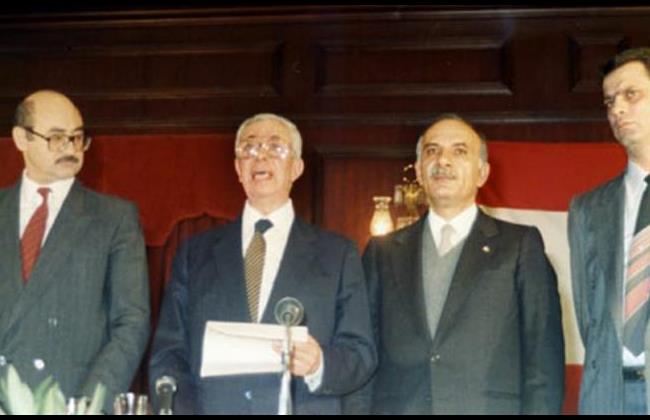
Elias Hrawi delivers his Inaugural speech, Nov. 24, 1989

Elias Hrawi delivers his Inaugural speech, Nov. 24, 1989

Things are moving very slowly in Lebanese politics these days, so I thought it would be interesting to see how Lebanon handled the presidential elections two decades ago, back when Berri was serving his very first term in office and when Hariri was still prime minister.

So here it is, the 1995 presidential elections, in the eyes of U.S. embassy.

(Spoiler alert: The parliament eventually extended Hrawi’s term)

(S)ELECTING A LEBANESE PRESIDENT IN 1995: A CURTAIN-RAISER
1994 November 9, 09:45 (Wednesday)
94BEIRUT5863_a
CONFIDENTIAL
CONFIDENTIAL
— Not Assigned —
CURTAIN-RAISER
1. CONFIDENTIAL – ENTIRE TEXT.
2. SUMMARY: VIRTUALLY EVERY PROMINENT MARONITE POLITICAN IN LEBANON (AND IN PARIS) HOPES TO SUCCEED PRESIDENT HRAWI, WHOSE TERM IS SET TO EXPIRE IN NOVEMBER 1995. FURIOUS JOCKEYING HAS BEGUN, AND A DIZZYING ARRAY OF POSSIBLE SCENARIOS EXISTS, BEGINNING WITH AN EXTENSION OF HRAWI’S TERM. THE FATE OF THE PEACE PROCESS IS WIDELY VIEWED AS A KEY DETERMINING FACTOR. THE LEBANESE HISTORICAL REFLEX TO SEEK FOREIGN BACKERS WILL MARK THE 1995 PROCESS: SYRIA WILL BE THE MAIN PLAYER, BUT CANDIDATES ARE ALSO SEEKING U.S., FRENCH, SAUDI, AND VATICAN SUPPORT. AS OF NOW, HRAWI, LAF COMMANDER EMILE LAHOUD, AND FORMER AMBASSADOR TO THE U.S. NASSIB LAHOUD ARE THE FRONT-RUNNERS. THE PRINCIPAL USG INTEREST SHOULD BE IN URGING THE SELECTION OF A PRESIDENT WITH ACROSS-THE-BOARD CREDIBILITY, BUT IN PARTICULAR WHO CAN HELP STEER THE MARONITES TOWARD POSITIVE PARTICIPATION IN FORMAL POLITICAL LIFE. SEPTEL REPORT WILL “HANDICAP” THE MOST PROMINENT CONTENDERS. END SUMMARY.
A PRESIDENT IN EVERY MARONITE’S MIRROR
————————————–
3. THE SIX-YEAR TERM OF ILYAS HRAWI IS SLATED TO EXPIRE IN NOVEMBER 1995, AT WHICH TIME PARLIAMENT WILL SELECT A SUCCESSOR. SHI’I NABIH BERRI AND SUNNI RAFIQ HARIRI BOTH HOPE ONE DAY TO BE THE FIRST MUSLIM PRESIDENT OF LEBANON, BUT NOBODY PREDICTS THAT THE NEXT PRESIDENT WILL BE ANYTHING OTHER THAN A MARONITE.
4. THERE IS NO SHORTAGE OF WOULD-BE SUCCESSORS IN THE MARONITE COMMUNITY. AT A RECENT SOCIAL EVENT FOR PARLIAMENTARIANS, A DRUZE MP ILLUSTRATED THE POINT WHEN HE TOASTED “TO THE NEXT PRESIDENT IN OUR MIDST–ALL SIX OF THEM.” THE LIST OF MARONITE “WANNABES” BRIDGES THE GAP BETWEEN THOSE WHO PARTICIPATED IN THE 1992 ELECTIONS AND THOSE WHO BOYCOTTED THE PROCESS, AND RUNS THE SPECTRUM FROM VIRULENT ANTI-SYRIANS TO THE SHAMELESS SURROGATES OF DAMASCUS. IN ADDITION TO THE SURFEIT OF WOULD-BE LEADERS IN THE COUNTRY, SUCH EXILES IN PARIS AS RAYMOND EDDE, AMINE GEMAYEL, AND MICHEL AOUN WANT TO EITHER GAIN THE PRIZE OR PLAY KINGMAKER.
THE SYRIAN ROLE, AS USUAL, KEY
——————————
5. REGIONAL REALITIES AND THE PRESENCE OF A PRO-SYRIAN MAJORITY IN THE LEBANESE PARLIAMENT ASSURE THAT SYRIA WILL HAVE THE DOMINANT VOICE IN THE SELECTION OF A NEW PRESIDENT. TO DATE, THE SARG HAS NOT TIPPED ITS HAND ABOUT ITS PREFERENCES. IN LEBANON, IT IS ASSUMED THAT THE PRESIDENTIAL SUCCESSION WILL BE CLOSELY TIED TO THE PEACE PROCESS, AND THAT THE SARG WILL CALCULATE ITS INTERESTS AS NEGOTIATIONS WITH ISRAEL PLAY THEMSELVES OUT. 6. EVEN THE MARONITES NOW JOCKEYING FOR POSITION BELIEVE THAT THE SYRIAN STRATEGY WILL BE TO LET THE CANDIDATES STRATCH, JOSTLE, AND ELBOW EACH OTHER TO THE POINT OF IMPASSE, AT WHICH POINT “BIG BROTHER” WILL STEP IN TO “HELP” THE LEBANESE SORT OUT THEIR SELF-MADE MESS. IN THE MEANTIME, DAMASCUS WILL HOST A CONSTANT STREAM OF CANDIDATES WHO SALLY ACROSS THE BORDER IN HOPE THAT ASAD WILL GIVE A FAVORABLE WORD, WINK, OR NOD.
THE U.S. ROLE: DIFFERENT SCENARIOS
———————————-
7. IT IS AXIOMATIC AMONG LEBANESE THAT THE USG WILL PLAY A KEY ROLE, EITHER ACTIVE OR PASSIVE, IN THE MAKING OF THE NEXT PRESIDENT. USG DRUTHERS ARE JUDGED TO BE DEPENDENT ON THE PEACE PROCESS. THOSE WHO BELIEVE THAT THE U.S. PLANS TO “SELL OUT” LEBANON FOR THE SAKE OF A SYRIAN-ISRAELI PEACE AGREEMENT FEAR THAT THE SARG AND THE USG WILL COOPERATE TO CREATE A LEBANESE QUISLING WHO WILL FAITHFULLY EXECUTE SYRIAN DIKTAT.
8. A MORE POSITIVE SCHOOL OF THOUGHT BELIEVES THAT THE USG, AT AN APPROPRIATE MOMENT, SHOULD URGE THE SARG TO EXERCISE ITS INFLUENCE TO GUARANTEE THE SELECTION OF A PRESIDENT WHO HAS A DEGREE OF CREDIBILITY ON ALL SIDES. THEY HOPE THAT DAMASCUS WILL BE SUFFICIENTLY BROAD-MINDED TO SEE THE NEED FOR A UNIFYING FIGURE, IN PARTICULAR SOMEONE WHO CAN LEAD THE MARONITES TOWARD POSITIVE PARTICIPATION IN FORMAL POLITICAL LIFE. SUCH SYRIAN ALTRUISM, HOWEVER, WOULD IN THEIR ESTIMATION BE DEPENDENT ON A SUCCESSFUL OUTCOME OF THE PEACE PROCESS.
9. THE MARONITE HARD CORE HOPES THAT A BREAKDOWN OF THE PEACE PROCESS WILL SOMEHOW LEAD THE USG (AND ISRAEL) TO SUPPORT A VOCAL OPPONENT OF SYRIA. THEY HOPE TO MOBILIZE MARONITE COMMUNITIES IN THE U.S. TO PRESSURE THE ADMINISTRATION TO SUPPORT “THE LEBANESE POWER OF DECISION” — WHICH IN THEIR CIRCLES MEANS RESTORING UNRIVALED MARONITE DOMINANCE.
OTHER PLAYERS: FRANCE, SAUDI ARABIA, THE VATICAN
——————————————— —
10. MANY MARONITES ARE HOPING THAT FRANCE WILL INVOLVE ITSELF IN THE PRESIDENTIAL RACE BY URGING SYRIA OR THE USG IN A PARTICULAR DIRECTION, OR, IN SOME FEVERED IMAGININGS, BY RESUMING THE ROLE OF GUARANTOR OF MARONITE POWER. THOSE MARONITES WHO MAKE THE PILGRIMAGE TO FOGGY BOTTOM SEEKING USG BLESSING USUALLY STOP OFF IN PARIS TO PRACTICE THEIR PITCH. THEORIES OF FRENCH PREFERENCES VARY WILDLY — FROM BACKING AOUN AND “MARONISME” TO SELLING OUT CHRISTIAN INTERESTS FOR THE SAKE OF CEMENTING WIDER FRENCH INTERESTS IN THE ARAB WORLD. IN PARTICULAR, MANY MARONITES FEAR THE WARM RELATIONS BETWEEN JACQUES CHIRAC AND SUNNI PRIME MINISTER HARIRI.
11. SAUDI ARABIA IS ALSO SEEN AS HAVING A ROLE TO PLAY, BUILDING ON ITS EXISTING RELATIONSHIP WITH HARIRI. SOME SPECULATE THAT RIYADH WILL POUR MONEY INTO LEBANON — OR EVEN SYRIA — TO SUPPORT HARIRI’S FAVORITE MARONITE, OR THAT, CONVERSELY, HARIRI WILL BE GIVEN INSTRUCTIONS WHOM TO SUPPORT. MOREOVER, ONE PROMINENT CANDIDATE, NASSIB LAHOUD, HAS INDEPENDENT TIES TO RIYADH (SEPTEL). SOME EXPECT THE USG TO URGE THE SAUDIS TO SUPPORT ITS FAVORED CANDIDATE.
12. PUNDITS EXPECT THAT THE VATICAN, THROUGH THE INFLUENCE IT MIGHT EXERCISE ON THE MARONITE PATRIARCH AND THUS HIS CHURCH, WILL INVOLVE ITSELF DEEPLY. THEY SEE THE ELEVATION OF PATRIARCH SFAYR TO CARDINAL AS A SIGN OF VATICAN INTEREST IN GUARDING CHRISTIAN “RIGHTS.” THE HARD CORE HOPES THAT THE POPE WILL PRESSURE THE USG AND FRANCE TO SUPPORT A “NATIONALIST”; MODERATES HOPE THAT THE VATICAN WILL STRONGLY URGE MARONITES TO PARTICIPATE IN POLITICAL LIFE; SOME BELIEVE THAT PAPAL NUNCIO PUENTE’S ONGOING DIALOGUE WITH HIZBALLAH LEADER FADLALLAH WILL HELP PRODUCE A PRESIDENT WITH BROAD CREDIBILITY. PUENTE SAYS THAT, HEALTH PERMITTING, THE POPE WILL VISIT LEBANON IF A PEACE AGREEMENT IS REACHED: IF THE VISIT HAPPENS, LOCAL EARS WILL BE KEEN TO SIGNALS OF A VATICAN PRESIDENTIAL PREFERENCE.
THE MUSLIM CONTRIBUTION
———————–
13. MOST PRESIDENTIAL MANEUVERING, OF COURSE, IS A STRICTLY MARONITE GAME. MUSLIMS–SHIA, SUNNI, AND DRUZE–ARE RELEGATED TO SECONDARY ROLES: EITHER TO BE THE GREEK CHORUS IN PARLIAMENT TO ECHO THE WISDOM RECEIVED FROM DAMASCUS, AND/OR TO STRIKE DEALS WITH MARONITE HOPEFULS TO OBTAIN THE POSITIONS TO WHICH MUSLIMS AT THIS POINT CAN ASPIRE. MUSLIM LEADERS ALREADY HAVE BEGUN CAUTIOUSLY TO ALIGN THEMSELVES, AS OFTEN AGAINST AS FOR A PARTICULAR MARONITE. UNTIL NOW, THE HIZBALLAH SHI’A HAVE NOT DISCUSSED THE RACE OPENLY: INSTEAD, THEY ARE PREOCCUPIED WITH WHAT SYRIA, AND PERHAPS IRAN, HAVE IN STORE FOR THEM AFTER PEACE WITH ISRAEL.
EXTENSION FOR HRAWI?
——————–
14. IN THE LAST FEW MONTHS, THERE HAS BEEN DISCUSSION OF A CONSTITUTIONAL AMENDMENT THAT WOULD ALLOW PRESIDENT HRAWI TO EXTEND HIS TERM BY PERHAPS TWO YEARS. DESPITE PUBLIC DISAVOWAL OF THE IDEA, HRAWI IS WORKING TOWARD THIS GOAL BEHIND THE SCENES. HE APPARENTLY WANTS TO BE SEEN AS THE PRESIDENT WHO TOOK OFFICE IN THE MIDST OF TURMOIL, THEN PRESIDED OVER A PERIOD IN WHICH LEBANON ENDED ITS CIVIL WAR, MADE PEACE WITH ISRAEL, THEN PUT ITSELF ON THE PATH TO ECONOMIC REVIVAL. WE HAVE ALSO DETECTED WHAT MAY BE A NASCENT EFFORT BY HRAWI TO BOOST HIS DOMESTIC CREDIBILITY BY PUTTING A BIT OF DAYLIGHT BETWEEN HIMSELF AND DAMASCUS.
15. THE LEBANESE SAY THAT THE SYRIANS HAVE SENT CONFLICTING SIGNALS ON THE ISSUE OF EXTENSION, AND THAT THE ISSUE MAY DEPEND ON THE FATE OF THE PEACE PROCESS. THE THINKING IS THAT, IF THE PROCESS STALLS, HRAWI WOULD REMAIN IN OFFICE, AND THE QUESTION OF THE PRESIDENCY, LIKE SO MANY OTHER ISSUES, WOULD REMAIN BLOCKED UNTIL THE SHAPE OF REGIONAL POLITICS BECAME CLEAR.
16. THERE ARE CONFLICTING REPORTS ON HOW PM HARIRI, SPEAKER BERRI, AND OTHER GOL FIGURES VIEW AN EXTENSION OF HRAWI. HARIRI AND BERRI DISLIKE HRAWI, BUT FEAR THAT A NEW, STRONGER PRESIDENT COULD JEOPARDIZE THE PREROGATIVES THEY HAVE BEEN ABLE TO CARVE OUT. PREDICTABLY, TO THE EXTENT THAT AN EXTENSION OF HRAWI WOULD ALSO HELP FREEZE THEM IN PLACE, THE IDEA IS ATTRACTIVE. IN THE ULTIMATE ANALYSIS, THEY WILL WAIT FOR SYRIA’S DEFINITIVE SIGNAL ON THE ISSUE.
17. INTERESTINGLY, THERE ARE VIRULENT OPPONENTS OF BOTH HRAWI AND SYRIA WHO SUPPORT AN EXTENSION. THEIR THINKING IS THAT THE ENEMIES OF SYRIA SHOULD CONCENTRATE THEIR EFFORTS ON THE 1996 PARLIAMENTARY ELECTIONS, SEEKING INTERNATIONAL OBSERVERS AND GUARANTEES. THE NEW, PRESUMABLY LESS SYRIAN-INFLUENCED PARLIAMENT WOULD THEN ELECT A PRESIDENT UNDER LESS SYRIAN SWAY.
THE USG INTEREST
—————-
18. THE USG’S VERY ACTIVE, UNSUCCESSFUL SUPPORT IN 1988 FOR MIKHAEL DAHER PROVIDES A CAUTIONARY LESSON FOR THE 1995 PRESIDENTIAL SELECTION PROCESS. ACTIVE USG BACKING FOR A PARTICULAR CANDIDATE WOULD PROBABLY SET IN MOTION A SERIES OF REACTIONS THAT WOULD DAMAGE THE CHANCES OF “AMERICA’S CHOICE.” THAT SAID, IT WOULD BE ALMOST IMPOSSIBLE FOR THE USG TO KEEP SILENT ABOUT THE SELECTION PROCESS: IF EXTENSION OF HRAWI REMAINS A LIVE ISSUE, WE WILL BE ASKED AT LEAST FOR COMMENT. IF A NEW PRESIDENT IS TO BE CHOSEN, WE WILL BE ASKED FOR OUR INPUT EVERY STEP OF THE WAY. PRESUMABLY, AT A MINIMUM, WE WOULD LIKE TO ASSURE THAT THE NEW PRESIDENT IS NOT HOSTILE TO USG INTERESTS.
19. UP TO THIS POINT, EMBASSY HAS ANSWERED INQUIRIES BY AVOIDING NAMES AND SAYING THAT WE HOPE A NEW PRESIDENT WILL FIT A CERTAIN PROFILE: HE/SHE SHOULD BE DEDICATED TO FINDING WAYS TO RECONCILE THE VARIOUS LEBANESE COMMUNITIES WITH EACH OTHER AND WITH THE NEEDS OF THE COMING ERA OF PEACE. HE/SHE SHOULD HAVE CREDIBILITY WITH ALL SIDES, AND IN THIS SENSE SHOULD NOT BE SEEN AS OVERLY TIED TO ANY FOREIGN SPONSOR. HE/SHE SHOULD ALSO VIEW AS A PRINCIPAL TASK ENCOURAGING THE MARONITES TOWARD MORE ACTIVE, POSITIVE PARTICIPATION IN FORMAL LEBANESE POLITICAL LIFE. IF THE TREND TOWARD CHRISTIAN NON-PARTICIPATION CONTINUES OR DEEPENS, THE PROSPECTS FOR INTERNAL RECONCILIATION AND STABILITY–WITHIN AND PERHAPS EVEN BEYOND LEBANON’S BORDERS–ARE POOR.
SCHLICHER
Six Months Of Vacuum

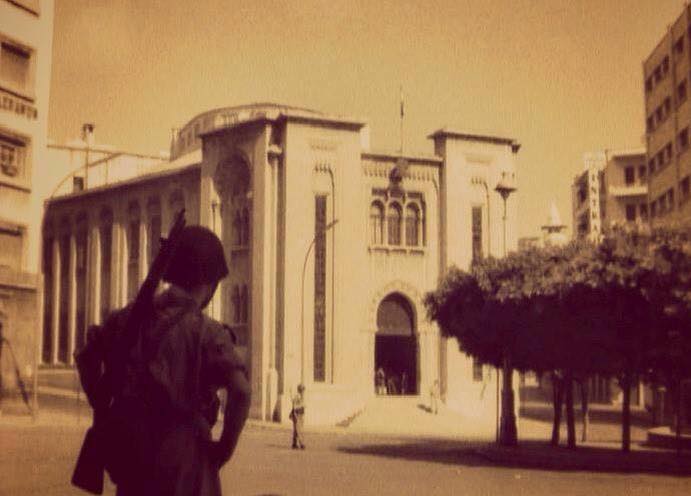
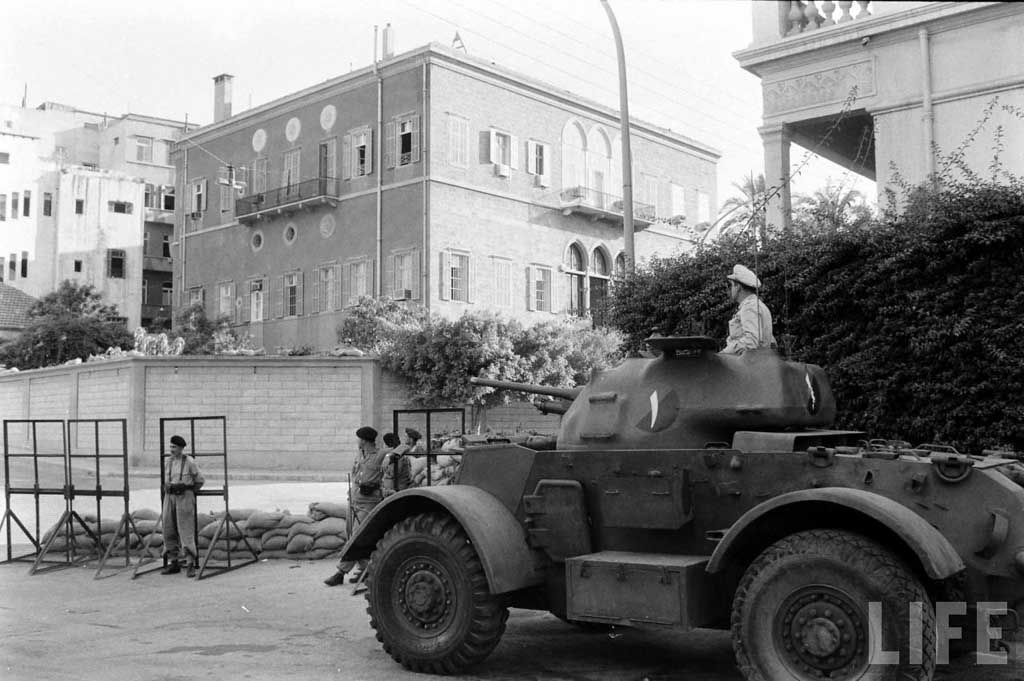
A Lebanese Staghound securing the presidential palace in Kantari, Beirut (1958)

A Lebanese Staghound securing the presidential palace in Kantari, Beirut (1958)

It’s already been six months since Michel Sleiman left office. And this month has been the most active one so far: The parliament approved its 2 years and seven months extension, the Future Movement hinted at the possibility of a presidential breakthrough, Aoun responded with an innovative counter-attack, and most importantly, there are renewed talks about the electoral law.

How the FM tried to break the vicious circle

Two weeks ago, one of the most shocking and unexpected maneuvers of the year broke the five months status-quo we had since Michel Sleiman left office: The Future Movement – via an interview with a Beirut MP – hinted that Sleiman Frangieh could be an accepted presidential candidate. The maneuver was surprising, yet brilliant:

If the FM – according to MP Shab’s hints – are seriously considering Frangieh’s candidacy, it would make Hezbollah look like a hypocrite in case they insist on Aoun or a consensual candidate, and it would create problems between the Marada and the FPM and between M8′s Christians and M8′s Muslims. A Frangieh presidency might seem like a March 8 victory, but on the long run, it will probably lead to the downfall of that alliance.

Such a maneuver from M14 would kill two candidacies with one stone: Aoun’s candidacy and Kahwaji’s candidacy. And in the process, it would kill the M8 alliance.

How Frangieh responded

So to sum things up here , Frangieh in his interview ended the Future Movement’s maneuver while it was still in its early stage and proved that he wouldn’t go behind his allies’ back in order to secure the presidency for himself. But he also indirectly gave the names of M8’s three presidential favorites: Aoun, Obeid (rumored to be Berri’s favori), and Kahwaji (rumored to be Hezbollah’s favori) while at the same time blacklisting two other possible consensual names: Georges Khoury (Who used to be the head of Lebanon’s intelligence service), and the governor of the central bank (Riad Salameh).

How Aoun responded

Aoun however was more subtle in his counter-attack. While he didn’t directly comment on M14’s maneuver, he said (in an interview with MTV) that he was ready to face off with Samir Geagea in parliament provided that there was no other candidate running in the presidential elections. The maneuver here is pretty much obvious: As demonstrated by the first round of the presidential elections, Samir Geagea could never get more than 50% of the votes needed to be elected. Walid Jumblatt, among other non-affiliated M8 politicians would never elect him as president. While Michel Aoun would also never get more than 50% of the votes (since the Jumblatt and Mikati blocs are hardly going to prefer him over Geagea), Michel Aoun – via his face off proposal – would have made sure that other presidential candidates would be surely gone from the race: Two names quickly come to mind here: Sleiman Frangieh and Henri Helou.

By making sure that it would be either Geagea or himself in Baabda, Aoun would have achieved a big win here and would have stopped two major M14 maneuvers from happening: The first one – electing Frangieh – was a long shot and its main goal was shattering the M8 alliance rather than securing the election of Frangieh – and it didn’t work anyway. The second maneuver is M8’s biggest fear: Should there be quorum, if M14 decides to support Jumblatt’s candidate – Henri Helou –  then he would become Lebanon’s next president since M14’s votes alongside Jumblatt’s ones are more than 65.
Aoun – and by getting everyone else to agree to his face off deal – Would have ruled out the possibility of M14 showing up to vote for Geagea but instead voting for Helou and electing him as president.

The FPM was trying to hit two birds with one stone: Keeping Frangieh outside the presidential race – independently of what Frangieh has to say- and at the same time preventing M14 from voting for Helou and electing him as president. This is why M8 won’t let the parliament meet to elect the president: It’s not because they fear that Geagea would be elected (Which is surreal). It’s because they fear that M14 would change their mind at the last minute and elect Helou after a deal with Walid Jumblatt. What confirms this theory is Jumblatt’s rejection of Aoun’s proposal (He called it undemocratic):

How the Lebanese Forces responded

The Lebanese Forces had two interesting reactions on the maneuvers of this month: The first one was their sudden interest in the electoral law and their reinvigorated support to a law they had previously agreed to (in May 2013) with the PSP and the FM. This is probably a reminder to the PSP and the FM that they are still an integral part of M14 and that they can give them concessions other parties would never give (Like on the electoral law). The second one was their approval of Aoun’s face-to-face competition with Geagea. After all, how can it harm the Lebanese Forces if Frangieh and Helou are out from the presidential race?

How vacancy in the presidency is in favor of M8

Now that the stances of every party is becoming clearer by the day, it would be interesting to see the bigger picture here, that is a lot similar to 2007 and 2008: March 8 is blocking the presidential elections because it gives them a tactical advantage: If they let it happen, there’s a possibility that M14 could eventually rally around Helou and elect him as president. Once Helou is elected president, M14 could – with the help of Jumblatt – form a government that is purely M14 and pass an electoral law that has the consent M14 (and M14 only). And the very fact that such a draft law already exists (It’s the one the LF mentioned) scares M8 even more. While M8 are more or less sure by now that Aoun’s chances are next to nil, Hezbollah’s ultimate goal of electing a consensual candidate that isn’t hostile towards its politics is becoming more likely. The delay in the presidential elections also gives M8 another advantage: By blocking the election of any president whatsoever, M8 could extort M14 into agreeing to their own terms: Just like 2008, the war for the presidential elections is the minor one. The main issue here is the deal that would include the name of the Lebanese president, and not the Lebanese president himself. There has been a lot of talk lately about a possible dialogue between Hezbollah and the Future Movement: While the dialogue in itself is likely to be useless, what is really important here is the FM’s precondition that the dialogue should start by solving the presidential deadlock before anything else: M14 wants to prevent M8 – via the preconditions of the dialogue – from asking for a deal (including the name of the president among other things). On the other hand, M8 needs guarantees that it wouldn’t be ousted from the next Lebanese government, and that an electoral law wouldn’t be voted without its consent. Deep down, the Aoun candidacy isn’t the will. It’s the way. After all, the only power M8 has (politically) is their “presidential blocking third”. So if they want to survive till the next parliamentary elections and if they want to make sure that their blocking third in the government is still there, now would be the smart time to take advantage of their number in parliament.

185 since the 25th of May. 21 days since the 5th of November. One million years till the next parliamentary elections.

On Independence And Constitutions

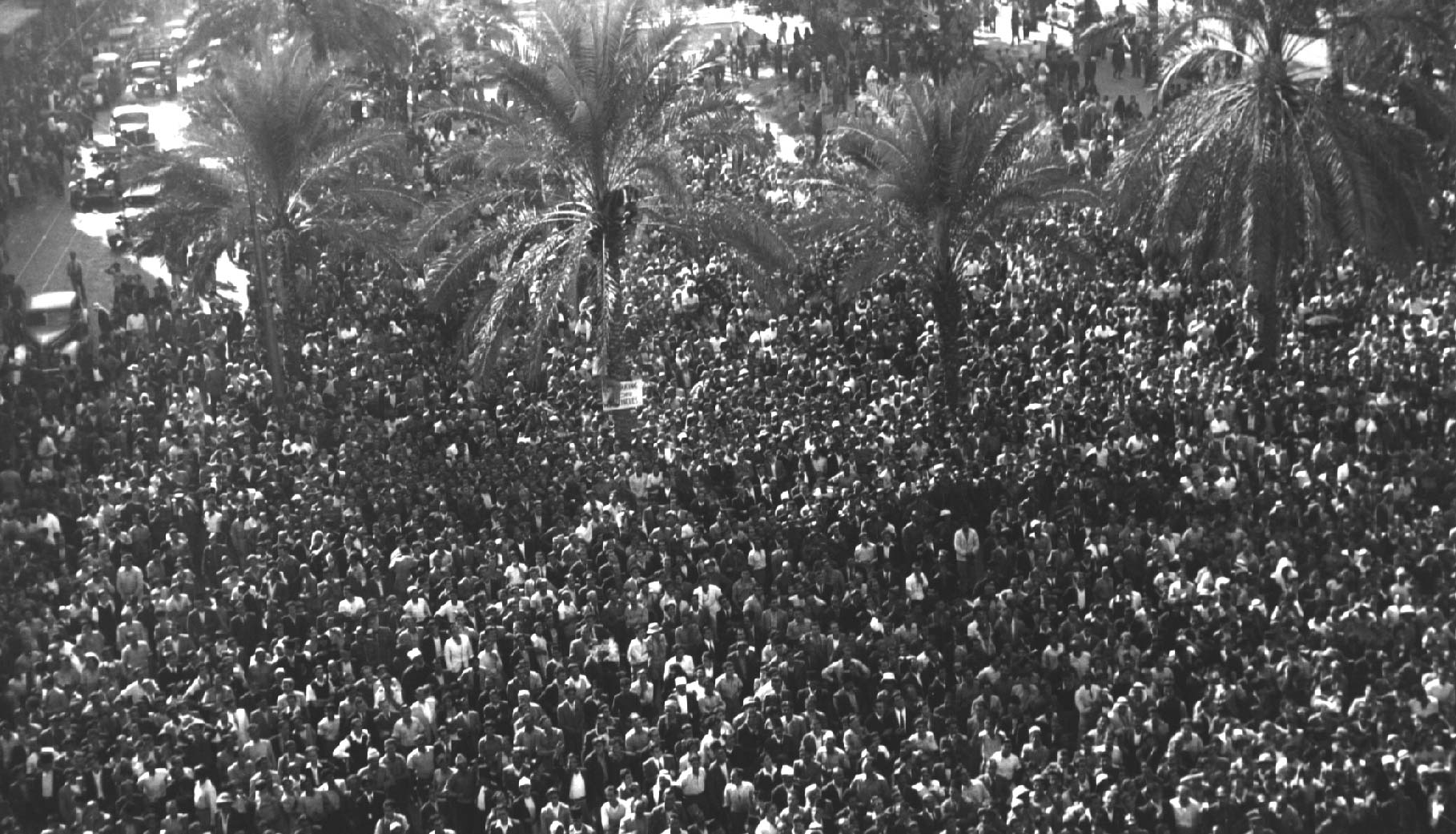
Beirut's Martyrs' Square during celebrations marking the release by the French of Lebanon's government from Rashayya prison on November 22, 1943

Beirut’s Martyrs’ Square during celebrations marking the release by the French of Lebanon’s government from Rashayya prison on November 22, 1943

Independent Lebanon is 71 years old today. But then again, if you think of it, we’re barely 7 years old: During the first two years we were still technically under the occupation of the French army. Then, up until 1958, no one really understood what was happening. The next seventeen years were basically buying time so that we don’t have a civil war, which we had anyway from 1975 till 1990. And then there were another fifteen years of Syrian tutelage, followed by 10 years that were more or less similar to the first fifteen ones in terms of democracy and productivity.

And this post isn’t about the fact that 71 years later we still don’t know how to elect a president. This post isn’t about the fact that 71 years later we still don’t know how to make a decent fair electoral law.

This post isn’t about the fact that 71 years later we still postpone parliamentary elections. This post isn’t about the fact that 71 years later we still have no control over the security situation.

This post isn’t about the fact that 71 years later we still wait for other states to solve our problems. This post isn’t about the fact that 71 years later we still don’t have a sustainable economy.

This post is about a Lebanese parliament that after 71 years of independence still doesn’t know how to follow the simple rules of the Constitution.

You’d think that after 14 parliamentary elections (since 1943) , we would have a parliament that actually knows how to handle a Constitution. Here’s a small compilation of the major constitutional violations that happened (or are still happening) in the past 10 years.

I – “Lebanon is a parliamentary democratic republic” (Yeah, right)

PREAMBLE
(INTRODUCED BY THE CONSTITUTIONAL LAW OF SEPTEMBER 21, 1990)
A) Lebanon is a sovereign, free, and independent country. It is a final homeland for all its citizens. It is unified in its territory, people, and institutions within the boundaries defined in this Constitution and recognized internationally.
B) Lebanon is Arab in its identity and in its affiliation. It is a founding and active member of the League of Arab States and abides by its pacts and covenants. Lebanon is also a founding and active member of the United Nations Organization and abides by its covenants and by the Universal Declaration of Human Rights. The Government shall embody these principles in all fields and areas without exception.
C) Lebanon is a parliamentary democratic republic based on respect for public liberties, especially the freedom of opinion and belief, and respect for social justice and equality of rights and duties among all citizens without discrimination.

II – “The people are the source of authority and sovereignty; they shall exercise these powers through the constitutional institutions.” (That’s why we don’t have elections anymore)

D) The people are the source of authority and sovereignty; they shall exercise these powers through the constitutional institutions.

III – “The political system is established on the principle of separation of powers, their balance and cooperation.” (That’s probably why it takes us eleven months to form a government)

E) The political system is established on the principle of separation of powers, their balance and cooperation.

F) The economic system is free and ensures private initiative and the right of private property.

IV – The even what?!?

G) The even development among regions on the educational, social, and economic levels shall be a basic pillar of the unity of the state and the stability of the system.

H) The abolition of political confessionalism shall be a basic national goal and shall be achieved according to a staged plan.
I) Lebanese territory is one for all Lebanese. Every Lebanese shall have the right to live in any part thereof and to enjoy the rule of law wherever he resides. There shall be no segregation of the people on the basis of any type of belonging, and no fragmentation, partition, or settlement of non-Lebanese in Lebanon.
J) There shall be no constitutional legitimacy for any authority which contradicts the ‘pact of mutual existence’.

V – I bet you didn’t even know that we’re supposed to (constitutionally) have a senate (Majlis Chuyukh). But right. Who cares.

Article 22
With the election of the first Chamber of Deputies on a national, non-confessional basis, a Senate shall be established in which all the religious communities shall be represented. Its authority shall be limited to major national issues.

VI – There is no quorum. There. Is. No. Quorum. You do not need 66% of the parliament to be present to elect the president. I repeat, you do not need 66% of the parliament to be present to elect the president.

Article 49
(As amended by the Constitutional Law of October 17, 1927, And by the constitutional law of may 8, 1929, And by the constitutional law of January 21, 1947 And by the constitutional law of September 21, 1990)
[…]
The President of the Republic shall be elected by secret ballot and by a twothirds majority of the Chamber of Deputies. After a first ballot, an absolute majority shall be sufficient. The President’s term is six years. He may not be re-elected until six years after the expiration of his last mandate. No one may be elected to the Presidency of the Republic unless he fulfills the conditions of eligibility for the Chamber of Deputies.

Did you read the word quorum? Because I didn’t. And if the Constitution wanted to say that there was a quorum, it would have said it clearly and mentioned directly the word “quorum”. Like in this article:

Article 65 (As amended by the Constitutional Law of September 21, 1990)

[…]
5. The Council of Ministers shall meet periodically in a special seat, and the President of the republic shall chair its meetings when he attends. The legal quorum for a Council meeting shall be a two-thirds majority of its members. It shall make its decisions by consensus. […]

Even the patriarch said that there was no 2/3 quorum.

VII – How did we elect Michel Sleiman again? Because, unlike what the legend says, the Constitution was not amended in 2008.

Article 49

[…]

It is also not possible to elect judges, Grade One civil servants, or their equivalents in all public institutions to the Presidency during their term or office or within two years following the date of their resignation and their effective cessation of service, or following retirement.

 Really, it wasn’t.

VIII – I don’t mean to be rude, but did “the Chamber meet automatically”? Because last time I checked, we still didn’t have a president.

Article 73
(As amended by the Constitutional Law of October 17, 1927, And the constitutional law of may 22,1948, And the constitutional law of april 24,1976)

One month at least and two months at most before the expiration of the term of office of the President of the Republic, the Chamber shall be convened by its President to elect the new President of the Republic. However, should it not be convened for this purpose, the Chamber shall meet automatically on the tenth day preceding the expiration of the President’s term of office.

IX – The Chamber shall meet immediately and by virtue of the law to elect a successor. Immediately. Immediately? Immediately. Immediately!

Article 74 (As amended by the Constitutional Law of October 17, 1927)

Should the Presidency become vacant through the death or resignation of the President or for any other cause, the Chamber shall meet immediately and by virtue of the law to elect a successor. If either Chamber happens to be dissolved at the time the vacancy occurs, the electoral bodies shall be convened without delay and, as soon as the elections have taken place, the Chamber meets by virtue of the law.

X – “And NOT a legislative body” (In other words, the parliament shouldn’t have been allowed to vote on the extension law)

Article 75 (As amended by the Constitutional Law of October 17, 1927)

The Chamber meeting to elect the President of the Republic shall be considered an electoral body and not a legislative assembly. It must proceed immediately, without discussion of any other act, to elect the Head of the State.

XI – General Budget? What was that again?

Article 83

Each year at the beginning of the October session, the Government shall submit to the Chamber of Deputies the general budget estimates of state expenditures and revenues for the following year. The budget shall voted upon article by article.

XII – No Comment.

Article 95

(As amended by the Constitutional Law of November 9, 1943 And by the constitutional law of September 21,1990)
The Chamber of Deputies that is elected on the basis of equality between Muslims and Christians shall take the appropriate measures to bring about the abolition of political confessionalism according to plan. A National Committee shall be formed, headed by the President of the Republic, it includes, in addition to the President of the Chamber of Deputies and the Prime Minister, leading political, intellectual, and social figures.
The tasks of this Committee shall be to study and propose the means to ensure the abolition of confessionalism, propose them to the Chamber of Deputies and to the Ministers council of ministers, and to follow up the execution of the transitional plan. During the transitional phase:
a. The sectarian groups shall be represented in a just and equitable manner in the formation of the Cabinet.
b. The principle of confessional representation in public service jobs, in the judiciary, in the military and security institutions, and in public and mixed agencies shall be cancelled in accordance with the requirements of national reconciliation; they shall be replaced by the principle of expertise and competence. However, Grade One posts and their equivalents shall be excepted from this rule, and the posts shall be distributed equally between Christians and Muslims without reserving any particular job for any sectarian group but rather applying the principles of expertise and competence.

And there are probably millions of other direct or indirect constitutional violations. They’re not as obvious as the ones here, but still, we see them almost every month.

But hey, look on the bright side: We’re so awesome and independent that we elect the president without having to rely on a Constitution.

 182 days since the 25th of May. 18 days since the 5th of November.

Endorsing Frangieh: March 14’s New Maneuver?

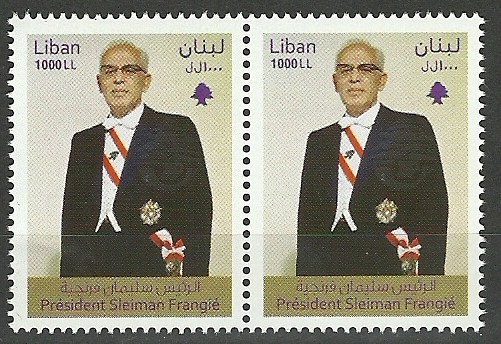
Sleiman Frangieh Timbre

Accordingly, [Future MP] Shab foresees serious negotiations taking place within “weeks, not months” to agree on a candidate “who can navigate a Sunni-Shiite conflict and who has the confidence of both parties […] someone with a certain degree of legitimate representation, but who is also agreeable to both sides.”

Asked by NOW who might fit that profile, Shab cited the leader of the 8 March-aligned Marada Movement, MP Sleiman Frangieh. When NOW queried how Frangieh, a staunch ally of Syrian President Bashar al-Assad, could be acceptable to 14 March, Shab hinted at a hypothetical agreement by which Frangieh’s presidency would be paired with Future leader MP Saad Hariri as prime minister.

(Source)

This is the beauty of Lebanese politics: Just when you thought that there would be no political maneuvers after the parliamentary extension and that we would enjoy at least three or four months of political silence, the Future Movement decides to throw this time bomb. The leading party of the March 14 alliance is apparently ready to strike a deal that involves the election of Syria’s man in Lebanon, Sleiman Frangieh, as president. True, Shab’s remarks don’t necessarily mean that there’s a consensus on the election of Frangieh among all the members of M14 (or even the FM), but even the idea of the Future Movement electing Frangieh is extremely shocking. So shocking that it might ironically be their best move since this presidential thing started.

A Thank You Note To Hezbollah?

Endorsing Frangieh might be a thank you note to Hezbollah. The party gave three gifts to the FM in the past three weeks: The first one was the official endorsement of Aoun that ended the FPM’s “Aoun is a consensual candidate” campaign. The second one was Hezbollah’s early decision to extend the parliament’s term although his main Christian ally opposed it and although it might have probably led to a decisive M8 victory – Due to the ISIS propaganda and the Christian fears. And the third one was Nasrallah’s friendly remarks about the Future Movement in his speech two weeks ago. These three stances indicated that there might be a rapprochement between the two parties (Similar to the one the FPM and the FM had in the autumn of 2013). Hezbollah had let down its main Christian ally three times in less than 3 weeks (And it’s in a context of presidential elections, making it worse for Aoun and even better for the FM). Perhaps accepting a Frangieh presidency might be a way of saying thank you to Hezbollah for postponing the elections, destroying Aoun’s last presidential hope, and not making a big deal out of the extension. And the very fact that Frangieh’s men were the only MPs from the change and reform bloc (27 MPs) that voted for the extension means that Frangieh is (1) fully independent from Aoun and (2) might as well be the intermediary between Hezbollah and the FM.

Perhaps Not A Thank You Note After All.

But how on earth would the Syrian regime’s oldest and closest ally, and Hezbollah’s primary ally in the North become an accepted consensual candidate? No matter how much you think about it, it’s surreal. Here’s something I wrote about the Frangieh presidency in October 2013 (Link for the full post):

Apparently on Thursday, Marada Movement leader Suleiman Franjieh warned of a presidential vacuum as the conflict over Syria continues and suggested that Lebanon adopts the 50 percent plus one vote formula to secure the office.

[…]

Let alone the fact that Frangieh’s allies took advantage of that particular constitutional clause (Of having the two thirds quorum in the Presidential elections) in order to block the election of an M14 candidate in 2008, the very fact that Frangieh is asking for a modification of that electoral process is very weird. Why? Let’s see why. Because Frangieh belongs to a coalition in the parliament that holds between the third and half of the seats in the parliament. That means that under the current constitutional rules, Frangieh – Let’s suppose for a while that he will be M8’s candidate – can block the electoral process by instructing his allies to boycott the session. Just to make it clear – and more complicated for you –  Frangieh said that a 50% plus one vote should be adopted. Thus theoretically, Frangieh spoke nothing about the quorum.  He only mentioned what the number of votes for the winner should be once there is quorum. So if Frangieh doesn’t want to change the quorum rule in the constitution but only the voting rule, nothing makes sense. Is Frangieh suggesting that we change the quorum or the winning vote number? Let’s see.

M8 has 40% of the votes, M14 45%, and the others (Mikati, Jumblatt …)15%  (The numbers aren’t exact, but you get the point)

Cas 1: Our lovely non functioning system (Quorum 66%, First round 66%, Second round 50%+1). Frangieh wants to run, but M14 and the others won’t vote for him. Frangieh instructs his allies to boycott. 40%>33% which means that there will be no quorum, thus no elections. In case the others will vote for him, that means he will have 55% of the votes. M14 boycotts, 45%>33%, meaning that there will also be no quorum.

Cas 2: Quorum remains untouched with Frangieh’s amendment (Quorum 66%, First round 50%+1). Frangieh wants to run, but M14 and the others won’t vote for him. Frangieh instructs his allies to boycott. 40%>33% which means that there will be no quorum, thus no elections. However, Frangieh is saying that he is making the amendment to make life simpler and easier for the parliament to elect the president. Which means that the amendment doesn’t make any sense (See, I told you!) because the quorum boycott is still here and if he wishes not to boycott and elect the president with 50%+1 he can simply wait for the second round and keep the constitution like it was (see Cas 1)

Cas 3:  Frangieh was actually talking about the quorum!  (Quorum  50%+1%, First round 50%+1).  40%<50% which means that Frangieh can’t freeze the process if he boycotts and has a very high chance of losing because 40%<50%. Unless…

Unless What?

Unless Frangieh is sure he can secure 65 MPs to vote for him. In politics you don’t actually propose something you might lose in, so there’s something fishy about this. If Frangieh meant cas 1 (or cas 2), he was probably just saying things to fill in the blanks of his speech. But if what Frangieh meant was cas 3, then something very dangerous is going on here.

Dangerous How?

If Frangieh can bring 65 votes, but not 86 (the 66% quorum that he wishes to remove in his reform) that can mean only few things. That means he isn’t a consensual candidate because he doesn’t have 66% of the votes (shocking, right?), that he will be running with M14 (See what I mean by dangerous?) against Aoun, or that Jumblatt and Mikati, along with Amal and Hezbollah and someone else will choose him as their sole candidate to the elections and throw Aoun outside which will probably make the latter closer to M14 than M8.

Read the last paragraph from last year’s post (emphasis on the words in green), and read it well. A Frangieh candidacy endorsed by M14 would ironically put Hezbollah in a very though position.

It’s as if a very poor person (Let’s call him Michel) asked for a loaf of bread, and instead, you give his other not-so-needy friend (Let’s call him Sleiman) a Burger that he can’t split – because it’s your only option. There’s nothing wrong about eating the Burger, except that Michel would hate you (and Sleiman) for it and you’ll eventually lose Michel as a friend.

You are Hezbollah, and the burger/loaf is obviously the presidency (I don’t think I need to clarify who Michel and Sleiman are).

Sleiman Frangieh had previously confirmed that he wasn’t anymore a presidential candidate and endorsed Michel Aoun. The problem here is that if March 14 endorses Frangieh, it would be highly tempting for Hezbollah and Frangieh to abandon the Aoun campaign. For Hezbollah, Aoun is silver but Frangieh is gold. Frangieh – unlike Aoun who has 18 MPs representing solely the FPM – doesn’t have a big bloc (4 MPs, including himself and Emile Rahme who is much more pro-Hezbollah than he is pro-Frangieh). Frangieh also has a limited electorate that he can rely on. And by limited, I mean it in a geographical, demographic, and sectarian way. Most (If not all) of Frangieh’s popular base is Christian, mostly Maronite, from the Zgharta Caza (Which is one of the smallest in terms of parliamentary representation with 3 MPs) and some of the surrounding villages in Koura. Frangieh doesn’t have foothold outside the North, belongs to a feudal family – and most importantly – faces continuous competition from other renowned political families established in Zgharta (Such as the Mouawads). In other words, Frangieh is too weak and can be manipulated by Hezbollah / Future Movement while Aoun (as a comparison) is much, much harder to keep under control. If Aoun switches sides, his ~ 22/23 MPs would be enough to change the status quo and throw a party outside the cabinet – be it Hezbollah, or even the FM. Frangieh can’t do anything with his 3 MPs (Yes, 3, because once he’s elected he loses his seat 😛 – And it’s actually 2 since you can’t really count Rahme as a loyalist). Frangieh won’t have his own base in the parliament to rely on, which means that he will fully be dependent on Hezbollah or the FM in everything concerning the legislation. Even if Frangieh wants to call for demonstrations, it wouldn’t have any impact unless Hezbollah joins him. Aoun wouldn’t need Hezbollah at all on the popular level –  in fact it would hurt him since the counter-propaganda would make it look as if his supporters aren’t Christian – making him an “illegitimate” Christian president. Frangieh is also a lot more pro-Syrian than Aoun is, and the Frangiehs have historical family ties with the Assad family that are almost 50 years old. Which means that even if every single MP in M14 endorses Frangieh, he would always be a friend of Syria – and thus closer to Hezbollah. Aoun, on the other hand, is a lot more unreliable so he might be a pain in the ass in case he decides to switch sides or go against the Syrian regime.

La morale: If you’re Hezbollah, and have to choose between Frangieh and Aoun, you’ll choose Frangieh every time. Every time.

Le Piège (Sowing Discontent Level: Future Movement)

If the FM allows and even supports the election of Frangieh, it would have given Hezbollah its golden candidate. It would have also looked like it would have won the elections, since it was the one who proposed Frangieh’s name first. The only problem here is that for Hezbollah, it would mean abandoning its now declared candidacy of Aoun. It would also mean that Nabih Berri’s opinion would be marginalized, and that the FPM would probably exit the March 8 alliance (and perhaps join a common Christian Front with the LF/Kaaeb who should also be in theory pissed because of the Frangieh election). In other words, Hezbollah would have won the presidency, but would’ve lost the integrity of the March 8 coalition. What’s the point of having a 100% loyal president if you can’t even influence 15% of the MPs when you want to form the government or vote for laws?

Hezbollah had a plan: Support Aoun till the end, and eventually settle – with Aoun’s blessing – on a non “Maronite Four” consensual candidate that has a friendly attitude towards Hezbollah, such as LAF commander Jean Kahwaji. Kahwaji’s election would have also been part of a bigger deal that should have been even more rewarding to the M8 alliance.

If the FM – according to MP Shab’s hints – are seriously considering Frangieh’s candidacy, it would make Hezbollah look like a hypocrite in case they insist on Aoun or a consensual candidate, and it would create problems between the Marada and the FPM and between M8’s Christians and M8’s Muslims. A Frangieh presidency might seem like a March 8 victory, but on the long run, it will probably lead to the downfall of that alliance.

Such a maneuver from M14 would kill two candidacies with one stone: Aoun’s candidacy and Kahwaji’s candidacy. And in the process, it would kill the M8 alliance.

174 days since the 25th of May. 10 days since the 5th of November.

Five Months Of Vacuum (And Another Parliamentary Extension)

Same shit, different day. Image dates back to the first parliamentary  extension. (31 May 2013)

Same shit, different day. Image dates back to the first parliamentary extension. (31 May 2013)

We are officially not heading to parliamentary elections.The parliament approved today a second extension to its term for two years and seven month (31 months). That’s 943 days. 943. Again, 943.  Most of the MPs voted for the extension while The FPM and Kataeb boycotted the session. While the extension move was very expected, several signs, especially in late August and the beginning of September hinted at the possibility of parliamentary elections happening this fall. But Lebanese politics are highly unpredictable. So what really happened these last two months?

This week Future Movement showed Berri that they could still bypass any of his vetoes regarding the presidential elections by endorsing M8’s “hidden candidate” (Jean Kahwaji). And Berri responded by reminding them that he too is unpredictable and that no matter what happens, he still holds the keys to the Lebanese parliament and could postpone for them the elections in case they wanted to. And in the process, the Lebanese Forces discovered that they were yet again left alone with no real power.

That was the situation in the first week of October. Then, on the 13th and 14th of October, three separate events proved that we were about to enter a turning point in Lebanon’s presidential/parliamentary politics.

(1) Hassan Nasrallah’s remarks while he was visiting the Bekaa were at the same time too violent about ISIS and awkwardly silent about the parliamentary elections. If Hezbollah genuinely wanted the elections to happen, Nasrallah would have publicly and clearly supported the demands of his Christian ally. The Bekaa speech would have also been a good occasion to start the electoral campaign, since the parliamentary elections were supposed to happen in the next month. But Nasrallah completely ignored the subject and instead chose to keep the anti-ISIS media war alive. The comments were 100% about ISIS and 0% about the elections or even broad Lebanese politics for that matter (No mention of the presidential elections either).

And there are two obvious reasons for that: Hezbollah’s top priority right now is the war next door, and exactly like the first extension’s context in 2013, the parliamentary elections would lead to two things:

A bad result:  A stronger Michel Aoun with a bigger parliamentary bloc (Making him more Hezbollah-independent which means that it would be easier for him to shift alliances or strike deals with his rivals).

A worse result: M14 wins the elections.

In both cases, it is more convenient for Hezbollah to keep the status quo, especially that the FM had previously threatened to boycott the parliamentary elections. Which means that Hezbollah would have had to deal with a political crisis, Sunni uproar, a non-representative parliament and possible Sunni-Shia clashes. (All this because Aoun might or might not have gained 7 extra seats.)

(2) The second development is about Amal and the FM. High ranking officials from both parties engaged in talks and the meeting was described as “positive” and aimed at extending the legislative term with “the minimum damage.” Two of the biggest blocs in parliament were already pro-extension.

(3) Hariri had previously hinted that M14 was ready to drop Geagea’s candidacy, but it didn’t seem that serious until he met with the Maronite patriarch and publicly endorsed the election of a consensual candidate. The maneuver was simple: By throwing Geagea outside the presidential race and endrosing a consensual candidate, M14 appears to the Lebanese public as the coalition that is spending most of the effort regarding the presidential elections. It puts pressure on Michel Aoun to back down but also gives the impression that the consensual candidate – once elected – would be an M14 sympathizer (since Aoun would be the last candidate to withdraw). Jean Kahwaji wouldn’t be “M8’s hidden candidate” anymore, but rather “M14’s proposed consensual candidate”. Properly speaking, it won’t be a win for M14, but it would definitively be defeat for Aoun.

Is A ‘Consensual War’ Starting?

Some rumors indicate that Jean Obeid might gather more support than Jean Kahwagi. Apparently, Obeid’s candidacy has the approval of Berri, Hariri and Jumblatt, which might mean that we could be heading (after the extension) to a “consensual candidate war”, with Obeid being supported by the “quadripartite alliance” Berri/Hezbollah/Mustaqbal/PSP (minus Hezbollah), Kahwagi being supported by Hezbollah, and Aoun being supported by himself while his Christian rivals seem to have no idea of what’s happening.

Baabda > Nejmeh Square

Throwing Geagea outside means however that the abandoned Lebanese Forces would have wanted to take their revenge somehow. The Lebanese- and especially the Christian electorate – are mainly against extending the parliament’s term. The wise thing to do from the Lebanese Forces would have been to embrace their electorate’s demands and piss off their Muslim allies by calling for elections and voting no for the extension. But that’s not what happened today. The FM and Berri’s biggest fear was that Christian MPs would boycott the extension session (making it invalid because of the lack of Christian support and creating constitutional problems). The very fact that the LF didn’t do that means something very important: Although they might not want the extension, they still value their allies’ importance. The LF needs the FM for the  presidential elections. Even the FPM – indirectly, with the Yes votes of their smaller ally, the Marada (4 votes) – gave a “Christian cover” for the extension and partially satisfied  Hezbollah’s political needs: For the LF and the FPM, abandoning your Muslim ally means losing the quest to Baabda. The Nejmeh square quarrel can obviously wait. For the Kataeb who don’t have a presidential candidate at the frontline of the presidential elections ( which is mainly about Geagea and Aoun), the wise thing to do was to please the Christian electorate and boycott the extension session. (Their alliance with Mustaqbal isn’t very relevant right now since they have no presidential candidate for the FM to support)

Retracing The Steps That Led To The Extension

The rest of October was rather quite similar to these two days. Even at the height of a political offensive by M14, Hezbollah reacted calmly – indicating its desperate need to eliminate something as simple as the idea of a Sunni-Shia political/military crisis – by “rejecting to engage in Spat with Mustaqbal despite a sharp rift“. On the other side of the political spectrum, the FM continued their presidential maneuver. The LF were once again indirectly bashed by their allies when Saad Hariri, approximately two weeks after his meeting with the Patriarch, declared the end of Geagea’s candidacy one more time. The first days of November were also similar. The most important stance was Hezbollah’s one, when Nasrallah (1) praised the FM for their stances on Tripoli’s events (indicating a rapprochement due to their similar stances on the extension) and (2) publicly – and probably for the first time – said that Aoun was Hezbollah’s candidate (Implying that Aoun was no longer a consensus candidate and indirectly ruling him out from the “Consensual candidate list” – something that should please the Mustaqbal party)

The Scary Part

What is scary here isn’t that Lebanese politicians lie and steal and deceive and postpone elections. That, we already know. What is truly scary here is that 25 years after Taef, we are starting to witness an obvious rapprochement between the Christian parties while a rivalry between the Muslim blocs and the major Christian ones is becoming more apparent by the day. Every time there’s an important law debated in parliament – Such as the electoral law or the extension law – the rift is yet again Christian/Muslim instead of M8/M14: 10 years after the creation of these alliances , it seems that they were more based on an electoral than ideological ground.

If there was one beautiful thing about the March 8 and 14 alliances, it was that they were religiously diverse. And now – with ISIS on our gates and with vacancy and dysfunction everywhere in the political establishment – is literally the worst time to lose that.

Clashes, Again

The war for the extension was until now political. Then, on the third week of October, clashes erupted between the Lebanese army and Islamist militants in Tripoli. It was the best thing that could have happened to the pro-extension parties. That, in addition to the other security issues, such as the Arsal fiasco, were more than enough to say that the government couldn’t handle organizing elections in such a context (which is total bullshit, since in the 1990s the parliamentary elections happened even when Israel was occupying the South). Just look at that headline:

North Lebanon mufti cancels Christian-Muslim summit over clashes

Now forget about that headline for a while, and read the following paragraphs (sorry, couldn’t find an English version)

            انطلاقاً من الأوضاع الأمنية التي يمر بها الوطن والتي تؤثر بشكل واضح ومباشر على الحياة الطبيعية في مناطق واسعة وفي معظم المحافظات اللبنانية حيث انتقال الحوادث والإشكالات من منطقة إلى أخرى سبّبت سقوط الشهداء والجرحى لا سيما في مدن رئيسية تشكل عقدة المواصلات الأساسية بين المناطق اللبنانية من الشمال إلى الجنوب إلى البقاع.

            وبناءً على ما لهذا الأمر من أثر مباشر على قدرة الجيش والقوى الأمنية التي تسخّر كل قوتها وانتشارها لضبط الأوضاع مع تكرار الإعتداءات على الجيش ووقوع خسائر في أرواح جنوده وضباطه مما شكّل تحدّياً لدوره أدّى إلى سحب ونقل قواته من مهامها الأساسية في الجنوب إلى مناطق أخرى.

ونظراً لانعكاس هذه الحالة وتلازمها مع تصعيد سياسي وانقسام يأخذ في كثير من الأحيان أبعاداً مذهبية وطائفية حادة تنذر تداعياتها بالفتنة التي أصبحت معالمها تنتقل من مكان لآخر وبأشكال متعددة.

وبالاطلاع التفصيلي على أوضاع أكثر من منطقة لبنانية تظهر أن سلاح الفوضى يعبث بأمنها حيث يتجرّأ المسلحون على هز هيبة الدولة واستقرار حياة الناس وصولاً إلى إطلاق الصواريخ على المناطق التي تشكل امتداداً للعاصمة وكذلك مدينة طرابلس مع ما لهذا من انعكاس على صورة لبنان إضافةً إلىسقوط عشرات القتلى ومئات الجرحى، والقصف الصاروخي المتكرر على مدينة الهرمل.

هذه الأوضاع الأمنية المتردية أدّت إلى أن العديد من الدول العربية والأجنبية نصحت رعاياها بمغادرة لبنان أو على الأقل عدم المجيء إليه إلا للضرورة القصوى.

وبما أن مجمل هذا الوضع الأمني والسياسي المتوتر يعطل بشكل كبير إمكانية القيام بتحرك إنتخابي وتنظيم الحملات التي تسمح للمواطن وللمرشح بممارسة حقه في إطار القوانين والأنظمة وتعطل قدرة التواصل بينهما في أغلب المناطق وخاصة في المدن الكبرى ومنها وإليها.

وتزامناً مع عدم الاستقرار الأمني هذا تأتي مشكلة غياب الاستقرار السياسي مع وجود حكومة مستقيلة.

كل هذا انعكس وسينعكس مع استحقاق الانتخابات بشكل سلبي على القطاعات الاقتصادية والتجارية والسياحية المتعثرة وبما يؤدي إلى شلل إقتصادي يدفع اللبنانيون ثمنه مباشرةً.

وبما أن معظم هذه الأمور السياسية والأمنية تتسم بصفات الظروف الاستثنائية والقوة القاهرة بأشد مفاهيمها. 

ولو سمحت الظروف لأي كان بالاستماع إلى وزيري الدفاع والداخلية وقادة الأجهزة لعرف بدقة حجم الصعوبات والأزمات التي يواجهونها والتي تتطلب المساعدة من الجميع.

وبمـا أنـه صـدرت في لبنـان قوانيـن مـددت مـدة ولايـة المجلـس النيابـي لأكثر من مرة وهي القوانين رقـم 1/76 –3/78 –14/80 –9/83 – 3/84 – 11/86 –  52/87 – 1/1989 .

وبمـا أن القوانيـن المذكـورة أعـلاه مـددت ولايـة المجلـس النيابـي تحـت وطـأة الحـرب والقـوة القاهـرةوالظروف الاستثنائية فإن اقتراح القانـون الذي نحن بصدده مـا هـو إلا لمنـع الحـرب واستدراك الفتنـة ونتائج الأزمـات الخطيـرة المحدقـة بنا.

In case you didn’t understand a word, those were the compelling reasons (الاسباب الموجبة) that came with the previous extension law of 2013 (find the full text here). According to the text, the main reasons for the extension were that the security situation is unstable (There was the Qussair battle at the time) , that there is no political stability (Mikati’s government was a caretaker one at the time) and that there is no agreement on the electoral law.

The main rhetoric used here is a preventive one: “The parliamentary extension is to prevent war” and is based on the fact that the previous extensions were made in times of war. You know, because since we didn’t have elections during the war, we shouldn’t have elections in order to prevent the war (what a logical sentence! – credit goes to our politicians)

Now read the headline again:

North Lebanon mufti cancels Christian-Muslim summit over clashes

That headline is the Christmas miracle. The political class that wasted most of the 17 previous months on forming a government that could have been formed in 17 minutes instead of agreeing on an electoral law, and that successfully postponed the presidential elections and established vacancy in Baabda, now received what it had always wanted: Clashes, sectarianism and terrorism, all in a combo package.

The other Christmas miracle was the decision of two Lebanese universities last week to postpone their student elections because of the security situation. Take it from the politicians’ point of view: If the universities can’t even hold elections in this context, how can the government organize them?

By the end of this week, the three extension requirements were met. It was finally time to pass the parliamentary extension: (a) There was no political stability (no president), (b) there was no new electoral law to use (apparently 17 months aren’t enough to write a couple of consensual articles on a piece of paper), and (c) There were severe security breaches.

Mabrouk, maddadna.

Is it politically correct to say 3a2bel el miyye?

165 days since the 25th of May. One million years till the next parliamentary elections.

Wikileaks’ Five Consensual Candidates Of 2007

Lebanese Parliament 1950s

Since Lebanon’s presidential politics are now about finding the consensual candidate (with the ًexpected withdrawal of Samir Geagea that should be followed by a similar move from Aoun), I thought it might be interesting to take a look at who the “consensual” candidates were in 2007. So here’s a diplomatic cable (Thank you, Julien Assange) discussing the main five consensual candidates of the last presidential elections.

BEIRUT 00001424 001.2 OF 004 Classified By: Jeffrey Feltman, Ambassador, per 1.4 (b) and (d).
1. (S) As we have reported, March 14 leaders say that Nassib Lahoud is their first choice for president, with Boutros Harb the fall-back; March 8 leaders at least tactically suggest Michel Aoun is their only candidate. At the same time there is considerable talk by both sides about finding a consensus choice, an approach that presumably rules out those three as well as undeclared March 14 candidates Amine Gemayel and Nayla Mouawad. Yet we are not convinced that March 8 leaders seek genuine consensus. Their Syrian and Iranian backers probably hope to exploit the public yearning for a solution in order to dictate a presidential choice, who would be a consensus candidate in name only. Failing that, March 8 leaders — and Michel Aoun — would probably prefer vacuum or chaos to blame on March 14 stubbornness. Suggesting that acquiring trump cards is more important than achieving consensus, Nabih Berri insists that discussions toward a consensus president will begin only after March 14 agrees to conditions that ensure a March 8 veto.
2. (S) But let us assume that the two clashing political camps succumb to domestic and international pressure to discuss compromise figures. Each side has a different definition of who counts as a consensus choice (with Harb believing obsequiousness will lead Berri secretly to back him and Aoun deluding his cult-like inner circle that he occupies the halfway point between March 8 and 12). But, despite differences, there are five names mentioned frequently as potential consensus candidates: LAF Commander Michel Sleiman, Central Bank Governor Riad Salameh, MP Robert Ghanem, ex-Minister Michel Edde, and Maronite League head Joseph Torbey. We guess that Berri would add ex-Ministers Jean Obeid and Fares Bouez to the consensus list, and Patriarch Sfeir would include ex-Ambassador Simon Karam and ex-Minister Demianos Kattar. Minister of Justice Charles Rizk would add himself. Occasionally, bankers Francois Bassil and Farid Raphael are mentioned, as is, infrequently, Higher Judicial Council chief Antoine Kheir. Some even raise the unlikely possibility of luring Carlos Ghosn from Renault-Nissan to Baabda. The darkest horses in the consensus sweepstakes include beach resort owner Roger Edde and lawyer Chibli Mallatt.
3. (S) At this point — and until or unless other names emerge — Sleiman, Salameh, Ghanem, Edde and Torbey probably have the best chance of branding themselves as the consensus candidate of choice acceptable to both camps (albeit begrudgingly in the March 14 case, given March 14 leaders’ belief that they have the majority right to elect a president). We can’t at this point predict the odds of who might prevail, or even if the consensus approach prevails over March 14 being able to elect one of its own. But in comparing the current choices, we can make a few observations about the behavior of the candidates in question. Our biggest concern is that all of the leading consensus candidates with the possible exception of Torbey (whose political views are largely unknown) have either documented or rumored ties to Syria that might make them vulnerable to interference. We also note that UN Special Coordinator to Lebanon Geir Pedersen believes that Sleiman and Salameh are the only two candidates acceptable to Hizballah, rendering them suspect. — LAF Commander Sleiman: In the aftermath of Nahr al-Barid, Sleiman is the most popular choice. He is a useful tool in deflating Michel Aoun, as many Aoun backers, including powerful MP Michel Murr, are ready to shift support to Sleiman. But Sleiman’s record has been mixed over the past three years. On the one hand, in permitting (and even facilitating) the spring 2005 demonstrations including the famous March 14 rally, Sleiman defied Syrian orders. He also oversaw the historic LAF troop withdrawal to the south and (after initially blinking) the Nahr al-Barid fight. UNIFIL reports that he promotes active LAF-UNIFIL cooperation. On the other hand, his public statements have been among the worst of any GOL officials (going beyond what would be considered politically imperative), and the LAF under his command has done almost nothing to stop Hizballah weapons smuggling and transport. We cannot imagine he would be more
BEIRUT 00001424 002.2 OF 004
forceful as president in implementing UNSCRs 1559 and 1701, especially if he owes Hizballah and Syria for helping to create his presidency. He is suspicious of March 14 and dislikes Siniora, who is openly contemptuous of Sleiman. To be president, Sleiman would require the same constitutional amendment passed for Emile Lahoud’s first time, waiving the usual two-year cooling-off period before the army commander is eligible to become president. We cannot say with certainty what his current ties to Syria are, but we assume that they remain active. — Central Bank Governor Riad Salameh: Salameh enjoys an excellent international reputation in financial circles for having prevented Lebanon’s financial meltdown. If examined closely, his methods may raise bankers’ eyebrows, but they worked. His candidacy is pushed by Lebanon’s financial and business circles, who cite a pragmatic, non-ideological approach and connections to all parties in Lebanon. But the number of rumors about Salameh’s private life and his alleged cover-up of the Bank al-Medina scandal raise concerns about the potential for blackmail. Unsubstantiated stories circulate about trips to Damascus to advise the Asad family on banking and finance. Once a protege of Rafiq Hariri, in 2004 he was seen as having betrayed Hariri, when he secretly worked with Emile Lahoud to reschedule bonds in advance of their mature dates (and at higher interest costs that padded his banker friends’ pockets); Hariri had planned to use the approaching financial crisis as leverage in his quiet campaign to prevent Lahoud’s extension. Nevertheless, Salameh is very close to Rafiq’s widow Nazek. Common wisdom is that he, too, would require a constitutional amendment to become president, although he makes an argument that the cooling-off period does not apply. PM Siniora and Salameh loathe each other, with each bearing grudges that date back years. While friendly to us, Salameh demonstrates a certain opaqueness, an ability to mask what he is really thinking or doing. As with Sleiman, we assume he maintains active ties to the Syrians. — MP Robert Ghanem: A long-time MP from West Biqa’, Ghanem comes from a part of Lebanon that has long been subject to heavy Syrian interference. While he voted against Emile Lahoud’s extension in 2004 (as Ghanem wanted to become president himself), Ghanem sat out the spring 2005 demonstrations. Fellow Christian MPs who did join March 14 tended to forgive Ghanem at the time, noting that his district’s location next to Syria explained his absence. By the 2005 legislative elections, he had thrown his lot in with the March 14 movement, successfully defending his parliamentary seat on a March 14 electoral list. As March 14 fortunes have fallen over the past year, however, Ghanem has tiptoed away, and he was not invited to the August meeting of March 14 Christians. Our sense is that Ghanem — a decent man — is politically opportunistic rather than ideological, malleable rather than principled. With his political base in the Biqa’, he will naturally work hard not to offend the Syrians. If the Syrians said “boo,” he would be among the first to be rattled. — Former Minister Michel Edde: Now an octogenarian, Edde has sufficient wealth not to fall into the usual Lebanese temptations of using public office for private gain. A generous donor to the Maronite church and former head of the Maronite League, he has the “Christian weight” that most of the other consensus candidates lack, through a close, decades-long friendship with Patriarch Sfeir. The French are seduced by his happy gourmand profile, and he is generous and ecumenical with his private charity. He serves, for example, as the first non-Druse officer of the primary Druse charity in Lebanon, thanks to his financial support. But his attitude about Sunnis, and Palestinian Sunnis in general, verges on racism. He views most issues from a paranoid perspective of how to preserve the political powers of a diminishing and (in his view) embattled Maronite population. Perversely, this has led him to traditionally cozy relations with Hizballah and Syria (with rumored links to Mohammed Nassif Khayrbek), all of whom he sees as needed counterweights to Sunni power. His views of Sunnis approaches those of General Aoun, although the perpetually sunny Edde drops the vitriol Aoun applies. Infamously, he once said that he would throw his body down before the Syrian tanks to prevent them from leaving, leading to the current jokes that, after the Syrian withdrawal, when Edde comes to
BEIRUT 00001424 003.2 OF 004
visit, he can slip in under the door without knocking. — Maronite League President Joseph Torbey: Torbey was elected as head of the Maronite League in May 2007, in a surprisingly heated race seen to have promoted him into the ranks of presidential contenders. A banker, Torbey was for years head of the Lebanese Bankers Association and previously Chairman of the Arab Bankers Association. His political views are not well known. He is head of Credit-Libanais Bank, which is majority Saudi-owned, leading some politicians to muse that he must lean in the direction of the Hariris and March 14. Yet his winning slate for the Maronite League board suggests a slight bias against March 14 (including, for example, LBC Chair Pierre Daher — an enemy of Samir Geagea — and Abdullah Bouhabib, close to former Deputy Prime Minister Issam Fares). But most observers feel he is pragmatic rather than political. Patriarch Sfeir has mentioned Torbey as an example of the “neutral” figure, “equal distance” from both March 8 and March 14 that Sfeir sees as needed to heal Lebanon’s deep political divide.
4. (S) If we had voting power and were confined to these five consensus candidates, what would we think? Despite his current popularity, we would eliminate Sleiman immediately: After Emile Lahoud and the experience with Michel Aoun earlier, Lebanon could benefit from a civilian president. And, whatever Sleiman’s admirable actions over the past three years, we believe pursuing an end to Hizballah’s arms smuggling would be a particularly hard sell with him, especially given his (accurate) suspicions about March 14’s only reluctant support and trust of him. He sees Syria and Hizballah as more reliable allies, we believe. We would scratch Michel Edde’s name off next, as someone who is well past his sell-by date. Much as we enjoy Edde’s friendship and cuisine, it is difficult to pursue a constructive agenda with someone who does not pause to take a breath in his unending monologues on Lebanon’s Christian identity. Edde’s presidential ambitions are taken most seriously by those who wish a weak president or those who are counting on Edde’s advanced age forcing an early vacancy in the office.
5. (S) As Saad Hariri pointed out himself (reftel), Robert Ghanem poses a challenge. He would not provide the strong leadership Lebanon needs in the years to come. But, as a decent man who did back the Special Tribunal (despite pervasive Syrian influence in his neighborhood), he would be an improvement over the incumbent in Baabda Palace. Unlike Emile Lahoud, Ghanem is not a believer in Syrian hegemony. Rather, our worries would be that his natural susceptibility to Syrian pressure would make him a facilitator of Syrian interests by default. We guess that Ghanem would try very hard to avoid conflict with either Syria or with us, making the choice of a PM all that much more important: the premier will have to help fill the leadership vacuum Ghanem is not prepared to fill. While we would be unexcited by the choice, Ghanem would not be a disaster, and it would be difficult to object to his candidacy, if he emerges out of a genuine consensus.
6. (S) Of all the five, Torbey and Salameh are probably the most modern thinkers, by virtue of their broad exposure in international business and financial circles. They have both been part of the financial establishment here that has kept Lebanon afloat despite the common belief that Lebanon should have collapsed financially years ago. In fact, the financial concerns would probably keep both Torbey and Salameh leaning toward the west, despite Syrian pressures and whatever vulnerabilities they have, since neither would want to preside over Lebanon’s bankruptcy. Financial pressure, in other words, could be a useful deterrent on either from going too far with the Syrians. Besides rumors of Syrian connections and some unsavory personal and business practices, Salameh faces the additional burdens of a constitutional amendment (at least according to most observers) and the hatred of Siniora. But, with Torbey such an unknown figure, we would probably, and without enthusiasm, end up backing Salameh as the least risky of the five.
7. (S) Unfortunately, none of these five candidates are statesmen. The exercise of examining potential compromise candidates reinforces our first impression that none of the consensus names currently in circulation indicate the type of exciting, dynamic leaders that would be ideal to move Lebanon
BEIRUT 00001424 004.2 OF 004
forward. But the desire to pull Lebanon backwards, toward renewed Syrian hegemony, is surely what motivates Syria’s agents here to object so strenuously to candidates like Nassib Lahoud who are. Lackluster as candidates like Salameh and Ghanem are, they at least would not willingly participate in facilitating the return of Syrian occupation of Lebanon.
8. (S) Much can happen between now and the expiration of Emile Lahoud’s presidential term at midnight on November 23. But, for now, a consensus solution for the presidency appears able merely to prevent immediate chaos and violence, not to deal decisively with Lebanon’s long-term problems. A consensus president prevents the emerges of a new crisis but is unlikely to have the influence to solve the existing problems. If there is a consensus president from the list we have provided here, we should keep our fingers crossed that Lebanon’s next prime minister is a strong, decisive figure to help compensate for the weakness in Baabda Palace. We have a sinking feeling that, with a weak compromise figure as president, Lebanon would be no more able to resolve the issues facing it than under the current dysfunctional line-up.
FELTMAN
149 days since the 25th of May. 28 days till the 16th of November.

Lebanon’s New Presidential Favorite?

Empty frames (presidential vacuum)

Visual vacuum: Portraits of ex-Lebanese President Michel Sleiman at state-run facilities replaced with empty frames. (Image source: The Daily Star, Mohamad Azakir)

Other than the fact that we still don’t have a president and that the parliamentary elections are in a month, Lebanon had two very busy weeks. Let’s take a look at some of these stories.

28/09/2014 – Army Repels Jihadist Infiltration Attempt as Gunmen Try to Spread Chaos in Lebanon (Naharnet)

The Lebanese army clashed with jihadists trying to infiltrate Lebanese territories at dawn Monday, leaving many dead and injured among their ranks, Voice of Lebanon radio (93.3) reported.

The infiltration attempt was made on the outskirts of the northeastern border town of Arsal, which last month witnessed bloody clashes between the army and militants from al-Qaida-linked al-Nusra Front and the Islamic State group.

28/09/2014 – Hariri: Syrian National Coalition Complaint on Army’s Arsal Raid Should’ve Mentioned Captive Troops (Naharnet)

Head of the Mustaqbal Movement MP Saad Hariri criticized on Sunday the Syrian National Coalition’s complaint to the United Nations Security Council over the Lebanese army’s treatment of Syrian refugees in the northeastern region of Arsal, deeming it as a “misstep” and saying that it disregards the ties between the Lebanese and Syrian people.

He said in a statement: “The Syrian National Coalition has the right to defend the refugees’ humanitarian rights … but the interests of the refugees and Syrian revolt also requires them to raise their voice and demand the release of the Lebanese soldiers and policemen abducted by Islamists in August.”

29/09/2014 – Saudi Arabia asks for clarification on weapons deal for Army (The Daily Star)

“For reasons that I cannot explain today, the Saudis have put conditions on the destinations of the arms,” Lebranchu said. When pressed what she meant by “destinations,” Lebranchu said that the already complex file would only be further complicated if she discussed the details publicly.

Moreover, the Saudis had not registered their specific concerns regarding the arms deal with the French by Friday evening as Lebranchu concluded her trip to Lebanon.

“If the Saudis have a problem [with the accord] … it would be helpful if they identified it quickly so that we could respond,” Lebranchu said. “We need to get this file moving.”

She was confident that the Saudis would express their precise concerns in the near future.

30/09/2014 – Iran to donate military equipment to Lebanese Army (The Daily Star)

Iran will donate military equipment to the Lebanese Army, a visiting Iranian official said Tuesday after talks with Prime Minister Tammam Salam.

“Given the role Lebanon is playing in fighting extremist takfiri terrorism in some border regions, Iran has decided to donate military equipment to the Lebanese Army, as a token of love and appreciation for Lebanon and its brave Army,” said Ali Shamkhani, secretary of the Supreme National Security Council of Iran.


01/10/2014 – Jumblat Calls for Exchange between Arsal Captives, Roumieh Prisoners to End Abduction Ordeal (Naharnet)

Progressive Socialist Party leader Walid Jumblat called on Wednesday for a swift exchange between the Arsal captives and Roumieh prison Islamist inmates, holding former Internal Security Forces personnel responsible for the “self-rule” at the facility.

“The government and crisis cell should follow up any exchange process with the kidnappers,” Jumblat said in an interview with An Nahar newspaper.

He denied any previous knowledge of the conditions set by the jihadists, who kidnapped a batch of soldiers after withdrawing from the northeastern border town of Arsal in August.

Note: Jumblatt had previously refused the idea of an exchange deal on the 7th of  September.

05/01/2014 – Lebanon to get Russian helicopters, air defense (The Daily Star)

“There are talks on buying Russian arms and special equipment by Lebanon,” the World Tribune quoted Machnouk as saying during his visit to Moscow in late September to discuss weapons supplies to Lebanon’s Internal Security Forces.

He said a delegation from the army would visit Moscow later this month to discuss proposals.

Any deal would most likely be financed by the $1 billion Saudi donation that was announced by former Prime Minister Saad Hariri in August.

Political sources last month told the The Daily Star that Hariri was working to revive 2010 arms negotiations with Moscow. The Russian ambassador confirmed at the time that talks were taking place without going into detail.

08/10/2014 – Lebanese Army receives new US arms delivery (The Daily Star)

he United States delivered a new batch of aid to the Lebanese Army Wednesday as part of Washington’s efforts to bolster the military’s capabilities to confront Syrian border violence.

The National News Agency reported that senior Army officers were handed ammunition at Beirut’s International Airport in the presence of representatives from U.S. Office of Defense Cooperation in Lebanon.

The Army has received several deliveries of U.S. military equipment, including arms and ammunitions, in the past weeks under the U.S. military assistance program.

08/10/2014 – France says $3 billion Lebanon arms deal to go ahead (Reuters)

“All the work is done and the President (Francois Hollande) indicated yesterday to Mr (Saad) al-Hariri that the conditions to fulfil the contract had been met,” Defence Minister Jean-Yves Le Drian told parliament.

“This is a necessity. The Lebanese army is the last barrier that exists against the security threats this country faces.”

08/10/2014 – Envoy: Iran’s Military Gift to Lebanon Ready for Delivery (Fars News Agency)

thali made the remarks after a meeting with Lebanese Democratic Party Leader Talal Arslan, where he expressed the hope that the gift would be sent to the Lebanese army through legal procedures in the Muslim Arab state, the Egyptian al-Bawaba news reported.

The envoy did not reveal details or the nature of the aid, but said the gift would help Lebanon meet all its Army needs  in its current war on terrorism.

Iran hopes the weapons can support Lebanon in its fight against the terrorist groups, he reiterated.

Meet Lebanon’s Top Presidential Candidate

I think that I’ve made my point by now. In less than 10 days, every possible country in the world suddenly volunteered to arm the Lebanese army. Faisal Kassem’s media campaign backfired, and by the end of this week, Jean Kahwaji had become Lebanon’s man of the month. At the same time, the Lebanese army was also getting credit for its achievement in keeping a relative peace in the Bekaa and for taking control of the situation. The credit came from everyone, except Berri. Although the speaker had earlier expressed his “frustration and defended the army against critics” (30/09), on the third of October the speaker indirectly attacked the army’s command by blaming the army for the delay regarding the controversial wage hike draft law. The speaker knew what he was doing. The Lebanese army was getting stronger and stronger in the context of a presidential vacancy. On one hand, the world’s greater powers are (probably) competing to gain the sympathy of the LAF leader via the arms deals, and on the other hand,  most of the M14 forces are endorsing Kawhaji’s moves. Jumblatt’s endorsement of the exchange deal with the Arsal militants made M8’s initial veto on the issue meaningless. Kahwaji, who is traditionally seen by the Lebanese media as being sympathetic to the March 8 Alliance (and particularly Hezbollah), was becoming at the same time stronger and more popular among M14 (proof: Kahwaji headed to Washington, Riyadh to discuss support for Lebanese army). That makes it a lot easier for him to become Lebanon’s next president,  and a lot harder for Berri to enforce some of his demands in a possible deal on Kahwaji’s candidacy. After all, if everyone agrees on Kahwaji, Berri becomes as influential as Talal Arslan.

Berri’s Maneuver

This is probably why Berri made two very interesting moves this week: In the first one, the parliament speaker attacked the army and blamed it for freezing the wage hike efforts (and hence tried to make Kahwaji  unpopular). In the second one, he declared that he was going to vote against the elections in case the Future Movement takes the decision to boycott the polls. And since the FM already took that decision, it means that Nabih Berri will vote against the elections. Which also means that:

1) There’s now at least more than 65 MPs against the elections.

2) The speaker can still enforce whatever terms he wants regarding the presidential elections by effectively deciding the outcome of the extension law vote since he – as it seems – is now in control of the swing votes in the parliament (regarding the Extension/ Temdid law) and can change his decision at any time (He just proved to everyone that he is unpredictable).

The Lebanese Forces In Denial (Again)

58+8=64. That means that exactly half of the parliament wants to stay in the parliament, while the other half wants parliamentary elections (which means that we will go to elections since an extension law needs 65 votes to pass). As striking as it might seem, the decision to keep the same parliament or to change it lies within the Lebanese Forces .

Probably for the first time since prehistory, the Lebanese Forces are in a position where they are actually in charge of taking a major decision (Going to elections in the context of a presidential vacancy). And they can use this rare moment of power in order to force the M8/M14 coalitions into a deal that might be favorable to their interests.

That was the situation in September. But since Berri decided that he was going to boycott the elections after all, the majority in the parliament is now against elections – regardless of what the LF think. The Lebanese Forces hence lost their bargaining chip which might explain their recent aggressive stances and their very weird decision to sue regular citizens (If we were a normal country, such an irresponsible decision, especially in the context of an extension of the parliament’s term would have led to a revolution. Emphasis on normal.)

So in other words, this week Future Movement showed Berri that they were unpredictable and could still bypass any of his vetoes regarding the presidential elections by endorsing M8’s “hidden candidate”. And Berri responded by reminding them that he too is unpredictable and that no matter what happens, he still holds the keys to the Lebanese parliament and could postpone for them the elections in case they wanted to. And in the process, the Lebanese Forces discovered that they were yet again left alone with no real power.

 141 days since the 25th of May. 36 days till the 16th of November.