Bimonthly analysis post

A Month Of Vacuum

Baabda Palace Chair

The last time I wrote a blog post, Michel Sleiman was leaving office. One week before that, vacuum was more probable than ever. And here we are, one month after the 25th of May, with no president, with a caretaker cabinet, and with a parliament whose term expires in November. What a lovely way to start the summer. Not much has changed since last month. Michel Aoun is still trying to strike a deal with Hariri – the latest maneuver was his vow to protect him if he’s elected as a president – while Geagea is still maintaining his candidacy in order to block any possible agreement. The PSP – and to a greater extent Nabih Berri and the Kataeb – are enjoying the show, hoping that a centrist closer to one of them might emerge as a consensual candidate.

Welcome to Lebanon, the only republic in the world that – instead of actually electing a president – spends huge amounts of time trying to figure out how a caretaker cabinet should handle the presidential powers.

A new maneuver…

Michel Aoun made a strategic mistake on the 21st of May. While he was trying – in one of his interviews – to convince the Future Movement of electing him as a president, he said something that would probably haunt him for the next few months. “Former Prime Minister Saad Hariri, Sayyed Hassan Nasrallah and I should be a three-sided triangle, and triangles cannot be broken up”. Unless Aoun is a fan of political suicide, he meant that a tripartite alliance between Hezbollah, the FPM, and the FM would be the best for the three. The three parties form a majority in the parliament, wouldn’t compete with each other – they do not appeal to the same religious electorates, and would destroy any rival alliance in most of the mixed districts.

But in Lebanese politics, you don’t mention the names of one Christian and two Muslims in the same sentence. Especially if one of the Muslims is a Shia and the other is Sunni. M14 took advantage of Aoun’s political faux-pas, successfully accusing him of trying to establish a 33% Shia – 33% Sunni – 33% Christian formula instead of the existing 50% Christian – 50% Muslim one. On the eve of the 25th of May, Aoun wasn’t anymore the man who was willing to send the country to vacuum in order to become president: He became the man who was willing to challenge Christian interests and even the very foundation of the Taef regime for personal gains.

…and a fast response

“We extremely regret recent remarks accusing our camp, especially the Shiite duo, of seeking tripartite power-sharing, and someone is trying to say that we want a presidential void because we want to reach tripartite power sharing. […] Years ago, the French were the first party to raise this issue in Tehran. They told the Iranians that the Taef Accord had become outdated and asked them about their opinion regarding tripartite power-sharing. The Iranians had never thought of this matter, but they asked us about it and we said that it is totally out of the question.” Nasrallah clarified.

A media campaign by M14 accusing Aoun of trying to implement a tripartite power sharing agreement would have destroyed Aoun and the FPM in the Christian camp. Hezbollah’s response was fast – it had to be. Nasrallah scored several mini-victories in his speech:

(1) By using the words “Shiite duo” he sent a message to Aoun reminding him that Berri – who was excluded by Aoun in his interview as Aoun only mentioned Nasrallah, Hariri and himself – would not under any circumstances be excluded in any deal regarding the presidential elections.

(2) Nasrallah distanced M8 from this controversy and threw it on the French. You know he succeeded when in the following morning the Kataeb had the “moral Christian political obligation” to ask the French embassy for clarifications.

(3) Nasrallah knows how to use his words. The Iranians had never thought of this matter, but they asked us about it and we said that it is totally out of the question. In a Middle-Eastern context where M14 accuses Hezbollah of following the orders from Iran’s Qassem Suleimani, Hezbollah’s secretary-general gave the impression to the Lebanese public that Hezbollah does not receive orders from Iran and always has the last say in local politics.

So how bad is the vacuum? It’s so bad that on the 22nd of June, we’re still tackling events that happened between the 21st of May and the 6th of June…

When the fear of not broadcasting the world cup makes a nation panic more than the fear of not electing a president, know two things: (1) The Lebanese president is as relevant as a soccer ball, and (2) we have been so accustomed to power vacuum that even a football game is more interesting for a Lebanese than the prospect of electing a new president.

At least in the world cup, a team is expected to win. In the matter of a month. And It’s not a consensual winner.

Reminder: We still don’t have a president – 29 days since the 25th of May.
Lack Of Quorum, And What It Means

Yep, that's Walid Jumblatt

Yep, that’s Walid Jumblatt

Lebanon had two busy weeks. Actually, not so busy, since the parliament failed to convene twice to elect the next Lebanese president. With approximately 57 MPs from M8, 52 from M14, and 19 centrists, things aren’t looking good so far for the primary Lebanese candidates (the Maronite Four, Geagea, Gemayel, Aoun and Frangieh).

Samir Geagea and Michel  Aoun are still hoping to relocate to the Baabda palace. Samir Geagea’s candidacy is currently being overshadowed by Amine Gemayel, who is trying to champion himself as Lebanon’s next consensual candidate by visiting every politician that has ever lived on Lebanese territory (see here, here, here). As predicted on the blog two months earlier, both Michel Aoun and Amine Gemayel are trying to gather parliamentary support by showing themselves as consensual strong candidates close to all parties.

However, with none of the Maronite Four expected to win the presidential elections, M8’s decision to boycott the session and deny quorum confirms one undeniable fact: Walid Jumblatt isn’t trusted by M8.  In fact, there is no way that any candidate might win the elections without the support of 65 MPs. The regular scenario implies that all rounds – if the status-quo stays the same – would bring in the same results of the first one. In other words, no candidate can secure the required 65 votes unless centrists side with M8 or M14. But since the M8 alliance is boycotting the sessions, the only explanation available is that it doesn’t believe that the Jumblatt bloc is going to vote for Helou in the second round of the elections – But instead for a moderate M14 candidate. M14 and Jumblatt together have more than 65 MPs,  and such a move from Jumblatt would  halt any Aoun-Hariri deal (by electing Hariri’s main candidate). After all, Walid Jumblatt isn’t very predictable, and he hasn’t stopped changing sides for the past ten years. And the very fact that he precisely waited for this week to reiterate his support for the Syrian opposition isn’t encouraging M8 to trust him more. Needless to say that Kamal Jumblatt voted against his ally’s candidate, Elias Sarkis in 1970. That’s why it’s not very wise from M8 to let the elections proceed normally – even if it means getting criticized by Bkirki for denying quorum.

Lebanon elects its president once every 6 years, which means that if by any mistake – such as providing quorum and Jumblatt supporting M14’s candidate – an anti-M8 president reaches power, it would be total chaos for the March 8 alliance. They would have lost a key position, and more importantly their main negotiation card for the next phase would turn to ashes. If you think that it’s only about the president, think again. There’s the prime minister that comes with him, the cabinet that rules till November, the electoral law, the parliamentary elections, and a whole new era after that. That’s why, for most politicians, a temporary vacuum –  while waiting for a huge deal covering the rest of the issues – doesn’t look so bad.

While Michel Sleiman is expected to leave office in two weeks, there are two things to keep in mind: Vacuum in the presidency is more probable than ever, and politicians don’t trust one another – What a precious discovery.

14 days till the 25th of May.

When Warlords Become Presidential Candidates

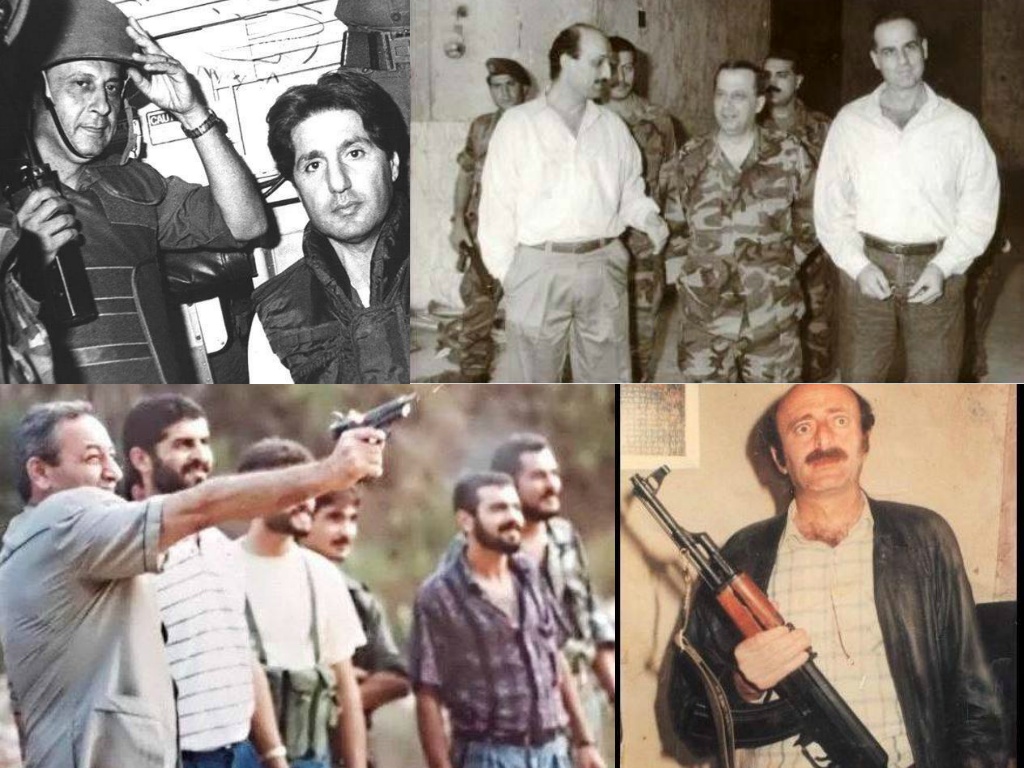
Warlord Collage

Reading and watching Geagea give press statements on his candidacy, I remember the space of terror he used to occupy for myself and my friends in Tariq al-Jadidah. I remember watching mortars explode from a window with a view of the northern coast with my grade school classmates during the Aoun-Geagea war. I remember a year spent in a mountainous Beirut suburb, away from school and from an apartment untenably close to “the Green Line.” Today, I try to imagine what a Palestinian in Lebanon thinks when she sees Geagea on TV confidently lay out why he should be president. Does her heartbreak as one by one, journalists fail to ask Geagea about his involvement in war time massacres? Has her heart been broken too many times in Lebanon, and does she simply change the channel? No one asks Geagea, or his rival Gemeyyel, about their wartime alliances with Israel, or their complicity in the siege of West Beirut, or their wars with rival Maronite leaders that left thousands dead and maimed.

I remember listening to the news with my family on the way to school the day that Gemeyyel left Beirut for Paris—It was a happy day. Years earlier, my five-year-old self had found an unexploded ordinance on our balcony in Tariq al-Jadidah. Amin Gemeyyel was President and he had ordered the army to shell the area. Many refused the order and deserted. I like to think that the unexploded ordinance on our balcony was the result of a soldier consciously removing explosive materials from mortal shells, knowing that his act would save the lives of residents. In reality, however, we have no idea why that shell did not explode. We were just lucky.

We were lucky again when the Lebanese army shelled our neighborhood during Aoun’s “War of Liberation” against the Syrian army, a war which apparently required the Lebanese army to shell heavily congested civilian areas in West Beirut. One particularly terrifying night, as my family was clustered in our foyer where we had been sleeping for days, my mother spread her arms across a wall and kissed it. This is the first memory I have of my parents as ordinary people; fragile, afraid, vulnerable. I have never been as profoundly shaken in my life as I was in that moment, watching my mother hug a concrete wall during a night of heavy shelling.

(Link)

Brainwashing

Goebbels would have been proud. If you repeat a lie often enough, people will believe it, and you will even come to believe it yourself. 

The war is over. The war is over. The war is over. The war is over. The war is over. The war is over. The war is over. The war is over. The war is over. The war is over. The war is over. The war is over. The war is over. The war is over. The war is over. The war is over. The war is over. The war is over. The war is over. The war is over. The war is over. The war is over. The war is over. The war is over. The war is over. The war is over. The war is over. The war is over. The war is over. The war is over. The war is over. The war is over. The war is over. The war is over. The war is over. The war is over. The war is over. The war is over. The war is over. The war is over. The war is over. The war is over. The war is over. The war is over. The war is over. The war is over. The war is over. The war is over. The war is over. The war is over. The war is over. The war is over. The war is over. The war is over. The war is over. The war is over. The war is over. The war is over. The war is over. The war is over. The war is over. The war is over. The war is over. The war is over. The war is over. The war is over. The war is over. The war is over. The war is over. The war is over. The war is over. The war is over. The war is over.

It is ok for the warlords who slaughtered your families, burned your houses, raped your women, enslaved your sons and brothers to fight their wars, and collaborated with the neighbors in the east or/and south to rule you. It is ok for the warlords who slaughtered your families, burned your houses, raped your women, enslaved your sons and brothers to fight their wars, and collaborated with the neighbors in the east or/and south to rule you. It is ok for the warlords who slaughtered your families, burned your houses, raped your women, enslaved your sons and brothers to fight their wars, and collaborated with the neighbors in the east or/and south to rule you. It is ok for the warlords who slaughtered your families, burned your houses, raped your women, enslaved your sons and brothers to fight their wars, and collaborated with the neighbors in the east or/and south to rule you. It is ok for the warlords who slaughtered your families, burned your houses, raped your women, enslaved your sons and brothers to fight their wars, and collaborated with the neighbors in the east or/and south to rule you. It is ok for the warlords who slaughtered your families, burned your houses, raped your women, enslaved your sons and brothers to fight their wars, and collaborated with the neighbors in the east or/and south to rule you. It is ok for the warlords who slaughtered your families, burned your houses, raped your women, enslaved your sons and brothers to fight their wars, and collaborated with the neighbors in the east or/and south to rule you. It is ok for the warlords who slaughtered your families, burned your houses, raped your women, enslaved your sons and brothers to fight their wars, and collaborated with the neighbors in the east or/and south to rule you.

Now repeat, we are a democracy.

Carefully watch as Lebanon’s parliament speaker, a former warlord, calls for presidential elections where three of the four main candidates – also former warlords – are competing with the fourth candidate, who happens to be the grandson of the president that led Lebanon into civil war in 1975. While the parliamentary ‘swing votes’ depend on the opinion of yet another warlord, the next Lebanese president will be the most illegitimate one since 1943: In 2020, he would have been elected by the parliament of 2009 – a parliament that ironically extended its term for failing to vote a law. As the civil war rages in Syria, the presidential elections happen at a time when in the executive power rules no one other than the son of the prime minister whose last irresponsible years in power saw the beginning of what would later become a civil war.

This is Lebanon’s biggest irony. Not the power vacuum, not the civil war, not even this play they call the presidential elections. I tried to find a detail concerning the presidential elections that doesn’t involve civil-war related issues. En vain. The candidates are of the civil war era, their programs are of the civil war era, the parties are of the civil war era, the lawmakers are of the civil war era, the absence of parliamentary elections is of the civil war era, and even our former overlord to the East is in a civil war.

What scares me most isn’t a warlord ruling from Baabda. What scares me is the idea that a young sous-lieutenant would one day manipulate the army as he wishes so that he can become president. What scares me is the idea that a failed president and warlord can become president again. What scares me is the idea that someone can become president for the simple fact that his grandfather was once one. What scares me is the idea that a Medical student who dropped out of medical school in order to commit war massacres might one day become president.

So while you’re happily watching the presidential elections on TV, my dear reader, think of the following: When the war comes – God forbid – do you want a president whose election inspires the medical student to carry his rifle and slaughter you, or save your children in the hospitals?

This isn’t about what these men want. It’s about what their election represents.

When war comes, the Lebanese will cry for peace. But always remember: They were the ones who worshiped the gods of war in times of peace.

30 days till the 25th of May.

What’s After The First Round?

Samir Geagea (Reuters)

Samir Geagea (Reuters)

Walid Jumblatt’s Democratic Gathering is reassembled, the March 14 coalition stands together as one unified alliance, and the March 8 coalition isn’t sparing a single effort to stop M14 from winning. Welcome back to 2009.

The Lebanese parties’ different stances are full of meanings. But first, let’s take a look at the results.

Results of the first parliamentary session to elect the Lebanese president:

Round I

  1. White Ballots: 52 Votes
  2. Samir Geagea: 48 Votes
  3. Henri Helou: 16 Votes
  4. Amine Gemayel: 1 Vote
  5. Canceled: 7 Votes (For Tarek and Dany Chamoun, Rachid Karami, Elias Zayek,  Jihane Frangieh)

4 MPs did not attend (Saad Hariri, Khaled Daher, Elie Aoun, Okab Sakr)

March 14’s Moves

In an alliance known for its diversity of Christian parties and representatives, the choice of Samir Geagea isn’t a smart one  for the coalition to win. But strategically speaking, it’s the most brilliant move any of the M14 parties – except the Lebanese Forces – are capable of. Samir Geagea leads M14’s biggest Christian party. Going against him in the presidential elections seems unwise. Future Movement would have lost its biggest Christian ally while the Kataeb – although benefiting from the absence of its main rival on the short-term – would eventually suffer heavy popular losses on the long-term (Similar to what the M14 had to go through after isolating Aoun in 2005). The Kataeb is a relatively small Christian party and any loss in popularity is fatal to it. Future Movement can’t afford to lose such a heavy Christian ally in such times. It would give the impression that Lebanon’s Sunnis are abandoning the Christians, ironically further isolating the Future Movement and giving M8 the upper hand in Lebanese politics.

One doesn’t have to be a mathematician to see that Geagea’s hopes of becoming president are null. You need 65 votes to become president, and Geagea – in the best scenario possible – can gather a maximum of 60. So why go against him when he can’t win?

By supporting Geagea, the Kataeb and the FM are paving the way for their next moves. They threw all their weight behind the leader of the Lebanese Forces – preemptively knowing that he has no chance in winning. The Kataeb successfully eliminated the candidacy of their biggest rival in the coalition for the next rounds: If Geagea can’t gather enough votes to win, perhaps it’s time for another candidate to try his luck. And now that the Future Movement did what was expected from it, and supported the Christian ally, it’s ethically more Ok for Hariri to strike a deal with Aoun or agree with Jumblatt on a candidate, since Geagea can’t make it. In case the Kataeb want to officially propose Gemayel’s name, the right thing to do from the LF would be endorsing him, since the Kataeb endorsed Geagea when he needed them. ‘Terbi7 Jmile’ would be the proper Lebanese comment to say here. The proof? Even before the first session had happened, the Kataeb were already nominating Gemayel for the next electoral session.

March 8’s Move

The March 8 coalition voted white in the elections. There were reports that M8 might vote for Emile Rahme in the elections, in order to give the impression that Aoun – who refused to run against Geagea – is a moderate while on the other hand making sure that Geagea couldn’t be one. He would have been facing the  pro-Syrian Emile Rahme after all.

M14’s endorsement of Geagea was  in fact a double political maneuver:

  1. Sending a message to M8 that M14 is unified no matter how controversial the candidate is.
  2. Persuading M8 to nominate Aoun as their candidate in face of Geagea, so that both candidates get cleared out and a compromise in which a candidate that’s more centrist than both might get better chances. The Kataeb particularly wanted a Aoun-Geagea confrontation so that Gemayel would look like a consensual candidate. After all, consensual candidates have the best chance of winning in presidential elections.

M8’s response was remarkably brilliant. Instead of proposing Emile Rahme in face of Geagea, they decided to be more original and vote white. Frankly, I don’t know what’s more humiliating: To lose the elections, or to lose the elections to no one.

A Quick Look At The Lebanese Centre

While M8 and M14 are busy ‘plotting’ against one another, The centrists are reorganizing themselves. Walid Jumblatt has profited from the new M8-M14 standoffs on the new president and has reunified his bloc (The Democratic Gathering). Although some reports had confirmed that he didn’t want Henri Helou – who defected from his bloc in 2011 – as president, Jumblatt finally ended up endorsing him for several reasons.

By choosing someone that sided – unlike him – with M14 in 2011 (when Mikati was named PM), Jumblatt is playing it smart. True, he is currently closer to M8 since 2011, but he just chose the closest M14  personality to him for the presidency. Henri Helou, after siding with M14 in 2011, and after being nominated by Jumblatt – separately from M14/M8 – suddenly became a consensual candidate representing Lebanon’s centrists. Jumblat could have chosen someone from the National Struggle Front (The MPs who stayed by his side in 2011), but he did choose one of the two Maronites who didn’t: He wants to make sure that M14 has even less votes in the parliament in case it wants to try to elect a president of its own and that he’ll have the biggest bloc possible in the parliament.

Najib Mikati, who was replaced by Tammam Salam with M8’s consent, is siding with Helou for obvious reasons. As a former “centrist PM” it is wiser for him to support Jumblatt’s candidate in the presidential elections. After all, Helou is the most consensual candidate currently on the table, and hence he has one of the best chances to become president after the maneuvers stop (If there’s a veto on the commander of the army and the BDL Governor). Who’s better to serve as his PM than Mikati?

Parliament convenes again next Wednesday.

32 days till the 25th of May.

Another version of this post was published at Executive Magazine.

Presidential ‘Surprises’

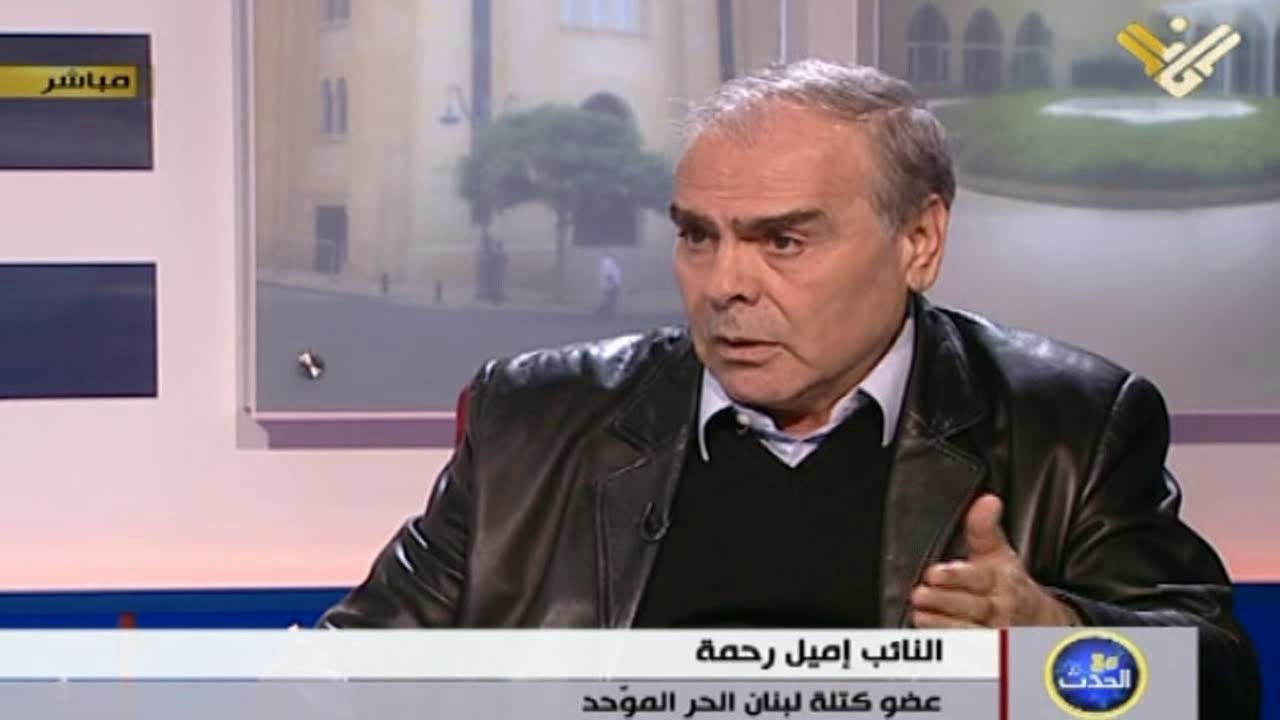
Emile Rahme on Al-Manar's Hezbollah TV

Emile Rahme on Hezbollah’s Al-Manar TV

The March 8 camp is preparing a series of “surprises” for Wednesday’s parliamentary session to elect a president, reported al-Joumhouria newspaper on Saturday without elaborating.

This does not however include the nomination of Free Patriotic Movement leader MP Michel Aoun, said March 8 sources.

They explained that the camp opted against this option because the lawmaker seeks to be a “consensual presidential candidate among all political powers, while keeping in mind that the March 14 alliance will not vote for him.” […]

The March 8 camp has therefore chosen the possible nomination of MP Emile Rahme instead of Aoun, reported the daily An Nahar Saturday.

(Link)

Surprise.

According to reports all over the internet, the March 8 alliance is thinking of nominating Emile Rahme as their presidential candidate instead of Aoun.

Emile Rahme’s Position

For M14, Emile Rahme is probably the most hated Christian MP. In a way, he’s like Future Movement’s Mohammad Raad, Walid Jumblatt’s Aoun/Geagea, or Hezbollah’s Ashraf Rifi. Emile Rahme is also one of the few MPs that are part of the FPM’s change and reform bloc without being a member of the FPM. Of the 27 men loyal to Aoun in the parliament, he’s one of two or three whose election depends entirely on Hezbollah’s votes. The vast majority of the change and reform bloc MPs (4 for Baabda, 7 for the Metn, 5 for Keserwan, 3 for Jbeil and 3 for Jezzine, a total of 22/27) represent North Mount-Lebanon and Jezzine, where the Christian electorate is at least more than the half in each constituency. 3 extra Marada MPs represent  Zgharta, which is also overwhelmingly Christian (even if the MPs aren’t directly loyal to Aoun but to Frangieh).

The last two MPs are a Druze loyal to Arslan representing Hasbaya, and Emile Rahme. The district Rahme represents is Baalbak-Hermel, Lebanon’s biggest Shia constituency, and happens also to be Hezbollah’s main electoral stronghold (the south is is considered to be more pro-Amal than pro-Hezbollah).

Let’s review Emile Rahme’s pros for a last time. He is Hezbollah’s strongest man in the change of reform bloc and one of the most vocal Christian anti-M14 lawmakers – in the middle between Aoun and Hezbollah – making him a prefect candidate in case M8 wants a rather politically violent candidate in face of Geagea. He’s even from a village that is next to Bcharri, Geagea’s hometown.

But Emile Rahme has an extra feature: He is the only Christian in the change and reform bloc that wasn’t elected by determining Christian votes (Baalbak-Hermel is 65% Shia). In other words, he’s considered to be relatively weak among the Christian electorate. As bad as that might sound, it’s actually something good because this quality is most likely to give him Jumblattist support. Michel Aoun would gain a president from his bloc, Hezbollah would gain a president from a district he electorally controls, Amal would gain a president that used to represent a Shia constituency, and Jumblatt would gain a president that has no popular Christian support. Both centrists and M8 win if Emile Rahme becomes Lebanon’s next president.

The Maneuver

Emile Rahme in Baabda is similar to a declaration of war for M14. Since Jumblatt is going to decide his candidate at the last minute, M14 can’t risk the election of Rahme. The only way to counter this move is by agreeing with M8 on a more moderate candidate. That candidate is no other than Michel Aoun, who didn’t yet officially announce his candidacy and said he won’t do it unless there’s a consensus on him. Emile Rahme’s candidacy (or rumors/reports of his nomination) to the presidency is a message to Future Movement from M8: Strike a consensual deal with Michel Aoun – the lesser of two evils for M14 – or risk the election of Emile Rahme.

Walid Jumblatt Is Still The Kingmaker

If M8 simply wanted to bring a ‘violent’ president from their ranks, they could have opted for Sleiman Frangieh. But the fact that Frangieh is considered to be rather strong especially within the northern Christian electorate wouldn’t make him too popular with Jumblatt. The key for winning here is to make Jumblat side by you in the elections. While M8 were proposing the name of Emile Rahme (Jumblatt might still reject him), M14 sources were speaking of two particular Maronites: Fouad Al-Saad and Henri Helou. These two MPs defected from the Jumblat’s bloc in 2011 when he decided to support Mikati in the parliamentary consultations, putting them at an equal distance between M14 and Walid Jumblatt. The leader of the PSP however ruled out this possibility, and is unlikely to support either of them for the elections – They did leave his bloc after all. The last remaining Maronite from his bloc, Elie Aoun, probably has higher chances than them.

Parliament convenes to elect the president on the 23rd of April.

35 days till the 25th of May.

Strikes, Silence, And Confusion: The War For Baabda Continues

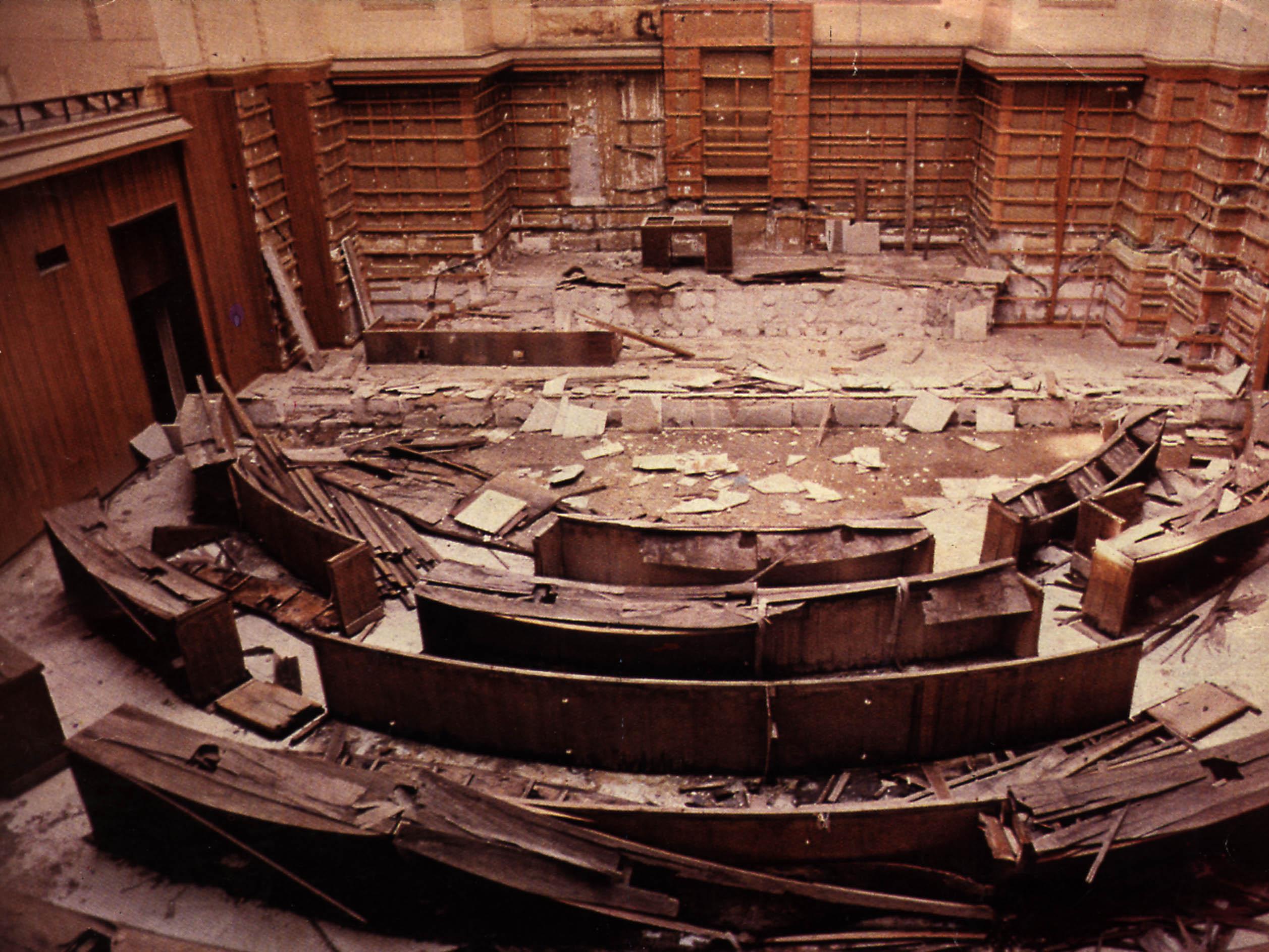
Since it's civil war commemoration week and the parliament will soon elect a president, i thought this unrelated picture of the parliament in 1976 would be the most appropriate for the post.

Since it’s civil war commemoration week and the parliament will soon elect a president, I thought this picture of the parliament in 1976 would be the most appropriate image for this  post.

FOR ANALYTICAL PURPOSES, THEREFORE, PARLIAMENTARY MEMBERSHIP BREAKS DOWN INTO THREE BASIS GROUPS TODAY AS FAR AS WE CAN DETERMINE: PRO-SARKIS (LARGEST BUT NOT YET DETERMINANT); INDEPENDENTS (SECOND AND KEY); AND PRO-EDDE. PRECISE NUMBERS ARE ANYBODY’S GUESS BUT WE WOULD PLACE SARKIS VOTES IN HAND TODAY AT SLIGHTLY OVER 50 RPT 50 AND, THEREFORE SUFFICIENT FOR ELECTION ON SECOND BALLOT IF SESSION GOES AHEAD. ELECTION BY THIS SLIM MARGIN, HOWEVER, WOULD LEAVE THE NEW PRESIDENT IN A RELATIVELY WEAK POSITION AND FACING A DIVIDED ELECTORATE–NOT A HAPPY PROSPECT. 

In case you were wondering, that was a flashback to the first  presidential elections (1976) of the civil war era, courtesy of Wikleaks’ Kissinger Cables.

Now back to 2014. Lots of things are happening lately and it would be interesting to see where we’re heading with all these events since Berri is going to call for a session to elect a president soon.

The Lebanese Forces

Let’s start with the situation among M14. Exactly 10 days ago, the only person that officially said he was running for the presidency was LF leader Samir Geagea. This early move had 2 motives: (1) Pressuring the Kataeb by making it politically awkward for them to propose another candidate (most probably Amine Gemayel), and (2) forestalling any kind of last-minute compromise between the Future Movement and the Free Patriotic Movement by embarrassing the FM and pushing them to embrace the candidacy of Samir Geagea. If politics in Lebanon were to be normal, the next predictable moves in Lebanon would be the Kataeb becoming shy and refusing to nominate anyone other than Geagea, and the FM supporting no other than the leader of their strongest Christian ally, the Lebanese Forces. That’s why the Lebanese Forces’ political maneuver was a brilliant move in a brilliant timing. But again, to assume that such consequences were definitely going to happen would mean that one simply doesn’t understand the complexity of Lebanese politics. Politics in Lebanon might be predictable, but it’s far from being that predictable.

The Kataeb

As I demonstrated one month and a half earlier, if M14 wants a serious competitor to Michel Aoun that would seem equally moderate, Amine Gemayel is the first name coming to mind. And the Kataeb know the advantage of their leader. He’s relatively on good terms with everyone, used to be a president, shares the same blood of Bachir Gemayel and was also exiled after the civil war. The two last features are particularly appealing to the Christian electorate. Concerning  the moderate part, Gemayel’s already on it: Sajaan Kazzi of the Kataeb called last week for closer and more sustainable ties with Iran. We all know what that means. And although the Kataeb didn’t officially nominate Gemayel, they did hint several times that he was the right man for the job, indicating that – unlike what the LF thought –  they will not support Geagea to the presidency. There was even a report saying that former Italian prime minister Silvio Berlusconi sent his aide to Lebanon – At Putin’s request – in order to help Gemayel in his campaign.

After all, now that the LF are outside the cabinet and acting all by themselves, it’s the best moment for the Kataeb to try to push a competitor from within M14 further outside. If M14 nominates Gemayel to the presidency, The Kataeb would eventually get the upper hand on the LF in the Christian side of M14. As a party that has 5 MPs out of 128 and that can’t even control one constituency alone in the parliamentary elections, believe me, you don’t wan’t to miss that chance.

Future Movement

However, I’m not saying that Amine Gemayel was actually approved by the FM. In fact, the FM are keeping an unusual awkward silence these past few days. True, minor cadres in the party might have said that they supported Geagea to the presidency, but there is still no definite word coming from Saad Hariri. The only things the former premier promised were (1) that the elections would be held on time and (2) that M14 would be fielding one, and only one presidential contender. So basically the movement’s stances stayed exactly the same since March, while everything else around them kept constantly changing. Future Movement’s silence is revealing. The party has five options here. The first one is supporting Geagea. The second one is embracing Gemayel. The third choice is to side with one of the independent M14 figures, such as Robert Ghanem or Boutros Harb. The fourth choice is striking a deal with the FPM in which Hariri would serve as prime minister under Aoun. The fifth final choice is supporting one of the Maronite two (Kahwagi/Salameh) in a deal similar to the 2008 Doha agreement. I’ll discuss the last two choices afterwards.

Geagea is responsible for PM Rachid Karami’s assassination, so embracing him would make the FM highly unpopular among Sunnis. Amine Gemayel also had his dark moments during the war, so he isn’t a favori either. Robert Ghanem might look as a promising candidate for the FM, but again, as this Al-Akhbar article suggests, the FM is more likely to abandon its allies in favor of a more reliable compromise with M8 – The same way they did in 2007 when they decided to back the neutral Michel Sleiman in the last 2 days before Lahoud left office.

Who knew, it turns out that the Lebanese Forces have on one hand an arrogant ally, and on the other hand, yet another arrogant ally. To be fair, Geagea’s early candidacy without consulting his allies was also an arrogant way to treat them.

The Silence 

Now I’m going to move to M8. The FPM, just like the FM, haven’t yet said a definite word on the presidential elections. The FPM didn’t directly nominate Aoun after the LF nominated Geagea in order to give the impression that Aoun, unlike Geagea, is not a polarized candidate but rather a consensual one. In fact, Aoun even sent a message to Hariri  that he won’t run in the elections unless there’s a consensus on him, implicitly inviting Hariri to strike a deal that would bring them both to power. The press is also circulating information revealing that Jean Obeid is Nabih Berri’s number 1 candidate, who also happens to get support from Walid Jumblatt. So basically among M8 the tendency is to get the most moderate candidate available in a compromise that would give M8 the largest number of benefits. In order to counter M8’s strategy, Geagea tried to take a more moderate position: He proposed Hezbollah partnership with Hezbollah  in case he wins.

The Strikes

When you talk about the  Lebanese presidential elections, you can’t simply ignore the neutral side. The most prominent candidates right now are the central bank governor Riad Salameh and the commander of the army Jean Kahwagi (The Maronite Two). Two interesting things happened in the past few weeks. For the first time since last year, Lebanon is witnessing several confrontations between the syndicates and the political class. On another note, the political class apparently just woke up from its coma and realized that the economy is in ashes. Banks are even striking over tax hike proposals. A couple of days ago, a pro-Berri MP sued a bank association (the ABL) while Berri refused to meet them. In other words, the recent discourse regarding the worsening economy aims at undermining the candidacy of BDL chief Riad Salameh while on the other end of the neutral side the army – with support from the executive authority – is implementing security plans everywhere throughout the country. It is even going after Rafaat Ali Eid, which is pretty big. It might be a simple coincidence, but I don’t believe in such things 15 days before the presidential elections. There seems to be a tendency to give the upper hand to Kahwaji as a neutral candidate while undermining Salameh at the same time.

Things are so confusing in Lebanon right now, that even the ElNashra  app notification on my phone is going crazy when it updates me with news on the presidential elections.

ElNashra Notification

40 days till the 25th of May.

Baabda 2014: A Game Of Throne

The 1958 Presidential Elections - LIFE Magazine

The 1958 Presidential Elections – LIFE Magazine

Two weeks ago, Lebanon’s new cabinet was securing the vote of confidence in the parliament. Except for a small number of maneuvers (see here, here, here, here), there was no major breakthrough during the 11 months deadlock regarding the presidential elections. These days are over: The Lebanese political scene is currently inundated with events related – directly or indirectly- to the election of the new Lebanese president.

“We want a strong president”

Read that sentence, and remember it well.  Four men keep saying it, all the time, everywhere, to whoever they meet, whatever the circumstances are.

Question: Should the parliament vote an electoral law? Answer: We want a strong president.

Q: Should the cabinet approve a certain decree?  A: We want a strong president.

Q: Are you in love? A: We want a strong president.

*has nightmares of weak presidents becoming zombies*

Q: Do you like pizza? A: We want a strong president.

For those of you who are wondering what that sentence means,  be surprised, for those five words are full with implications.

1) We: Since the sentence is usually repeated by Samir Geagea, the Kataeb, Sleiman Frangieh, and Michel Aoun, The “We” refers primarily to the leading Four Maronite leaders. If anyone else is saying it, it’s probably an echo.

2) Want: Usually, you want what you can’t have. In the case of the Maronite Four (MF), they are all aspiring to relocate to the Baabda palace for the next 6 years. But they all know that the chances of another neutral candidate are much higher.

3) A Strong President: This is the best part. According to Sleiman Frangieh’s universal definition of strong president – a definition apparently recognized by his other 3 Maronite colleagues, check the interview with Marcel Ghanema strong president is a person that meets only one of the following criteria:

  1. His name is Michel Aoun
  2. His name is Sleiman Frangieh
  3. His name is Samir Geagea
  4. His name is Amine Gemayel

This is the part where I stop the sarcasm 😀 . The Maronite Four (MF), along with everyone else, have managed to pull out a breathtaking political maneuver lately. The idea of a strong president, embraced by the Maronite patriarch, and hundreds of other politicians from all sides is not just a simple sentence that everyone repeats on biased TV stations. The idea of seeking a strong president – from a closed group of 4 members – is equivalent to the idea of eliminating all the other choices. This systematic sentimental brainwashing that the Maronite Four have been doing for the past two to three months, by convincing the Lebanese public – via an uninterrupted collective propaganda campaign – that Lebanon needs a strong president has one huge aim: Excluding any other popular Maronite – not belonging to the MF – from the race. The first names coming to mind are former minister Ziyad Baroud, the commander of the army Jean Kahwagi,  and the governor of the central bank Riad Salame.

Samir Geagea/Amine Gemayel’s biggest fear isn’t Michel Aoun or Sleiman Frangieh becoming presidents. And the same goes for Aoun/Frangieh: Their biggest fear isn’t Geagea or Gemayel in office. Their biggest fear is that a neutral figure takes power. Each and every one of them would have to deal with a newcomer to internal Christian politics that is likely to reduce their power – both on an electoral level and on an administrative level. For example, instead of having 3 ministers with the LF, 3 with the FPM, and 3 with the president, The FPM/LF will get to split the president’s share if he’s Aoun or Geagea, hence maximizing their influence in any future cabinet.

 There’s also another synonym of “strong president” : It’s not Michel Sleiman. So when  the MF tell you they want a strong president, you should always understand it as an opposition to extending president Sleiman’s term.

The MF: An Unusual Gathering

Probably for the first time in the history of the blog, I am starting a post with no direct mention to the March 14 or March 8 alliances. And that’s not a coincidence. Michel Aoun’s allies have failed him in May 2013, when they extended the terms of the parliament – against his will. Also in May 2013, Future Movement failed the Kataeb when they refused to support the Orthodox Gathering Law in parliament. 10 Months later, the FM – without the consent of the Lebanese Forces – would enter a cabinet with Hezbollah,  throwing the LF by themselves in the opposition to an all-embracing cabinet. The Maronite Four have learned their lesson: They cannot rely on their Muslim allies, and they are the weaker parties of the M14 and M8 alliances due to their small parliamentary blocs (except for Aoun). After 10 years of counting on their Muslim allies, the Christians parties apparently realized that unless they preemptively unanimously agree on certain matters (Like electing a strong president), their allies were going to compromise and agree on another consensual candidate without consulting them.

Suspicious Timings

In 24 hours, the army dismantled an explosive-rigged vehicle on the outskirts of Arsal, finalized preparations for a Cabinet-sanctioned security plan for Tripoli, confiscated ammunition coming from Syria, raided a refugee camp, while at the same time the military prosecutor – in an unprecedented move – issued warrants against 200 suspects involved in the Tripoli clashes (See here for more details).
In case you’re confused, that’s the commander of the army presenting his candidacy to the presidential elections.

Another interesting observation is Geagea being officially nominated as presidential candidate by the Lebanese Forces. While this seems perfectly normal, it actually isn’t. Geagea is officially running to the presidential elections without previously getting the green light from the other M14 parties, particularly Al-Mustaqbal. So basically, this is what Geagea is trying to do: preemptively proposing his candidature in order to force and put pressure on the Future Movement to endorse him. This political maneuver aims at setting him as the de-facto candidate of the FM, and hence destroying the chances of electing Michel Aoun as president in a future FM-FPM deal. Exactly 1 month ago, the primary candidate from M14 was Gemayel. Due to his preemptive move, Geagea made it harder for Gemayel to run for office, while successfully (?) sabotaging any compromise between M8 and M14 similar to the cabinet one where he was excluded.

Use Your Calculator

 You need 65 MPs to win the elections, and a quorum of 86 MPs to make it happen. Since M14 and M8 both don’t have the absolute majority, expect millions of rounds. Each one will end with approximately 60 votes for each candidate (probably Aoun/Geagea), since Jumblatt will not vote for anyone of them. The press is even circulating information that he said he would start a civil war if one of them gets elected.

So to sum things up, the Maronite Four want one of them as president even though none of the Maronite Four is ready to elect the other (except for Frangieh). Everyone in the parliament either wants Geagea or Aoun, except for Jumblatt. The alternative would be electing someone neutral, from outside the Maronite Four traditional candidates. But hey, there’s the Veto coming from the Maronite Four.

But one should look on the bright side, there are other candidates: A pious (that’s sarcasm) person (please check the video. please.) named Rachid-Louis Labaki, and an actor, Adel Karam, also officially presented their candidacy.

Just kidding. There is no bright side.

50 days till the 25th of May.