Bimonthly analysis post

Four Months Of Vacuum

Baabda Palace during its construction, 1969

Baabda Palace during its construction, 1969 (Image source)

Four months is nothing. It took the Lebanese parliament 13 months to elect Rene Mouawad in 1989, and 7 months to elect Michel Sleiman in 2008. Before the Salam cabinet crisis (Lebanon’s longest governmental vacancy ever, 11 months), the longest period of vacancy regarding the executive power was 7 months (Rachid Karami, 1969). So, proportionally speaking, the next president should be elected in the matter of 13*11 /7 = 20 months (16 months from now). That’s January 2016. Cool, no?

The presidential elections are old news

No one cares about the Lebanese presidential elections anymore. It’s not a priority. ِAs it turns out, the Lebanese parliament is perfectly comfortable at legislating and the government is even more comfortable at ruling now that there is no president in power. A change or a vacancy in the presidency isn’t scary for Lebanese politicians. What’s truly scary is a change in the Lebanese parliament. Change the parliament, you change the status quo. So if you think that a president is going to be elected before  they strike a deal regarding the parliamentary elections (and the electoral law), don’t. The vacancy in the presidency is yet another alibi to use in case the parliament wants to extend its mandate (other than the 1960 law alibi that was used in 2013). It’s also a valuable negotiation card to use when things go bad for one of the two coalitions.

The Lebanese Forces en force (It’s payback time)

Rewind to February 2014. The only party that was left out of the Salam cabinet was Samir Geagea’s Lebanese Forces. True, it was their decision to stay out of the executive power, but the FM acted like they couldn’t care less at the time, which gave Michel Aoun a nice advantage two months before Sleiman left office.

The Lebanese forces have 8 MPs in the parliament (That’s more than what Jumblatt used to have in 2012). That number is relatively low and means nothing, unless you use it – à la Jumblatt – to manipulate both coalitions in order to serve the party’s interests. The Future Movement needs an extension of the parliament’s term now more than ever. The Lebanese Forces, on the other hand, have nothing to lose if they participate in the elections. Out of the 8 seats, 3 are from Zahle (friendly Sunni electorate), 2 are from Bsharri (Geagea’s hometown and the LF’s e stronghold), 1 is from the Shouf (friendly druze and Sunni electorates), 1 is from Koura (friendly Sunni electorate, although relatively less influential than in the other cases) and the last MP is from Batroun. So in the worst case scenario, under the 1960 electoral law, Geagea loses 2 seats out of the 8 (And he’s not even using the 8). Best case scenario: Geagea goes to elections, asks for more “sovereignty” from the Future Movement regarding the Christian seats in the constituencies where the Sunni electorate is present – almost 1/3 of the FM bloc are Christian MPs – and tries to control the Metn and Keserwan seats by defeating Aoun there. Although his chances are slim, it does seems tempting to defeat the main presidential contender (Aoun) in the middle of a presidential vacancy, no?

A possible deal

Here’s the situation, as of this week. Hezbollah is still relatively silent about the parliamentary elections (Nasrallah spoke last tuesday, but only about ISIS – willingly ignoring the subject of parliamentary elections). However Berri and his party want elections, and the same goes for Michel Aoun and his party. Which means that we should assume that their common ally, Hezbollah, is likely to go to elections should both of them head to polls. To sum things up here, M8 has around 58 MPs who are in favor of the elections and are likely to vote against extension. The centrists (Jumblatt & co)  are likely to vote against elections.  In M14, the FM and its proxies are against the parliamentary elections, and the Kataeb seem to have a similar opinion. The FM have even threatened to boycott the elections. The only party that is going against the current here is the LF. According to the LF’s George Adwan, they are going to vote against the extension. 58+8=64. That means that exactly half of the parliament wants to stay in the parliament, while the other half wants parliamentary elections (which means that we will go to elections since an extension law needs 65 votes to pass). As striking as it might seem, the decision to keep the same parliament or to change it lies within the Lebanese Forces .

Probably for the first time since prehistory, the Lebanese Forces are in a position where they are actually in charge of taking a major decision (Going to elections in the context of a presidential vacancy). And they can use this rare moment of power in order to force the M8/M14 coalitions into a deal that might be favorable to their interests.

So let’s sum things up: We’re a country that has no president, no elections, no functioning cabinet, a self-extending parliament that doesn’t meet anyway, and whose students pass without official exams.

Also, Samir Geagea might be the new Walid Jumblatt.

127 days since the 25th of May. 50 days till the 16th of November.

WikiLeaks’ Quick Guide To The Presidential Candidates

Baabda Palace in 1990 (Photo: Jamal al-Saaidi)

There are as many presidential candidates as the number of Syrian soldiers in this picture of Baabda Palace in 1990 (Photo: Nabil Ismail/AFP)

In the past 10 days, there has been a lot of talk about finding a consensual presidential candidate. Walid Jumblatt and Speaker Berri made an initiative in August and they were followed this week by a similar stance from the  March 14 alliance. Since the presidential elections are not exclusively about Geagea and Aoun anymore, I thought that it would be interesting to publish the following WikiLeaks cable that discusses the main 26 candidates from 2007. Except for those who are deceased, the candidates are basically still the same ones. The cable separates the candidates into  8 categories: “March 14” (Nassib Lahoud, Boutros Hareb, Amine Gemayel, Nayla Mouawad, Samir Franjieh), “the consensus candidates” (Robert Ghanem, Charles Rizk), “the perennial candidate” 😛 (Michel Aoun), “Amal’s favorite” (John Obeid), “the constitutionally challenged” (Michel Sleiman, Riad Salameh), “the octogenarians” (Michel Edde, Michel Khoury, Pierre Daccash), “the uninspiring” (Chibli Mallat, Fares Boueiz, Roger Edde, Demianos Kattar, Simon Karam, Joseph Torbey, Shakib Qortbawi, Charles Chidiac, Nabil Mechantaff, Farid Raphael) and “the dark horse” 😛 (Johnny Abdo).

LEBANON: A QUICK GUIDE TO THE PRESIDENTIAL CANDIDATES
2007 October 23, 14:14 (Tuesday)
07BEIRUT1659_a
CONFIDENTIAL
CONFIDENTIAL
— Not Assigned —
20137
— Not Assigned —
TEXT ONLINE
— Not Assigned —
TE
— N/A or Blank —
— N/A or Blank —
— Not Assigned —
— Not Assigned —

SUMMARY

——-

1. (SBU) The list of candidates to be Lebanon’s president, by tradition a Maronite Christian, is growing longer as the end of current President Emile Lahoud’s term on November 23 grows nearer. With its October 23 session now cancelled, parliament is scheduled to convene on November 12 in a second attempt to vote for Lebanon’s next president. As of now, the gap between majority March 14 and opposition March 8-Aoun forces remains wide. The chances the two sides will agree on a consensus candidate is remote, although much could change between now and November 12. Following are snapshot descriptions of each of the (25 and counting) contenders, both declared and otherwise. End summary.

MARCH 14

——–

2. (C) NASSIB LAHOUD (declared): Generally acknowledged to be the best candidate, Lahoud is a cousin to President Emile Lahoud, but their politics couldn’t be more different. Nassib’s strong anti-Syrian position and his close ties with Saudi Arabia (his sister-in-law was once married to King Abdallah) make his candidacy an automatic red line for the pro-Syrian opposition. Lahoud’s only hope for the nomination is if March 14 proceeds with a half plus one vote, a controversial step that March 8 declares unconstitutional. Lahoud, who was an MP before losing his Metn seat to the Aoun bloc in 2005, voted against the 2004 constitutional amendment extending Emile Lahoud’s presidential term. Aoun bloc supporters speak with suspicion about Lahoud’s marriage to a Sunni, while Hizballah accuses Lahoud of overly warm ties to the U.S., given that Lahoud was one Lebanon’s ambassador to Washington. Lahoud is considered the “cleanest” candidate, having shut down all Lebanese operations of his successful engineering firm when he entered politics. Some people suggest, in fact, that Lahoud will never be permitted to become president because the Syrians could not bribe or blackmail him.

3. (C) BOUTROS HARB (declared): Flattered by Speaker Nabih Berri’s promises of support, Harb, in contrast with his March 14 partners, supports March 8’s call for a mandatory two-thirds quorum in hopes that it will help him become the consensus candidate. Should March 14 proceed with a half plus one vote, he claims he will support Lahoud. A long-time MP from Batroun, Harb voted against the Syrian-backed extension of President Lahoud and joined early opposition movements against Syrian control of Lebanon. As the one-time lawyer for Bank al-Medina chief Rana Qoleilat, Harb has not cleansed himself entirely of the whiff of scandal from Bank al-Medina’s spectacular 2003 collapse.

4. (SBU) AMINE GEMAYEL: As yet undeclared, the brother of assassinated President-elect Bashir and father of assassinated Industry Minister Pierre, Amine considers the presidency his due right. Leader of the Phalange party. In 1988 then President Amine appointed LAF Commander General Michel Aoun as acting prime minister when parliament failed to elect a new president, earning a death threat from Lebanese Forces leader Samir Geagea (now his ally in March 14) and splitting the LAF.

5. (C) NAYLA MOUAWAD: The only female candidate (and only the third woman in Lebanon’s history to serve in the cabinet), Mouawad is the widow of assassinated President Rene Mouawad and honorary president of the Rene Mouawad Foundation in the United States. She is Minister of Social Affairs in the Siniora cabinet and, as an MP from Zghorta, voted against the extention of Lahoud’s mandate. While recognized as being one of the hardest working political figures in the country, Mouawad herself recognizes that she has only slim chances of succeeding in presidential elections. She has told us that, if it’s clear she cannot win, she will vote for Nassib Lahoud.

6. (SBU) SAMIR FRANJIEH: Also known as the “Red Bey” because of his leftist leanings and feudal heritage, Franjiyeh was

BEIRUT 00001659 002.2 OF 005

instrumental in the creation of the Qornet Chahwan Christian opposition group that called for Syrian withdrawal from Lebanon. He strongly advocates the implementation of all UN resolutions related to Lebanon, specifically UNSCR 1559 and 1701. Because of his leftist past, Franjieh appeals to a large number of Shia intellectuals. He is close to Walid Jumblatt and was a close associate to late PM Rafiq Hariri. Franjieh’s weakness is his lack of popular support in his Christian district of Zgharta, and because he was elected to parliament with the Muslim votes of Tripoli. Known in March 14 circles as “the good Franjieh,” he is strongly opposed by his cousin Suleiman Franjieh, the “bad Franjieh” and former MP and ex-minister who is close to Bashar al-Asad.

THE CONSENSUS CANDIDATES

————————

7. (SBU) ROBERT GHANEM (declared): Ghanem, who hails from the Biqa’, denies being a member of March 14 and is seen by some as being too susceptible to Syrian political pressure. Indeed, with Syrian troops virtually at his doorstep, he failed to attend the March 14, 2005 Cedar Revolution demonstration, and voted for the 2004 extension of President Lahoud’s mandate following Syrian threats. A “decent” man according to our contacts from all sides, it is unclear how strongly he would stand up to the Syrians should he receive the nomination. His name was one of seven mentioned as potential consensus candidates in the October 22 issue of ad-Diyyar, a pro-Syrian newspaper.

8. (SBU) CHARLES RIZK: Currently Minister of Justice and in the past a long-time friend of President Lahoud, Rizk distanced himself from Lahoud following the 2005 assassination of MP Gebran Tueini. He played a crucial role in the creation of the UN Special Tribunal for the assassination of former PM Rafiq Hariri and has used this platform to promote himself as a presidential candidate. While appointed as one of “Lahoud’s men” to the Siniora cabinet, Rizk defied orders in refusing to resign in November 2006 with the Shia ministers. He has become broadly acceptable to March 14 because of his dogged pursuit of the tribunal. The French like Rizk for his impeccable language skills, which have made him Lebanon’s more or less permanent representative to the Francophonie. (With good English as well, Rizk has offered to represent Lebanon at what he jokingly calls the “Anglophonie.”)

THE PERENNIAL CANDIDATE

———————–

9. (C) MICHEL AOUN (forever declared): Nominally Hizballah’s one and only candidate (or so he would like to believe), the Free Patriotic Movement (FPM) leader and former Lebanese Armed Forces (LAF) commander insists he alone enjoys the majority of the Christian and popular vote and therefore deserves to be president. Often described as being mentally unstable, the opportunistic Aoun, realizing Hizballah’s support for him is perfunctory, recently began reaching out to March 14 in an effort to boost his dwindling prospects. He may have the highest single popularity ratings in the country of any Christian politician, but that is balanced by one of the highest negative ratings as well. Aoun is infamous for picking the wrong side of issues — as PM and interim (acting) head of State, he continued to support Saddam Hussein after Iraq’s invasion of Kuwait, and he opposed the Taif accord that even the Patriarch accepted.

AMAL’S FAVORITE

—————

10. (C) JOHN OBEID: A long-time pro-Syrian figure and former Baathist, Obeid shifted gears in 2004 when he refused to attend the cabinet session that extended President Lahoud’s term. Then Lebanon’s foreign minister, Obeid believed that he deserved the presidency himself. Obeid is nevertheless Parliament Speaker and Amal leader Nabih Berri’s preferred candidate. Despite Obeid’s renewed ties with majority leader Saad Hariri, Lebanese Forces Samir Geagea still vetoes his candidacy. Maronite Patriarch Sfeir acquires the expression of one smelling a very bad odor when Obeid’s name is mentioned. Obeid’s name was also touted in the October 22 ad-Diyyar story as an acceptable (presumably to Syria)

BEIRUT 00001659 003.2 OF 005

consensus choice.

THE CONSTITUTIONALLY CHALLENGED

——————————-

11. (C) MICHEL SLEIMAN: Commander of the Lebanese Armed Forces (LAF) for the last nine years, General Sleiman’s popularity soared following the September 2 defeat of Fatah al-Islam militants in the Nahr al-Barid Palestinian camp in northern Lebanon. Sleiman’s long tenure as head of the LAF entailed close ties with the Syrians, and it is not clear how strong these ties remain. Because he is a sitting government official, the constitution prohibits him from running for president without a two year interim period, though parliament (with a two-thirds majority) could vote to amend the constitution if it appears the General is the only candidate who can “save the country.” Ad-Diyyar newspaper did Sleiman no favors in including his name in the October 22 list of potential consensus candidates, inclusion that reinforces the March 14 impression that Sleiman, while basically an honest figure, is too close to to the Syrians.

12. (C) RIAD SALAMEH: The 2006 Central Banker of the Year according to the U.S. finance magazine Euromoney, Salameh is considered to be a capable central banker and technocrat. Although he argues that he is not a government employee and therefore needs no constitutional amendment, most believe he faces the same obstacle as Sleiman. Also like Sleiman, it is not clear where his loyalties lie; Salameh is rumored to be a close economic advisor to Syrian President Bashar Asad. His name, too, was in the October 22 ad-Diyyar article.

THE OCTOGENARIANS

—————–

13. (C) MICHEL EDDE: A prominent figure in Lebanon’s Maronite community, happy gourmand Edde emphasizes the protection of the Lebanese Christians and the need for Maronites to maintain a role in government. Edde was close to former Prime Minister Rafiq Hariri. While privately supportive of the Special Tribunal, Edde has remained quiet publicly on most contentious political issues. Resolving the Palestinian refugee issue is at the top of his agenda, and he believes that the time is ripe to find a solution — any solution — as long as that means the Palestinians (who are mostly Sunni) do not stay in Lebanon to further dilute the Christian demographics. Edde was close to former Surete General chief Jamil as-Sayyid, now in prison at UNIIIC request for possible involvement in the Hariri assassination. Edde is the butt of jokes about his comments several years ago that he would throw his body down to prevent Syrian tanks from leaving Lebanon. Like many of the other candidates, Edde professes disinterest but will accept the presidency if elected, and demonstrated his nonchalance by being abroad on a trip when parliament was scheduled to convene October 23. Edde, too, was on the October 22 ad-Diyyar list of potential compromise candidates.

14. (C) MICHEL KHOURY: The son of Lebanon’s first independence president, Bechara Khoury, and a member of the March 14 alliance, “Sheikh” Michel has close links to the Vatican. While strongly March 14 in views, he privately suggesting dropping the formation of the Special Tribunal in an attempt to break the political deadlock and stop the political assassinations. Though quick to protest at suggestions that he could become Lebanon’s next president, the always elegant Khoury would, in our view, be a good choice, though he probably is too pro-March 14 to be a consensus candidate. If he would emerge as a serious candidate, we are certain that he would accept our request that he strongly back the Tribunal. 15.

(C) PIERRE DACCASH: Daccash ran unopposed as a so-called “consensus” candidate for a Baabda-Aley seat after the death (unusually by natural cases) of March 14 MP Edmond Naim. Since his election, however, Daccash has towed closely to the Aoun line and is seen around town frequently with former Minister Youssef Salameh (known as “Pumpkin head,” both for his appearance and his allegiance to Emile Lahoud). Now, Daccash is touted again as a “consensus” candidate, this time for the presidency. He is from a predominately Shia area, Hadath, and is considered by some to be a weak president, if

BEIRUT 00001659 004.2 OF 005

elected. Pro-Syrian newspaper ad-Diyyar included him on its October 22 list of seven acceptable candidates.

THE UNINSPIRING

—————

16. (SBU) CHIBLI MALLAT: An active member in the Cedar revolution, Mallat co-founded and coordinated organizations for democracy and judicial accountability in mass crimes in Iraq (formed the Indict Saddam Association) and conducted judicial action leading to the indictment of Libyan President Muammar Kaddafi for the disappearance of Shiite Imam Mussa Sadr.

17. (C) FARES BOUEIZ: The long-winded Boueiz endorsed Syrian foreign policies during the mandate of his father-in-law (1989-1998), late President Elias Hraoui. Boueiz has forged strong relations with then Syria’s Foreign Minister Faruq Shara. Boueiz boycotted the cabinet session that extended President Lahoud’s term in September 2004, voted against Lahoud’s extension in parliament, and joined the Bristol opposition group that formed in autumn 2004. Since then, however, he has drifted back into the Syrian orbit, garnering him a place on ad-Diyyar’s October 22 list of potential consensus candidates. Boueiz is widely considered the most corrupt of the candidates, at the opposite end of the cleanliness scale from Nassib Lahoud. According to reports, Boueiz, when foreign minister, sold honorary consul positions and made other decisions based on bribes.

18. (SBU) ROGER EDDE: An international financier and prominent project developer, Edde is the owner of the popular Edde Sands Beach Resort. He supports a strategic peace between Israel and Lebanon, and between Israel and Syria, with a solution for the Palestinian issue. He supported Free Patriotic Movement head General Michel Aoun politically and financially while Aoun was in exile in Paris, but he broke from the group in 2005 after Aoun failed to include Edde on his parliamentary list and joined March 14. Edde is critical of Aoun’s “memorandum of understanding” with Hizballah.

19. (C) DEMIANOS KATTAR: A former Minister of Finance (in the Mikati government), Kattar has distanced himself from political figures he worked with but has remained close to Maronite Patriarch Sfeir. He openly says that he is the favorite presidential candidate for Bkirke – the seat of the Maronite Church. Kattar considers that he has built “executive experience” having served for ten weeks in the Mikati-led Cabinet in 2005 as Finance Minister and Economy and Trade Minister. In 2003, he became advisor to President Emile Lahoud, but then distanced himself from Lahoud around 2004 and became close to Mikati. Kattar has built a successful career as a management consultant in the Gulf region. Citing Kattar’s proclivity to talk rather than do, Najib Mikati tells us that the appointment of Kattar was his sole mistake in forming his cabinet.

20. (SBU) SIMON KARAM: Rumored to be the Patriarch’s favorite, Karam’s vocal criticisms of Berri and Hizballah almost certainly rule out his chances. The Syrians evicted him from his position as Lebanon’s Ambassador to the U.S. in 1992 because he attempted to lobby for a gradual Israel withdrawal from Lebanon gradually. Karam strongly supports the disarmament of Hizballah and all militias in Lebanon, and he supports the Special Tribunal. He further advocates changing the mandate of UNIFIL to deploy it along the Syrian-Lebanese border. While agreeing with March 14 principles, he opposes March 14 practices, believing (with some justification) that March 14 has not expended sufficient efforts to win independent Shia support.

21. (SBU) JOSEPH TORBEY: The newly elected president of the Maronite League, Torbey is an expert in Lebanese and regional banking and financial issues. He is the longtime chairman and general manager of Credit Libanais group, which includes a variety of local and regional companies specializing in investment banking, insurance, real estate, IT, and tourism. Formerly head of both the Lebanese and Arab Bankers Assocation, he has been active recently in visiting the various political leaders in an attempt to bridge the gap between the opposition and pro-government.

BEIRUT 00001659 005.2 OF 005

22. (SBU) SHAKIB QORTBAWI: The former head of the Bar Association of Beirut, Qortbawi has been a fervent advocate for freedom of expression and brought to the forefront cases of human rights abuses during the Syrian era. A former member of the executive committee of the National Bloc party, Qortbawi was among the first people to join the Qornet Shahwan Christian opposition group during 2001. Though not a member of Michel Aoun’s Free Patriotic Movement, he espoused all of Aoun’s anti-Syrian policies and stances. He ran on Aoun’s list for the parliamentary elections during 2005 but lost to Jumblatt’s candidate.

23. (SBU) CHARLES CHIDIAC: The president of the Republican Reform Party, Chidiac’s campaign platform primarily rests with defeating Hizballah’s strength in Lebanon and reining in Syria, through building a coalition of non-Hizballah Shia and providing economic incentives. Claiming not to particularly want the presidency, which he started considering when Lahoud’s term was renewed in 2004, Chidiac is running now because he feels there is no one else. When pushed, he will acknowledge that he is March 14, but not explicitly. He says that if it comes to a compromise candidate, Jumblatt would support him.

24. (SBU) NABIL MECHANTAFF: Nabil Mechantaff is a lawyer from the Shouf district and currently serves as chairman of the Lebanese Movement party. He shifted gears several times in his political life, starting as a staunch supporter of Lebanese Forces head Samir Geagea during the civil war, then becoming an Aounist during Aoun’s era, and now he is flirting with the Gemayel family. He presented himself as a presidential candidate several times in the past. He strongly opposes Hizballah’s arms and supports the international tribunal.

25. (SBU) FARID RAPHAEL: A banker, Farid Raphael was appointed Minister of Finance during the seventies under former President Elias Sarkis. He is currently the CEO of Banque Libanon-Francaise and was head of the Bankers’ Association. He was close to the late PM Rafiq Hariri. In the nineties, Raphael set up a holding company that purchased the cargo carrier TMA. It is alleged that Raphael acted as the frontman for Hariri, who later pulled out from the holding company. Raphael took over TMA and is now trying to sell it. As a businessman, Raphael has little involvement with current political groups.

THE DARK HORSE

————–

26. (C) JOHNNY ABDO: A former LAF G-2 Intelligence Director, Abdo is said to be the dark horse for Hariri and March 14, in the event elections are held with a half plus one majority. Geagea is supportive because Abdo was close to Bashir Gemayel, and, as a former LAF officer, Abdo also enjoys support from the military. He is on Hariri’s payroll and it is believed that Jumblatt would not oppose him (despite Abdo’s assassination attempt on Jumblatt in 1983). Abdo and Michel Aoun are bitter enemies.

FELTMAN

(Link to the cable on Wikileaks)

103 days since the 25th of May. 74 days till the 16th of November.

Three Months Of Vacuum

Presidential Palace Sign

It has been a tough month for the March 8 Alliance. In the last week of July, the Maronite Patriarch launched four consecutive maneuvers against Michel Aoun and his party, taking stances even bolder than his anti-M8 predecessor Sfeir. And just when the Islamist-Lebanese army clashes in Arsal were starting to give a propaganda boost to Hezbollah, Hariri decided to come back to Beirut and turn this Hezbollah opportunity into an opportunity for his party and the March 14 alliance by showing himself as the moderate politician coming home to save the republic. He didn’t only come back to Lebanon at a critical time: He also managed to steal from Hezbollah the moment they had been waiting for. In the aftermath of the Arsal clashes, Hezbollah was supposed to look like the good guy and ISIS the bad one, hence justifying the Hezb’s intervention in Syria. Hariri’s comeback and the relatively quick and bold intervention by the army in the Bekaa threw Hezbollah out of the equation and showed Future Movement instead of Hezbollah as the good guy. The week after that, Hezbollah had to suffer another blow when the user behind the Free Sunnis of Baalbak twitter account was caught and turned out to be a sympathizer of the party. So in order to improve their position, the FPM and Hezbollah launched a political counter-attack on the March 14 alliance.

Contre-attaque no.1

Hezbollah, like most of the time, decided to avoid entering in a direct media confrontation with the March 14 alliance and decided to shift the public’s attention to ISIS: The Islamic State was the main theme in Nasrallah’s speech on the 14th of August. The timing was perfect for Nasrallah: It was on the July 2006 ceasefire day, the target was ISIS, and in the background Israel was dropping bombs on Gaza. It couldn’t get any better than this for Hezbollah.

Contre-attaque no.2

This other counter-attack is courtesy of FPM leader Michel Aoun. While Hezbollah was busy redirecting the public’s attention to ISIS, Aoun was playing it smart by insisting on the only proposal the Maronite patriarch hadn’t violently criticized: The direct presidential elections. The constitutional amendment was proposed by the Free Patriotic Movement in early July but was quickly thrown off the table after almost everyone criticized it. The Free Patriotic Movement might have played a losing card yet one more time, but at least this time it would mean distracting the people from M14’s recent gains. And the M14 coalition fell right into the trap: They stopped mentioning Hariri’s billion dollar comeback and instead decided to get into a media war with the FPM regarding a constitutional amendment that has -1000% chance of passing. The importance of Aoun’s proposal is that it buys him some time: The parliament cannot discuss a constitutional amendment in an exceptional session, so the direct presidential elections bill will have to wait till October 15 (when the parliament starts to hold normal sessions). That date is only two weeks short from November. And what’s happening in November again? The parliamentary elections.

In other words, if Aoun decides to hang on to this bill and wait for it to fail in the parliament in late October it would mean that Lebanon will enter November with no president and a soon-to-be-expired parliament. If Aoun, backed by his allies, decides to vote against an extension of the parliament’s term (It’s highly unlikely that Berri or Jumblatt would give up their positions in the parliament so Aoun will have to ask help from the March 14 Christians to stop an extension of the parliament’s term) the Free Patriotic Movement would have put the M14 alliance in a tough spot: Vote for him president or face a total collapse of the president-less and parliament-less Lebanese regime (since most of the political class doesn’t want parliamentary elections before presidential elections). This direct presidential elections proposal is Michel Aoun’s passport and alibi of doing nothing till the 15th of October. The maneuver depends on the cooperation of the other Christian parties and it will most probably fail, but it’s Aoun’s last bullet in this presidential race.

Jumblatt. Walid Jumblatt.

While the March 8 and 14 alliances were acting normal again by escalating their stances against one each other, another politician was using his old techniques again:  On the last week of July, Walid Jumblatt met Nasrallah. On the first week of August, he met Aoun. On the 18th of August, he met Frangieh. And just when everyone thought that he was once again siding with the M8 coalition, he decided – on the same day he met Frangieh – to issue the following statement: “The Arab Druze must decide between a narrow and temporary sectarian affiliation that is being manipulated by the Syrian regime and a wider Arabic belonging”. And that, dear reader, is how you confuse everyone.

Is Ashraf Rifi the new Abbas Ibrahim?

September and October will be two very important months for the Lebanese parties. The fate of the general and presidential elections will depend on who will have the upper hand by the beginning of autumn. That mainly depends on what will happen with the Lebanese soldiers Kidnapped by the militants in Arsal. During similar events in the past, it used to be Sûreté Générale director Abbas Ibrahim who negotiated with the militants in order to release kidnapped Lebanese (Like in the case of the Lebanese who were taken hostages by Syrian rebels in Aazaz). Since Ibrahim was rumored to be closer to M8 than to M14, his successes were usually considered as mini-victories for the March 8 alliance. However this year the ministries of defense, interior and Justice are in the M14 camp which means that the M14 alliance will most probably use the security ministries  in order to negotiate with the militants instead of Ibrahim.

Here’s an early example:

Commenting on the Arsal clashes between army troops and jihadist militants earlier this month, Rifi assured that the kidnapped soldiers and Internal Security Forces members will be freed “without any exchange for detained Islamists.

(Link)

The March 8 and 14 alliances are likely to fight on who gets to negotiate with the militants. The party that succeeds in the negotiations gains the upper hand for the next few weeks, boosting the alliance’s position in the very critical months of September and October.

The dilemma

The main issue in Lebanon today is whether to (1) organize the presidential elections before the parliamentary elections or (2) the parliamentary elections before the presidential elections .

(1) means that there should be an agreement on a president soon or else the parliament will have to extend its term for a second time until there has been an agreement on a president. That being said, the parliament will have to give free candy in order to pass the extension without any trouble (Free candy is what Lebanese politicians give to the people so that they ignore their mistakes. For example, when the parliament extended its term for the first time, the free candy was the law on domestic violence that the parliament  passed after the extension). In our case, the yummiest free candy would be approving the wage hike for the civil servants just after the extension. (That way calling the parliament illegitimate would mean calling the long-awaited bill illegitimate)

(2) means that the parliament – that couldn’t agree on an electoral law for the past 6 years – is going to agree on an electoral law in the matter of a month and a half and then we’ll happily head to elections in November. There’s only a few thousand problems:

a) It would be a miracle if they would agree on a law.

b) Even if that miracle happens, a president is still needed to sign the law.

c) constitutionally speaking, the miracle can’t happen because the parliament theoretically (that rule has been broken before) cannot legislate with no president in power.

d) The majority of the parliament refuses to the go to elections based on the 2008 modified electoral law.

e) That means that we need a new electoral law.

f) bringing us again to (a)

We’re now a country with no elections, with an expired parliament, with a caretaker cabinet, with no president, and whose students pass without official exams.

95 days since the 25th of May. 82 days till the 16th of November.

On The Maronite Patriarch And Presidential Elections

Paul Peter Meouchi

Maronite Patriarch Paul Peter Meouchi in a press conference (Image from the 1958 crisis)

On July 23, Patriarch Rai said something very surprising. I couldn’t find any English version of it, so I’m going to quote him in Arabic.

مرّةً أخرى نطالب، مع اللبنانيين المخلصين، رئيسَ المجلس النيابي ونوّابَ الأمّة الالتزامَ بالدستور الذي يوجبُ على المجلس أن ينتخب فوراً رئيساً للجمهورية، أي أن يلتئم يوميّاً لهذه الغاية ولا يكون إلّا هيئة انتخابية لا اشتراعية، بحكم المواد الدستورية 73 و74 و75 الواضحة وضوح الشمس. وكم يؤسفُنا أن يكون نصابُ الثلثَين، الذي لا يفرضه الدستور، بل توافق عليه اللبنانيون قد تحوّلَ عن غايته. لقد توافقوا على حضور ثلثَي أعضاء المجلس النيابي لانتخاب رئيسٍ للجمهورية بنصف عدد أعضاء المجلس زائد واحد، لكي تُعطى هالةٌ للرئيس المُنتخَب، وطمأنينةٌ للناخبين فأصبح نصابُ الثلثَين وسيلةً لتعطيل الانتخاب وحرمان الدولة من رأسها، من دون أن نعلم حتى متى، لكنّنا نعرفُ أن هذا يشلّ البلاد ويقوّضُ أوصالَها ويحطّم آمالَ الشعب ولا سيّما شبابه وأجياله الطالعة. ونتساءل أيُّ قيمة تبقى لنصاب الثلثَين؟ وهل النصابُ هو بعد في خدمة رئاسة الجمهورية، أم جعلها رهينةً له.

(Link)

What matters most in this paragraph is the part where the Maronite Patriarch says that there is no constitutional basis for the two thirds quorum required to elect the president.

Article 49 of the Lebanese Constitution says that “The President of the Republic shall be elected by secret ballot and by a twothirds majority of the Chamber of Deputies. After a first ballot, an absolute majority shall be sufficient. The President’s term is six years. He may not be re-elected until six years after the expiration of his last mandate. No one may be elected to the Presidency of the Republic unless he fulfills the conditions of eligibility for the Chamber of Deputies.”

There was always a huge debate whether there is actually a quorum regarding the presidential elections in Lebanon, since the Constitution stipulates that a first two-thirds majority is needed to elect a president on the first round, but doesn’t specify if the presence of 2/3 of the MPs is necessary to proceed with election of the president.

So what’s so important about Rai’s opinion on the presidential quorum?

1. It contradicts what his predecessor Sfeir said 7 years ago

August 29, 2007

“There are those who talk of boycotting presidential elections, this is unfair and disastrous for the country,” Sfeir said from Diman on Tuesday. “Elections must proceed in accordance with the Constitution, with two thirds of MPs in the first session, and after that maybe with half-plus-one of MPs,” Sfeir added.

He said if from the first electoral session a simple majority is adopted to elect a president the other side could claim this to be a violation of the Constitution which would prompt them to respond similarly.

“Thus we would get two presidents, two governments, two Lebanons and so on, which would be ruinous for the country as a whole,” Sfeir said.

Sfeir said that in Lebanon a constitutional amendment occurs at every juncture, a harmful process, adding that only the national interest should warrant an amendment.

(Link)

2. It can be bad for Christians

Political sources said Maronite Patriarch Beshara Rai’s recent speech in which he said that the Constitution did not stipulate that a two-thirds quorum was required to elect a president was an attempt by the head of the Maronite Church to break the presidential deadlock. But the sources added that some legal experts had advised Rai to refrain from starting this debate, as electing a president with a quorum of absolute majority would allow Muslim MPs to impose their preferred candidate.

(Link)

The Maronite Patriarch, on July 23, supported an explanation of the Constitution that was contradictory to his predecessor’s interpretation, and that could in the future put Christian interests at risk (In case some of the MPs decide one day to elect a Muslim president it wouldn’t be possible anymore for the other MPs to block the elections even if they had more than 33% of the seats).

Let’s put things in context here. The coalition that is boycotting the presidential election sessions is the March 8 coalition which means that the Patriarch’s speech was mainly targeting Aoun’s camp. So  the patriarch was willing to give up what’s best for Christians and Bkirki’s long-term explanation of a controversial constitutional article in order to put the Free Patriotic Movement in  a weaker position. And the Patriarch’s implicit criticism of Aoun on July 23 was only the first move.

“Humanity is the only thing we share with you. Come let’s talk and reach an understanding on this basis … you rely on the language of arms, terrorism, violence and influence, but we rely on the language of dialogue, understanding and respect for others,” Rai addressed ISIS during a speech Wednesday at a dinner of the Episcopal Media Committee.

(Link)

It’s no secret that the biggest winner with the Islamic State’s rise in Iraq is the Free Patriotic Movement who is gaining from the propaganda more than anyone. The more the Christians will fear the concept of a Sunni Caliphate, the more Aoun would probably win seats in the next parliamentary elections. For a Patriarch who once equated terrorists with atheists, it’s a very weird idea to start talks with the Islamic State and it is probably a (failed) attempt to make the Christian electorate less frightened and thus less friendly to the FPM.

That was move number 2.

July 27, 2014

“March 14 doesn’t want a president aligned with March 8, and March 8 doesn’t want a president aligned with March 14, therefore there is a need to move toward a president who is outside both blocs,” Rai said during Mass in Diman, adding that “there are many Maronite figures who are worthy of the presidency.”

(Link)

To be clear here, “A president who is outside both blocs” ≠ “Michel Aoun”

As a reminder, Bkirki used to support the election of one of the Maronite Four. So in a way,  it’s a 180° change of policy.

That was move number 3. 

July 20, 2014

Maronite Patriarch Beshara Rai Sunday said he wished the term of former President Michel Sleiman was extended until a new president is elected and urged the international community to help the Christians of Iraq.

Addressing Sleiman during a mass to commemorate the anniversary of Mar Charbel, a revered Maronite saint, Rai said he wished the former president would have stayed in office until a new head of state was elected.

“But what to do, those who support void rejected the suggestion,” Rai said in a veiled reference to the Free Patriotic Movement and Hezbollah. “They opted for shutting down the presidential palace after President Sleiman kept it open.”

(Link)

That was move number 4. (Actually it was the first move since it was on July 20, but you get the point)

So to sum things up, the Maronite Patriarch criticized the March 8 alliance 4 times in 1 week, using 4 different maneuvers, and even taking a more radical position than the anti-M8 Patriarch Sfeir.

If the Patriarch is truly siding with M14, it’s a big moral defeat for Aoun and Hezbollah. Let’s wait and see.

70 days since the 25th of May.

Two Months Of Vacuum

Image source: The Daily Star/Mohammad Azakir

Image source: The Daily Star/Mohammad Azakir

There’s nothing more lovable about these presidential elections than rumors. Every day Lebanon wakes up with no president, thousands of rumors see light. Five days ago, news reports suggested that Aoun might be elected as the next president. According to the possible deal,  Aoun leaves office two years after his election (a constitutional amendment shortens his term to two years) and he gets to name the next commander of the army.

Is it a viable deal?

Is it a humiliation for Aoun? Yes, it is. But it’s also a victory. Aoun would be elected as president in a very delicate situation: The Islamic State is making gains in Iraq, Syria is descending further into chaos, and the relative calm in Gaza is coming to end. If Aoun would have been elected in different circumstances, it could have been pure humiliation. Aoun would be forever seen as the man that has given up everything – even the two-thirds of his constitutional term – in order to become president. But in such circumstances, the FPM could be able to picture the deal as a sacrifice rather than a humiliation. Instead of becoming the next Mubarak, Aoun would look like Jesus for the Christian electorate: The politician that committed political suicide and humiliated himself in order to save the country and unify it: Not a political suicide after all. Aoun would reportedly get to nominate the next commander of the army (probably his son-in-law Shamel Roukouz) in exchange of serious efforts to put Hezbollah’s military intervention in Syria under control. For Geagea and the Kataeb, it would mean getting rid of the strongest Christian leader and paving the way to the election of an LF or Kataeb politician after Aoun’s retirement ( humiliating Aoun in the process also seems like a nice goal, although Geagea is still vetoing any scenario involving the election of Aoun). For Hariri, it would mean establishing himself as a strong Prime Minister with legitimacy across the political spectrum. For Hezbollah, it would give the party two years to finish whatever they have to finish in Syria, and for Berri and Jumblatt, it would mean two more years as speaker and kingmaker (The parliamentary elections will likely happen right before Aoun leaves so that the new parliament would elect the new president)

Everybody wins. That’s why the deal is practical. What makes it even more viable is that Annahar reported in May that the March 8 alliance pushed for the deal and Al-Akhbar is now saying that  the Future Movement is pushing for it. The main objection to the deal is coming from the Patriarch  (Link). But no one listens to the Patriarch anyway.

Jumblatt’s moves

Last week, Jumblatt mentioned three important stances: He opposed a governmental agreement between the FPM and the FM on the administrative appointments, he agreed with Berri on the need to stage the presidential elections before the parliamentary elections, and he finally said that he might consider withdrawing Helou’s candidacy if Geagea and Aoun agree to withdraw from the presidential race (Jumblatt later denied that he was willing to give up the Helou candidacy). The importance of these stances lies in Future Movement’s response: It was rather aggressive, accusing Jumblatt of trying to create a rift between the FPM and the FM. After all, the deal on the appointments was struck between Fouad Siniora and Abou Saab: If Siniora is reaching deals with the FPM ministers, that’s reason enough for Jumblatt to panic (Siniora is probably the least expected FM official to deal with the FPM – They wrote a book on his corruption when used to be in office)

Hariri’s comeback

However the most interesting stance in the few days was in Hariri’s latest speech (Link).

The first step in the former PM’s roadmap includes electing a new president and ending the vacuum at the country’s top post.

“This is a national priority,” Hariri considered.

“Secondly, (the roadmap includes) forming a new cabinet that is similar to the current one. The cabinet, alongside the new president, will rule in the coming phase and hold the parliamentary elections,” he added.

“Thirdly, Hizbullah’s withdrawal from the Syrian war. And fourthly, setting up a national comprehensive plan to confront terrorism in all its forms. This is a national duty that is the responsibility of the state, not of any sect or party.”

So what’s missing in Hariri’s roadmap?

Instead of focusing on what Hariri said, focus here on what Hariri didn’t say: Hariri says that Hezbollah should stay away from the Syrian civil war, but fails to mention anything regarding the disarmament of the party. In other words, Hariri is offering Hezbollah a deal where they get to keep the weapons (+ gain national and trans-sectarian legitimacy) in exchange of staying out of the Syrian conflict.

On the bright side, Lebanese parties are finally starting to seriously negotiate an agreement regarding the presidential elections.

Syria is bombing the Bekaa, Israel is shelling the south, we’re not having parliamentary elections anymore, and the parliament is having trouble agreeing on a president even after 2 months of vacancy in Baabda. In a parallel universe, this year could have been 1976 or 1989.

Just kidding, we’re still in the middle ages.

58 days since the 25th of May.

Is Walid Jumblatt Making A Move?

Walid Jumblatt Drinking Matte

Everyone is lazy in Summer, especially Lebanese politicians. In 2012, they were  too lazy to draft a consensual electoral law. In 2013, they were too lazy to form a government. In 2014, they’re too lazy to elect a president. But Walid Jumblatt is making an exception this month with his numerous statements and the PSP’s new maneuvers in the parliament and the cabinet. Take a look at them, one by one.

July 3

Cabinet members told Education Minister Elias Bou Saab that his agreement with the head of the parliamentary Future bloc, former Prime Minister Fouad Siniora, over appointments at the state-run university was not enough and more discussion was required to finalize the issue, sources told The Daily Star.

Ministers allied with MP Walid Jumblatt and the Kataeb Party as well as Tourism Minister Michel Pharaon opposed Bou Saab’s agreement with the March 14 coalition, prompting the Cabinet to postpone debate on the issue to the next session, the sources said.

“The Cabinet discussed the issue of appointing deans at the Lebanese University and employing some members of the teaching board in it. It decided to continue discussing this issue at the next session next Thursday,” Information Minister Ramzi Joreige told reporters after a nearly five-hour session chaired by Prime Minister Tammam Salam at the Grand Serail.

(Link)

[Note: The debate was postponed again during the Thursday session]

July 5

“Speaker Nabih Berri agreed with Progressive Socialist Party leader MP Walid Jumblat that parliamentary elections shouldn’t be staged ahead of the election of a new president.

According to al-Akhbar newspaper published on Saturday, the two officials reject parliamentary elections amid the ongoing situation in the country.

Berri and Jumblat are reportedly preparing the extension of the parliament’s term for two years and a half or even three years.

(Link)

July 15

I don’t mind … withdrawing the nomination of [Democratic Gathering bloc] MP Henry Helou if the others withdraw their candidates to facilitate a settlement that would end the presidential vacuum,” Jumblatt said in remarks published Tuesday.

He urged the various political leaders to put national interests above their own.

“We should seek to fortify the country politically through putting national interests above all else and this translates into speedy concessions by everyone, all the way to the election of a consensus president who can manage the crisis,” Jumblatt told the local daily As-Safir.”

(Link)

I don’t like to speculate, and there’s still nothing (yet) to analyze, but Jumblatt is planning something here (Perhaps giving up the Helou candidacy and the cabinet deadlock in exchange for the extension of the parliament term). As demonstrated by his three stances, he currently holds the keys to the presidential elections, the extension of the parliament term, and the administrative appointments. And he’s going to use these three negotiation cards very carefully in order to take full advantage of his kingmaker position.

Reminder: We still don’t have a president – 52 days since the 25th of May.

Wikileaks And The 2008 Presidential Elections: Behind The Scenes

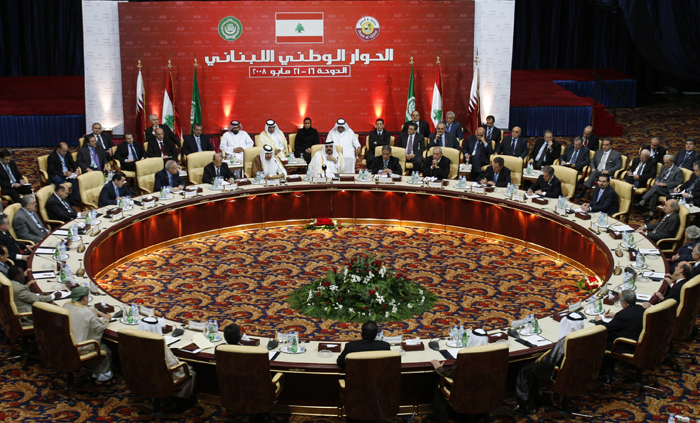
Doha Agreement

There’s not a lot to comment on concerning the presidential elections, so I thought It would be nice if I made a compilation of interesting cables connected to the 2008 presidential elections that I found on Wikileaks. What makes these texts so awesome is that they give hints on everything that happened afterwards: The May 7 events, Walid Jumblatt’s 2009 shift, Safadi and Mikati’s 2011 shift, the Sleiman-Aoun tensions, and even Michel Sleiman’s 2013 rivalry with the March 8 alliance. Elias El Murr sees his next president (Sleiman) as a coward, and Geagea wants to arm the Lebanese Forces.

Enjoy.

Pre-May 7

SAMIR GEAGEA ON AOUN’S ARMS, PRESIDENCY

Date:

2007 September 18, 12:48 (Tuesday)

Canonical ID:

07BEIRUT1435_a

The early preparations for the May 7 events?

2. (S) The Ambassador met privately with Samir Geagea in the Lebanese Forces stronghold of Bsharre, a town in north Lebanon, on 9/17 before a lunch with local officials attended by both. Geagea, with his usual intensity, zeroed in on what he insisted were tangible plans, training, and weapons distribution by pro-Syrian forces for a forcible military take-over of Lebanon. Claiming to have inside sources, Geagea said that Michel Aoun, Hizballah, Marada chief Suleiman Franjieh, Druse opposition figures Talal Arslan and Wi’am Wihab, and other pro-Syrians like Zahar Khatib were preparing their followers for militia-type street action to cut March 14 strongholds off from one another. Many things could spark putting this plan into action, Geagea said, but the election of a March 14 president without the presence of two-thirds of the parliamentary members would be the most likely.

HIZBALLAH ARMS ALLEGEDLY GO TO AOUN VIA FRANJIEH

3. (S) Geagea said that Hizballah is being careful to avoid direct military support to Aoun, which, if discovered, would discredit Aoun with the Christians and Hizballah (with its claims that its arms are directed against Israel only) more generally. Instead, Hizballah is providing arms to Franjieh. Franjieh then opens his arsenals to Aoun, making the arms transfers, if leaked, appear to be one Christian opposition leader helping another with personal protection. One of the main recipient of the arms from Franjieh is MP Selim Aoun, an Aoun bloc MP on Ily Skaff’s Zahleh list. Selim Aoun is charged with distributing the arms to others in the Aoun camp and has established strategically located cells of 50-70 fighters each. Franjieh is providing some of the training facilities and has recently opened Marada offices far beyond its Zghorta headquarters in order to serve as rallying and training points as well as safehouses. Zahar al-Khatib plays a key training role of Aounist fighters, again in order to keep Hizballah somewhat at arms distance from Aoun.

ONE EXAMPLE OF MARCH 8-AOUN PLANS: ISOLATING JUMBLATT’S FIGHTERS

4. (S) When ordered into action, the cells will immediately cut off roads and communication links, to divide and isolate March 14 groups from one another. As only one example in what he said was a long list of plans, Geagea described how Walid Jumblatt’s fighters would be bottled up. In a detailed account, Geagea said that Aoun forces in Kahali (along the Damascus highway, above Aley) have operational plans to join forces with Arslan’s anti-Jumblatt Druse forces in Aley in order to sever the Damascus highway just above Beirut. Hizballah, helped by Selim Aoun’s forces in Zahle, will cut off the Biqa’ valley end of the road. At the same time, Arslan’s people will join with the PFLP-GC and Hizballah to cut the southern highway out of Beirut south of the airport. This will prevent Walid Jumblatt’s Druse fighters from being able to reach Beirut from the Chouf and west Biqa’. Hizballah, while part of this, will attempt to stay in the background, using, for example, orange shirts in the Zahleh area to imply that the Aounists are more numerous than they are.

GEAGEA CLAIMS LAF KNOWS BUT CHOOSES TO DO NOTHING

5. (S) Geagea expressed deep frustration with the Lebanese Armed Forces (LAF). G-2 (army intelligence) chief Georges Khoury is aware of these plans. Not only has Geagea shared his information, but Khoury has his own confirmation. But the LAF is doing nothing. If the LAF would raid a single safehouse of Selim Aoun, for example, it would put a chill through the entire operation. But the LAF has too many Aoun sympathizers within its officer ranks to move against what Aoun is doing. Geagea claimed to have pushed for Zahar Khatib (once close to Jumblatt but now a staunch ally of Syria) to be pulled in for questioning, as a fall-back to questioning Aoun’s followers. But the LAF refuses to move. 6. (S) The Ambassador suggested that the LAF may be looking at weapons distributions by Aoun, Jumblatt, Franjieh, and Geagea himself as all part of the same pattern of increased personal protection and preparedness. Shaking his head, Geagea said that, were the LAF to look into the weapons distribution by Aoun and Franjieh, they would see offensive, not defensive, plans. If the LAF would call in some of Aoun’s weapons distributors, such as Selim Aoun, for questioning, then all of the arms dealing would decrease. Geagea asked for USG pressure on the LAF to respond to the growing threat: “they (the March 8-Aoun forces) already have an army, Hizballah. Now they’re building another army (the alleged arming of Aoun forces). They can’t have the LAF, too.” (We note that Georges Khoury has recently expressed anger and bitterness about March 14 complaints regarding LAF performance; Geagea’s comments are surely among the type that annoy Khoury.)

“He expressed concern, however, about whether Mohammed Safadi and the Tripoli MPs would be with March 14 when needed.”

HARB’S FLIRTATION WITH BERRI: METHOD IN HIS MADNESS

7. (S) The Ambassador asked Geagea about the presidential race. Geagea repeated the familiar two-pronged March 14 strategy: to welcome unconditional dialogue to seek a consensus candidate, while simultaneously shoring up March 14 ranks in preparation of electing Nassib Lahoud with an absolute majority (but without two-thirds quorum) if attempts to find a consensus candidate fail. He expressed concern, however, about whether Mohammed Safadi and the Tripoli MPs would be with March 14 when needed. The Ambassador asked, realistically, who would be acceptable consensus candidates for March 14. Maybe Charles Rizk, Geagea said, but certainly not LAF Commander Michel Sleiman. He expressed some concern about whether Saad Hariri might be willing to do a deal regarding Central Bank Governor Riad Salameh, whom Geagea dismissed as too close to the Syrians. 8. (S) The Ambassador asked whether Geagea thought Boutros Harb’s current, exaggerated courtship of Parliament Speaker Nabih Berri might make Harb acceptable to the March 8-Aoun forces. Unlike Saad Hariri’s concern (reftel), Geagea said that he was not worried about the constant verbal bouquets Harb throws Berri’s way. While he judged Harb to only have 10-15 percent chance of getting Berri on board, it was worth trying. If Harb can be elected as a consensus candidate with two-thirds quorum, then everybody is better off. Harb starts out his presidency with sufficient credibility and backing to work. Nassib Lahoud, on the other hand, is a better candidate, “the best,” Geagea said (reversing his previous ranking, which put Harb above Lahoud). But Nassib, despite his fortitude, would be at a great disadvantage in taking office, if half the country questions his legitimacy and the March 8-Aoun forces militarily take over sections of the country. Better to have Harb, if he can win consensus.

Read the full text here.

LEBANON: MICHEL SLEIMAN ANNOYED AT AOUN

Date:

2007 December 7, 17:09 (Friday)

Canonical ID:

07BEIRUT1928_a

“That man needs to see a doctor!”

4. (C) The Ambassador asked Sleiman about Aoun’s other public pronouncements and demands, such as the proportional split of the cabinet according to parliamentary bloc representation. “That man needs to see a doctor!” Sleiman said, wiggling his forefinger to the side of his head as if indicating mental illness). Aoun claims to want to strengthen the president. But, instead, Aoun wants to deny Sleiman one of the few absolute powers accruing to the president — the ability to co-sign with the PM the cabinet formation decree, naming ministers and portfolios. Sleiman indicated that he would use that signatory authority in order to place some of his own people on the cabinet. He said that, in his view, his ministers should, by swinging between March 14 and March 8 blocs within the cabinet, be able to provide the decisive cabinet votes.

Read the full text here.

LEBANON: JUMBLATT CONCERNED ABOUT UNIIIC DELAYS, SUNNI MILITIAS, AND HIZBALLAH FIBER OPTIC NETWORK

Date:

2008 April 8, 15:59 (Tuesday)

Canonical ID:

08BEIRUT490_a

The Sunnis are arming themselves, the army has no morale, and a  fiber optics network creates problems

8. (S) The second issue Jumblatt raised was Saad’s reported training of Sunni militias in Lebanon (allegedly 15,000 members in Beirut and more in Tripoli). In establishing his own “security agencies” in Beirut and Tripoli, Saad was being badly advised by “some people,” Jumblatt said, such as ISF General Ashraf Rifi. In his meeting with Jumblatt, Hassan admitted having knowledge that members of Saad’s Future Movement were being trained. Hassan reportedly opposed such training, but “people around Saad” (i.e., Rifi) were telling him to go ahead. (Note: The Jordanians have refused to train Internal Security Forces (ISF) members hand-picked and vetted by the Embassy to participate in a DA/ATA-funded Terrorism Crime Scene Investigation program, reportedly because they don’t want to be involved in training “Saad’s militia.” End note.) Jumblatt said Saad’s militia would cause significant damage to March 14, especially because Geagea’s Lebanese Forces and Suleiman Franjieh’s Marada were in line to train their own forces.

9. (C) Meanwhile, the LAF has lost its morale after the January 27 clash with Shia protesters. Jumblatt also decried the casualties inflicted on innocent civilians every time celebratory — and illegal — gunshots are fired following a major political speech.

HIZBALLAH’S FIBER OPTIC NETWORK

10. (C) Jumblatt’s last agenda item was the recent report on Hizballah’s (illegal) fiber optics network in Lebanon. According to fellow Druze and Telecom Minister Marwan Hamadeh, under whose auspices the report had been prepared, the report had not yet officially been presented to PM Siniora, because the “security apparatus” was hesitating to make it official. Jumblatt said that LAF G-2 Intelligence Director George Khoury and ISF General Rifi were talking about coordinating the report with Hizballah security chief Wafiq Safa, who reportedly warned that any action taken against the network would be considered an “act of war.” Jumblatt provided Charge with a copy of the map indicating the location of the network.

11. (C) Jumblatt expressed perplexity at Siniora’s failure to push on the report. (Note: LAF Commander Sleiman asked the same question in his conversation last week with the Charge. End Note.) Defense Minister Elias Murr reportedly was blaming Khoury for the delay.

NEXT STEPS FOR MARCH 14

12. (C) Jumblatt complained that March 14 (in part due to Saad’s absence) did not yet have a unified position on cabinet expansion, nor on how to respond to Speaker Berri’s call for a new National Dialogue. Pulling out a power point presentation prepared by the March 14 Secretariat, he confirmed, however, that the Secretariat was consulting with March 14 leaders on the way forward. One of the Secretariat’s ideas was to hold an international conference SIPDIS for Lebanon, though it was not clear how, where, or who would host such a conference. He agreed with the Charge that March 14 needed to be proactive, especially to combat the “Lebanon fatigue” that was spreading not only in the international community, but also in his hometown Chouf region, where the people he met with were fed up with the situation.

Jumblatt Says Sleiman’s statement is stupid

MICHEL SLEIMAN’S STATEMENT “STUPID”

13. (C) Never one to mince words, Jumblatt called Lebanese Armed Forces (LAF) Commander Michel Sleiman’s recent announcement that he planned to retire August 21, three months before the end of his commission, “stupid.” Jumblatt interpreted the announcement as a warning to both the majority and opposition to hurry up with the election. It’s as if he’s asking us to beg him to stay, Jumblatt said, adding, “He’s a nice guy, but not too bright.” He called the As-Safir newspaper editor who had interviewed Sleiman “a bad egg.”

Read the full text here.

Post-May 7

LEBANON: MINDEF MURR MEETING ON 11 MAY 2008

Date:

2008 May 13, 21:32 (Tuesday)

Canonical ID:

08BEIRUT681_a

“These are Sleiman’s three C’s; caution, coward, collusion.”

2. (C) Charge, accompanied by Defense Attach and PolOff, met with Deputy Prime Minister and Minister of Defense Elias Murr at his residence in Rabieh on Sunday, May 11 at 10:00 a.m.

HIZBALLAH IS JUST OUTSIDE MY WALLS OVER 200 FIGHTERS MOVED IN LAST NIGHT

3. (C) Murr set the stage for our early Sunday morning by telling us about his newest neighbors. Evidently, Free Patriotic Movement (FPM) leader Michel Aoun has received 200 new body guards to protect his residence in Rabieh which is not far from Murr’s home. These fighters had infiltrated into Rabieh on dirt tracks that were not guarded. Now, according to Murr, his nine year old daughter asks him, “who are those dirty men with beards outside?” (Comment. If Murr were really in distress about this new development, it is unlikely that he would still have his two children in the house while his ex-wife was out of the country. End Comment.) 4. (C) In addition to the 200 fighters around his house, Murr told us that he knew of an additional 400 fighters that had infiltrated the Dikwayne areas of the Metn. Murr assessed that all of these forces were being brought in to intimidate Amine Gemayel’s Phalange Party and to prepare to cut the main highway leading north out of Beirut. (Note. Defense Attach noted a significant increase in the number of LAF armored vehicles deployed on this highway on the morning of 11 May. This was the first time Defense Attach has seen armored personnel carriers on this highway in the last two years. End Note.)

ARMY COMMANDER AND INTELLIGENCE CHIEF IN HIZBULLAH’S BACK POCKET

5. (C) Murr, clearly upset with the LAF’s lack of performance, told Charge that Sleiman was a “coward.” Charge recalled USDP Edelman’s question to Sleiman about a lack of LAF action leading to questions of either caution or collusion on the part of the LAF. Murr agreed saying , “these are Sleiman’s three C’s; caution, coward, collusion.” (Note. Former President

Read the full text here.

LEBANON: GEAGEA DROPS BY AGAIN

Date:

2008 May 12, 21:34 (Monday)

Canonical ID:

08BEIRUT669_a

Geagea wants to arm the Lebanese Forces…via Rifi!

10. (C) Geagea noted that the current situation is not terrible, but that March 14 needed something significant to “hold Hizballah back.” He offered, “We could turn a defeat into a victory.” He told the Charge that the focus needs to shift to a more long-term look at how to defeat Hizballah.

11. (C) Privately, Geagea followed up on his previous requests for ammunition for his LF fighters (Ref D), and informed the Charge that he had seen Internal Security Forces (ISF) Director General Ashraf Rifi earlier in the day. Geagea reported that he is working with Rifi on buying ammunition at list price from other countries for himself and Walid Jumblatt. (Comment: We visited Rifi at 1300 today, May 12, and then saw him later in the afternoon at his close friend Saad’s residence, septel. It looks like Geagea is moving along with his preparations to arm his fighters. End comment.) COMMENT

12. (C) Geagea approached us to ask that we urge Saad and Jumblatt to ease their pressure on Siniora to agree to withdraw the Cabinet’s decisions. While Siniora has been resolute in upholding the Cabinet’s decisions, to the point of choosing to resign rather than concede on this issue, it is interesting to note that we were told by several interlocutors that Siniora had walked into the May 5 Cabinet meeting believing the head of airport security Wafiq Chucair should be investigated before a transfer decision was made. Always thinking strategically, Geagea appeared indifferent as to whether the Cabinet withdrew its decisions or not, and was more interested in moving beyond the “issue of the day” so that the bigger problems (Hizballah) can be tackled. 13. (C) We hear Saad Hariri and Geagea when they say that they do not want the Arab League delegation to be in “listening-mode” during their visit. We agree that the delegation can be most helpful if it brings a serious program to table. Geagea and Siniora have started thinking along these lines by suggesting that the Cabinet’s decisions be discussed in a National Dialogue. To make this visit effective, we suggest the delegation draws up a firm program prior to its arrival. End comment. SISON

Read the full text here.

LEBANON: PARLIAMENT ELECTS MICHEL SLEIMAN AS PRESIDENT

Date:

2008 May 26, 14:04 (Monday)

Canonical ID:

08BEIRUT766_a

A Resistance In The Past Tense

10. (C) Most of our interlocutors deemed Sleiman’s speech, which they believed he drafted himself, as “unexpectedly” strong. One contact said Sleiman had been overheard to say “they won’t be expecting this” just moments before entering the plenary. Caretaker FM Tareq Mitri noted as significant Sleiman’s references to the “resistance” in the past tense, as assessment shared by Justice Minister Rizk and UAE Foreign Minister Abdullah bin Zayed al Nahyan, who believed it was a deliberate nuance that merited attention. Seated at dinner with the Charge and Pol/Econ Chief, Internal Security Forces (ISF) General Ashraf Rifi, Surete Generale head Wafiq Jezzini and Lebanese Armed Forces G-2 (military intelligence) Director BG Georges Khoury expressed surprise that Sleiman’s remarks had been as hard-hitting as they were. All three believed he had drafted the text himself.

“This is how it starts. Remember this moment. Walid is moving toward Hizballah.”

15. (C) Following the election, Speaker Berri hosted a dinner in honor of the Qatari Emir at the Biel convention center, where Patchi chocolates were placed at each plate with the words “Thank you Qatar” inscribed on the wrapping. While many of the foreign dignitaries had departed, the Lebanese were out in full force. Druze leader Walid Jumblatt created great consternation at the Charge’s dinner table when he walked across the room to greet FM Mottaki. Surete General Gen. Jezzine told the Charge, “This is how it starts. Remember this moment. Walid is moving toward Hizballah.” Jumblatt later pooh-poohed the encounter, telling the Charge FM Mottaki did not even know who Jumblatt was.

Read the full text here.