Bimonthly analysis post

The Time For Moderation

1984...

1984…

For a country that took 11 months to get out of the deadlock, the events of the past few days are revealing. Sleiman Frangieh will not run for the presidential elections: It’s official. In his interview with Al-Mayadeen, the leader of the Marada party endorsed the candidacy of Michel Aoun. The FPM leader on the other hand was busy commending Saad Hariri’s speech “characterized with moderation“. On the other side of the political spectrum, Amine Gemayel was praising the Iranian policies in the regions, only days after Hariri promised the Patriarch that the presidential elections would be held on time.

M8 Unified

Although it might be hard to believe, Frangieh’s withdrawal makes sense. For M14, he is the most despised Christian leader out there. For Hezbollah and Amal, he is a minor Christian politician. For the FPM, he is a local ally that mustn’t get stronger under any circumstances, especially that he is more likely to answer to Damascus than to Rabieh in case something goes bad between the Syrian regime and its biggest Christian ally. Frangieh hence has no shot at all to become president in 2014: Even if he runs as the sole candidate backed by M8, his name can never become a consensual one, and M14 pressure on Jumblatt would eventually prevent the latter of voting for the Marada candidate. By running for office in 2014, Frangieh would have angered the FPM, lost the elections, and found himself isolated. Patience is a virtue. Out of the “Maronite four” (Gemayel, Geagea, Aoun and himself), Frangieh is by far the youngest, and the very fact that in 2020 Amine Gemayel would be 78, Michel Aoun 86 and Samir Geagea 67 makes him the perfect candidate for the elections. By then, he would have become M8’s number one, the Syrian crisis would have probably ended, and he’ll get to have  6 years to adapt to any new situation, make new alliances, or switch sides. In 2020, the odds can be in his favor. In 2014, they’re not.

Michel Aoun on the other hand understood the rules of the game (after years of experience). The president is practically always a consensual one, especially in times of crisis. Fouad Chehab was elected for refusing to engage the army in the conflict. Charles Helou was elected because he was one of Chehab’s closest men to the opposition. Sleiman Frangieh was elected for his pro-Nasserist history and his anti-Palestinian tendencies. Elias Sarkis was elected for staying neutral throughout the first year of the civil war. In Lebanese politics, if you don’t compromise, you lose it all: Raymond Edde stayed 50 years in the opposition and never made it to the presidential palace. And for the millionth time (see here, here, herehere and here), this is what Michel Aoun is trying to achieve. Even though he might never become a consensual candidate in the matter of a year’s effort, he can still become M8’s most moderate politician. And how do we know it works? Because his new moderate attitude made Frangieh withdraw for lack of support from M8 and M14, forced the different M8 factions to pamper him more (so he doesn’t defect) and eventually unified M8 behind him while turning him into a more acceptable candidate to M14. After spending most of 2012 and 2013 accusing Hariri of being an extremist politician supporting rogue Islamist militants, he describes Hariri in 2014 of being the voice of moderation. There is no such thing as a coincidence. Everyone hoping to succeed has to be a moderate ahead of the presidential elections. For Michel Aoun, being a moderate means that he’ll have to praise the Future Movement.

M14 Unified

When I say everyone, I include M14’s candidate. And while we’re at it, there will be one,  and only one candidate coming from the ranks of M14. Hariri reiterated in his meeting with the Patriarch on Friday that the March 14 coalition would field one presidential contender. Meanwhile in the Christian camp of M14, the Kataeb – now strong of their huge share in the cabinet – are preparing their comeback. Among the possible candidates for the presidency, there’s LF leader Samir Geagea (head of the biggest Christian M14 party) , popular independent MPs such as Boutros Hareb, and last but not least former president Amine Gemayel, leader of the Kataeb party.

M14 needs a candidate that is in full harmony with its policies while being at the same time acceptable by M8. Samir Geagea, while being the strongest Christian in M14, doesn’t fit the criteria. The majority of independent MPs , although enjoying some support and prestige from the parliament – Boutros Hareb has been in the parliament for the past 42 years – are also too violent for M8.

One has to see it from a very particular perspective. Aoun is popular, was a commander of the army and a former prime minister,  is seen as protector of Christian interests (due to his stances on the cabinet formation and the electoral law), has strong allies, is currently establishing ties with various parties – notably the Future Movement, and is fashioning himself as a moderate. If M14 wants a serious competitor, the first name coming to mind is Amine Gemayel. He leads Lebanon’s oldest and most prestigious Christian party, had the same stances regarding the electoral law and the cabinet, has good ties with most of the parties and is at the core of M14. Also who’s better to compete with Aoun than the president who appointed him as commander of the army and later prime minister?

The Kataeb are aware of their sudden power in the executive power and of the precious value of their leader: Amine Gemayel asked for the elections to be held on time, dismissed any other consensual candidate by requesting the parliament to elect a strong president (hinting at “the Maronite Four”), nominating himself to the presidency and finally starting to laud some of the M8 rivals, namely Iran. Like Michel Aoun, he is showing his moderate side. While rumors on the streets say that Hariri is likely going to endorse the leader of the Kataeb, Gemayel’s relation with Lebanon’s kingmaker Walid Jumblatt isn’t very good (due to civil war-related issues). Since Jumblatt isn’t a fan of Aoun either, we might probably see a third consensual name endorsed by the centrists. The press is circulating the names of Jean Obeid (who apparently also enjoys the support of Berri and Hariri) and the usual “two Maronites” : the commander of the army and the governor of the central bank.

2014 Is Not 2008 (Or Is It?)

Even if the elections are held on time, and even if the M8 and M14 alliances do not boycott the elections and everything goes according to the plan (no lack of quorum), there is still one problem: None of both alliances can secure 65 votes (absolute majority) to support its candidate. While it is more obvious by the day that M14 and M8 would be each supporting one candidate to the presidency, it remains unclear what side Walid Jumblatt and Mikati’s parliamentary blocs would back. If the Jumblatt-Mikati duo decides not to participate in the elections, neither M8 nor M14 will be able to secure the post for its candidate. Without Jumblatt and Mikati, M14 has around 58 MPs while M8 has a bit less than that (around 57).

The constitution stipulates that a 2/3 majority is necessary to elect a president in the first round, while an absolute majority would be needed for all the rounds after that. unlike 2007, when the presence of M8 and M14 in the parliament would have probably ended in an M14 candidate as a president (since they held the majority), the elections of 2014 are different. Even if everyone shows up, the elections would be like a play. The MPs will keep voting for the same candidates, and since no camp can secure 65 votes, the elections can go on forever. In other words, none of the two coalition will take it upon itself to boycott the parliamentary session and get treated with disregard from the public for “paralyzing the states’ institutions”. Because unlike 2008, there is no coalition holding the majority of votes in the parliament which means that the minority coalition doesn’t need to boycott and block quorum in order to prevent the majority of electing a president of its ranks.

While nothing is official or definite, we are approaching the elections with 2 candidates, Michel Aoun of M8 and Amine Gemayel of M14 that are – unlike 2007 – fighting to get the support of the rival camp by playing the moderate card, while the name of the third consensual candidate is soon to be determined.

Reminder: The government didn’t win the confidence vote yet.

The Presidential Race Begins

Naharnet Michel Aoun Nominates Geagea For Presidency

In what is probably the most misleading article title since the beginning of time, Naharnet tells us that “Aoun Links Cabinet with Presidential Elections, Says he Nominates Geagea“. In the same context, Berri apparently said that he won’t deal with the matter before March 25, when the 60-day Constitutional deadline for the election of a new president starts. But since every possible politician is talking about the presidential elections, I find it hard how he’ll manage to do that. So what is exactly happening 5 months before the 25th of May? 

Mini-heart attack yet? Don’t panic. Aoun isn’t actually going to nominate Geagea (Naharnet forgot to put the word mockingly before says in the title). However, Aoun said that he wants a strong president and he clearly won’t nominate Geagea  (since he mockingly nominated him). On the opposite side, he is distancing himself from his ally (and apparently presidential rival) Sleiman Frangieh by asking for the election of a president from the first round (requiring the two-thirds of votes) while Frangieh previously said that he had no problem in electing the president with absolute majority (Here’s a nice post from October explaining why). Meaning that Aoun is likely to nominate someone from the FPM (him?).

Khabsa within M8

Frangieh and Aoun are endorsing two different electoral strategies, meaning that they will probably not be endorsing each other. This small competition is only the beginning. There will come a time where other M8 parties will have to choose between Frangieh and the Aounist candidate . So with who will side Hezbollah? The whole confusion emerging from within the March 8 coalition also means that the other centrist parties would have a much more free hand and will be more able to distance themselves from the March 8 camp or put conditions on the shattered M8 alliance. Jumblatt and Mikati in stronger positions also means that the president would be in a better place in case he wishes to extend his mandate. March 14’s silence and Tammam Salam’s passivity show us that the deal – if a consensus is to be reached – won’t strictly be about the government but rather the whole crisis, and its recent newcomer: The presidential elections.

Too Much USJ And No Jumblatt

Did I miss anyone? Correct! Jumblatt’s quiet attitude for the past few weeks – only 3 weeks earlier he was engaged in a violent media war against M14 and M8 – indicates that everyone is considering his options. After all, Jumblatt is still the kingmaker, and his stances will with no doubt influence everything. In fact Jumblatt’s silence is probably behind most of the parties’ cautiousness. No one wants to rush to the losing side. And the identity of that side will be clearer once Jumblatt takes a decision. 

If you’ve been following the news this week you’d be aware of the student elections in USJ and their violent aftermath (see here, here, here). One must keep in mind that USJ is one of the biggest and most prestigious universities in Lebanon, and its political relevance comes from the fact that it is a Christian University mostly attended by Christian students. Other than the demographic cause, the campus where most of the trouble happened is in the heart of Ashrafieh, while the University itself is the Alma mater of roughly half of the Lebanese presidents. That’s why the university elections at USJ matter more – strategically speaking – to the Christian leaders than the elections at the Lebanese University, AUB, LAU or any other university. Although the tensions are more of a yearly tradition now, this year I can’t but relate the unusually high tensions (Classes were suspended for two days in Huvelin campus)  to the near presidential elections. For the reasons stated above, whoever the winner is at USJ , it’s a huge boost for him ahead of the presidential elections. Probably explains why Aoun lashed out at Geagea and why Samy Gemayel entered in a media / propaganda war against Michel Aoun and M8 following the elections.

Reminder: We still don’t have a government.

Don't forget to follow @moulahazat on Twitter for updates on new posts!

Frangieh’s Presidential Election Reform And What It Means

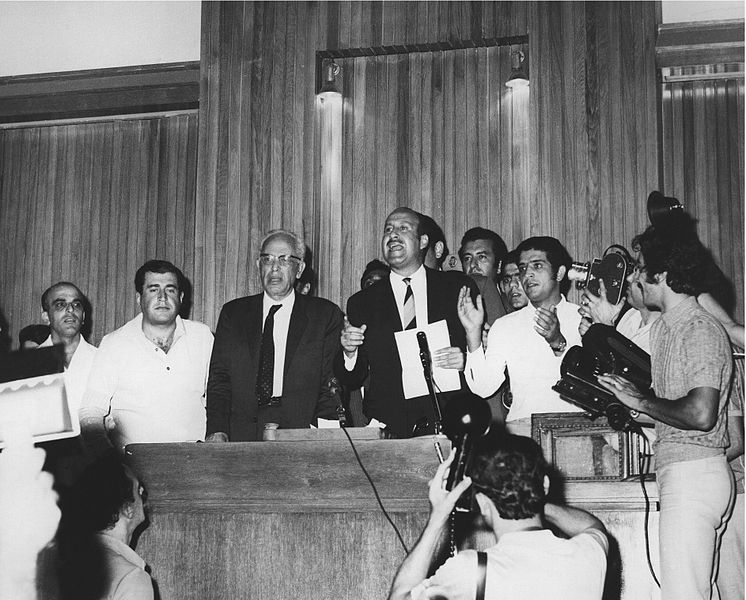
Deputy Speaker Michel Sassin declaring Suleiman Frangieh (The Grandfather) President in 1970

Deputy Speaker Michel Sassine declaring Suleiman Frangieh (The Grandfather) President in 1970

With Tammam Salam’s inability to form a government, the parliament’s failures to convene – which is unconstitutional anyway – and the electoral law impasse forgotten, I find myself obliged to talk about something new to Lebanese politics this month: The presidential elections.

Apparently on Thursday, Marada Movement leader Suleiman Franjieh warned of a presidential vacuum as the conflict over Syria continues and suggested that Lebanon adopts the 50 percent plus one vote formula to secure the office.

Wait What

Let alone the fact that Frangieh’s allies took advantage of that particular constitutional clause (Of having the two thirds quorum in the Presidential elections) in order to block the election of an M14 candidate in 2008, the very fact that Frangieh is asking for a modification of that electoral process is very weird. Why? Let’s see why. Because Frangieh belongs to a coalition in the parliament that holds between the third and half of the MPs in the parliament. That means that under the current constitutional rules, Frangieh – Let’s suppose for a while that he will be M8’s candidate – can block the electoral process by instructing his allies to boycott the session. Just to make it clear – and more complicated for you –  Frangieh said that a 50% plus one vote should be adopted. Thus Theoretically, Frangieh spoke nothing about the quorum.  He only mentioned what the number of votes for the winner should be once there is quorum. So if Frangieh doesn’t want to change the quorum rule in the constitution but only the voting rule, nothing makes sense. Is Frangieh suggesting that we change the quorum or the winning vote number? Let’s see.

M8 has 40% of the votes, M14 45%, and the others (Mikati, Jumblatt …)15%  (The numbers aren’t exact, but you get the point)

Case 1: Our lovely non functioning system (Quorum 66%, First round 66%, Second round 50%+1). Frangieh wants to run, but M14 and the others won’t vote for him. Frangieh instructs his allies to boycott. 40%>33% which means that there will be no quorum, thus no elections. In case the others will vote for him, that means he will have 55% of the votes. M14 boycotts, 45%>33%, meaning that there will also be no quorum.

Case 2: Quorum remains untouched with Frangieh’s amendment (Quorum 66%, First round 50%+1). Frangieh wants to run, but M14 and the others won’t vote for him. Frangieh instructs his allies to boycott. 40%>33% which means that there will be no quorum, thus no elections. However, Frangieh is saying that he is making the amendment to make life simpler and easier for the parliament to elect the president. Which means that the amendment doesn’t make any sense (See, I told you!) because the quorum boycott is still here and if he wishes not to boycott and elect the president with 50%+1 he can simply wait for the second round and keep the constitution like it was (see Cas 1)

Case 3:  Frangieh was actually talking about the quorum!  (Quorum  50%+1%, First round 50%+1).  40%<50% which means that Frangieh can’t freeze the process if he boycotts and has a very high chance of losing because 40%<50%. Unless…

Unless What?

Unless Frangieh is sure he can secure 65 MPs to vote for him. In politics you don’t actually propose something you might lose in, so there’s something fishy about this. If Frangieh meant cas 1 (or cas 2), he was probably just saying things to fill in the blanks of his speech. But if what Frangieh meant was cas 3, then something very dangerous is going on here.

Dangerous How?

If Frangieh can bring 65 votes, but not 86 (the 66% quorum that he wishes to remove in his reform) that can mean only few things. That means he isn’t a consensual candidate because he doesn’t have 66% of the votes (shocking, right?), that he will be running with M14 (See what I mean by dangerous?) against Aoun, or that Jumblatt and Mikati, along with Amal and Hezbollah and someone else will choose him as their sole candidate to the elections and throw Aoun outside which will probably make the latter closer to M14 than M8.

While the theory of having Frangieh and M14 as allies is unimaginable, the very fact that Jumblatt and Hariri have engaged in a media war lately, that Jumblatt is starting to prefer M8’s 9-6-6 formation over M14’s 8-8-8 one and that Aoun is actually getting closer to the Future Movement makes the second theory absurd yet executable.

However the most plausible explanation to this whole reform question is that Frangieh doesn’t want to extend to Suleiman for 6 years. Knowing that a boycott would create another revolutionary vacuum (Expired parliament, no president, no government, Yay!) he is probably paving the way for a small consensual amendment: only 1 (or 2?) extra year for Suleiman while implementing the reform of 50%+1 (M14 and the others should be enough to elect Suleiman), in exchange of something else for M8 (their formula for the government gets adopted? A consensual electoral law?). M8 will be theoretically still boycotting the elections – except this time it’s harmless to the electoral process.

Oh, and speaking of 50%+1, Frangieh’s Grandfather was actually elected by exactly 50%+1 of the votes. Actually, it was 50%+0.5, (he got 50 out of 99 votes. 99/2=49.5 which means he got 50%+0.5) and that is why in the picture, it’s not the speaker Sabre Hamade – his political rival who considered 50%+0.5 instead of the absolute majority (50%+1) to be unconstitutional – proclaiming him president, but Hamade’s deputy.

And look at us, complaining about the 66% quorum.

Is Michel Aoun Switching Sides?

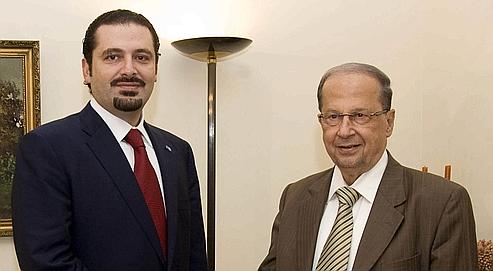
Hariri-Aoun Meeting in 2009 (AFP)

Hariri-Aoun Meeting in 2009 (AFP)

At first sight, Lebanon seems politically normal. No parliamentary sessions, no functioning government, a bad economy, ambassadors visiting politicians, and like always, no solution to the deadlock. However, in the last few days, three consecutive incidents in the March 8 camp almost went unnoticed.

Drawing The Red Lines

The Tomahawk effect that kept all the politicians silent for two weeks is obviously fading away. And while everyone was focused on Berri’s initiative to solve the crisis, another interesting development was marginalized. Michel Aoun, who made sure in the past 3 months to keep his criticism against Hezbollah centered on the party’s political stances, indirectly attacked Hezbollah’s military activity in a statement accusing M14 of initially providing cover for Hezbollah’s telecom network. And that statement wasn’t the only one. A meeting between the FPM leader and the U.S. ambassador Hale ended in a Aounist approval of the Baabda declaration that was recently questioned by Hezbollah.

If It Ain’t Broke Don’t Fix It

Hezbollah clearly understood that something was going wrong. Or why else would a delegation of the party go visit Aoun, only to make sure that the ties between the two allies were still the same? If the ties were still the same, why bother fixing them?

The Wind Of Change

For Aoun to question his 7 year-alliance with Hezbollah at a moment’s notice would be an act of political insanity. Switching sides implies that the second side is indeed willing to accept you as a member. And that is probably what Aoun is trying to do with his small yet remarkably strong statements. You might view that describing the new stances by strong is an exaggeration but one must not forget that the FPM is Hezbollah’s main national ally and by far his strongest political ally, meaning that any criticism, no matter how small it is, is in fact more harmful than the strongest M14 – or even Amal – political stance against Hezbollah. Aoun is checking out if any of the M14 leaders will understand his small hints and welcome his statements. Stronger statements at a faster rate – without an M14 welcoming attitude – might throw Aoun all by himself on the outside, which is not a good thing for a Lebanese politician.

Yet Another Political Maneuver

The issue is far more complicated than the FPM pissing off Hezbollah in a Christian area for popular gain (By rejecting the telecom network in Lebanon’s biggest Christian city). Another Hezbollah Christian ally, Sleiman Frangieh, is preparing himself for presidential elections.  Frangieh is younger than Aoun but is also (arguably) the biggest pro-Syrian among Hezbollah’s allies, making him a perfect candidate for the Hezbollah-led alliance in case the war in Syria reaches a certain level of hostilities. Hezbollah might embrace the Frangieh candidacy, and that can justify the FPM’s decaying relation with the party.  Aoun wants to make sure that it will be him – or one of his Maronite protégés – who will be the official M8 candidate for the May elections, and his new stances can be seen as a small political maneuver (or even blackmail).

The Lessons Of  1988 And 2008

When the Americans were trying to push for their own candidate in the 1988 presidential elections, Aoun – who wanted the presidency for himself –  criticized the U.S. motives and announced that  Lebanon is not an American protectorate. What happened next – you guessed it – is that Aoun was eventually removed from power because he went against the regional tide.  In 2008, when Aoun failed again to notice that the regional context implied that a centrist president should take power, General Suleiman was elected president. This time though, Aoun seems to have understood the rules of the game. By being slightly more moderate in the wake of the American-Russian agreement on Syria (and even ironically agreeing with the American Ambassador this time), and by trying to settle his issues with most of the Lebanese parties, Michel Aoun is discretely trying to go with the flow and adapt to the circumstances of the next presidential elections.