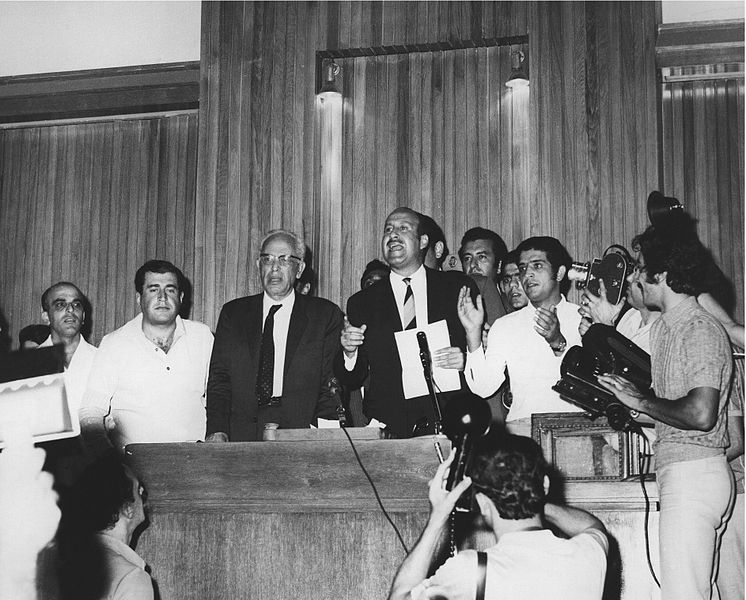
Deputy Speaker Michel Sassine declaring Suleiman Frangieh (The Grandfather) President in 1970
With Tammam Salam’s inability to form a government, the parliament’s failures to convene – which is unconstitutional anyway – and the electoral law impasse forgotten, I find myself obliged to talk about something new to Lebanese politics this month: The presidential elections.
Apparently on Thursday, Marada Movement leader Suleiman Franjieh warned of a presidential vacuum as the conflict over Syria continues and suggested that Lebanon adopts the 50 percent plus one vote formula to secure the office.
Wait What
Let alone the fact that Frangieh’s allies took advantage of that particular constitutional clause (Of having the two thirds quorum in the Presidential elections) in order to block the election of an M14 candidate in 2008, the very fact that Frangieh is asking for a modification of that electoral process is very weird. Why? Let’s see why. Because Frangieh belongs to a coalition in the parliament that holds between the third and half of the MPs in the parliament. That means that under the current constitutional rules, Frangieh – Let’s suppose for a while that he will be M8’s candidate – can block the electoral process by instructing his allies to boycott the session. Just to make it clear – and more complicated for you – Frangieh said that a 50% plus one vote should be adopted. Thus Theoretically, Frangieh spoke nothing about the quorum. He only mentioned what the number of votes for the winner should be once there is quorum. So if Frangieh doesn’t want to change the quorum rule in the constitution but only the voting rule, nothing makes sense. Is Frangieh suggesting that we change the quorum or the winning vote number? Let’s see.
M8 has 40% of the votes, M14 45%, and the others (Mikati, Jumblatt …)15% (The numbers aren’t exact, but you get the point)
Case 1: Our lovely non functioning system (Quorum 66%, First round 66%, Second round 50%+1). Frangieh wants to run, but M14 and the others won’t vote for him. Frangieh instructs his allies to boycott. 40%>33% which means that there will be no quorum, thus no elections. In case the others will vote for him, that means he will have 55% of the votes. M14 boycotts, 45%>33%, meaning that there will also be no quorum.
Case 2: Quorum remains untouched with Frangieh’s amendment (Quorum 66%, First round 50%+1). Frangieh wants to run, but M14 and the others won’t vote for him. Frangieh instructs his allies to boycott. 40%>33% which means that there will be no quorum, thus no elections. However, Frangieh is saying that he is making the amendment to make life simpler and easier for the parliament to elect the president. Which means that the amendment doesn’t make any sense (See, I told you!) because the quorum boycott is still here and if he wishes not to boycott and elect the president with 50%+1 he can simply wait for the second round and keep the constitution like it was (see Cas 1)
Case 3: Frangieh was actually talking about the quorum! (Quorum 50%+1%, First round 50%+1). 40%<50% which means that Frangieh can’t freeze the process if he boycotts and has a very high chance of losing because 40%<50%. Unless…
Unless What?
Unless Frangieh is sure he can secure 65 MPs to vote for him. In politics you don’t actually propose something you might lose in, so there’s something fishy about this. If Frangieh meant cas 1 (or cas 2), he was probably just saying things to fill in the blanks of his speech. But if what Frangieh meant was cas 3, then something very dangerous is going on here.
Dangerous How?
If Frangieh can bring 65 votes, but not 86 (the 66% quorum that he wishes to remove in his reform) that can mean only few things. That means he isn’t a consensual candidate because he doesn’t have 66% of the votes (shocking, right?), that he will be running with M14 (See what I mean by dangerous?) against Aoun, or that Jumblatt and Mikati, along with Amal and Hezbollah and someone else will choose him as their sole candidate to the elections and throw Aoun outside which will probably make the latter closer to M14 than M8.
While the theory of having Frangieh and M14 as allies is unimaginable, the very fact that Jumblatt and Hariri have engaged in a media war lately, that Jumblatt is starting to prefer M8’s 9-6-6 formation over M14’s 8-8-8 one and that Aoun is actually getting closer to the Future Movement makes the second theory absurd yet executable.
However the most plausible explanation to this whole reform question is that Frangieh doesn’t want to extend to Suleiman for 6 years. Knowing that a boycott would create another revolutionary vacuum (Expired parliament, no president, no government, Yay!) he is probably paving the way for a small consensual amendment: only 1 (or 2?) extra year for Suleiman while implementing the reform of 50%+1 (M14 and the others should be enough to elect Suleiman), in exchange of something else for M8 (their formula for the government gets adopted? A consensual electoral law?). M8 will be theoretically still boycotting the elections – except this time it’s harmless to the electoral process.
Oh, and speaking of 50%+1, Frangieh’s Grandfather was actually elected by exactly 50%+1 of the votes. Actually, it was 50%+0.5, (he got 50 out of 99 votes. 99/2=49.5 which means he got 50%+0.5) and that is why in the picture, it’s not the speaker Sabre Hamade – his political rival who considered 50%+0.5 instead of the absolute majority (50%+1) to be unconstitutional – proclaiming him president, but Hamade’s deputy.
And look at us, complaining about the 66% quorum.
 Moulahazat
You must be logged in to post a comment.