8 March Alliance

Lebanon’s New Presidential Favorite?

Empty frames (presidential vacuum)

Visual vacuum: Portraits of ex-Lebanese President Michel Sleiman at state-run facilities replaced with empty frames. (Image source: The Daily Star, Mohamad Azakir)

Other than the fact that we still don’t have a president and that the parliamentary elections are in a month, Lebanon had two very busy weeks. Let’s take a look at some of these stories.

28/09/2014 – Army Repels Jihadist Infiltration Attempt as Gunmen Try to Spread Chaos in Lebanon (Naharnet)

The Lebanese army clashed with jihadists trying to infiltrate Lebanese territories at dawn Monday, leaving many dead and injured among their ranks, Voice of Lebanon radio (93.3) reported.

The infiltration attempt was made on the outskirts of the northeastern border town of Arsal, which last month witnessed bloody clashes between the army and militants from al-Qaida-linked al-Nusra Front and the Islamic State group.

28/09/2014 – Hariri: Syrian National Coalition Complaint on Army’s Arsal Raid Should’ve Mentioned Captive Troops (Naharnet)

Head of the Mustaqbal Movement MP Saad Hariri criticized on Sunday the Syrian National Coalition’s complaint to the United Nations Security Council over the Lebanese army’s treatment of Syrian refugees in the northeastern region of Arsal, deeming it as a “misstep” and saying that it disregards the ties between the Lebanese and Syrian people.

He said in a statement: “The Syrian National Coalition has the right to defend the refugees’ humanitarian rights … but the interests of the refugees and Syrian revolt also requires them to raise their voice and demand the release of the Lebanese soldiers and policemen abducted by Islamists in August.”

29/09/2014 – Saudi Arabia asks for clarification on weapons deal for Army (The Daily Star)

“For reasons that I cannot explain today, the Saudis have put conditions on the destinations of the arms,” Lebranchu said. When pressed what she meant by “destinations,” Lebranchu said that the already complex file would only be further complicated if she discussed the details publicly.

Moreover, the Saudis had not registered their specific concerns regarding the arms deal with the French by Friday evening as Lebranchu concluded her trip to Lebanon.

“If the Saudis have a problem [with the accord] … it would be helpful if they identified it quickly so that we could respond,” Lebranchu said. “We need to get this file moving.”

She was confident that the Saudis would express their precise concerns in the near future.

30/09/2014 – Iran to donate military equipment to Lebanese Army (The Daily Star)

Iran will donate military equipment to the Lebanese Army, a visiting Iranian official said Tuesday after talks with Prime Minister Tammam Salam.

“Given the role Lebanon is playing in fighting extremist takfiri terrorism in some border regions, Iran has decided to donate military equipment to the Lebanese Army, as a token of love and appreciation for Lebanon and its brave Army,” said Ali Shamkhani, secretary of the Supreme National Security Council of Iran.


01/10/2014 – Jumblat Calls for Exchange between Arsal Captives, Roumieh Prisoners to End Abduction Ordeal (Naharnet)

Progressive Socialist Party leader Walid Jumblat called on Wednesday for a swift exchange between the Arsal captives and Roumieh prison Islamist inmates, holding former Internal Security Forces personnel responsible for the “self-rule” at the facility.

“The government and crisis cell should follow up any exchange process with the kidnappers,” Jumblat said in an interview with An Nahar newspaper.

He denied any previous knowledge of the conditions set by the jihadists, who kidnapped a batch of soldiers after withdrawing from the northeastern border town of Arsal in August.

Note: Jumblatt had previously refused the idea of an exchange deal on the 7th of  September.

05/01/2014 – Lebanon to get Russian helicopters, air defense (The Daily Star)

“There are talks on buying Russian arms and special equipment by Lebanon,” the World Tribune quoted Machnouk as saying during his visit to Moscow in late September to discuss weapons supplies to Lebanon’s Internal Security Forces.

He said a delegation from the army would visit Moscow later this month to discuss proposals.

Any deal would most likely be financed by the $1 billion Saudi donation that was announced by former Prime Minister Saad Hariri in August.

Political sources last month told the The Daily Star that Hariri was working to revive 2010 arms negotiations with Moscow. The Russian ambassador confirmed at the time that talks were taking place without going into detail.

08/10/2014 – Lebanese Army receives new US arms delivery (The Daily Star)

he United States delivered a new batch of aid to the Lebanese Army Wednesday as part of Washington’s efforts to bolster the military’s capabilities to confront Syrian border violence.

The National News Agency reported that senior Army officers were handed ammunition at Beirut’s International Airport in the presence of representatives from U.S. Office of Defense Cooperation in Lebanon.

The Army has received several deliveries of U.S. military equipment, including arms and ammunitions, in the past weeks under the U.S. military assistance program.

08/10/2014 – France says $3 billion Lebanon arms deal to go ahead (Reuters)

“All the work is done and the President (Francois Hollande) indicated yesterday to Mr (Saad) al-Hariri that the conditions to fulfil the contract had been met,” Defence Minister Jean-Yves Le Drian told parliament.

“This is a necessity. The Lebanese army is the last barrier that exists against the security threats this country faces.”

08/10/2014 – Envoy: Iran’s Military Gift to Lebanon Ready for Delivery (Fars News Agency)

thali made the remarks after a meeting with Lebanese Democratic Party Leader Talal Arslan, where he expressed the hope that the gift would be sent to the Lebanese army through legal procedures in the Muslim Arab state, the Egyptian al-Bawaba news reported.

The envoy did not reveal details or the nature of the aid, but said the gift would help Lebanon meet all its Army needs  in its current war on terrorism.

Iran hopes the weapons can support Lebanon in its fight against the terrorist groups, he reiterated.

Meet Lebanon’s Top Presidential Candidate

I think that I’ve made my point by now. In less than 10 days, every possible country in the world suddenly volunteered to arm the Lebanese army. Faisal Kassem’s media campaign backfired, and by the end of this week, Jean Kahwaji had become Lebanon’s man of the month. At the same time, the Lebanese army was also getting credit for its achievement in keeping a relative peace in the Bekaa and for taking control of the situation. The credit came from everyone, except Berri. Although the speaker had earlier expressed his “frustration and defended the army against critics” (30/09), on the third of October the speaker indirectly attacked the army’s command by blaming the army for the delay regarding the controversial wage hike draft law. The speaker knew what he was doing. The Lebanese army was getting stronger and stronger in the context of a presidential vacancy. On one hand, the world’s greater powers are (probably) competing to gain the sympathy of the LAF leader via the arms deals, and on the other hand,  most of the M14 forces are endorsing Kawhaji’s moves. Jumblatt’s endorsement of the exchange deal with the Arsal militants made M8’s initial veto on the issue meaningless. Kahwaji, who is traditionally seen by the Lebanese media as being sympathetic to the March 8 Alliance (and particularly Hezbollah), was becoming at the same time stronger and more popular among M14 (proof: Kahwaji headed to Washington, Riyadh to discuss support for Lebanese army). That makes it a lot easier for him to become Lebanon’s next president,  and a lot harder for Berri to enforce some of his demands in a possible deal on Kahwaji’s candidacy. After all, if everyone agrees on Kahwaji, Berri becomes as influential as Talal Arslan.

Berri’s Maneuver

This is probably why Berri made two very interesting moves this week: In the first one, the parliament speaker attacked the army and blamed it for freezing the wage hike efforts (and hence tried to make Kahwaji  unpopular). In the second one, he declared that he was going to vote against the elections in case the Future Movement takes the decision to boycott the polls. And since the FM already took that decision, it means that Nabih Berri will vote against the elections. Which also means that:

1) There’s now at least more than 65 MPs against the elections.

2) The speaker can still enforce whatever terms he wants regarding the presidential elections by effectively deciding the outcome of the extension law vote since he – as it seems – is now in control of the swing votes in the parliament (regarding the Extension/ Temdid law) and can change his decision at any time (He just proved to everyone that he is unpredictable).

The Lebanese Forces In Denial (Again)

58+8=64. That means that exactly half of the parliament wants to stay in the parliament, while the other half wants parliamentary elections (which means that we will go to elections since an extension law needs 65 votes to pass). As striking as it might seem, the decision to keep the same parliament or to change it lies within the Lebanese Forces .

Probably for the first time since prehistory, the Lebanese Forces are in a position where they are actually in charge of taking a major decision (Going to elections in the context of a presidential vacancy). And they can use this rare moment of power in order to force the M8/M14 coalitions into a deal that might be favorable to their interests.

That was the situation in September. But since Berri decided that he was going to boycott the elections after all, the majority in the parliament is now against elections – regardless of what the LF think. The Lebanese Forces hence lost their bargaining chip which might explain their recent aggressive stances and their very weird decision to sue regular citizens (If we were a normal country, such an irresponsible decision, especially in the context of an extension of the parliament’s term would have led to a revolution. Emphasis on normal.)

So in other words, this week Future Movement showed Berri that they were unpredictable and could still bypass any of his vetoes regarding the presidential elections by endorsing M8’s “hidden candidate”. And Berri responded by reminding them that he too is unpredictable and that no matter what happens, he still holds the keys to the Lebanese parliament and could postpone for them the elections in case they wanted to. And in the process, the Lebanese Forces discovered that they were yet again left alone with no real power.

 141 days since the 25th of May. 36 days till the 16th of November.

Four Months Of Vacuum

Baabda Palace during its construction, 1969

Baabda Palace during its construction, 1969 (Image source)

Four months is nothing. It took the Lebanese parliament 13 months to elect Rene Mouawad in 1989, and 7 months to elect Michel Sleiman in 2008. Before the Salam cabinet crisis (Lebanon’s longest governmental vacancy ever, 11 months), the longest period of vacancy regarding the executive power was 7 months (Rachid Karami, 1969). So, proportionally speaking, the next president should be elected in the matter of 13*11 /7 = 20 months (16 months from now). That’s January 2016. Cool, no?

The presidential elections are old news

No one cares about the Lebanese presidential elections anymore. It’s not a priority. ِAs it turns out, the Lebanese parliament is perfectly comfortable at legislating and the government is even more comfortable at ruling now that there is no president in power. A change or a vacancy in the presidency isn’t scary for Lebanese politicians. What’s truly scary is a change in the Lebanese parliament. Change the parliament, you change the status quo. So if you think that a president is going to be elected before  they strike a deal regarding the parliamentary elections (and the electoral law), don’t. The vacancy in the presidency is yet another alibi to use in case the parliament wants to extend its mandate (other than the 1960 law alibi that was used in 2013). It’s also a valuable negotiation card to use when things go bad for one of the two coalitions.

The Lebanese Forces en force (It’s payback time)

Rewind to February 2014. The only party that was left out of the Salam cabinet was Samir Geagea’s Lebanese Forces. True, it was their decision to stay out of the executive power, but the FM acted like they couldn’t care less at the time, which gave Michel Aoun a nice advantage two months before Sleiman left office.

The Lebanese forces have 8 MPs in the parliament (That’s more than what Jumblatt used to have in 2012). That number is relatively low and means nothing, unless you use it – à la Jumblatt – to manipulate both coalitions in order to serve the party’s interests. The Future Movement needs an extension of the parliament’s term now more than ever. The Lebanese Forces, on the other hand, have nothing to lose if they participate in the elections. Out of the 8 seats, 3 are from Zahle (friendly Sunni electorate), 2 are from Bsharri (Geagea’s hometown and the LF’s e stronghold), 1 is from the Shouf (friendly druze and Sunni electorates), 1 is from Koura (friendly Sunni electorate, although relatively less influential than in the other cases) and the last MP is from Batroun. So in the worst case scenario, under the 1960 electoral law, Geagea loses 2 seats out of the 8 (And he’s not even using the 8). Best case scenario: Geagea goes to elections, asks for more “sovereignty” from the Future Movement regarding the Christian seats in the constituencies where the Sunni electorate is present – almost 1/3 of the FM bloc are Christian MPs – and tries to control the Metn and Keserwan seats by defeating Aoun there. Although his chances are slim, it does seems tempting to defeat the main presidential contender (Aoun) in the middle of a presidential vacancy, no?

A possible deal

Here’s the situation, as of this week. Hezbollah is still relatively silent about the parliamentary elections (Nasrallah spoke last tuesday, but only about ISIS – willingly ignoring the subject of parliamentary elections). However Berri and his party want elections, and the same goes for Michel Aoun and his party. Which means that we should assume that their common ally, Hezbollah, is likely to go to elections should both of them head to polls. To sum things up here, M8 has around 58 MPs who are in favor of the elections and are likely to vote against extension. The centrists (Jumblatt & co)  are likely to vote against elections.  In M14, the FM and its proxies are against the parliamentary elections, and the Kataeb seem to have a similar opinion. The FM have even threatened to boycott the elections. The only party that is going against the current here is the LF. According to the LF’s George Adwan, they are going to vote against the extension. 58+8=64. That means that exactly half of the parliament wants to stay in the parliament, while the other half wants parliamentary elections (which means that we will go to elections since an extension law needs 65 votes to pass). As striking as it might seem, the decision to keep the same parliament or to change it lies within the Lebanese Forces .

Probably for the first time since prehistory, the Lebanese Forces are in a position where they are actually in charge of taking a major decision (Going to elections in the context of a presidential vacancy). And they can use this rare moment of power in order to force the M8/M14 coalitions into a deal that might be favorable to their interests.

So let’s sum things up: We’re a country that has no president, no elections, no functioning cabinet, a self-extending parliament that doesn’t meet anyway, and whose students pass without official exams.

Also, Samir Geagea might be the new Walid Jumblatt.

127 days since the 25th of May. 50 days till the 16th of November.

Are We Heading To Parliamentary Elections?

نعم للتمديد لاني خروف

Found in the streets of Ashrafieh

In the last ten days, the Lebanese media was mainly preoccupied by two stories.

Here’s the first one, published by the pro-M8 newspaper Al-Akhbar:

US President Barack Obama surprised his visitors, the delegation of Eastern Christians patriarchs, on Thursday when he told them that Syrian President Bashar al-Assad “protected the Christians in Syria.” Obama met with the delegation in the White House for 35 minutes, during which the patriarchs presented a paper in which they exposed the situation of Christians in the Middle East and the threats and challenges they are facing, due in part to the expansion of the Islamic State in Iraq and Syria (ISIS) militant group.

Sources told Al-Akhbar that the highlight of the meeting was when Obama said the following phrase: “We know that President Bashar al-Assad protected Christians in Syria.”

Obama then used the term “the Syrian government” instead of “regime,” which is usually used by the US to describe the government in Syria.

Here’s the second one, published by the pro-M14 newspaper Al-Mustaqbal:

Hezbollah has established a new largely Christian armed group in Jezzine that has been compared to the Resistance Brigades in Sidon, drawing members from the party’s ally, the Free Patriotic Movement, security sources told The Daily Star. The Christian Resistance Brigades, as they have been dubbed, was created on the pretext of preparing for the threat posed by ISIS to Christians in the Levant.

However, the sources insisted that Hezbollah deliberately recruited Christian youth from the FPM in order to create an acceptable façade for the group, which is in fact controlled by Hezbollah.

Jezzine MP Ziad Aswad, a member of the FPM, couldn’t be reached for comment.

According to the sources, more than 60 members have been trained and divided into subgroups tasked with discreetly guarding the towns of Jezzine, Ain Majdaline and others at night.

Each member reportedly receives a monthly allowance of $500 and is supplied with a rifle, military clothing and ammunition.

Until now, between 60 and 70 rifles have been provided for the members of the Jezzine Brigades, the source said. Hezbollah is reportedly aiming to recruit at least 200 members, who are expected to patrol the Christian towns and villages of the area.

The decision to establish the brigades was made during a series of bilateral meetings between Hezbollah and the FPM at the house of an FPM official, identified only by his initials as N.N.

The two parties, according to the sources, have agreed that the FPM-affiliated brigades would take the responsibility for guarding the district’s Christian towns.

(Daily Star)

Is There A Media War?

Although contradictory statements and random arming procedures shouldn’t be something alarming in a country like Lebanon, the two stories are most probably closer to fiction than reality because

(1) If – according to Al-Akhbar’s suggestion – Obama was going to change stances vis-à-vis the Syrian regime, then why is it that he refused to cooperate with it against ISIS? Even if Obama became so protective of the regime, how is it that the M8 media previously helped circulating information that the U.S. armed ISIS? Something’s not right here, and it is highly unlikely that out of nowhere Obama would reveal that he is pleased  with Assad’s policies in Syria.

(2) Let’s take the second story from a completely different point of view. Imagine that tayyar.org wrote an article with the following sentence: “Future Movement handpicked 200 members of the Lebanese Forces, from Bcharre, to patrol the villages in case something goes wrong. They are even arming them with 70 rifles.”

So what’s wrong with the story of Hezbollah arming Jezzine’s Aounists? Everything.

(a) Hezbollah is arming his Christian ally in the region where it is the least needed. Hezbollah is already in control in Jezzine and his decision to share power with someone else would only complicate things for him.

(b) Hezbollah is arming the FPM with 70 rifles. I’m no expert here, but 70 rifles are relatively easy for anyone to buy in the Lebanese black market. So why would the FPM need Hezbollah in order to arm itself with 70 rifles? It’s not as if they were buying Katiouchas or Khaibars…

(c) There is no relevant reason to why the FPM would arm themselves, especially in Jezzine. Most of the Muslims in the caza are Shias, and if Hezbollah truly wanted to arm them in order to benefit from their help afterwards, it would have been smarter for him to arm the Christians of a region were he doesn’t have any foothold such as the North or the Chouf.

(d) According to this Wikileaks cable, a similar story from 2007 tells us that Hezbollah would never directly arm Aoun.

SAMIR GEAGEA ON AOUN’S ARMS, PRESIDENCY

Date:

2007 September 18, 12:48 (Tuesday)

Canonical ID:

07BEIRUT1435_a

2. (S) The Ambassador met privately with Samir Geagea in the Lebanese Forces stronghold of Bsharre, a town in north Lebanon, on 9/17 before a lunch with local officials attended by both. Geagea, with his usual intensity, zeroed in on what he insisted were tangible plans, training, and weapons distribution by pro-Syrian forces for a forcible military take-over of Lebanon. Claiming to have inside sources, Geagea said that Michel Aoun, Hizballah, Marada chief Suleiman Franjieh, Druse opposition figures Talal Arslan and Wi’am Wihab, and other pro-Syrians like Zahar Khatib were preparing their followers for militia-type street action to cut March 14 strongholds off from one another. Many things could spark putting this plan into action, Geagea said, but the election of a March 14 president without the presence of two-thirds of the parliamentary members would be the most likely.

HIZBALLAH ARMS ALLEGEDLY GO TO AOUN VIA FRANJIEH

3. (S) Geagea said that Hizballah is being careful to avoid direct military support to Aoun, which, if discovered, would discredit Aoun with the Christians and Hizballah (with its claims that its arms are directed against Israel only) more generally. Instead, Hizballah is providing arms to Franjieh. Franjieh then opens his arsenals to Aoun, making the arms transfers, if leaked, appear to be one Christian opposition leader helping another with personal protection. One of the main recipient of the arms from Franjieh is MP Selim Aoun, an Aoun bloc MP on Ily Skaff’s Zahleh list. Selim Aoun is charged with distributing the arms to others in the Aoun camp and has established strategically located cells of 50-70 fighters each. Franjieh is providing some of the training facilities and has recently opened Marada offices far beyond its Zghorta headquarters in order to serve as rallying and training points as well as safehouses. Zahar al-Khatib plays a key training role of Aounist fighters, again in order to keep Hizballah somewhat at arms distance from Aoun.

So why Is There A Media War?

the M8 media wants us to think that Obama likes Assad, and the M14 media wants Saida’s Sunnis and Jezzine’s M14 Christians to panic and become paranoid of scary rifle-armed FPM proxies. And they are both probably making up stories that help their strategies. This brings us to the main question: If the parliament is going to smoothly postpone the elections and re-extend its term, why on earth are we witnessing one of the most aggressive media wars since 2012? Why would the media outlets be bothering themselves with bashing the other side of the political spectrum if it leads to nothing? I mean, Obama is about to join the Baath party and 200 FPM members from Jezzine are about to invade Saida with 70 rifles, so there must be something worth this.

Are We Heading To Parliamentary Elections?

The sudden aggressive stances attributed to the parties’ mouthpieces tell us that we might eventually be having parliamentary elections (Here’s the full list of candidates by the way). After all, October 2014 is nothing like May 2013.

May 2013:

The political maneuvering Michel Aoun has done with the Orthodox Gathering Law for the past few months clearly made him more popular among Christians than the Christian M14 parties. If 2000 to 3000 votes change side in each Christian district, the FPM will have the ability to win several more districts than 2009 like Batroun, Ashrafieh and Koura. 10 extra MPs on M8’s side mean that the majority changes in the parliament. And that makes one understand why the Future Movement are currently Ok. with an extension of the Mandate. Hezbollah doesn’t have time for elections with what is happening at Qussair, and an extension to the mandate also means that Berri gets to stay speaker for 6 extra months and even 2 extra years (Who knows). And why the big No from Jumblatt to elections? 68 MPs on the side of M8 without the Jumblatt votes make Lebanon’s kingmaker as powerful as the Kataeb. The man who was responsible of the last two governmental changes in 2011 and 2013, will not stay as influential as he is now if the Status Quo changes and an alliance gets able to hold more than 64 MPs without him.

October 2014 is different. The rise of the Islamic State and Hezbollah’s intervention in Syria boosted M8’s popularity in Lebanon, especially among Christians. Michel Aoun – who used the Orthodox Gathering Law in May 2013 to gain the upper hand in the Christian scene – is now using ISIS’s presence for the same reasons. Unlike 2013, if M8 wins the elections it will probably get to choose the next president – making it worth it this time for the Shia duo to proceed to elections. Things aren’t so messy anymore for Hezbollah in Syria, and Berri – with M8’s probable win – would probably stay speaker anyway, and this time for 4 years. And how can we be sure that M8 has the upper hand? Saad Hariri was perhaps one of the first politicians to publicly back the parliament’s extension, the Future Movement is panickingour FM minister of interior doesn’t want elections and is handling the issue very badly, Hezbollah is suspiciously silent on the matter while Michel Aoun actually made the effort and visited Jumblatt in Clemenceau, probably in order to ask for his support. And the fact that Aoun met Jumblatt might suggest that everyone else in M8 is already Ok with the idea of elections.

And here’s the cherry on the top: The March 14 Alliance is actually giving up its parliament boycott after a meeting between Berri and the LF’s Adwan. In other words, M8 probably blackmailed them into giving up some of their stances (and in exchange, agreed to the parliament extension?)

We might or might not go to parliamentary elections, but if we go to elections, M8 will probably be in command, and if we don’t, M8 will still probably be in command.

Reminder: We still don’t have a president.

117 days since the 25th of May. 60 days till the 16th of November.

Three Months Of Vacuum

Presidential Palace Sign

It has been a tough month for the March 8 Alliance. In the last week of July, the Maronite Patriarch launched four consecutive maneuvers against Michel Aoun and his party, taking stances even bolder than his anti-M8 predecessor Sfeir. And just when the Islamist-Lebanese army clashes in Arsal were starting to give a propaganda boost to Hezbollah, Hariri decided to come back to Beirut and turn this Hezbollah opportunity into an opportunity for his party and the March 14 alliance by showing himself as the moderate politician coming home to save the republic. He didn’t only come back to Lebanon at a critical time: He also managed to steal from Hezbollah the moment they had been waiting for. In the aftermath of the Arsal clashes, Hezbollah was supposed to look like the good guy and ISIS the bad one, hence justifying the Hezb’s intervention in Syria. Hariri’s comeback and the relatively quick and bold intervention by the army in the Bekaa threw Hezbollah out of the equation and showed Future Movement instead of Hezbollah as the good guy. The week after that, Hezbollah had to suffer another blow when the user behind the Free Sunnis of Baalbak twitter account was caught and turned out to be a sympathizer of the party. So in order to improve their position, the FPM and Hezbollah launched a political counter-attack on the March 14 alliance.

Contre-attaque no.1

Hezbollah, like most of the time, decided to avoid entering in a direct media confrontation with the March 14 alliance and decided to shift the public’s attention to ISIS: The Islamic State was the main theme in Nasrallah’s speech on the 14th of August. The timing was perfect for Nasrallah: It was on the July 2006 ceasefire day, the target was ISIS, and in the background Israel was dropping bombs on Gaza. It couldn’t get any better than this for Hezbollah.

Contre-attaque no.2

This other counter-attack is courtesy of FPM leader Michel Aoun. While Hezbollah was busy redirecting the public’s attention to ISIS, Aoun was playing it smart by insisting on the only proposal the Maronite patriarch hadn’t violently criticized: The direct presidential elections. The constitutional amendment was proposed by the Free Patriotic Movement in early July but was quickly thrown off the table after almost everyone criticized it. The Free Patriotic Movement might have played a losing card yet one more time, but at least this time it would mean distracting the people from M14’s recent gains. And the M14 coalition fell right into the trap: They stopped mentioning Hariri’s billion dollar comeback and instead decided to get into a media war with the FPM regarding a constitutional amendment that has -1000% chance of passing. The importance of Aoun’s proposal is that it buys him some time: The parliament cannot discuss a constitutional amendment in an exceptional session, so the direct presidential elections bill will have to wait till October 15 (when the parliament starts to hold normal sessions). That date is only two weeks short from November. And what’s happening in November again? The parliamentary elections.

In other words, if Aoun decides to hang on to this bill and wait for it to fail in the parliament in late October it would mean that Lebanon will enter November with no president and a soon-to-be-expired parliament. If Aoun, backed by his allies, decides to vote against an extension of the parliament’s term (It’s highly unlikely that Berri or Jumblatt would give up their positions in the parliament so Aoun will have to ask help from the March 14 Christians to stop an extension of the parliament’s term) the Free Patriotic Movement would have put the M14 alliance in a tough spot: Vote for him president or face a total collapse of the president-less and parliament-less Lebanese regime (since most of the political class doesn’t want parliamentary elections before presidential elections). This direct presidential elections proposal is Michel Aoun’s passport and alibi of doing nothing till the 15th of October. The maneuver depends on the cooperation of the other Christian parties and it will most probably fail, but it’s Aoun’s last bullet in this presidential race.

Jumblatt. Walid Jumblatt.

While the March 8 and 14 alliances were acting normal again by escalating their stances against one each other, another politician was using his old techniques again:  On the last week of July, Walid Jumblatt met Nasrallah. On the first week of August, he met Aoun. On the 18th of August, he met Frangieh. And just when everyone thought that he was once again siding with the M8 coalition, he decided – on the same day he met Frangieh – to issue the following statement: “The Arab Druze must decide between a narrow and temporary sectarian affiliation that is being manipulated by the Syrian regime and a wider Arabic belonging”. And that, dear reader, is how you confuse everyone.

Is Ashraf Rifi the new Abbas Ibrahim?

September and October will be two very important months for the Lebanese parties. The fate of the general and presidential elections will depend on who will have the upper hand by the beginning of autumn. That mainly depends on what will happen with the Lebanese soldiers Kidnapped by the militants in Arsal. During similar events in the past, it used to be Sûreté Générale director Abbas Ibrahim who negotiated with the militants in order to release kidnapped Lebanese (Like in the case of the Lebanese who were taken hostages by Syrian rebels in Aazaz). Since Ibrahim was rumored to be closer to M8 than to M14, his successes were usually considered as mini-victories for the March 8 alliance. However this year the ministries of defense, interior and Justice are in the M14 camp which means that the M14 alliance will most probably use the security ministries  in order to negotiate with the militants instead of Ibrahim.

Here’s an early example:

Commenting on the Arsal clashes between army troops and jihadist militants earlier this month, Rifi assured that the kidnapped soldiers and Internal Security Forces members will be freed “without any exchange for detained Islamists.

(Link)

The March 8 and 14 alliances are likely to fight on who gets to negotiate with the militants. The party that succeeds in the negotiations gains the upper hand for the next few weeks, boosting the alliance’s position in the very critical months of September and October.

The dilemma

The main issue in Lebanon today is whether to (1) organize the presidential elections before the parliamentary elections or (2) the parliamentary elections before the presidential elections .

(1) means that there should be an agreement on a president soon or else the parliament will have to extend its term for a second time until there has been an agreement on a president. That being said, the parliament will have to give free candy in order to pass the extension without any trouble (Free candy is what Lebanese politicians give to the people so that they ignore their mistakes. For example, when the parliament extended its term for the first time, the free candy was the law on domestic violence that the parliament  passed after the extension). In our case, the yummiest free candy would be approving the wage hike for the civil servants just after the extension. (That way calling the parliament illegitimate would mean calling the long-awaited bill illegitimate)

(2) means that the parliament – that couldn’t agree on an electoral law for the past 6 years – is going to agree on an electoral law in the matter of a month and a half and then we’ll happily head to elections in November. There’s only a few thousand problems:

a) It would be a miracle if they would agree on a law.

b) Even if that miracle happens, a president is still needed to sign the law.

c) constitutionally speaking, the miracle can’t happen because the parliament theoretically (that rule has been broken before) cannot legislate with no president in power.

d) The majority of the parliament refuses to the go to elections based on the 2008 modified electoral law.

e) That means that we need a new electoral law.

f) bringing us again to (a)

We’re now a country with no elections, with an expired parliament, with a caretaker cabinet, with no president, and whose students pass without official exams.

95 days since the 25th of May. 82 days till the 16th of November.

Lack Of Quorum, And What It Means

Yep, that's Walid Jumblatt

Yep, that’s Walid Jumblatt

Lebanon had two busy weeks. Actually, not so busy, since the parliament failed to convene twice to elect the next Lebanese president. With approximately 57 MPs from M8, 52 from M14, and 19 centrists, things aren’t looking good so far for the primary Lebanese candidates (the Maronite Four, Geagea, Gemayel, Aoun and Frangieh).

Samir Geagea and Michel  Aoun are still hoping to relocate to the Baabda palace. Samir Geagea’s candidacy is currently being overshadowed by Amine Gemayel, who is trying to champion himself as Lebanon’s next consensual candidate by visiting every politician that has ever lived on Lebanese territory (see here, here, here). As predicted on the blog two months earlier, both Michel Aoun and Amine Gemayel are trying to gather parliamentary support by showing themselves as consensual strong candidates close to all parties.

However, with none of the Maronite Four expected to win the presidential elections, M8’s decision to boycott the session and deny quorum confirms one undeniable fact: Walid Jumblatt isn’t trusted by M8.  In fact, there is no way that any candidate might win the elections without the support of 65 MPs. The regular scenario implies that all rounds – if the status-quo stays the same – would bring in the same results of the first one. In other words, no candidate can secure the required 65 votes unless centrists side with M8 or M14. But since the M8 alliance is boycotting the sessions, the only explanation available is that it doesn’t believe that the Jumblatt bloc is going to vote for Helou in the second round of the elections – But instead for a moderate M14 candidate. M14 and Jumblatt together have more than 65 MPs,  and such a move from Jumblatt would  halt any Aoun-Hariri deal (by electing Hariri’s main candidate). After all, Walid Jumblatt isn’t very predictable, and he hasn’t stopped changing sides for the past ten years. And the very fact that he precisely waited for this week to reiterate his support for the Syrian opposition isn’t encouraging M8 to trust him more. Needless to say that Kamal Jumblatt voted against his ally’s candidate, Elias Sarkis in 1970. That’s why it’s not very wise from M8 to let the elections proceed normally – even if it means getting criticized by Bkirki for denying quorum.

Lebanon elects its president once every 6 years, which means that if by any mistake – such as providing quorum and Jumblatt supporting M14’s candidate – an anti-M8 president reaches power, it would be total chaos for the March 8 alliance. They would have lost a key position, and more importantly their main negotiation card for the next phase would turn to ashes. If you think that it’s only about the president, think again. There’s the prime minister that comes with him, the cabinet that rules till November, the electoral law, the parliamentary elections, and a whole new era after that. That’s why, for most politicians, a temporary vacuum –  while waiting for a huge deal covering the rest of the issues – doesn’t look so bad.

While Michel Sleiman is expected to leave office in two weeks, there are two things to keep in mind: Vacuum in the presidency is more probable than ever, and politicians don’t trust one another – What a precious discovery.

14 days till the 25th of May.

What’s After The First Round?

Samir Geagea (Reuters)

Samir Geagea (Reuters)

Walid Jumblatt’s Democratic Gathering is reassembled, the March 14 coalition stands together as one unified alliance, and the March 8 coalition isn’t sparing a single effort to stop M14 from winning. Welcome back to 2009.

The Lebanese parties’ different stances are full of meanings. But first, let’s take a look at the results.

Results of the first parliamentary session to elect the Lebanese president:

Round I

  1. White Ballots: 52 Votes
  2. Samir Geagea: 48 Votes
  3. Henri Helou: 16 Votes
  4. Amine Gemayel: 1 Vote
  5. Canceled: 7 Votes (For Tarek and Dany Chamoun, Rachid Karami, Elias Zayek,  Jihane Frangieh)

4 MPs did not attend (Saad Hariri, Khaled Daher, Elie Aoun, Okab Sakr)

March 14’s Moves

In an alliance known for its diversity of Christian parties and representatives, the choice of Samir Geagea isn’t a smart one  for the coalition to win. But strategically speaking, it’s the most brilliant move any of the M14 parties – except the Lebanese Forces – are capable of. Samir Geagea leads M14’s biggest Christian party. Going against him in the presidential elections seems unwise. Future Movement would have lost its biggest Christian ally while the Kataeb – although benefiting from the absence of its main rival on the short-term – would eventually suffer heavy popular losses on the long-term (Similar to what the M14 had to go through after isolating Aoun in 2005). The Kataeb is a relatively small Christian party and any loss in popularity is fatal to it. Future Movement can’t afford to lose such a heavy Christian ally in such times. It would give the impression that Lebanon’s Sunnis are abandoning the Christians, ironically further isolating the Future Movement and giving M8 the upper hand in Lebanese politics.

One doesn’t have to be a mathematician to see that Geagea’s hopes of becoming president are null. You need 65 votes to become president, and Geagea – in the best scenario possible – can gather a maximum of 60. So why go against him when he can’t win?

By supporting Geagea, the Kataeb and the FM are paving the way for their next moves. They threw all their weight behind the leader of the Lebanese Forces – preemptively knowing that he has no chance in winning. The Kataeb successfully eliminated the candidacy of their biggest rival in the coalition for the next rounds: If Geagea can’t gather enough votes to win, perhaps it’s time for another candidate to try his luck. And now that the Future Movement did what was expected from it, and supported the Christian ally, it’s ethically more Ok for Hariri to strike a deal with Aoun or agree with Jumblatt on a candidate, since Geagea can’t make it. In case the Kataeb want to officially propose Gemayel’s name, the right thing to do from the LF would be endorsing him, since the Kataeb endorsed Geagea when he needed them. ‘Terbi7 Jmile’ would be the proper Lebanese comment to say here. The proof? Even before the first session had happened, the Kataeb were already nominating Gemayel for the next electoral session.

March 8’s Move

The March 8 coalition voted white in the elections. There were reports that M8 might vote for Emile Rahme in the elections, in order to give the impression that Aoun – who refused to run against Geagea – is a moderate while on the other hand making sure that Geagea couldn’t be one. He would have been facing the  pro-Syrian Emile Rahme after all.

M14’s endorsement of Geagea was  in fact a double political maneuver:

  1. Sending a message to M8 that M14 is unified no matter how controversial the candidate is.
  2. Persuading M8 to nominate Aoun as their candidate in face of Geagea, so that both candidates get cleared out and a compromise in which a candidate that’s more centrist than both might get better chances. The Kataeb particularly wanted a Aoun-Geagea confrontation so that Gemayel would look like a consensual candidate. After all, consensual candidates have the best chance of winning in presidential elections.

M8’s response was remarkably brilliant. Instead of proposing Emile Rahme in face of Geagea, they decided to be more original and vote white. Frankly, I don’t know what’s more humiliating: To lose the elections, or to lose the elections to no one.

A Quick Look At The Lebanese Centre

While M8 and M14 are busy ‘plotting’ against one another, The centrists are reorganizing themselves. Walid Jumblatt has profited from the new M8-M14 standoffs on the new president and has reunified his bloc (The Democratic Gathering). Although some reports had confirmed that he didn’t want Henri Helou – who defected from his bloc in 2011 – as president, Jumblatt finally ended up endorsing him for several reasons.

By choosing someone that sided – unlike him – with M14 in 2011 (when Mikati was named PM), Jumblatt is playing it smart. True, he is currently closer to M8 since 2011, but he just chose the closest M14  personality to him for the presidency. Henri Helou, after siding with M14 in 2011, and after being nominated by Jumblatt – separately from M14/M8 – suddenly became a consensual candidate representing Lebanon’s centrists. Jumblat could have chosen someone from the National Struggle Front (The MPs who stayed by his side in 2011), but he did choose one of the two Maronites who didn’t: He wants to make sure that M14 has even less votes in the parliament in case it wants to try to elect a president of its own and that he’ll have the biggest bloc possible in the parliament.

Najib Mikati, who was replaced by Tammam Salam with M8’s consent, is siding with Helou for obvious reasons. As a former “centrist PM” it is wiser for him to support Jumblatt’s candidate in the presidential elections. After all, Helou is the most consensual candidate currently on the table, and hence he has one of the best chances to become president after the maneuvers stop (If there’s a veto on the commander of the army and the BDL Governor). Who’s better to serve as his PM than Mikati?

Parliament convenes again next Wednesday.

32 days till the 25th of May.

Another version of this post was published at Executive Magazine.

Presidential ‘Surprises’

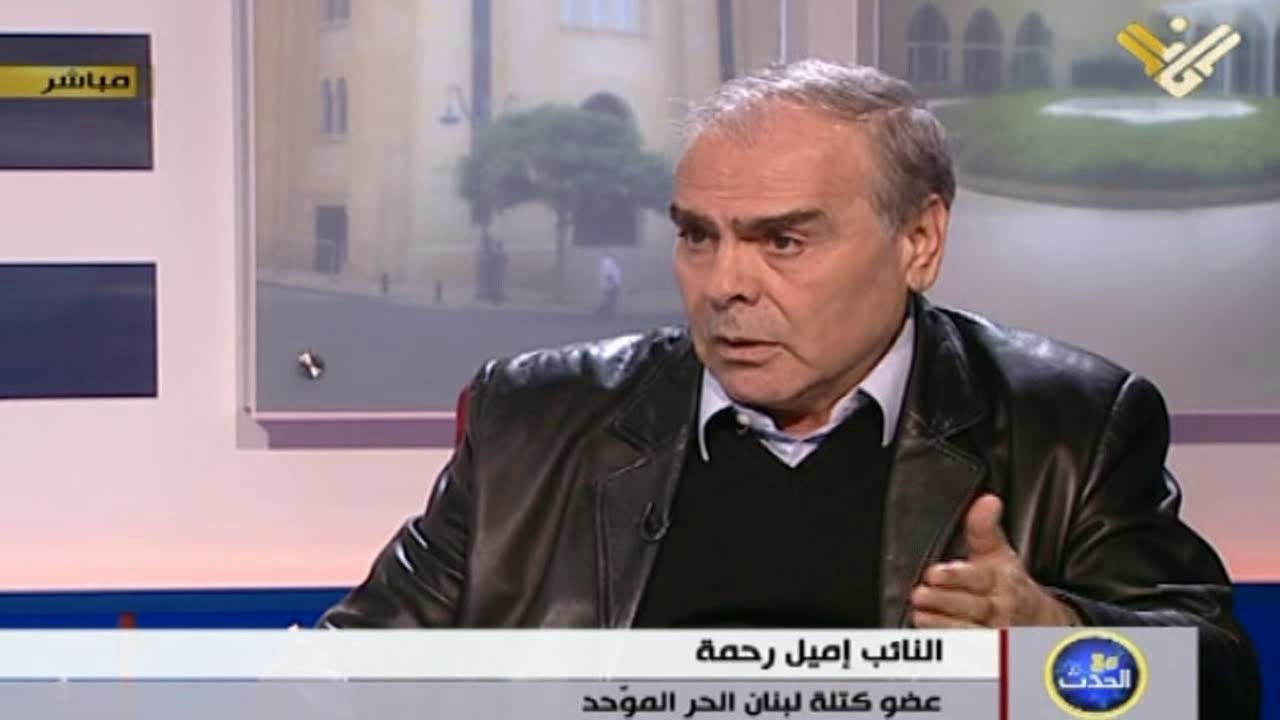
Emile Rahme on Al-Manar's Hezbollah TV

Emile Rahme on Hezbollah’s Al-Manar TV

The March 8 camp is preparing a series of “surprises” for Wednesday’s parliamentary session to elect a president, reported al-Joumhouria newspaper on Saturday without elaborating.

This does not however include the nomination of Free Patriotic Movement leader MP Michel Aoun, said March 8 sources.

They explained that the camp opted against this option because the lawmaker seeks to be a “consensual presidential candidate among all political powers, while keeping in mind that the March 14 alliance will not vote for him.” […]

The March 8 camp has therefore chosen the possible nomination of MP Emile Rahme instead of Aoun, reported the daily An Nahar Saturday.

(Link)

Surprise.

According to reports all over the internet, the March 8 alliance is thinking of nominating Emile Rahme as their presidential candidate instead of Aoun.

Emile Rahme’s Position

For M14, Emile Rahme is probably the most hated Christian MP. In a way, he’s like Future Movement’s Mohammad Raad, Walid Jumblatt’s Aoun/Geagea, or Hezbollah’s Ashraf Rifi. Emile Rahme is also one of the few MPs that are part of the FPM’s change and reform bloc without being a member of the FPM. Of the 27 men loyal to Aoun in the parliament, he’s one of two or three whose election depends entirely on Hezbollah’s votes. The vast majority of the change and reform bloc MPs (4 for Baabda, 7 for the Metn, 5 for Keserwan, 3 for Jbeil and 3 for Jezzine, a total of 22/27) represent North Mount-Lebanon and Jezzine, where the Christian electorate is at least more than the half in each constituency. 3 extra Marada MPs represent  Zgharta, which is also overwhelmingly Christian (even if the MPs aren’t directly loyal to Aoun but to Frangieh).

The last two MPs are a Druze loyal to Arslan representing Hasbaya, and Emile Rahme. The district Rahme represents is Baalbak-Hermel, Lebanon’s biggest Shia constituency, and happens also to be Hezbollah’s main electoral stronghold (the south is is considered to be more pro-Amal than pro-Hezbollah).

Let’s review Emile Rahme’s pros for a last time. He is Hezbollah’s strongest man in the change of reform bloc and one of the most vocal Christian anti-M14 lawmakers – in the middle between Aoun and Hezbollah – making him a prefect candidate in case M8 wants a rather politically violent candidate in face of Geagea. He’s even from a village that is next to Bcharri, Geagea’s hometown.

But Emile Rahme has an extra feature: He is the only Christian in the change and reform bloc that wasn’t elected by determining Christian votes (Baalbak-Hermel is 65% Shia). In other words, he’s considered to be relatively weak among the Christian electorate. As bad as that might sound, it’s actually something good because this quality is most likely to give him Jumblattist support. Michel Aoun would gain a president from his bloc, Hezbollah would gain a president from a district he electorally controls, Amal would gain a president that used to represent a Shia constituency, and Jumblatt would gain a president that has no popular Christian support. Both centrists and M8 win if Emile Rahme becomes Lebanon’s next president.

The Maneuver

Emile Rahme in Baabda is similar to a declaration of war for M14. Since Jumblatt is going to decide his candidate at the last minute, M14 can’t risk the election of Rahme. The only way to counter this move is by agreeing with M8 on a more moderate candidate. That candidate is no other than Michel Aoun, who didn’t yet officially announce his candidacy and said he won’t do it unless there’s a consensus on him. Emile Rahme’s candidacy (or rumors/reports of his nomination) to the presidency is a message to Future Movement from M8: Strike a consensual deal with Michel Aoun – the lesser of two evils for M14 – or risk the election of Emile Rahme.

Walid Jumblatt Is Still The Kingmaker

If M8 simply wanted to bring a ‘violent’ president from their ranks, they could have opted for Sleiman Frangieh. But the fact that Frangieh is considered to be rather strong especially within the northern Christian electorate wouldn’t make him too popular with Jumblatt. The key for winning here is to make Jumblat side by you in the elections. While M8 were proposing the name of Emile Rahme (Jumblatt might still reject him), M14 sources were speaking of two particular Maronites: Fouad Al-Saad and Henri Helou. These two MPs defected from the Jumblat’s bloc in 2011 when he decided to support Mikati in the parliamentary consultations, putting them at an equal distance between M14 and Walid Jumblatt. The leader of the PSP however ruled out this possibility, and is unlikely to support either of them for the elections – They did leave his bloc after all. The last remaining Maronite from his bloc, Elie Aoun, probably has higher chances than them.

Parliament convenes to elect the president on the 23rd of April.

35 days till the 25th of May.