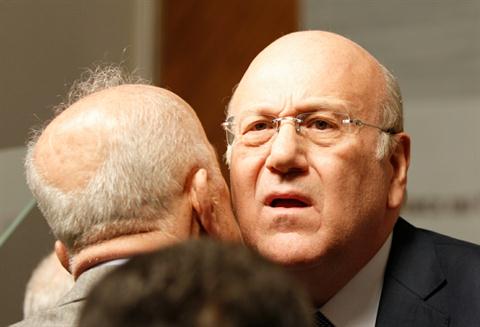
Deputy Prime Minister Samir Moukbel and Mikati after the resignation (The Daily Star)
The Lebanese government of June 2011 is now history. Najib Mikati resigned due to a lack of agreement on an electoral comitte to oversee the elections and Mikati’s failure to extend the the term of ISF chief Ashraf Rifi . You can see his resignation speech [here]. Such a move can be full of meanings, so why did Mikati resign? And more importantly, why now?
It’s all in the Speech
Mikati said that he thought about resigning twice before. The first time was about M8’s refusal to fund the Special Tribunal for Lebanon, and the second time was when Wissam Al-Hassan was assassinated. If Mikati had resigned when the STL wasn’t being funded, it would’ve been too early. Back then, M14 was still strong and he could’ve been easily replaced. If Mikati had resigned after Al Hassan’s funeral, it would’ve also been a fatal bullet for his political career (Resigning meant that his government was responsible for what happened). At both times, Mikati knew that if he would resign it will have negative consequences on him before everyone else. So why now? Mikati wanted an alibi to leave the government so that he can run in the elections. But he couldn’t simply leave. He wanted to leave in a context that makes him stronger, not weaker. And instead of giving him one reason to quit, they gave him two. It was the perfect moment for him. The first motive is a national one, while the second motive is about Sunni politics.
A National Alibi
Mikati resigned because they wouldn’t let him organise elections. Read that sentence, (more…)
 Moulahazat
You must be logged in to post a comment.